Browse by Category
Fiction
- Action & Adventure
- African American
- Anthologies
- Children's Fiction
- Classics
- Comics & Graphic Novels
- Coming of Age
- Contemporary
- Cultural & Regional
- Drama
- Erotica
- Fantasy
- General
- Historical Fiction
- Horror
- Humor & Satire
- Literary Fiction
- Mystery, Thriller & Suspense
- Poetry
- Religious & Inspirational
- Romance
- Science Fiction
- Short Stories
- War & Military
- Westerns
- Women's Fiction
- Young Adult
Non-Fiction
- Antiques & Collectibles
- Arts & Photography
- Biographies & Memoirs
- Business & Money
- Children's Non-Fiction
-
Computers & Technology
- Artificial Intelligence
- Computer Science
- Cybersecurity & Cryptography
- Data Science & Analytics
- Databases & Big Data
- Game Development & Design
- General
- Hardware & DIY
- Mobile App Development
- Networking & Cloud Computing
- Operating Systems
- Programming
- Robotics
- Software
- Software Engineering
- User Experience (UX) & Design
- Web Development & Design
- Cooking, Food & Wine
- Crafts, Hobbies & Home
- Education & Teaching
- Engineering
- General
- Health, Fitness & Dieting
-
History
- African History
- African History - North Africa
- African History - Sub-Saharan Africa
- American History
- American History - 20th Century
- American History - Civil War
- American History - Colonial Period
- Ancient History
- Asian History
- Asian History - China
- Asian History - India
- Asian History - Japan
- Asian History - Southeast Asia
- European History
- European History - Ancient Greece
- European History - Ancient Rome
- European History - Medieval
- European History - Modern
- European History - Renaissance
- General
- Middle Eastern History
- Military History
- Military History - Aviation
- Military History - Naval
- Social & Cultural History
- World History
- Humor & Entertainment
- Industrial Technology
- Language Learning
- Law
- LGBTQ+ Non-Fiction
- Literary Criticism
- Medical Books
- Parenting & Relationships
- Philosophy
- Politics & Social Sciences
- Reference
- Religion & Spirituality
-
Science & Math
- Agricultural Sciences
- Astronomy & Space Science
- Behavioral Sciences
- Biological Sciences
- Botany & Plant Science
- Chemistry
- Earth Sciences
- Engineering - Chemical
- Engineering - Civil
- Engineering - Electrical
- Engineering - Mechanical
- Environment
- General
- Geology
- Mathematics
- Nature & Ecology
- Oceanography
- Paleontology
- Physics
- Statistics
- Self-Help
- Sports & Outdoors
- Study Aids
- Sustainability & Green Living
- Textbooks
- Transportation
- Travel
- True Crime
- Urban Planning & Development
- Veterinary Medicine
- Writing & Publishing
Jump to Section
MixCache.com Total Access
Unlimited reading and audiobooks for every book published by MixCache.com.
Included titles carry the MTA badge.
Learn more →
Technologies of Violence: Weapons Innovation and Military Revolutions
MTA
How New Tools Reshape Tactics, Institutions, and Global Power
About this book:
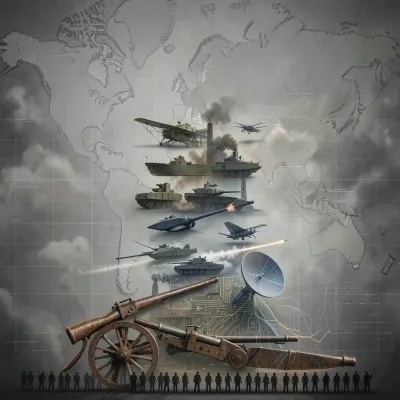
*Technologies of Violence* explores how breakthrough military innovations—from gunpowder and rifling to artificial intelligence and cyber weapons—reshape tactics, institutions, and global power. The book’s central thesis argues that technology only transforms warfare when it is paired with complementary doctrines, organizational adaptability, and political will. By examining a vast historical arc, the author demonstrates a recurring "move-countermove" cycle where every new offensive capability eventually triggers defensive countermeasures, leading to a perpetual struggle for technological and strategic advantage.
The narrative traces major military revolutions through history, beginning with how gunpowder centralized state power and the industrialization of war turned logistics and manufacturing into decisive factors. It examines the shift from the massed formations of the Napoleonic era to the precision-strike and networked warfare of the late 20th century. Key episodes, such as the dreadnought arms race and the advent of strategic bombing, illustrate how institutional inertia and bureaucratic politics often delay or distort the integration of new tools, sometimes leading to catastrophic strategic surprises when old doctrines fail to match new realities.
In the contemporary landscape, the book analyzes the democratization of lethality, where cheap drones, IEDs, and cyber weapons allow non-state actors and smaller powers to challenge the technological overmatch of great powers. The rise of "transparent battlespace" through C4ISR networks is contrasted with emerging "wildcards" like quantum sensing, hypersonics, and synthetic biology. These advancements compress decision-making timelines and blur the boundaries between peace and war, creating a "gray zone" that complicates traditional notions of deterrence, escalation, and national sovereignty.
Ultimately, the book argues that the future of conflict will be defined by the convergence of artificial intelligence, autonomy, and biotechnology. These shifts pose profound ethical and legal challenges, as machines begin to participate in lethal decision-making and human performance is augmented through biological means. The author concludes that while the tools of violence change, the fundamental requirement for security remains an institutional capacity for rapid learning, resilient supply chains, and the preservation of democratic oversight in an increasingly automated and surveyed world.
What You'll Find Inside:
- Military revolutions require technology to combine with doctrine, organization, logistics, and political will—innovations fail without these complementary adaptations.
- History shows a relentless move-countermove cycle where every technological advantage triggers countermeasures, preventing permanent dominance.
- Breakthroughs like gunpowder and rifling drove state centralization by making warfare too expensive for feudal lords, shifting power to centralized states.
- Industrial capacity and logistics determine whether innovations can be sustained at scale, often outweighing tactical brilliance in prolonged conflicts.
- Modern technologies such as AI, cyber weapons, and hypersonics intensify ethical dilemmas and compress decision-making timelines, challenging existing norms of control and accountability.
Who's It For:
This book is essential for defense strategists, policymakers, military planners, and technology analysts who need to understand how technological innovations interact with institutional dynamics to shape warfare. It also benefits students of international relations, history, and security studies seeking a framework to anticipate disruption, as well as ethicists and citizens grappling with the societal implications of autonomous systems, cyber conflict, and emerging weapons technologies. Readers involved in defense procurement, doctrine development, or technology policy will find particular value in its analysis of why some innovations succeed while others fail amid bureaucratic and political constraints.
Table of Contents:
- Introduction
- Chapter 1 Patterns of Revolution: Technology, Tactics, and Institutions
- Chapter 2 Gunpowder’s First Shock: Fortifications, Firepower, and Statecraft
- Chapter 3 Rifling and Industrial War: Accuracy, Logistics, and the Nation-State
- Chapter 4 Wires and Rails: Telegraphy, Mobilization, and Command
- Chapter 5 The Dreadnought Gamble: Capital Ships, Strategy, and Risk
- Chapter 6 Airpower Ascendant: From Reconnaissance to Strategic Bombing
- Chapter 7 Mechanization and Blitzkrieg: Radios, Speed, and Combined Arms
- Chapter 8 The Nuclear Revolution: Deterrence, Stability, and Fear
- Chapter 9 Precision Strikes: Sensors, Guidance, and the Information Edge
- Chapter 10 Networks at War: C4ISR and the Transparent Battlespace
- Chapter 11 Small Arms and Rebellion: Kalashnikovs, IEDs, and Irregular War
- Chapter 12 Drones and Remote Warfare: Persistence, Risk, and Law
- Chapter 13 Cyber Weapons: Code, Coercion, and Attribution
- Chapter 14 Space as a Domain: Satellites, Navigation, and Anti-Satellite Arms
- Chapter 15 Autonomy and AI: Learning Machines and Lethal Decision-Making
- Chapter 16 Hypersonics vs. Defenses: Speed, Maneuver, and Penetration
- Chapter 17 The Spectrum Fight: Electronic Warfare and Electromagnetic Dominance
- Chapter 18 Biotech on the Battlefield: Biosecurity, Enhancement, and Dual Use
- Chapter 19 The Arsenal of Innovation: Manufacturing, Logistics, and Supply Chains
- Chapter 20 Buying Power: Procurement, Incentives, and Bureaucratic Politics
- Chapter 21 Doctrine and Discovery: Wargaming, Experimentation, and Learning
- Chapter 22 Diffusion and Control: Exports, Sanctions, and the Arms Market
- Chapter 23 Law, Ethics, and Restraint: Norms for New Tools of Force
- Chapter 24 Society Under Surveillance: Civil-Military Relations and Democracy
- Chapter 25 Futures and Wildcards: Offsets, Disruption, and Strategic Surprise
Author:
Published By:
Date Published:
May 13, 2026
Type:
Nonfiction
Language:
English
Word Count:
83,397 words
Reading Time:
5 hours 50 minutes
Sample:
Order:
Order Technologies of Violence: Weapons Innovation and Military Revolutions (Paperback) on MixCache.com:
Buy NowPrint copy is made to order and ships worldwide. Includes the ebook free, ready to read instantly.
$5 account credit for all new MixCache.com accounts, usable toward any ebook purchase!*