Browse by Category
Fiction
- Action & Adventure
- African American
- Anthologies
- Children's Fiction
- Classics
- Comics & Graphic Novels
- Coming of Age
- Contemporary
- Cultural & Regional
- Drama
- Erotica
- Fantasy
- General
- Historical Fiction
- Horror
- Humor & Satire
- Literary Fiction
- Mystery, Thriller & Suspense
- Poetry
- Religious & Inspirational
- Romance
- Science Fiction
- Short Stories
- War & Military
- Westerns
- Women's Fiction
- Young Adult
Non-Fiction
- Antiques & Collectibles
- Arts & Photography
- Biographies & Memoirs
- Business & Money
- Children's Non-Fiction
-
Computers & Technology
- Artificial Intelligence
- Computer Science
- Cybersecurity & Cryptography
- Data Science & Analytics
- Databases & Big Data
- Game Development & Design
- General
- Hardware & DIY
- Mobile App Development
- Networking & Cloud Computing
- Operating Systems
- Programming
- Robotics
- Software
- Software Engineering
- User Experience (UX) & Design
- Web Development & Design
- Cooking, Food & Wine
- Crafts, Hobbies & Home
- Education & Teaching
- Engineering
- General
- Health, Fitness & Dieting
-
History
- African History
- African History - North Africa
- African History - Sub-Saharan Africa
- American History
- American History - 20th Century
- American History - Civil War
- American History - Colonial Period
- Ancient History
- Asian History
- Asian History - China
- Asian History - India
- Asian History - Japan
- Asian History - Southeast Asia
- European History
- European History - Ancient Greece
- European History - Ancient Rome
- European History - Medieval
- European History - Modern
- European History - Renaissance
- General
- Middle Eastern History
- Military History
- Military History - Aviation
- Military History - Naval
- Social & Cultural History
- World History
- Humor & Entertainment
- Industrial Technology
- Language Learning
- Law
- LGBTQ+ Non-Fiction
- Literary Criticism
- Medical Books
- Parenting & Relationships
- Philosophy
- Politics & Social Sciences
- Reference
- Religion & Spirituality
-
Science & Math
- Agricultural Sciences
- Astronomy & Space Science
- Behavioral Sciences
- Biological Sciences
- Botany & Plant Science
- Chemistry
- Earth Sciences
- Engineering - Chemical
- Engineering - Civil
- Engineering - Electrical
- Engineering - Mechanical
- Environment
- General
- Geology
- Mathematics
- Nature & Ecology
- Oceanography
- Paleontology
- Physics
- Statistics
- Self-Help
- Sports & Outdoors
- Study Aids
- Sustainability & Green Living
- Textbooks
- Transportation
- Travel
- True Crime
- Urban Planning & Development
- Veterinary Medicine
- Writing & Publishing
Jump to Section
MixCache.com Total Access
Unlimited reading and audiobooks for every book published by MixCache.com.
Included titles carry the MTA badge.
Learn more →
Symptom Detective: How to Track, Analyze, and Communicate Your Body's Signals
MTA
A systematic toolkit for journaling symptoms, recognizing patterns, and preparing for medical consultations
About this book:
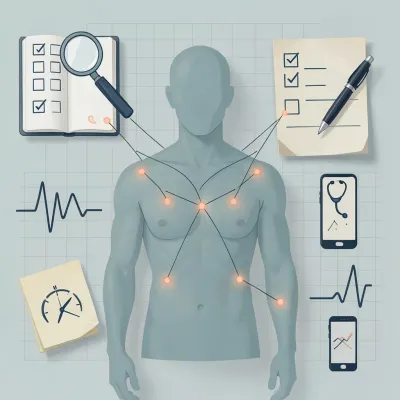
"Symptom Detective: How to Track, Analyze, and Communicate Your Body's Signals" provides a comprehensive toolkit for individuals to systematically record, interpret, and present their health data. The book emphasizes that while bodies constantly send signals, these often go unnoticed or are poorly communicated in brief medical consultations. It introduces symptom journaling not as a chore, but as a crucial bridge between subjective experience and objective, actionable information for healthcare providers. Key to this approach is starting small and consistently logging basic details, gradually expanding to capture more nuanced information about symptoms, context, and potential confounders.
The book delves into specific symptom domains, offering tailored strategies for tracking each. For pain, it advocates mapping intensity, location, quality, and triggers, often using body maps and timing to reveal patterns. For fatigue, it distinguishes between physical, cognitive, and emotional exhaustion, introducing concepts like pacing and post-exertional malaise (PEM) and the importance of tracking exertion and recovery. Digestive tracking emphasizes granular food logs, meal timing, and bowel habit monitoring, while sleep tracking focuses on duration, latency, quality, and disruptions, alongside circadian cues. Mood and stress are also treated as physiological data points, with methods for identifying emotional triggers and effective coping strategies.
A central theme is the transition from raw data to meaningful insights and effective communication. The book teaches how to identify personal baselines and recognize significant flare-ups from normal variability, using techniques like rolling averages and the "three-day rule." It promotes N-of-1 trials for self-experimentation, allowing individuals to test specific hypotheses about triggers or interventions. Visual storytelling through charts, timelines, and heat maps is presented as a powerful way to transform complex data into scannable, clinician-ready narratives. Practical advice is given on crafting concise summaries for appointments, prioritizing concerns, and even scripting difficult conversations to ensure effective advocacy.
Beyond personal tracking, the book addresses the complexities of special situations like travel, shift work, and life transitions, and emphasizes adapting methods for diverse populations including children and older adults, acknowledging barriers related to physical ability, cognition, language, and socioeconomic status. It also stresses the critical importance of data hygiene and privacy, providing guidance on securing sensitive health information and understanding data sharing practices. Ultimately, "Symptom Detective" empowers readers to become active participants in their own healthcare, transforming subjective experiences into objective, actionable knowledge that fosters better understanding, faster diagnoses, and more optimized treatment and self-management.
What You'll Find Inside:
- Learn systematic symptom journaling techniques to track, analyze, and communicate body signals effectively
- Discover domain-specific approaches for pain, fatigue, digestion, sleep, and mood with targeted tracking methods
- Build a personalized tracking toolkit using paper, apps, and wearables that fits your lifestyle and needs
- Transform symptom data into actionable insights through visualization, pattern recognition, and self-experimentation
- Master communication strategies to create clinician-ready summaries and make the most of medical appointments
Who's It For:
This book is for anyone experiencing persistent or troubling symptoms who wants to better understand their body's signals. It's particularly valuable for people with chronic conditions, those navigating complex health issues that span multiple specialties, individuals preparing for medical appointments who want to make the most of limited time with clinicians, and anyone interested in self-tracking as a tool for better health management. The book is designed to be accessible regardless of medical background, focusing on practical, sustainable tracking habits rather than requiring scientific expertise.
Table of Contents:
- Introduction
- Chapter 1 Why Track? The Case for Symptom Journaling
- Chapter 2 Getting Started: Building a Sustainable Tracking Habit
- Chapter 3 What to Capture: Symptoms, Context, and Confounders
- Chapter 4 Scales and Metrics: Turning Feelings into Numbers
- Chapter 5 Designing Your Toolkit: Paper, Apps, and Wearables
- Chapter 6 Pain Patterns: Mapping Intensity, Location, and Triggers
- Chapter 7 Fatigue and Energy: Pacing, Post-Exertional Symptoms, and Recovery
- Chapter 8 Digestion and Nutrition: Food Logs, Tolerance, and Timing
- Chapter 9 Sleep and Rest: Quality, Quantity, and Circadian Cues
- Chapter 10 Mood and Stress: Emotional Signals and Coping Strategies
- Chapter 11 Flare-Ups and Baselines: Detecting Change Over Time
- Chapter 12 Experiments that Work: N-of-1 Trials and Protocols
- Chapter 13 Visual Storytelling: Charts, Timelines, and Dashboards
- Chapter 14 From Notes to Narrative: Crafting a Clinician-Ready Summary
- Chapter 15 Preparing for Appointments: Questions, Priorities, and Scripts
- Chapter 16 Medication and Interventions: Tracking Responses and Side Effects
- Chapter 17 Multisystem Clues: When Symptoms Cross Specialties
- Chapter 18 Special Situations: Travel, Work Shifts, and Life Transitions
- Chapter 19 Inclusion and Access: Adapting Methods for All Bodies
- Chapter 20 Data Hygiene and Privacy: Keeping Your Records Safe
- Chapter 21 Collaborating with Caregivers: Shared Logs and Roles
- Chapter 22 Pediatric and Geriatric Tracking: Age-Specific Considerations
- Chapter 23 Case Studies I: Faster Diagnoses through Patterns
- Chapter 24 Case Studies II: Optimizing Treatment and Self-Management
- Chapter 25 Staying the Course: Motivation, Reflection, and Next Steps
Author:
Published By:
Date Published:
May 10, 2026
Type:
Nonfiction
Language:
English
Word Count:
66,751 words
Reading Time:
4 hours 40 minutes
Sample:
Order:
Order Symptom Detective: How to Track, Analyze, and Communicate Your Body's Signals (Hardcover) on MixCache.com:
Buy NowPrint copy is made to order and ships worldwide. Includes the ebook free, ready to read instantly.
$5 account credit for all new MixCache.com accounts, usable toward any ebook purchase!*