Browse by Category
Fiction
- Action & Adventure
- African American
- Anthologies
- Children's Fiction
- Classics
- Comics & Graphic Novels
- Coming of Age
- Contemporary
- Cultural & Regional
- Drama
- Erotica
- Fantasy
- General
- Historical Fiction
- Horror
- Humor & Satire
- Literary Fiction
- Mystery, Thriller & Suspense
- Poetry
- Religious & Inspirational
- Romance
- Science Fiction
- Short Stories
- War & Military
- Westerns
- Women's Fiction
- Young Adult
Non-Fiction
- Antiques & Collectibles
- Arts & Photography
- Biographies & Memoirs
- Business & Money
- Children's Non-Fiction
-
Computers & Technology
- Artificial Intelligence
- Computer Science
- Cybersecurity & Cryptography
- Data Science & Analytics
- Databases & Big Data
- Game Development & Design
- General
- Hardware & DIY
- Mobile App Development
- Networking & Cloud Computing
- Operating Systems
- Programming
- Robotics
- Software
- Software Engineering
- User Experience (UX) & Design
- Web Development & Design
- Cooking, Food & Wine
- Crafts, Hobbies & Home
- Education & Teaching
- Engineering
- General
- Health, Fitness & Dieting
-
History
- African History
- African History - North Africa
- African History - Sub-Saharan Africa
- American History
- American History - 20th Century
- American History - Civil War
- American History - Colonial Period
- Ancient History
- Asian History
- Asian History - China
- Asian History - India
- Asian History - Japan
- Asian History - Southeast Asia
- European History
- European History - Ancient Greece
- European History - Ancient Rome
- European History - Medieval
- European History - Modern
- European History - Renaissance
- General
- Middle Eastern History
- Military History
- Military History - Aviation
- Military History - Naval
- Social & Cultural History
- World History
- Humor & Entertainment
- Industrial Technology
- Language Learning
- Law
- LGBTQ+ Non-Fiction
- Literary Criticism
- Medical Books
- Parenting & Relationships
- Philosophy
- Politics & Social Sciences
- Reference
- Religion & Spirituality
-
Science & Math
- Agricultural Sciences
- Astronomy & Space Science
- Behavioral Sciences
- Biological Sciences
- Botany & Plant Science
- Chemistry
- Earth Sciences
- Engineering - Chemical
- Engineering - Civil
- Engineering - Electrical
- Engineering - Mechanical
- Environment
- General
- Geology
- Mathematics
- Nature & Ecology
- Oceanography
- Paleontology
- Physics
- Statistics
- Self-Help
- Sports & Outdoors
- Study Aids
- Sustainability & Green Living
- Textbooks
- Transportation
- Travel
- True Crime
- Urban Planning & Development
- Veterinary Medicine
- Writing & Publishing
Jump to Section

Want unlimited access to all books published by MixCache.com (plus their audiobooks)? Try MixCache.com Total Access. Look for the MTA badge on book covers to identify included titles.
Access to infinite ebooks: Don't see the book you want? Suggest it and we'll create it (free!) for you from scratch with our powerful AI book writer. Then read it with MTA - besides profiting from any sales it makes!
The Immune System Explained: How Your Body Fights Infection and How to Strengthen It
MTA
Readable deep dive into innate and adaptive immunity with practical immune-support strategies
About this book:
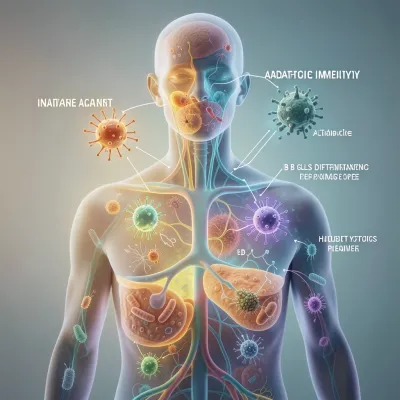
"The Immune System Explained" offers a comprehensive deep dive into the body's intricate defense mechanisms, demystifying the complex world of immunity. The book begins by establishing the fundamental distinction between the innate and adaptive immune systems: the innate system provides rapid, non-specific first-line defense through physical barriers like skin and mucosa, as well as cellular responders such as phagocytes and NK cells, complemented by the swift molecular cascade of the complement system. The adaptive system, by contrast, offers a highly specific, learned, and memorable response, orchestrated by B cells (producing precision antibodies) and T cells (acting as helpers, killers, and regulators), with its processes centralized in lymphoid organs like lymph nodes, the spleen, and the thymus. Antigen presentation via MHC molecules is highlighted as the crucial communication link that allows T cells to recognize and respond to specific threats, differentiating between intracellular and extracellular pathogens.
The book then explores critical immune processes, including inflammation, which, despite discomfort, is presented as an essential, coordinated emergency operation driven by cytokines to contain threats and initiate repair. Immunological memory is revealed as the adaptive system's ability to "remember" past pathogens, enabling faster and stronger responses upon re-exposure, a principle that underpins the efficacy of vaccines. Various pathogen "playbooks"—viruses, bacteria, fungi, and parasites—are detailed, showing how each type presents unique challenges that elicit distinct immune responses. The integral role of the microbiome, particularly in the gut, skin, and airways, is emphasized as a crucial partner in immune education and regulation, producing beneficial metabolites and influencing immune cell development from birth.
A significant portion of the book is dedicated to understanding immune dysregulation, explaining how breakdowns in "tolerance" lead to autoimmune diseases, where the immune system attacks self-tissues, and how "hypersensitivity" results in overreactions to harmless allergens. The dynamic nature of immunity across the lifespan is also covered, from the immature but maternally protected immune system of infants to the unique immunological demands of pregnancy and the gradual changes of immunosenescence in aging. Crucially, the text bridges scientific understanding with practical strategies, dedicating chapters to the profound impact of lifestyle factors: the neuroimmune link of stress and mind, the restorative power of sleep, the immune-boosting effects of appropriate exercise, and the foundational role of nutrition (macronutrients, micronutrients, and phytochemicals). It also offers an evidence-based review of immune-supportive supplements and practical advice for navigating everyday illness, including fever management and when to seek medical care.
Finally, the book looks to the future, highlighting the revolutionary advancements in immunotherapy, such as immune checkpoint inhibitors and CAR-T cell therapy, which harness the immune system to fight diseases like cancer. It emphasizes the growing field of precision prevention, which seeks to tailor immune-supportive strategies to individual genetic profiles, microbiomes, and environmental exposures, leveraging cutting-edge technologies like genomic sequencing and immune profiling. The overarching message is that while scientific understanding of immunity continues to deepen at an astonishing pace, the most powerful and accessible tools for strengthening one's immune system remain the daily, consistent choices made regarding diet, sleep, movement, stress management, and environmental awareness, which together build lasting immune resilience.
What You'll Find Inside:
- Learn how innate and adaptive immunity work together as the body's two‑tiered defense system, from skin barriers to T‑ and B‑cell specificity.
- Discover practical, evidence‑based lifestyle strategies—nutrition, sleep, exercise, stress management, and microbiome support—that shape immune function every day.
- Understand how vaccines train immunological memory, why boosters matter, and what herd immunity means for community protection.
- Explore the balance between tolerance and overreaction, including autoimmunity, allergies, and how the immune system avoids attacking self.
- Get a real‑world toolkit for managing everyday illness, tracking habits, and making informed choices about supplements and environmental exposures.
Who's It For:
This book is written for adults who want a clear, science‑based understanding of how their immune system operates and how daily habits influence it. It is especially valuable for individuals interested in preventing infection, managing chronic inflammation, supporting aging immunity, or making informed decisions about vaccines, nutrition, and lifestyle. Readers with no prior immunology background will find the concepts accessible, while those managing health conditions will appreciate the practical, evidence‑focused guidance.
Author:
Published By:
Date Published:
May 10, 2026
Type:
Nonfiction
Language:
English
Word Count:
65,386 words
Reading Time:
4 hours 35 minutes
Sample:
Order:
Order The Immune System Explained: How Your Body Fights Infection and How to Strengthen It (Hardcover) on MixCache.com:
Buy NowPrint copy is made to order and ships worldwide. Includes the ebook free, ready to read instantly.
$5 account credit for all new MixCache.com accounts, usable toward any ebook purchase!*