Browse by Category
Fiction
- Action & Adventure
- African American
- Anthologies
- Children's Fiction
- Classics
- Comics & Graphic Novels
- Coming of Age
- Contemporary
- Cultural & Regional
- Drama
- Erotica
- Fantasy
- General
- Historical Fiction
- Horror
- Humor & Satire
- Literary Fiction
- Mystery, Thriller & Suspense
- Poetry
- Religious & Inspirational
- Romance
- Science Fiction
- Short Stories
- War & Military
- Westerns
- Women's Fiction
- Young Adult
Non-Fiction
- Antiques & Collectibles
- Arts & Photography
- Biographies & Memoirs
- Business & Money
- Children's Non-Fiction
-
Computers & Technology
- Artificial Intelligence
- Computer Science
- Cybersecurity & Cryptography
- Data Science & Analytics
- Databases & Big Data
- Game Development & Design
- General
- Hardware & DIY
- Mobile App Development
- Networking & Cloud Computing
- Operating Systems
- Programming
- Robotics
- Software
- Software Engineering
- User Experience (UX) & Design
- Web Development & Design
- Cooking, Food & Wine
- Crafts, Hobbies & Home
- Education & Teaching
- Engineering
- General
- Health, Fitness & Dieting
-
History
- African History
- African History - North Africa
- African History - Sub-Saharan Africa
- American History
- American History - 20th Century
- American History - Civil War
- American History - Colonial Period
- Ancient History
- Asian History
- Asian History - China
- Asian History - India
- Asian History - Japan
- Asian History - Southeast Asia
- European History
- European History - Ancient Greece
- European History - Ancient Rome
- European History - Medieval
- European History - Modern
- European History - Renaissance
- General
- Middle Eastern History
- Military History
- Military History - Aviation
- Military History - Naval
- Social & Cultural History
- World History
- Humor & Entertainment
- Industrial Technology
- Language Learning
- Law
- LGBTQ+ Non-Fiction
- Literary Criticism
- Medical Books
- Parenting & Relationships
- Philosophy
- Politics & Social Sciences
- Reference
- Religion & Spirituality
-
Science & Math
- Agricultural Sciences
- Astronomy & Space Science
- Behavioral Sciences
- Biological Sciences
- Botany & Plant Science
- Chemistry
- Earth Sciences
- Engineering - Chemical
- Engineering - Civil
- Engineering - Electrical
- Engineering - Mechanical
- Environment
- General
- Geology
- Mathematics
- Nature & Ecology
- Oceanography
- Paleontology
- Physics
- Statistics
- Self-Help
- Sports & Outdoors
- Study Aids
- Sustainability & Green Living
- Textbooks
- Transportation
- Travel
- True Crime
- Urban Planning & Development
- Veterinary Medicine
- Writing & Publishing
Jump to Section
MixCache.com Total Access
Unlimited reading and audiobooks for every book published by MixCache.com.
Included titles carry the MTA badge.
Learn more →
The Emotional Body: How Emotions Affect Physiological Health and Healing
MTA
Integrative techniques linking psychology, stress physiology, and somatic practices for holistic wellbeing
About this book:
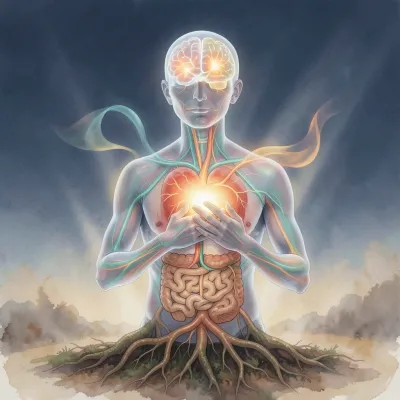
*The Emotional Body* explores the intricate biological and psychological highways connecting the human mind and physical health. Drawing on neuroscience, stress physiology, and somatic practices, the book argues that emotions are not merely abstract feelings but embodied processes that tune the autonomic nervous system, calibrate immune responses, and set thresholds for pain. By demystifying the "mind-body bridge," the text explains how chronic stress and trauma can lead to physiological dysregulation, manifesting in real physical symptoms like migraines, irritable bowel syndrome, and fibromyalgia.
The book details the roles of the Autonomic Nervous System (ANS) and the HPA axis in managing the stress response, emphasizing how the body often becomes stuck in protective patterns of "threat" rather than "safety." Central to the narrative is the concept of interoception—the body’s ability to sense its internal state—and how predictive processing in the brain can amplify or soften physical sensations based on emotional context. Through the lens of Polyvagal Theory, the author illustrates how the vagus nerve and social engagement are essential for shifting the body from a state of mobilization or shutdown back into a state of restorative calm.
To facilitate healing, the text provides a comprehensive toolkit of integrative techniques. These include mindfulness and attention training to reduce symptom burden, cognitive-behavioral skills to challenge catastrophic thinking, and somatic practices like breathwork and progressive muscle relaxation to directly influence physiology. The book also covers specialized modalities such as Eye Movement Desensitization and Reprocessing (EMDR), Somatic Experiencing, and Emotional Freedom Techniques (EFT), which target the deep-seated memories and survival energies often stored in the body’s tissues.
Ultimately, the book frames health as a dynamic skill rather than a static state. It emphasizes that while biological factors like sleep, nutrition, and inflammation are foundational, the way individuals relate to their internal experiences determines their long-term resilience. By combining objective measurement—such as heart rate variability (HRV) biofeedback—with a values-based approach to living, the book offers a roadmap for patients to move from chronic symptom management toward a sustainable sense of physiological safety and holistic wellbeing.
What You'll Find Inside:
- How emotions directly influence physiological systems including the autonomic nervous system, HPA axis, and immune response, creating real physical symptoms from psychological states.
- The role of interoception and predictive processing in shaping bodily experiences, explaining how the brain's predictions can create or amplify symptoms like chronic pain and anxiety.
- Understanding allostatic load and the cumulative biological impact of chronic stress across cardiovascular, metabolic, immune, and neural systems.
- Evidence-based integrative techniques including mindfulness, cognitive-behavioral skills, somatic practices, breathwork, vagal engagement, and trauma-informed methods like EMDR and Somatic Experiencing.
- Practical guidance for designing personalized healing plans that address chronic conditions (IBS, migraine, fibromyalgia) by targeting nervous system regulation and emotional-physiological feedback loops.
Who's It For:
This book is for individuals experiencing chronic physical symptoms with emotional or stress-related components, such as IBS, migraines, fibromyalgia, or persistent pain and fatigue. It also serves healthcare providers, therapists, and wellness practitioners seeking integrative approaches that bridge psychology, neuroscience, and somatic practices. Readers interested in understanding the science behind mind-body connections and learning practical self-regulation tools for stress, trauma, and emotional health will find particular value.
Table of Contents:
- Introduction
- Chapter 1 Mapping the Mind–Body Bridge
- Chapter 2 Emotions, the Brain, and the Body: A Guided Tour
- Chapter 3 The Autonomic Nervous System and the HPA Axis
- Chapter 4 Interoception and Predictive Processing
- Chapter 5 Allostasis, Load, and the Biology of Stress
- Chapter 6 Psychoneuroimmunology: How Feelings Shape Immunity
- Chapter 7 Pain, Perception, and Central Sensitization
- Chapter 8 Trauma, Attachment, and the Body’s Memory
- Chapter 9 From Threat to Safety: The Vagus Nerve and Social Engagement
- Chapter 10 Foundations of Emotional Regulation
- Chapter 11 Mindfulness and Attention Training for Symptom Relief
- Chapter 12 Cognitive and Behavioral Skills for the Body
- Chapter 13 Acceptance, Values, and Psychological Flexibility
- Chapter 14 Somatic Practices: Breath, Posture, and Movement
- Chapter 15 Tension Release and Grounding: Progressive and Sensorimotor Methods
- Chapter 16 Working with Emotions in the Body: EFT and Somatic Experiencing
- Chapter 17 EMDR, Memory Reconsolidation, and Physiological Change
- Chapter 18 Sleep, Nutrition, and Inflammation in Emotional Health
- Chapter 19 Heart Rate Variability and Biofeedback for Resilience
- Chapter 20 Chronic Conditions: IBS, Migraine, and Fibromyalgia
- Chapter 21 The Social Body: Relationships, Culture, and Work Stress
- Chapter 22 Assessment and Measurement: From Diaries to Wearables
- Chapter 23 Designing an Integrative Healing Plan
- Chapter 24 Case Studies: Pathways from Symptom to Safety
- Chapter 25 Sustaining Change and Preventing Relapse
Author:
Published By:
Date Published:
May 10, 2026
Type:
Nonfiction
Language:
English
Word Count:
72,428 words
Reading Time:
5 hours 4 minutes
Sample:
Order:
Order The Emotional Body: How Emotions Affect Physiological Health and Healing (Paperback) on MixCache.com:
Buy NowPrint copy is made to order and ships worldwide. Includes the ebook free, ready to read instantly.
$5 account credit for all new MixCache.com accounts, usable toward any ebook purchase!*