
Browse by Category
Fiction
- Action & Adventure
- African American
- Anthologies
- Children's Fiction
- Classics
- Comics & Graphic Novels
- Coming of Age
- Contemporary
- Cultural & Regional
- Drama
- Erotica
- Fantasy
- General
- Historical Fiction
- Horror
- Humor & Satire
- Literary Fiction
- Mystery, Thriller & Suspense
- Poetry
- Religious & Inspirational
- Romance
- Science Fiction
- Short Stories
- War & Military
- Westerns
- Women's Fiction
- Young Adult
Non-Fiction
- Antiques & Collectibles
- Arts & Photography
- Biographies & Memoirs
- Business & Money
- Children's Non-Fiction
-
Computers & Technology
- Artificial Intelligence
- Computer Science
- Cybersecurity & Cryptography
- Data Science & Analytics
- Databases & Big Data
- Game Development & Design
- General
- Hardware & DIY
- Mobile App Development
- Networking & Cloud Computing
- Operating Systems
- Programming
- Robotics
- Software
- Software Engineering
- User Experience (UX) & Design
- Web Development & Design
- Cooking, Food & Wine
- Crafts, Hobbies & Home
- Education & Teaching
- Engineering
- General
- Health, Fitness & Dieting
-
History
- African History
- African History - North Africa
- African History - Sub-Saharan Africa
- American History
- American History - 20th Century
- American History - Civil War
- American History - Colonial Period
- Ancient History
- Asian History
- Asian History - China
- Asian History - India
- Asian History - Japan
- Asian History - Southeast Asia
- European History
- European History - Ancient Greece
- European History - Ancient Rome
- European History - Medieval
- European History - Modern
- European History - Renaissance
- General
- Middle Eastern History
- Military History
- Military History - Aviation
- Military History - Naval
- Social & Cultural History
- World History
- Humor & Entertainment
- Industrial Technology
- Language Learning
- Law
- LGBTQ+ Non-Fiction
- Literary Criticism
- Medical Books
- Parenting & Relationships
- Philosophy
- Politics & Social Sciences
- Reference
- Religion & Spirituality
-
Science & Math
- Agricultural Sciences
- Astronomy & Space Science
- Behavioral Sciences
- Biological Sciences
- Botany & Plant Science
- Chemistry
- Earth Sciences
- Engineering - Chemical
- Engineering - Civil
- Engineering - Electrical
- Engineering - Mechanical
- Environment
- General
- Geology
- Mathematics
- Nature & Ecology
- Oceanography
- Paleontology
- Physics
- Statistics
- Self-Help
- Sports & Outdoors
- Study Aids
- Sustainability & Green Living
- Textbooks
- Transportation
- Travel
- True Crime
- Urban Planning & Development
- Veterinary Medicine
- Writing & Publishing
Jump to Section
MixCache.com Total Access
Unlimited reading and audiobooks for every book published by MixCache.com.
Included titles carry the MTA badge.
Learn more →
War and Wealth: Economic Mobilization, Industry, and Finance in Wartime
MTA
How economies convert to war production and the fiscal tools that sustain campaigns
About this book:
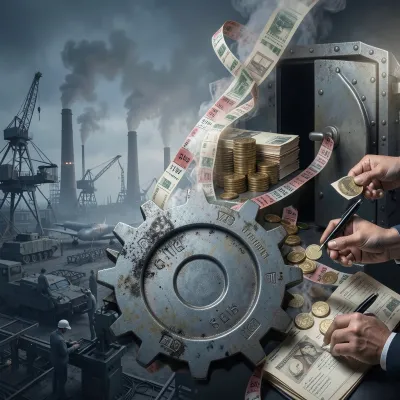
"War and Wealth: Economic Mobilization, Industry, and Finance in Wartime" provides a comprehensive analysis of how economies transform to support military objectives, focusing on the interplay of capacity, control, and credibility. The book argues that successful military strategy is bounded by a nation's ability to produce and move goods, its institutional capacity to direct economic activity, and its fiscal and monetary credibility. It delves into the granular details of industrial conversion, from retooling factories for armaments production to managing labor, securing raw materials, and establishing complex logistics networks. The text highlights that these transformations are not merely technical but also profoundly reshape societal structures, labor dynamics, and the relationship between the state and its citizens.
A core theme is the critical role of finance in sustaining prolonged conflict. The book examines the various methods governments employ to fund wars, including taxation, borrowing through bonds, and money creation, and the inherent trade-offs each method entails for inflation, debt, and public trust. It discusses how central banks navigate the tension between fiscal demands and price stability, and how states implement price controls, rationing, and capital controls to manage scarcity and prevent economic collapse. The work also explores the dark underbelly of war economies, such as illicit markets, smuggling, and corruption, which inevitably arise when official channels fail to meet demand, challenging state authority and eroding morale.
The book extends its analysis to international dimensions, dissecting the economics of coalition warfare, including aid programs like Lend-Lease and burden-sharing agreements that distribute resources and liabilities among allies. It also examines the economic impact of blockades, sanctions, and financial warfare, as well as the unique challenges faced by developing states and occupied territories, where extraction and exploitation often distort local economies. Through detailed case studies—from the Napoleonic Wars and the U.S. Civil War to World War I and World War II—the book illustrates how these economic principles manifest across different historical contexts, revealing both enduring patterns and context-specific adaptations.
Finally, "War and Wealth" addresses the complex process of demobilization and reconversion after hostilities cease. It explores the challenges of transitioning from a war economy back to peacetime, including managing demobilized labor forces, reorienting industries, unwinding financial controls, and dealing with accumulated debt and inflation. The book concludes that the economic legacies of war—in terms of institutional changes, technological advancements, altered social contracts, and shifts in global economic power—cast long shadows, profoundly shaping the post-conflict world and influencing future economic policy for generations.
What You'll Find Inside:
- The three economic constraints framework—capacity, control, and credibility—that defines mobilization limits and shapes wartime economic transformation
- Industrial conversion processes detailing how peacetime factories are retooled for armaments production, including machine tool scarcity, labor force adaptation, and supply chain reorganization
- Financial mechanisms of war covering taxation strategies, war bond drives, monetary expansion, and the inflationary trade-offs inherent in conflict financing
- Labor mobilization dynamics including conscription, workforce diversification (particularly women's entry), wage controls, and the evolving wartime social contract
- Coalition economics examining burden-sharing mechanisms like Lend-Lease, combined resource allocation boards, and the challenges of aligning national interests with collective war goals
Who's It For:
This book is primarily designed for policymakers involved in defense planning, economic resilience, and crisis management who need to understand how governments can effectively mobilize resources during conflict. It will also benefit historians and scholars of economic history, military history, and international relations seeking a rigorous analytical framework to interpret past wars. Additionally, professionals in fields such as development economics, public finance, and strategic studies will find valuable insights into the economic dimensions of warfare and postwar recovery.
Table of Contents:
- Introduction
- Chapter 1 Why Economies Go to War: A Framework
- Chapter 2 Raising the Legions of Industry: Mobilization Authorities and Institutions
- Chapter 3 Turning Peace Plants into Arsenals: Industrial Conversion at Scale
- Chapter 4 Labor, Conscription, and the Wartime Social Contract
- Chapter 5 Materials, Mines, and Fuel: Securing Strategic Resources
- Chapter 6 Moving the Arsenal: Logistics, Shipping, and Rail under Fire
- Chapter 7 Prices, Rationing, and Queues: Managing Scarcity
- Chapter 8 Tax States at War: Designing Revenues for Campaigns
- Chapter 9 Borrowing for Victory: Bonds, Debt, and Credibility
- Chapter 10 Money, Inflation, and Central Banks in Conflict
- Chapter 11 Trade, Blockades, and Capital Controls
- Chapter 12 Buying the Battlefield: Procurement, Contracts, and Incentives
- Chapter 13 Innovation Under Pressure: Science, R&D, and Learning Curves
- Chapter 14 Big Primes and Small Workshops: Industrial Structure in War
- Chapter 15 Coalition Economies: Lend-Lease, Aid, and Burden Sharing
- Chapter 16 Occupation, Extraction, and the Economics of Plunder
- Chapter 17 Illicit Markets: Smuggling, Black Exchange, and Corruption
- Chapter 18 Propaganda, Savings Drives, and Morale on the Home Front
- Chapter 19 Neutrality, Sanctions, and Financial Warfare
- Chapter 20 The View from the Periphery: War Economies in Developing States
- Chapter 21 Case Study I: The Napoleonic Wars and the Birth of Modern War Finance
- Chapter 22 Case Study II: The U.S. Civil War and Competing Fiscal States
- Chapter 23 Case Study III: World War I—Total War and the Managed Economy
- Chapter 24 Case Study IV: World War II—Arsenals of Democracy and Command Systems
- Chapter 25 After the Guns Fall Silent: Demobilization, Reconversion, and the Long Shadow
Author:
Published By:
Date Published:
May 7, 2026
Type:
Nonfiction
Language:
English
Word Count:
68,733 words
Reading Time:
4 hours 49 minutes
Sample:
MixCache.com Total Access
Get unlimited access to this book + all books published by MixCache.com for $11.99/month
Subscribe to MTAOr purchase this book individually below
Order:
Buy the War and Wealth: Economic Mobilization, Industry, and Finance in Wartime ebook on MixCache.com:
Buy Now
Full ebook will be available immediately
- read online or download as a PDF file.
$5 account credit for all new MixCache.com accounts, usable toward any ebook purchase!*






Ratings & Reviews
Ask Questions About This Book
Have a question about the content? Ask our AI assistant!
Start by asking a question about "War and Wealth: Economic Mobilization, Industry, and Finance in Wartime"
Example: "Does this book mention William Shakespeare?"
Thinking...