Browse by Category
Fiction
- Action & Adventure
- African American
- Anthologies
- Children's Fiction
- Classics
- Comics & Graphic Novels
- Coming of Age
- Contemporary
- Cultural & Regional
- Drama
- Erotica
- Fantasy
- General
- Historical Fiction
- Horror
- Humor & Satire
- Literary Fiction
- Mystery, Thriller & Suspense
- Poetry
- Religious & Inspirational
- Romance
- Science Fiction
- Short Stories
- War & Military
- Westerns
- Women's Fiction
- Young Adult
Non-Fiction
- Antiques & Collectibles
- Arts & Photography
- Biographies & Memoirs
- Business & Money
- Children's Non-Fiction
-
Computers & Technology
- Artificial Intelligence
- Computer Science
- Cybersecurity & Cryptography
- Data Science & Analytics
- Databases & Big Data
- Game Development & Design
- General
- Hardware & DIY
- Mobile App Development
- Networking & Cloud Computing
- Operating Systems
- Programming
- Robotics
- Software
- Software Engineering
- User Experience (UX) & Design
- Web Development & Design
- Cooking, Food & Wine
- Crafts, Hobbies & Home
- Education & Teaching
- Engineering
- General
- Health, Fitness & Dieting
-
History
- African History
- African History - North Africa
- African History - Sub-Saharan Africa
- American History
- American History - 20th Century
- American History - Civil War
- American History - Colonial Period
- Ancient History
- Asian History
- Asian History - China
- Asian History - India
- Asian History - Japan
- Asian History - Southeast Asia
- European History
- European History - Ancient Greece
- European History - Ancient Rome
- European History - Medieval
- European History - Modern
- European History - Renaissance
- General
- Middle Eastern History
- Military History
- Military History - Aviation
- Military History - Naval
- Social & Cultural History
- World History
- Humor & Entertainment
- Industrial Technology
- Language Learning
- Law
- LGBTQ+ Non-Fiction
- Literary Criticism
- Medical Books
- Parenting & Relationships
- Philosophy
- Politics & Social Sciences
- Reference
- Religion & Spirituality
-
Science & Math
- Agricultural Sciences
- Astronomy & Space Science
- Behavioral Sciences
- Biological Sciences
- Botany & Plant Science
- Chemistry
- Earth Sciences
- Engineering - Chemical
- Engineering - Civil
- Engineering - Electrical
- Engineering - Mechanical
- Environment
- General
- Geology
- Mathematics
- Nature & Ecology
- Oceanography
- Paleontology
- Physics
- Statistics
- Self-Help
- Sports & Outdoors
- Study Aids
- Sustainability & Green Living
- Textbooks
- Transportation
- Travel
- True Crime
- Urban Planning & Development
- Veterinary Medicine
- Writing & Publishing
Jump to Section
MixCache.com Total Access
Unlimited reading and audiobooks for every book published by MixCache.com.
Included titles carry the MTA badge.
Learn more →
Cities of Gold to Oil: Resource Booms and Economic Cycles in the Americas
MTA
Case studies of gold rushes, oil discoveries, and boom-bust development across the hemisphere
About this book:
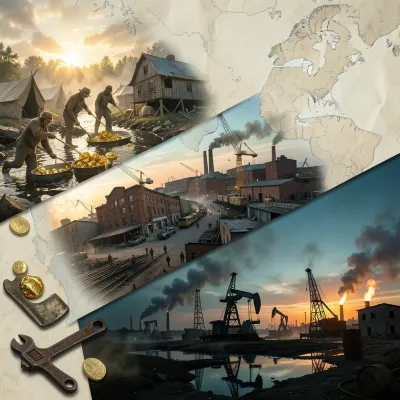
*Cities of Gold to Oil: Resource Booms and Economic Cycles in the Americas* provides a comprehensive historical and analytical overview of how sudden natural resource discoveries have shaped the urban, social, and economic landscapes of the Western Hemisphere. Spanning from the colonial silver mines of Potosí and the gold rushes of California and the Klondike to the modern extraction of oil in Venezuela and lithium in the Andes, the book illustrates a recurring "boomtown effect." These cycles are characterized by rapid in-migration, skewed demography, and overextended infrastructure, often followed by environmental degradation and fiscal instability when commodity prices eventually collapse.
The book moves beyond the traditional "resource curse" narrative by examining how different governance choices and institutional frameworks determine whether a region achieves long-term diversification or suffers from "Dutch disease" and stranded assets. It highlights the critical roles of infrastructure as a political project and the often-overlooked household economies led by women that stabilize transient communities. Through comparative case studies in countries like Brazil, Mexico, Canada, and Guyana, the text traces how railroads, pipelines, and ports have redrawn maps of power and how indigenous and local voices have increasingly demanded consultation and consent in the extractive process.
The final chapters address the environmental legacies of tailings and flares alongside the fiscal challenges of managing royalties and stabilization funds. As the world pivots toward a green energy transition, the book argues that the demand for "transition minerals" like copper and lithium will trigger new booms. It concludes by offering a policy playbook for the future, emphasizing that the sustainable management of resources requires disciplined saving, robust environmental oversight, and the conversion of finite mineral wealth into renewable human and physical capital to ensure a resilient post-extractive future.
What You'll Find Inside:
- Resource booms as transformative demographic events that reshape migration patterns, gender ratios, and household economies across the Americas, from Potosí to Fort McMurray
- Infrastructure development as a political project that channels extraction wealth while creating lasting geographic dependencies and social inequalities
- Environmental legacies of boom-bust cycles including tailings, flares, and water politics, and the struggle to internalize ecological costs through governance
- Fiscal management challenges including stabilization funds, royalty systems, and the politics of saving resource windfalls versus immediate spending pressures
- Institutional frameworks for consultation, consent, and benefit-sharing that determine whether booms create broad-based gains or enclaves of inequality and conflict
Who's It For:
Policymakers, investors, historians, and social scientists seeking to understand resource-driven transformation in the Americas will find this book invaluable. It provides policymakers with tools for managing fiscal cycles and designing sustainable infrastructure, offers investors a framework for assessing institutional risks in extractive industries, and gives historians and social scientists comparative evidence to refine debates about booms, busts, and energy transitions in an era of climate change.
Table of Contents:
- Introduction
- Chapter 1 Gold and Black Gold: A Framework for Resource Booms in the Americas
- Chapter 2 Potosí, Bolivia: The Mountain That Fed Empires
- Chapter 3 California Gold Rush: San Francisco’s Takeoff and Turmoil, 1848–1865
- Chapter 4 Klondike to Nome: Northern Frontiers and Transient Cities
- Chapter 5 Minas Gerais, Brazil: Gold, Slavery, and Colonial Urban Networks
- Chapter 6 The Rubber Boom: Manaus and Belém’s Belle Époque
- Chapter 7 Mexico’s Veins and Wells: From Silver Camps to Tampico’s Oil
- Chapter 8 Texas and Oklahoma: Gushers, Grids, and the Petroleum Metropolis
- Chapter 9 Alberta’s Athabasca: Fort McMurray and the Oil Sands Urban System
- Chapter 10 Venezuela’s Orinoco: Caracas, Company Towns, and a Petro-State’s Rise and Fall
- Chapter 11 Trinidad and Tobago: Gas, Industrial Policy, and Small-Island Scale
- Chapter 12 Andean Copper Corridors: Chuquicamata, Calama, and Antofagasta
- Chapter 13 Peru’s Mining Conflicts: Growth, Governance, and the Local State
- Chapter 14 Colombia’s Patchwork: Coal, Oil, and the Llanos Frontier
- Chapter 15 Guyana and Suriname: Offshore Discoveries and Small-State Dilemmas
- Chapter 16 Shale Revolutions: Vaca Muerta and the Bakken’s Continental Ripples
- Chapter 17 The Lithium Triangle: Brines, Batteries, and Community Rights
- Chapter 18 Rails, Pipelines, and Ports: Infrastructure as Political Project
- Chapter 19 Demography in Motion: Migration, Gender Ratios, and Household Economies
- Chapter 20 Urban Form and Housing: From Tent Cities to Peripheral Sprawl
- Chapter 21 Environmental Legacies: Tailings, Flares, and Water Politics
- Chapter 22 Fiscal Cycles: Royalties, Stabilization Funds, and the Politics of Saving
- Chapter 23 Institutions and Voice: Concessions, Consultation, and Consent
- Chapter 24 After the Boom: Diversification, Tourism, and Post-Extractive Futures
- Chapter 25 Managing the Next Boom: Policy Playbooks for a Warming World
Author:
Published By:
Date Published:
May 5, 2026
Type:
Nonfiction
Language:
English
Word Count:
74,324 words
Reading Time:
5 hours 12 minutes
Sample:
Order:
Order Cities of Gold to Oil: Resource Booms and Economic Cycles in the Americas (Paperback) on MixCache.com:
Buy NowPrint copy is made to order and ships worldwide. Includes the ebook free, ready to read instantly.
$5 account credit for all new MixCache.com accounts, usable toward any ebook purchase!*