
Browse by Category
Fiction
- Action & Adventure
- African American
- Anthologies
- Children's Fiction
- Classics
- Comics & Graphic Novels
- Coming of Age
- Contemporary
- Cultural & Regional
- Drama
- Erotica
- Fantasy
- General
- Historical Fiction
- Horror
- Humor & Satire
- Literary Fiction
- Mystery, Thriller & Suspense
- Poetry
- Religious & Inspirational
- Romance
- Science Fiction
- Short Stories
- War & Military
- Westerns
- Women's Fiction
- Young Adult
Non-Fiction
- Antiques & Collectibles
- Arts & Photography
- Biographies & Memoirs
- Business & Money
- Children's Non-Fiction
-
Computers & Technology
- Artificial Intelligence
- Computer Science
- Cybersecurity & Cryptography
- Data Science & Analytics
- Databases & Big Data
- Game Development & Design
- General
- Hardware & DIY
- Mobile App Development
- Networking & Cloud Computing
- Operating Systems
- Programming
- Robotics
- Software
- Software Engineering
- User Experience (UX) & Design
- Web Development & Design
- Cooking, Food & Wine
- Crafts, Hobbies & Home
- Education & Teaching
- Engineering
- General
- Health, Fitness & Dieting
-
History
- African History
- African History - North Africa
- African History - Sub-Saharan Africa
- American History
- American History - 20th Century
- American History - Civil War
- American History - Colonial Period
- Ancient History
- Asian History
- Asian History - China
- Asian History - India
- Asian History - Japan
- Asian History - Southeast Asia
- European History
- European History - Ancient Greece
- European History - Ancient Rome
- European History - Medieval
- European History - Modern
- European History - Renaissance
- General
- Middle Eastern History
- Military History
- Military History - Aviation
- Military History - Naval
- Social & Cultural History
- World History
- Humor & Entertainment
- Industrial Technology
- Language Learning
- Law
- LGBTQ+ Non-Fiction
- Literary Criticism
- Medical Books
- Parenting & Relationships
- Philosophy
- Politics & Social Sciences
- Reference
- Religion & Spirituality
-
Science & Math
- Agricultural Sciences
- Astronomy & Space Science
- Behavioral Sciences
- Biological Sciences
- Botany & Plant Science
- Chemistry
- Earth Sciences
- Engineering - Chemical
- Engineering - Civil
- Engineering - Electrical
- Engineering - Mechanical
- Environment
- General
- Geology
- Mathematics
- Nature & Ecology
- Oceanography
- Paleontology
- Physics
- Statistics
- Self-Help
- Sports & Outdoors
- Study Aids
- Sustainability & Green Living
- Textbooks
- Transportation
- Travel
- True Crime
- Urban Planning & Development
- Veterinary Medicine
- Writing & Publishing
Jump to Section
MixCache.com Total Access
Unlimited reading and audiobooks for every book published by MixCache.com.
Included titles carry the MTA badge.
Learn more →
Seafloor Mining and Deep-Sea Resources: Science, Risk, and Governance
MTA
An evidence-based assessment of mineral prospecting, environmental risk, and policy choices
About this book:
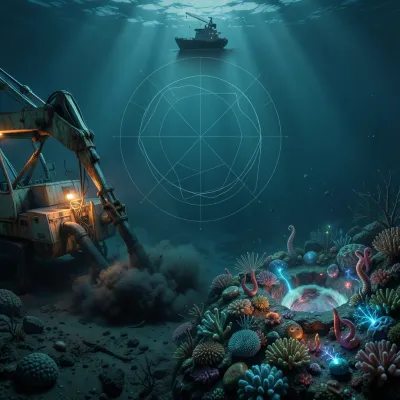
*Seafloor Mining and Deep-Sea Resources* provides an interdisciplinary assessment of the geological potential, environmental risks, and governance challenges associated with extracting minerals from the ocean abyss. The book details the formation of polymetallic nodules on abyssal plains and cobalt-rich crusts on seamounts, highlighting their role as critical reservoirs for nickel, cobalt, and rare-earth elements necessary for the global energy transition. It emphasizes that while these deposits are vast, they reside in highly stable, low-energy environments where biological and geological processes occur over millions of years, making the ecosystems exceptionally vulnerable to disturbance and slow to recover.
The text moves beyond mineralogy to explore the complex ecological networks of the deep sea, including pelagic-benthic coupling and the intricate food webs of the "oasis-like" seamounts. Significant attention is given to the mechanical impacts of mining, specifically the physics of sediment plumes, the disruption of carbon sequestration, and the intrusion of noise and light into a sensitive sensory environment. By utilizing life-cycle assessments and risk-modeling tools, the book compares the ecological and climate-related costs of seabed mining against traditional land-based alternatives and circular economy strategies like recycling and substitution.
The final section addresses the legal and social dimensions of this emerging industry, focusing on the United Nations Convention on the Law of the Sea (UNCLOS) and the regulatory role of the International Seabed Authority (ISA). The authors examine the importance of Regional Environmental Management Plans (REMPs) and Areas of Particular Environmental Interest (APEIs) in balancing extraction with conservation. Ultimately, the book argues for a precautionary approach to governance, emphasizing that "social license" and data transparency are as critical to the industry’s future as technological feasibility. It concludes by presenting various scenarios for the frontier, suggesting that responsible stewardship requires adaptive management and a willingness to prioritize long-term planetary health over immediate mineral gain.
What You'll Find Inside:
- Comprehensive assessment of deep-sea mineral resources including polymetallic nodules, cobalt-rich ferromanganese crusts, and rare-earth element deposits, covering their formation, distribution, and economic potential
- Analysis of environmental impacts from mining operations, addressing sediment plumes, noise/light disturbance, carbon cycling implications, and ecosystem vulnerability with attention to recovery timescales
- Examination of governance frameworks including UNCLOS, the International Seabed Authority, national jurisdictions, and regional environmental management plans with Areas of Particular Environmental Interest
- Evaluation of socio-economic factors including market dynamics for nickel/cobalt/REEs, life-cycle assessment, social license considerations, and comparative analysis with land-based alternatives and recycling
- Presentation of decision-making tools like multi-criteria analysis, precautionary approaches, and adaptive management for balancing resource extraction with environmental protection amid scientific uncertainty
Who's It For:
This book is written for a diverse audience including scientists and engineers seeking cross-disciplinary context, policymakers and regulators setting rules amid uncertainty, investors and industry leaders evaluating projects and responsibilities, civil society groups and coastal communities advocating for ecological and social safeguards, and students entering this fast-moving field. It provides the interdisciplinary synthesis needed for informed decision-making about deep-sea resource extraction.
Table of Contents:
- Introduction
- Chapter 1 The Deep Ocean as a Resource Frontier
- Chapter 2 Geology of Polymetallic Nodules on the Abyssal Plain
- Chapter 3 Cobalt-Rich Ferromanganese Crusts on Seamounts
- Chapter 4 Rare-Earth Elements in Deep-Sea Deposits
- Chapter 5 Baseline Ecology of Abyssal Plains
- Chapter 6 Seamount Ecosystems and Endemicity
- Chapter 7 Pelagic–Benthic Coupling and Food Webs
- Chapter 8 Sediment Plumes: Physics and Impact Pathways
- Chapter 9 Noise, Light, and Operational Disturbance
- Chapter 10 Carbon Cycling, Sequestration, and Climate Linkages
- Chapter 11 Population Connectivity and Recovery Potential
- Chapter 12 Mining Systems and Operational Scenarios
- Chapter 13 Environmental Survey, Monitoring, and Modeling
- Chapter 14 Risk Assessment: Tools and Uncertainties
- Chapter 15 Life-Cycle Assessment and Supply-Chain Context
- Chapter 16 Onshore Alternatives, Substitution, and Recycling
- Chapter 17 Economic Viability and Market Dynamics for Ni, Co, and REEs
- Chapter 18 Social License, Stakeholders, and Equity
- Chapter 19 International Law: UNCLOS and the International Seabed Authority
- Chapter 20 Regional Environmental Management Plans and APEIs
- Chapter 21 National Jurisdictions and Coastal State Interests
- Chapter 22 Decision Frameworks: MCDA, Precaution, and Adaptive Management
- Chapter 23 Case Studies: Clarion–Clipperton Zone and Pacific Seamounts
- Chapter 24 Data, Transparency, and Open Science
- Chapter 25 Futures, Scenarios, and Governance Pathways
Author:
Published By:
Date Published:
May 4, 2026
Type:
Nonfiction
Language:
English
Word Count:
59,138 words
Reading Time:
4 hours 8 minutes
Sample:
MixCache.com Total Access
Get unlimited access to this book + all books published by MixCache.com for $11.99/month
Subscribe to MTAOr purchase this book individually below
Order:
Buy the Seafloor Mining and Deep-Sea Resources: Science, Risk, and Governance ebook on MixCache.com:
Buy Now
Full ebook will be available immediately
- read online or download as a PDF file.
$5 account credit for all new MixCache.com accounts, usable toward any ebook purchase!*


Ratings & Reviews
Ask Questions About This Book
Have a question about the content? Ask our AI assistant!
Start by asking a question about "Seafloor Mining and Deep-Sea Resources: Science, Risk, and Governance"
Example: "Does this book mention William Shakespeare?"
Thinking...