Browse by Category
Fiction
- Action & Adventure
- African American
- Anthologies
- Children's Fiction
- Classics
- Comics & Graphic Novels
- Coming of Age
- Contemporary
- Cultural & Regional
- Drama
- Erotica
- Fantasy
- General
- Historical Fiction
- Horror
- Humor & Satire
- Literary Fiction
- Mystery, Thriller & Suspense
- Poetry
- Religious & Inspirational
- Romance
- Science Fiction
- Short Stories
- War & Military
- Westerns
- Women's Fiction
- Young Adult
Non-Fiction
- Antiques & Collectibles
- Arts & Photography
- Biographies & Memoirs
- Business & Money
- Children's Non-Fiction
-
Computers & Technology
- Artificial Intelligence
- Computer Science
- Cybersecurity & Cryptography
- Data Science & Analytics
- Databases & Big Data
- Game Development & Design
- General
- Hardware & DIY
- Mobile App Development
- Networking & Cloud Computing
- Operating Systems
- Programming
- Robotics
- Software
- Software Engineering
- User Experience (UX) & Design
- Web Development & Design
- Cooking, Food & Wine
- Crafts, Hobbies & Home
- Education & Teaching
- Engineering
- General
- Health, Fitness & Dieting
-
History
- African History
- African History - North Africa
- African History - Sub-Saharan Africa
- American History
- American History - 20th Century
- American History - Civil War
- American History - Colonial Period
- Ancient History
- Asian History
- Asian History - China
- Asian History - India
- Asian History - Japan
- Asian History - Southeast Asia
- European History
- European History - Ancient Greece
- European History - Ancient Rome
- European History - Medieval
- European History - Modern
- European History - Renaissance
- General
- Middle Eastern History
- Military History
- Military History - Aviation
- Military History - Naval
- Social & Cultural History
- World History
- Humor & Entertainment
- Industrial Technology
- Language Learning
- Law
- LGBTQ+ Non-Fiction
- Literary Criticism
- Medical Books
- Parenting & Relationships
- Philosophy
- Politics & Social Sciences
- Reference
- Religion & Spirituality
-
Science & Math
- Agricultural Sciences
- Astronomy & Space Science
- Behavioral Sciences
- Biological Sciences
- Botany & Plant Science
- Chemistry
- Earth Sciences
- Engineering - Chemical
- Engineering - Civil
- Engineering - Electrical
- Engineering - Mechanical
- Environment
- General
- Geology
- Mathematics
- Nature & Ecology
- Oceanography
- Paleontology
- Physics
- Statistics
- Self-Help
- Sports & Outdoors
- Study Aids
- Sustainability & Green Living
- Textbooks
- Transportation
- Travel
- True Crime
- Urban Planning & Development
- Veterinary Medicine
- Writing & Publishing
Jump to Section
MixCache.com Total Access
Unlimited reading and audiobooks for every book published by MixCache.com.
Included titles carry the MTA badge.
Learn more →
Measuring the Deep: Field Techniques for Modern Oceanographers
MTA
Practical methods and protocols for sampling, sensors, and data collection at sea
About this book:
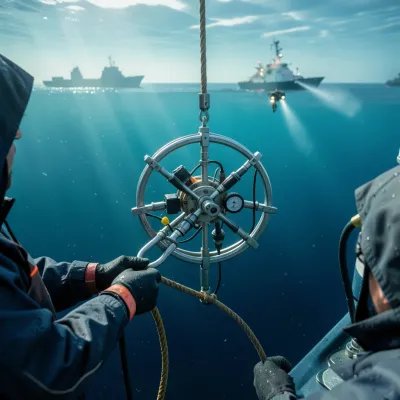
"Measuring the Deep: Field Techniques for Modern Oceanographers" is a comprehensive guide to practical methods and protocols for oceanographic research at sea, aimed at students, technicians, and scientists. The book emphasizes hands-on techniques, safe operating procedures, and rigorous data management for collecting trustworthy oceanographic data. It covers the entire lifecycle of a research cruise, from initial planning and safety culture to the post-cruise archiving and publication of data.
The initial chapters focus on foundational aspects such as cruise planning, vessel operations, deck safety, and precise navigation, highlighting the importance of anticipating challenges and coordinating with ship crews. Subsequent chapters delve into specific sampling and sensing technologies, including CTD/Rosette operations for water sampling, specialized techniques for nutrients, oxygen, and carbonate system measurements, and stringent trace-metal clean protocols. It also details the deployment and operation of current profilers (ADCPs), optical and biogeochemical sensors, and various biological sampling methods like nets, pumps, eDNA, and imaging.
Further sections address more complex instrumentation and observational strategies. These include sediment grabs and coring techniques (box, gravity, multicorer, piston), seafloor mapping with multibeam, sidescan, and sub-bottom profilers, and the deployment and maintenance of long-term observation systems such as moorings, drifters, and time-series stations. The book also covers the increasing role of autonomous platforms like gliders, Argo floats, and AUVs, alongside remotely operated vehicles (ROVs) and benthic instrumentation. Cross-cutting themes like sensor calibration, biofouling mitigation, power/communications, real-time telemetry, and troubleshooting are integrated throughout.
A significant portion of the book is dedicated to data integrity and management, underscoring the necessity of quality assurance/quality control (QA/QC), uncertainty estimation, metadata standards, and adherence to FAIR (Findable, Accessible, Interoperable, Reusable) principles. The final chapters emphasize the critical link between fieldwork and scientific reporting, covering archiving, reproducibility, and the ethical/environmental compliance required for impactful oceanographic publications. Overall, the book serves as an indispensable reference for ensuring the accuracy, reliability, and long-term utility of data collected from the challenging deep-sea environment.
What You'll Find Inside:
- Step-by-step protocols for core oceanographic operations including CTD/rosette casts, water sampling, sediment coring, and seafloor mapping techniques with emphasis on contamination control and data quality.
- Specialized guidance on trace-metal clean techniques, ultra-clean sampling procedures, and contamination mitigation strategies essential for biogeochemical and chemical oceanography measurements.
- Comprehensive coverage of modern observational platforms including autonomous systems (gliders, AUVs, Argo floats), moorings, drifters, and ROV operations for extended temporal and spatial ocean monitoring.
- Practical approaches to sensor calibration, validation, uncertainty estimation, and quality assurance/quality control frameworks to ensure defensible, reproducible oceanographic datasets.
- End-to-end workflow from cruise planning and safety culture through data management, metadata standards, FAIR practices, and publication-ready reporting for oceanographic research continuity.
Who's It For:
This book is designed for oceanography students embarking on their first research cruises, marine technicians and engineers responsible for maintaining and deploying instrumentation in challenging sea conditions, and research scientists who need to ensure the integrity and reproducibility of oceanographic datasets. It serves as an essential field reference for anyone involved in ship-based oceanographic operations seeking to transform ship time into trustworthy, publishable data through disciplined methods and documentation.
Table of Contents:
- Introduction
- Chapter 1 Cruise Planning, Safety Culture, and Field Readiness
- Chapter 2 Vessel Operations, Deck Safety, and Rigging Fundamentals
- Chapter 3 Navigation, Station-Keeping, and Precise Positioning
- Chapter 4 Winches, Wires, and Over‑the‑Side Handling Systems
- Chapter 5 CTD/Rosette Operations and Water Sampling Protocols
- Chapter 6 Nutrients, Oxygen, and Carbonate System Sampling
- Chapter 7 Trace‑Metal Clean Techniques and Contamination Control
- Chapter 8 Current Profiling and Microstructure: ADCPs and Turbulence
- Chapter 9 Optical and Biogeochemical Sensors: Fluorescence, PAR, and Turbidity
- Chapter 10 Biological Sampling: Nets, Pumps, eDNA, and Imaging
- Chapter 11 Sample Handling, Preservation, and Cold‑Chain Logistics
- Chapter 12 Sediment Grabs and Coring: Box, Gravity, Multicorer, and Piston
- Chapter 13 Seafloor Mapping: Multibeam, Sidescan, and Sub‑Bottom Profiling
- Chapter 14 Moorings, Drifters, and Time‑Series Stations
- Chapter 15 Autonomous Platforms: Gliders, Argo Floats, and AUVs
- Chapter 16 ROV Operations and Benthic Instrumentation
- Chapter 17 Sensor Calibration, Validation, and Intercomparison
- Chapter 18 Deployment Design, Biofouling Mitigation, and Maintenance
- Chapter 19 Power, Communications, and Data Logging at Sea
- Chapter 20 Real‑Time Telemetry, Telepresence, and Remote Support
- Chapter 21 Data Management, Metadata Standards, and FAIR Practices
- Chapter 22 Quality Assurance/Quality Control and Uncertainty Estimation
- Chapter 23 Troubleshooting Playbooks and Onboard Repair Techniques
- Chapter 24 Checklists, Permits, and Environmental/Ethical Compliance
- Chapter 25 From Cruise to Publication: Archiving, Reproducibility, and Reporting
Author:
Published By:
Date Published:
May 3, 2026
Type:
Nonfiction
Language:
English
Word Count:
61,944 words
Reading Time:
4 hours 20 minutes
Sample:
Order:
Order Measuring the Deep: Field Techniques for Modern Oceanographers (Hardcover) on MixCache.com:
Buy NowPrint copy is made to order and ships worldwide. Includes the ebook free, ready to read instantly.
$5 account credit for all new MixCache.com accounts, usable toward any ebook purchase!*