Browse by Category
Fiction
- Action & Adventure
- African American
- Anthologies
- Children's Fiction
- Classics
- Comics & Graphic Novels
- Coming of Age
- Contemporary
- Cultural & Regional
- Drama
- Erotica
- Fantasy
- General
- Historical Fiction
- Horror
- Humor & Satire
- Literary Fiction
- Mystery, Thriller & Suspense
- Poetry
- Religious & Inspirational
- Romance
- Science Fiction
- Short Stories
- War & Military
- Westerns
- Women's Fiction
- Young Adult
Non-Fiction
- Antiques & Collectibles
- Arts & Photography
- Biographies & Memoirs
- Business & Money
- Children's Non-Fiction
-
Computers & Technology
- Artificial Intelligence
- Computer Science
- Cybersecurity & Cryptography
- Data Science & Analytics
- Databases & Big Data
- Game Development & Design
- General
- Hardware & DIY
- Mobile App Development
- Networking & Cloud Computing
- Operating Systems
- Programming
- Robotics
- Software
- Software Engineering
- User Experience (UX) & Design
- Web Development & Design
- Cooking, Food & Wine
- Crafts, Hobbies & Home
- Education & Teaching
- Engineering
- General
- Health, Fitness & Dieting
-
History
- African History
- African History - North Africa
- African History - Sub-Saharan Africa
- American History
- American History - 20th Century
- American History - Civil War
- American History - Colonial Period
- Ancient History
- Asian History
- Asian History - China
- Asian History - India
- Asian History - Japan
- Asian History - Southeast Asia
- European History
- European History - Ancient Greece
- European History - Ancient Rome
- European History - Medieval
- European History - Modern
- European History - Renaissance
- General
- Middle Eastern History
- Military History
- Military History - Aviation
- Military History - Naval
- Social & Cultural History
- World History
- Humor & Entertainment
- Industrial Technology
- Language Learning
- Law
- LGBTQ+ Non-Fiction
- Literary Criticism
- Medical Books
- Parenting & Relationships
- Philosophy
- Politics & Social Sciences
- Reference
- Religion & Spirituality
-
Science & Math
- Agricultural Sciences
- Astronomy & Space Science
- Behavioral Sciences
- Biological Sciences
- Botany & Plant Science
- Chemistry
- Earth Sciences
- Engineering - Chemical
- Engineering - Civil
- Engineering - Electrical
- Engineering - Mechanical
- Environment
- General
- Geology
- Mathematics
- Nature & Ecology
- Oceanography
- Paleontology
- Physics
- Statistics
- Self-Help
- Sports & Outdoors
- Study Aids
- Sustainability & Green Living
- Textbooks
- Transportation
- Travel
- True Crime
- Urban Planning & Development
- Veterinary Medicine
- Writing & Publishing
Jump to Section
MixCache.com Total Access
Unlimited reading and audiobooks for every book published by MixCache.com.
Included titles carry the MTA badge.
Learn more →
Architects of Mars
MTA
Designing sustainable habitats, infrastructure, and logistics for human settlement on Mars
About this book:
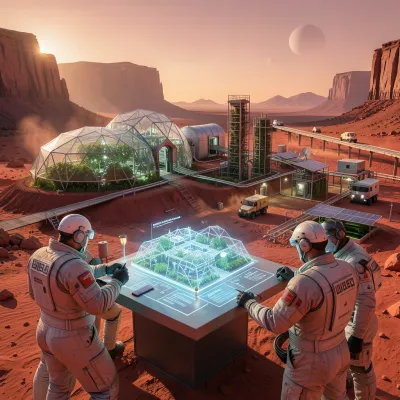
*Architects of Mars* provides a comprehensive technical and strategic roadmap for the transition from human exploration to permanent settlement on the Red Planet. The book argues that Martian sustainability is primarily a systems-integration and logistics challenge, where every design choice—from habitat architecture to power generation—is dictated by the planet’s extreme constraints, including its thin carbon dioxide atmosphere, abrasive perchlorate-laden dust, and high radiation environment. Central to the book’s thesis is the absolute necessity of In-Situ Resource Utilization (ISRU), transforming Martian regolith and subsurface ice into propellant, breathable air, and 3D-printed infrastructure to reduce the "tyranny of launch mass" from Earth.
The text details a phased settlement strategy that evolves through distinct stages: a lean, survival-focused Base; a resource-producing Outpost; a manufacturing-capable Township; and eventually a self-directed City. Each phase requires escalating levels of autonomy and closed-loop life support systems, where water recycling, waste valorization, and controlled environment agriculture are integrated into a circular economy. The book emphasizes that technical success is inextricably linked to human factors, advocating for habitat designs that prioritize psychological resilience, spatial variety, and social stability through robust governance frameworks and ethical standards.
A significant portion of the book is dedicated to risk management and the engineering of resilience. It examines the mechanical toll of the Martian environment on robotics and mobility, the complexities of thermal management, and the requirement for redundant safety protocols to manage emergencies like decompression or fire. To mitigate these risks, the author advocates for the rigorous use of Earth analogs—such as polar stations and desert outposts—and robotic pathfinders to validate technologies before human arrival. This iterative process of testing and validation is presented as the only way to ensure that the infrastructure of a new world is both functional and durable.
Ultimately, the book frames the settlement of Mars as a multigenerational project that must balance public investment with emerging private economic models. It explores the legal, ethical, and financial structures necessary to support a distant civilization, from property rights under the Outer Space Treaty to the development of a localized Martian economy. By synthesizing engineering, social planning, and economics, *Architects of Mars* presents a pragmatic vision of a future where humanity is no longer a visitor to the solar system but a permanent, multi-planetary resident.
What You'll Find Inside:
- In-Situ Resource Utilization (ISRU) as the governing principle for sustainability, detailing water extraction, atmospheric processing, regolith conversion, and waste valorization to enable power, propellant, construction materials, and agriculture
- Integrated systems approach connecting power generation (solar, fission, storage), thermal management, radiation protection, habitat design, and life support closure to create resilient, interdependent Martian infrastructure
- Comprehensive habitat architectures covering pressure vessel geometries, radiation shielding strategies (regolith, water, polyethylene), thermal control systems, expandable modular designs, and human factors considerations for long-duration habitation
- End-to-end logistics architecture addressing Earth-Mars supply chains, ISRU propellant production, surface transportation systems (rovers, hoppers), and decentralized resource distribution networks enabling settlement growth and resilience
- Phased settlement strategy progressing from survival-focused base to self-sustaining township and city, incorporating risk analysis, governance frameworks, economic models, and technology maturation pathways for scalable development
Who's It For:
The book is primarily intended for aerospace engineers, mission planners, and space architecture professionals designing Mars settlement systems. It also serves investors and program leaders seeking to understand the economic and risk frameworks for Martian development, as well as systems engineers interested in closed-loop life support and ISRU technologies. Policymakers and researchers exploring space governance and extraterrestrial sustainability will find valuable insights in the later chapters covering legal, ethical, and societal dimensions of permanent Mars settlement.
Table of Contents:
- Introduction
- Chapter 1 Why Mars, Why Now: Mission Drivers and Constraints
- Chapter 2 Choosing the Landing Site: Geology, Latitude, Resources, and Risk
- Chapter 3 The Martian Operating Environment: Atmosphere, Gravity, and Dust
- Chapter 4 In‑Situ Resource Utilization Fundamentals
- Chapter 5 Water Prospecting and Extraction: Ice, Brines, and Subsurface Reserves
- Chapter 6 Regolith to Infrastructure: Excavation, Sintering, and 3D Printing
- Chapter 7 Power Systems: Solar, Fission, Energy Storage, and Microgrids
- Chapter 8 Thermal Management: Heat Rejection, Insulation, and Seasonal Strategies
- Chapter 9 Radiation Protection: Shielding, Storm Shelters, and Dose Budgets
- Chapter 10 Habitat Architectures: Pressure Vessels, Layouts, and Expandables
- Chapter 11 Life Support and Closed‑Loop Systems: Air, Water, and Waste
- Chapter 12 Food Production: Controlled Environment Agriculture and Bioregenerative Loops
- Chapter 13 Robotics and Autonomy for Construction, Operations, and Maintenance
- Chapter 14 Mobility and Surface Transportation: Rovers, Hoppers, and Routes
- Chapter 15 Logistics Architecture: Earth‑Mars Supply Chains and ISRU Propellants
- Chapter 16 Communications and Navigation: Orbiters, Relays, and Surface Networks
- Chapter 17 Human Health and Performance: Medicine, Habitability, and Psychology
- Chapter 18 Dust Mitigation and Planetary Protection: Standards and Practices
- Chapter 19 Safety Engineering and Emergency Response: Faults, Fire, and Decompression
- Chapter 20 Governance, Law, and Ethics of Settlement
- Chapter 21 Economics and Financing Models for Martian Development
- Chapter 22 Phased Settlement Strategy: Base, Outpost, Township, City
- Chapter 23 Risk Analysis and Decision Frameworks for Mars Programs
- Chapter 24 Design Standards, Certification, and Interface Control
- Chapter 25 Earth Analogs and Pathfinders: Testing, Validation, and Iteration
Author:
Published By:
Date Published:
May 3, 2026
Type:
Nonfiction
Language:
English
Word Count:
61,525 words
Reading Time:
4 hours 19 minutes
Sample:
Order:
Order Architects of Mars (Paperback) on MixCache.com:
Buy NowPrint copy is made to order and ships worldwide. Includes the ebook free, ready to read instantly.
$5 account credit for all new MixCache.com accounts, usable toward any ebook purchase!*