Browse by Category
Fiction
- Action & Adventure
- African American
- Anthologies
- Children's Fiction
- Classics
- Comics & Graphic Novels
- Coming of Age
- Contemporary
- Cultural & Regional
- Drama
- Erotica
- Fantasy
- General
- Historical Fiction
- Horror
- Humor & Satire
- Literary Fiction
- Mystery, Thriller & Suspense
- Poetry
- Religious & Inspirational
- Romance
- Science Fiction
- Short Stories
- War & Military
- Westerns
- Women's Fiction
- Young Adult
Non-Fiction
- Antiques & Collectibles
- Arts & Photography
- Biographies & Memoirs
- Business & Money
- Children's Non-Fiction
-
Computers & Technology
- Artificial Intelligence
- Computer Science
- Cybersecurity & Cryptography
- Data Science & Analytics
- Databases & Big Data
- Game Development & Design
- General
- Hardware & DIY
- Mobile App Development
- Networking & Cloud Computing
- Operating Systems
- Programming
- Robotics
- Software
- Software Engineering
- User Experience (UX) & Design
- Web Development & Design
- Cooking, Food & Wine
- Crafts, Hobbies & Home
- Education & Teaching
- Engineering
- General
- Health, Fitness & Dieting
-
History
- African History
- African History - North Africa
- African History - Sub-Saharan Africa
- American History
- American History - 20th Century
- American History - Civil War
- American History - Colonial Period
- Ancient History
- Asian History
- Asian History - China
- Asian History - India
- Asian History - Japan
- Asian History - Southeast Asia
- European History
- European History - Ancient Greece
- European History - Ancient Rome
- European History - Medieval
- European History - Modern
- European History - Renaissance
- General
- Middle Eastern History
- Military History
- Military History - Aviation
- Military History - Naval
- Social & Cultural History
- World History
- Humor & Entertainment
- Industrial Technology
- Language Learning
- Law
- LGBTQ+ Non-Fiction
- Literary Criticism
- Medical Books
- Parenting & Relationships
- Philosophy
- Politics & Social Sciences
- Reference
- Religion & Spirituality
-
Science & Math
- Agricultural Sciences
- Astronomy & Space Science
- Behavioral Sciences
- Biological Sciences
- Botany & Plant Science
- Chemistry
- Earth Sciences
- Engineering - Chemical
- Engineering - Civil
- Engineering - Electrical
- Engineering - Mechanical
- Environment
- General
- Geology
- Mathematics
- Nature & Ecology
- Oceanography
- Paleontology
- Physics
- Statistics
- Self-Help
- Sports & Outdoors
- Study Aids
- Sustainability & Green Living
- Textbooks
- Transportation
- Travel
- True Crime
- Urban Planning & Development
- Veterinary Medicine
- Writing & Publishing
Jump to Section
MixCache.com Total Access
Unlimited reading and audiobooks for every book published by MixCache.com.
Included titles carry the MTA badge.
Learn more →
Beyond Chemical Rockets: Advanced Propulsion for Deep Space
MTA
Electric, nuclear, and exotic propulsion technologies enabling faster, more efficient missions
About this book:
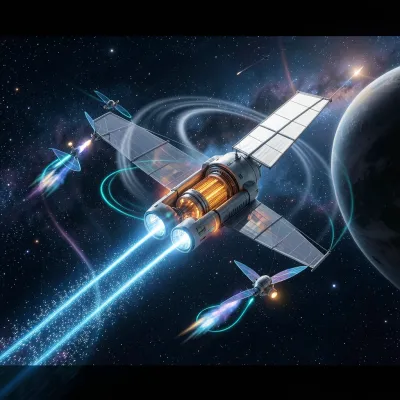
*Beyond Chemical Rockets: Advanced Propulsion for Deep Space* provides a comprehensive technical and programmatic overview of the technologies destined to replace or augment traditional liquid and solid rockets. The book moves from the fundamental physics of spacecraft propulsion—emphasizing specific impulse, thrust-to-power ratios, and delta-v budgets—to detailed examinations of established and emerging systems. It categorizes these advancements into three primary pillars: electric propulsion (including gridded ion, Hall-effect, and plasma thrusters), nuclear propulsion (both thermal and electric), and beamed-energy concepts such as solar and photonic sails. Each section balances theoretical performance with practical engineering challenges, such as thermal management, power processing, and the long-term degradation of materials in the harsh space environment.
The text places a significant emphasis on the system integration and mission design required for deep-space exploration. It explores how high-power electric and nuclear systems enable complex trajectories, such as low-thrust spirals to the outer planets and rapid human-crewed transits to Mars. By comparing various propulsion families, the book illustrates how hybrid architectures—combining chemical boosters, aerocapture, and advanced cruise stages—can optimize the trade-offs between mission duration, payload mass, and propellant efficiency. Beyond the hardware, the discussion incorporates the critical roles of power sources, from high-efficiency solar arrays to compact fission reactors, and the logistical infrastructure needed for sustained cislunar and interplanetary activity.
Finally, the book addresses the programmatic, economic, and safety frameworks essential for the maturation of these technologies. It outlines the path from laboratory research to in-space demonstrations, highlighting the regulatory and safety hurdles associated with nuclear systems and high-power lasers. The concluding chapters provide a strategic roadmap leading to the year 2050, identifying key development milestones and decision points for building a sustainable propulsion portfolio. Ultimately, the work serves as a bridge between specialized disciplines, advocating for a diversified toolkit to enable the next era of robotic reconnaissance, planetary logistics, and human presence throughout the solar system.
What You'll Find Inside:
- Comprehensive survey of electric propulsion technologies—ion, Hall, RF/Helicon, and high‑power plasma thrusters—covering physics, performance metrics, flight heritage, and scaling trade‑offs.
- Detailed treatment of nuclear propulsion options (thermal and electric), including reactor cycles, power conversion, waste‑heat management, safety, and their impact on crewed Mars and outer‑planet missions.
- Exploration of beamed‑energy and exotic concepts such as laser/microwave sails, tethers, magsails, and plasma magnets, with analysis of their potential for rapid transit and interstellar precursor missions.
- Integration challenges examined: power processing units, high‑voltage architectures, thermal management, propellant selection (xenon, krypton, iodine, alternatives), and spacecraft‑level trade‑offs for high‑power systems.
- Programmatic roadmap to 2050: technology readiness levels, cost/risk assessments, hybridization strategies, and decision‑point milestones for building a sustainable deep‑space propulsion portfolio.
Who's It For:
This book is intended for aerospace engineers, propulsion specialists, and mission architects involved in designing deep‑space robotic or crewed missions. It also serves graduate students and researchers seeking a comprehensive, comparative reference on electric, nuclear, and beamed‑energy propulsion technologies. Program managers and policy makers will benefit from the technology‑readiness, cost, and roadmap analyses that inform investment decisions. Readers will gain the tools needed to evaluate propulsion options against mission requirements and to integrate advanced systems into spacecraft architectures.
Table of Contents:
- Introduction
- Chapter 1 The Propulsion Landscape: Fundamentals, Performance Metrics, and Delta‑v Budgets
- Chapter 2 Electric Propulsion Overview: Principles, Regimes, and Trade Spaces
- Chapter 3 Gridded Ion Thrusters: Physics, Design, and Flight Heritage
- Chapter 4 Hall-Effect Thrusters: Variants, Scaling, and Lifetime
- Chapter 5 Magnetoplasmadynamic and Other High-Power Plasma Thrusters
- Chapter 6 RF and Helicon Thrusters: Emerging Concepts and Test Results
- Chapter 7 VASIMR and Variable–Specific Impulse Engines
- Chapter 8 Propellants for Electric Thrusters: Xenon, Krypton, Iodine, and Alternatives
- Chapter 9 Power Processing Units and High-Voltage Architectures
- Chapter 10 Power Sources in Deep Space: Solar Arrays, RTGs, and Fission Reactors
- Chapter 11 Thermal Management and Spacecraft Integration for High-Power EP
- Chapter 12 Nuclear Thermal Propulsion: Reactor Cycles, Fuels, and Nozzles
- Chapter 13 Nuclear Electric Propulsion: Reactor-to-Thruster Architectures
- Chapter 14 Safety, Testing, and Regulatory Pathways for In-Space Nuclear Systems
- Chapter 15 Beamed-Energy Propulsion: Lasers, Microwaves, and Photonic Sails
- Chapter 16 Laser-Thermal and Laser-Electric Concepts
- Chapter 17 Tethers, Sails, and Electrodynamic Braking (Magsails, Plasma Magnets)
- Chapter 18 Hybrid Staging: Combining Chemical, Aerocapture, and Advanced Propulsion
- Chapter 19 Mission Design with Electric and Nuclear: Spirals, Rendezvous, and Logistics
- Chapter 20 Human Missions to Mars and Beyond: Architectures and Timelines
- Chapter 21 Outer Planets, Kuiper Belt, and Interstellar Precursor Missions
- Chapter 22 Technology Readiness, Ground Testing, and In-Space Demonstrations
- Chapter 23 Cost, Risk, and Programmatics: Building a Sustainable Propulsion Portfolio
- Chapter 24 Comparative Analyses: Matching Systems to Mission Classes
- Chapter 25 Roadmap to 2050: Development Milestones and Decision Points
Author:
Published By:
Date Published:
May 3, 2026
Type:
Nonfiction
Language:
English
Word Count:
62,945 words
Reading Time:
4 hours 24 minutes
Sample:
Order:
Order Beyond Chemical Rockets: Advanced Propulsion for Deep Space (Hardcover) on MixCache.com:
Buy NowPrint copy is made to order and ships worldwide. Includes the ebook free, ready to read instantly.
$5 account credit for all new MixCache.com accounts, usable toward any ebook purchase!*