Browse by Category
Fiction
- Action & Adventure
- African American
- Anthologies
- Children's Fiction
- Classics
- Comics & Graphic Novels
- Coming of Age
- Contemporary
- Cultural & Regional
- Drama
- Erotica
- Fantasy
- General
- Historical Fiction
- Horror
- Humor & Satire
- Literary Fiction
- Mystery, Thriller & Suspense
- Poetry
- Religious & Inspirational
- Romance
- Science Fiction
- Short Stories
- War & Military
- Westerns
- Women's Fiction
- Young Adult
Non-Fiction
- Antiques & Collectibles
- Arts & Photography
- Biographies & Memoirs
- Business & Money
- Children's Non-Fiction
-
Computers & Technology
- Artificial Intelligence
- Computer Science
- Cybersecurity & Cryptography
- Data Science & Analytics
- Databases & Big Data
- Game Development & Design
- General
- Hardware & DIY
- Mobile App Development
- Networking & Cloud Computing
- Operating Systems
- Programming
- Robotics
- Software
- Software Engineering
- User Experience (UX) & Design
- Web Development & Design
- Cooking, Food & Wine
- Crafts, Hobbies & Home
- Education & Teaching
- Engineering
- General
- Health, Fitness & Dieting
-
History
- African History
- African History - North Africa
- African History - Sub-Saharan Africa
- American History
- American History - 20th Century
- American History - Civil War
- American History - Colonial Period
- Ancient History
- Asian History
- Asian History - China
- Asian History - India
- Asian History - Japan
- Asian History - Southeast Asia
- European History
- European History - Ancient Greece
- European History - Ancient Rome
- European History - Medieval
- European History - Modern
- European History - Renaissance
- General
- Middle Eastern History
- Military History
- Military History - Aviation
- Military History - Naval
- Social & Cultural History
- World History
- Humor & Entertainment
- Industrial Technology
- Language Learning
- Law
- LGBTQ+ Non-Fiction
- Literary Criticism
- Medical Books
- Parenting & Relationships
- Philosophy
- Politics & Social Sciences
- Reference
- Religion & Spirituality
-
Science & Math
- Agricultural Sciences
- Astronomy & Space Science
- Behavioral Sciences
- Biological Sciences
- Botany & Plant Science
- Chemistry
- Earth Sciences
- Engineering - Chemical
- Engineering - Civil
- Engineering - Electrical
- Engineering - Mechanical
- Environment
- General
- Geology
- Mathematics
- Nature & Ecology
- Oceanography
- Paleontology
- Physics
- Statistics
- Self-Help
- Sports & Outdoors
- Study Aids
- Sustainability & Green Living
- Textbooks
- Transportation
- Travel
- True Crime
- Urban Planning & Development
- Veterinary Medicine
- Writing & Publishing
Jump to Section
MixCache.com Total Access
Unlimited reading and audiobooks for every book published by MixCache.com.
Included titles carry the MTA badge.
Learn more →
Dynastic DNA: Genetics, Genealogy, and the Science of Royal Lineages
MTA
Genetic discoveries and genealogical methods that illuminate royal histories
About this book:
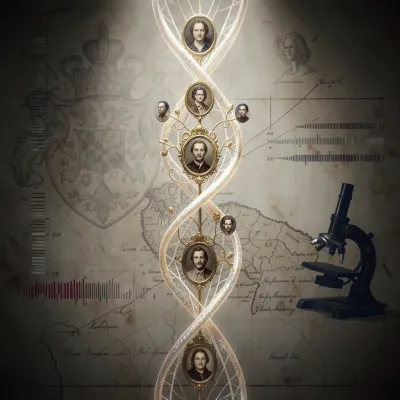
*Dynastic DNA: Genetics, Genealogy, and the Science of Royal Lineages* explores the intersection of molecular biology and historical research, detailing how DNA analysis has revolutionized our understanding of royal houses. The book begins by establishing a "genetic toolbox," explaining the roles of Y-chromosome, mitochondrial, and autosomal DNA in tracing paternal, maternal, and complex kinship lines. It emphasizes that while genetics provides a biological record, it must be synthesized with traditional genealogical methods—such as the "genealogical proof standard"—and forensic archaeology to verify the identity and context of royal remains.
The text delves into the biological realities of power, notably the impact of endogamy and inbreeding on famous dynasties like the Spanish Habsburgs. It illustrates how these marriage strategies, intended to preserve power, often led to genetic burdens and succession crises. Through high-profile case studies—including the identification of Richard III under a Leicester car park, the forensic untangling of the Romanov family massacre, and the reconstruction of Pharaonic lineages—the book demonstrates how science can resolve centuries-old mysteries, unmask impostors, and clarify the fate of "lost princes."
Beyond Europe, the book expands its scope to the royal traditions of Africa, Asia, and the Americas, using isotope analysis and deep-ancestry haplogroups to track migration, alliance, and the movement of royal courts. These chapters highlight that "royal blood" is often a cosmopolitan mix of far-flung influences rather than a pure, isolated strain. The narrative also addresses the technical challenges of working with ancient DNA, such as degradation and contamination, and the role of modern technologies like AI and Big Data in mapping vast, interconnected family networks.
Finally, the work grapples with the ethical, legal, and social implications of this research. It discusses the "law of the dead," the necessity of informed consent from descendant communities, and the politics of repatriation. By acknowledging the limits of genetics—specifically that DNA cannot adjudicate legal legitimacy or moral right to rule—the book concludes that the study of dynastic DNA is a partnership between science and history. This partnership humanizes historical icons and replaces static myths with a more honest, complex account of human power and heredity.
What You'll Find Inside:
- How Y-DNA and mitochondrial DNA trace unbroken paternal and maternal royal lineages across centuries, serving as molecular surnames for dynasty verification
- The integration of genetic evidence with traditional genealogical methods to resolve historical mysteries like contested successions and lost princes
- Case studies demonstrating DNA's role in identifying royal remains, from Richard III under a car park to the Romanovs in a mass grave
- How endogamy and inbreeding affected royal health and succession throughout history, revealed through genetic analysis of ancient remains
- Ethical considerations, legal frameworks, and interpretive limitations when applying genetic science to royal remains and historical narratives
Who's It For:
This book is designed for historians, genealogists, and geneticists interested in the intersection of science and royal history. It will also benefit archaeologists, students of history or genetics, and general readers fascinated by how modern DNA analysis is resolving centuries-old mysteries about royal lineages. Readers should have some familiarity with historical concepts but no specialized genetic knowledge is required, as the book explains scientific concepts in accessible terms.
Table of Contents:
- Introduction
- Chapter 1 The Genetic Toolbox: DNA Basics for Lineage Research
- Chapter 2 Pedigrees and Proof: Genealogical Methods Meet Molecular Data
- Chapter 3 Bones, Teeth, and Time: Forensic Archaeology of Royal Burials
- Chapter 4 Y Chromosomes and Kingship: Paternal Lines Across Centuries
- Chapter 5 Mitochondrial Memories: Queens, Maternal Lines, and Dynastic Daughters
- Chapter 6 Autosomal Signals: Reconstructing Kinship in Entangled Houses
- Chapter 7 The Ancient DNA Revolution: From Tombs to Genomes
- Chapter 8 Endogamy and Inbreeding: Health, Heirs, and the Royal Gene Pool
- Chapter 9 The Language of Haplogroups: Mapping Dynasties to Deep Ancestry
- Chapter 10 Contested Successions: Using DNA to Test Claims and Counterclaims
- Chapter 11 The Lost Princes Problem: From Rumor to Genetic Evidence
- Chapter 12 The Romanovs and the Birth of Forensic Genetics
- Chapter 13 Richard III and the King in the Car Park
- Chapter 14 Pharaohs and Mummies: Rethinking Ancient Royal Houses
- Chapter 15 Royalty Beyond Europe: Dynastic Genetics in Africa, Asia, and the Americas
- Chapter 16 Impostors, Pretenders, and Misattributed Paternity
- Chapter 17 Surnames, Heraldry, and Y-DNA Lineage Projects
- Chapter 18 Marriage, Alliance, and Migration: Tracing Courts with Isotopes and DNA
- Chapter 19 Ethics at the Tomb: Consent, Repatriation, and Cultural Sensitivities
- Chapter 20 The Law of the Dead: Exhumations, Evidence, and the Courts
- Chapter 21 Privacy and Power: Genomic Data in the Public Eye
- Chapter 22 Algorithms and Archives: AI, Big Data, and the Future of Genealogy
- Chapter 23 Visualizing Descent: Trees, Graphs, and Networked Royal Histories
- Chapter 24 What DNA Cannot Tell Us: Limits, Noise, and Interpretive Pitfalls
- Chapter 25 After the Results: Narratives, Memory, and the Politics of Lineage
Author:
Published By:
Date Published:
May 2, 2026
Type:
Nonfiction
Language:
English
Word Count:
59,043 words
Reading Time:
4 hours 8 minutes
Sample:
Order:
Order Dynastic DNA: Genetics, Genealogy, and the Science of Royal Lineages (Paperback) on MixCache.com:
Buy NowPrint copy is made to order and ships worldwide. Includes the ebook free, ready to read instantly.
$5 account credit for all new MixCache.com accounts, usable toward any ebook purchase!*