Browse by Category
Fiction
- Action & Adventure
- African American
- Anthologies
- Children's Fiction
- Classics
- Comics & Graphic Novels
- Coming of Age
- Contemporary
- Cultural & Regional
- Drama
- Erotica
- Fantasy
- General
- Historical Fiction
- Horror
- Humor & Satire
- Literary Fiction
- Mystery, Thriller & Suspense
- Poetry
- Religious & Inspirational
- Romance
- Science Fiction
- Short Stories
- War & Military
- Westerns
- Women's Fiction
- Young Adult
Non-Fiction
- Antiques & Collectibles
- Arts & Photography
- Biographies & Memoirs
- Business & Money
- Children's Non-Fiction
-
Computers & Technology
- Artificial Intelligence
- Computer Science
- Cybersecurity & Cryptography
- Data Science & Analytics
- Databases & Big Data
- Game Development & Design
- General
- Hardware & DIY
- Mobile App Development
- Networking & Cloud Computing
- Operating Systems
- Programming
- Robotics
- Software
- Software Engineering
- User Experience (UX) & Design
- Web Development & Design
- Cooking, Food & Wine
- Crafts, Hobbies & Home
- Education & Teaching
- Engineering
- General
- Health, Fitness & Dieting
-
History
- African History
- African History - North Africa
- African History - Sub-Saharan Africa
- American History
- American History - 20th Century
- American History - Civil War
- American History - Colonial Period
- Ancient History
- Asian History
- Asian History - China
- Asian History - India
- Asian History - Japan
- Asian History - Southeast Asia
- European History
- European History - Ancient Greece
- European History - Ancient Rome
- European History - Medieval
- European History - Modern
- European History - Renaissance
- General
- Middle Eastern History
- Military History
- Military History - Aviation
- Military History - Naval
- Social & Cultural History
- World History
- Humor & Entertainment
- Industrial Technology
- Language Learning
- Law
- LGBTQ+ Non-Fiction
- Literary Criticism
- Medical Books
- Parenting & Relationships
- Philosophy
- Politics & Social Sciences
- Reference
- Religion & Spirituality
-
Science & Math
- Agricultural Sciences
- Astronomy & Space Science
- Behavioral Sciences
- Biological Sciences
- Botany & Plant Science
- Chemistry
- Earth Sciences
- Engineering - Chemical
- Engineering - Civil
- Engineering - Electrical
- Engineering - Mechanical
- Environment
- General
- Geology
- Mathematics
- Nature & Ecology
- Oceanography
- Paleontology
- Physics
- Statistics
- Self-Help
- Sports & Outdoors
- Study Aids
- Sustainability & Green Living
- Textbooks
- Transportation
- Travel
- True Crime
- Urban Planning & Development
- Veterinary Medicine
- Writing & Publishing
Jump to Section
MixCache.com Total Access
Unlimited reading and audiobooks for every book published by MixCache.com.
Included titles carry the MTA badge.
Learn more →
The Soviet-Finnish Winter War Revisited
MTA
Diplomacy, Military Strategy, and International Repercussions, 1939–1940
About this book:
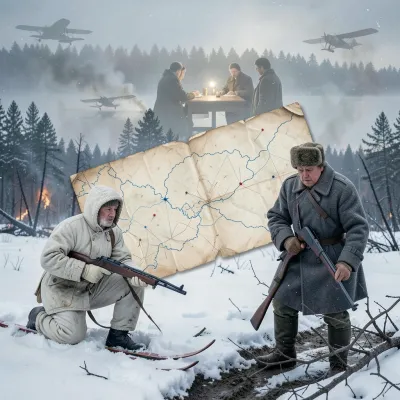
The Soviet-Finnish Winter War of 1939-1940 was a brutal and unexpected conflict that pitted the vastly superior Soviet Red Army against the smaller, but highly determined, Finnish forces. Fueled by Soviet security concerns over Leningrad's proximity to the Finnish border, exacerbated by the Molotov-Ribbentrop Pact, Moscow demanded territorial concessions and a naval base. Finland, steadfast in its neutrality and sovereignty, refused. The war officially began with the "Mainila Incident," a contested border shelling used by the Soviets as a *casus belli*, leading to a massive Soviet offensive on November 30, 1939.
Initially, the Red Army faced significant setbacks, largely due to its rigid command structure, the debilitating effects of the purges on its officer corps, and a profound underestimation of the Finnish winter and the Finns' mastery of their challenging terrain. Finnish forces, though outnumbered, skillfully employed small-unit tactics, such as the legendary "motti" (encirclement) strategy, on skis in the deep snow and dense forests, inflicting disproportionately heavy casualties on unprepared Soviet columns, particularly on the northeastern fronts at Salla and Suomussalmi. Finland's fortified Mannerheim Line on the Karelian Isthmus also proved a far tougher obstacle than anticipated, absorbing weeks of Soviet assaults.
The international response was characterized by widespread condemnation of Soviet aggression, leading to the USSR's expulsion from the League of Nations and a global outpouring of public sympathy for Finland. Humanitarian aid and thousands of foreign volunteers flowed to Finland, providing crucial morale support, though concrete military intervention from major powers like Britain and France was ultimately constrained by their own strategic preoccupations with Nazi Germany and the reluctance of neutral Sweden and Norway to permit transit. Germany, observing from the sidelines, largely saw the war as a useful distraction and an indicator of Soviet military weakness, reinforcing Hitler's later miscalculations.
By February 1940, the Red Army, having learned from its costly mistakes, adapted its tactics, employing overwhelming artillery concentrations and improved combined-arms coordination. This sustained assault eventually breached the Mannerheim Line, pushing Finland to the brink of collapse. Exhausted and isolated, Finland was forced to seek peace. The Moscow Peace Treaty of March 12, 1940, ceded substantial Finnish territory, including the entire Karelian Isthmus and the city of Viipuri, and leased the Hanko peninsula to the USSR for a naval base. Despite the territorial losses, Finland retained its independence.
The aftermath saw profound changes in both nations. In Moscow, the Winter War served as a harsh, albeit necessary, learning experience, forcing critical reforms in Red Army doctrine, logistics, and training that would prove vital in the upcoming Great Patriotic War. For Finland, the war became a defining moment of national identity, cementing a culture of armed neutrality, self-reliance, and resilience ("sisu"). The conflict also significantly reshaped regional security in Scandinavia and the Baltics, accelerating the German invasion of Norway and Denmark and the Soviet annexation of the Baltic states, leaving a lasting legacy on the geopolitics of Northern Europe.
What You'll Find Inside:
- The Winter War exposed critical flaws in Soviet military readiness due to purges, rigid command structures, and inadequate winter warfare preparation, despite eventual adaptation and learning through costly experience.
- Finnish defensive success relied on innovative small-unit tactics (motti formations), expert use of terrain and weather, and high morale driven by the concept of sisu, rather than numerical superiority against the larger Red Army.
- Diplomatic negotiations failed due to irreconcilable differences over Soviet security demands regarding Leningrad and Finnish sovereignty concerns, with the Mainila incident serving as a contested casus belli that both sides interpreted to justify their positions.
- International sympathy for Finland was substantial but limited in practical effect due to Scandinavian neutrality concerns and Allied focus on the German threat, resulting in mostly humanitarian aid and volunteer efforts rather than decisive military intervention.
- The war's outcome significantly influenced subsequent events: prompting Soviet military reforms that proved vital in WWII, shaping Finnish postwar policy of armed neutrality, and altering regional power dynamics in Scandinavia and the Baltic as great powers reassessed their strategies.
Who's It For:
This book is intended for students, scholars, and serious enthusiasts of 20th-century military history, international relations, and Scandinavian studies. It will particularly benefit readers interested in the interplay between diplomacy and military strategy, the winter warfare lessons learned by both the Red Army and Finnish forces, and how regional conflicts can influence broader geopolitical developments. The detailed analysis of archival sources and operational records makes it valuable for researchers seeking a nuanced understanding of the Winter War's causes, conduct, and consequences beyond traditional narratives.
Table of Contents:
- Introduction
- Chapter 1 Europe on the Brink: The Molotov–Ribbentrop Context
- Chapter 2 Borderlands and Buffer Zones: Soviet Security and Leningrad
- Chapter 3 The Finnish Dilemma: Neutrality, Mobilization, and Diplomacy
- Chapter 4 Negotiations in Moscow: From Proposals to Ultimatums
- Chapter 5 The Mainila Incident: Casus Belli and Contested Evidence
- Chapter 6 Opening Blows: The Offensive of November 30, 1939
- Chapter 7 The Mannerheim Line: Myth, Engineering, and Reality
- Chapter 8 Command and Control: Purges, Doctrine, and Red Army Readiness
- Chapter 9 Winter as a Weapon: Terrain, Weather, and Small-Unit Tactics
- Chapter 10 Propaganda and Morale: Nations at War
- Chapter 11 The International Response: League of Nations, Public Opinion, and Volunteers
- Chapter 12 Aid and Embargoes: Britain, France, Sweden, and the Baltic
- Chapter 13 Air War Over the North: Strategy, Technology, and Civilian Bombardment
- Chapter 14 Maritime and Lake Operations: The Gulf of Finland and Ladoga
- Chapter 15 Intelligence and Deception: Reconnaissance, Codes, and Camouflage
- Chapter 16 The Northeastern Fronts: Salla, Suomussalmi, and Motti Tactics
- Chapter 17 Reassessing Losses: Casualty Accounting, Material Attrition, and Methods
- Chapter 18 February Lessons: Artillery, Sappers, and Operational Adaptation
- Chapter 19 Diplomacy Renewed: Pathways to an Armistice
- Chapter 20 The Moscow Peace Treaty of March 12, 1940: Terms and Maps
- Chapter 21 Aftermath in Helsinki: Politics, Society, and Strategic Reorientation
- Chapter 22 Aftermath in Moscow: Reform, Doctrine Debates, and Military Learning
- Chapter 23 Scandinavia and the Baltic: Shifts in Regional Security
- Chapter 24 The War’s Shadow in 1940: Perceptions in Berlin, London, and Paris
- Chapter 25 Memory, Myth, and Reassessment: The Winter War in Contemporary Perspective
Author:
Published By:
Date Published:
May 2, 2026
Type:
Nonfiction
Language:
English
Word Count:
59,998 words
Reading Time:
4 hours 12 minutes
Sample:
Order:
Order The Soviet-Finnish Winter War Revisited (Hardcover) on MixCache.com:
Buy NowPrint copy is made to order and ships worldwide. Includes the ebook free, ready to read instantly.
$5 account credit for all new MixCache.com accounts, usable toward any ebook purchase!*