
Browse by Category
Fiction
- Action & Adventure
- African American
- Anthologies
- Children's Fiction
- Classics
- Comics & Graphic Novels
- Coming of Age
- Contemporary
- Cultural & Regional
- Drama
- Erotica
- Fantasy
- General
- Historical Fiction
- Horror
- Humor & Satire
- Literary Fiction
- Mystery, Thriller & Suspense
- Poetry
- Religious & Inspirational
- Romance
- Science Fiction
- Short Stories
- War & Military
- Westerns
- Women's Fiction
- Young Adult
Non-Fiction
- Antiques & Collectibles
- Arts & Photography
- Biographies & Memoirs
- Business & Money
- Children's Non-Fiction
-
Computers & Technology
- Artificial Intelligence
- Computer Science
- Cybersecurity & Cryptography
- Data Science & Analytics
- Databases & Big Data
- Game Development & Design
- General
- Hardware & DIY
- Mobile App Development
- Networking & Cloud Computing
- Operating Systems
- Programming
- Robotics
- Software
- Software Engineering
- User Experience (UX) & Design
- Web Development & Design
- Cooking, Food & Wine
- Crafts, Hobbies & Home
- Education & Teaching
- Engineering
- General
- Health, Fitness & Dieting
-
History
- African History
- African History - North Africa
- African History - Sub-Saharan Africa
- American History
- American History - 20th Century
- American History - Civil War
- American History - Colonial Period
- Ancient History
- Asian History
- Asian History - China
- Asian History - India
- Asian History - Japan
- Asian History - Southeast Asia
- European History
- European History - Ancient Greece
- European History - Ancient Rome
- European History - Medieval
- European History - Modern
- European History - Renaissance
- General
- Middle Eastern History
- Military History
- Military History - Aviation
- Military History - Naval
- Social & Cultural History
- World History
- Humor & Entertainment
- Industrial Technology
- Language Learning
- Law
- LGBTQ+ Non-Fiction
- Literary Criticism
- Medical Books
- Parenting & Relationships
- Philosophy
- Politics & Social Sciences
- Reference
- Religion & Spirituality
-
Science & Math
- Agricultural Sciences
- Astronomy & Space Science
- Behavioral Sciences
- Biological Sciences
- Botany & Plant Science
- Chemistry
- Earth Sciences
- Engineering - Chemical
- Engineering - Civil
- Engineering - Electrical
- Engineering - Mechanical
- Environment
- General
- Geology
- Mathematics
- Nature & Ecology
- Oceanography
- Paleontology
- Physics
- Statistics
- Self-Help
- Sports & Outdoors
- Study Aids
- Sustainability & Green Living
- Textbooks
- Transportation
- Travel
- True Crime
- Urban Planning & Development
- Veterinary Medicine
- Writing & Publishing
Jump to Section
MixCache.com Total Access
Unlimited reading and audiobooks for every book published by MixCache.com.
Included titles carry the MTA badge.
Learn more →
Iran's Regional Strategy: Proxies, Alliances, and Middle East Influence
MTA
A geopolitical study of Iran's regional networks, military strategy, and foreign policy goals
About this book:
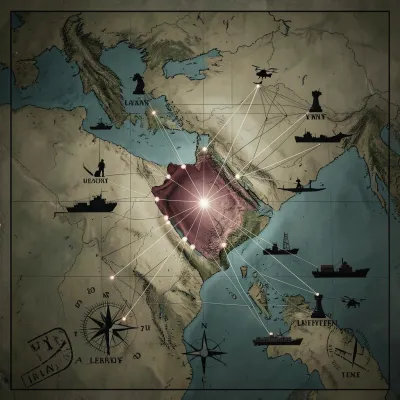
"Iran's Regional Strategy" meticulously dissects the intricate and multifaceted approach Tehran employs to project power and secure its interests across the Middle East. The book argues that Iran's regional influence is a product of deeply ingrained historical habits, a resilient revolutionary ideology, and a strategic culture that prioritizes deterrence through asymmetric means and calibrated pressure. Since the 1979 revolution, Iran has eschewed conventional military dominance, instead fostering a complex web of state and non-state alliances, exemplified by its enduring partnership with Hezbollah, its strategic entrenchment in Syria and Iraq, and its opportunistic support for the Houthi movement in Yemen. This "Axis of Resistance" is not a monolithic command structure but a flexible mosaic of relationships, where partners retain significant autonomy while serving Iran's broader strategic goals.
The book details the institutional machinery behind this strategy, primarily focusing on the Islamic Revolutionary Guard Corps (IRGC) and its Quds Force, which act as architects and executors of extraterritorial operations. It highlights how these security establishments, often operating with budgetary autonomy and overlapping functions with civilian diplomacy and intelligence, cultivate and sustain proxies through financial aid, military training, and ideological guidance. Iran's toolkit extends beyond kinetic capabilities, integrating sophisticated information operations, cyber warfare, and economic statecraft, including elaborate sanctions evasion networks and leveraging its significant energy resources. This comprehensive approach allows Iran to exert influence and impose costs on adversaries across various domains, often blurring the lines between peace and conflict in what is termed "gray-zone competition."
Geographic considerations are central to Iran's strategy, with the book exploring its "northern and southern arcs of influence." From the complex balancing act in the Caucasus to its critical maritime strategy in the Persian Gulf and Strait of Hormuz, Iran utilizes its strategic location and asymmetric naval capabilities to threaten global energy flows and deter regional rivals. The text also delves into specific regional theaters like the Palestinian arena, detailing Iran's nuanced ties with groups like Hamas and Palestinian Islamic Jihad, which serve both ideological and strategic purposes. Crucially, the book emphasizes the inherent limits of Iran's influence, constrained by economic pressures, the agency of its partners, domestic political rivalries, and the counterbalancing efforts of regional and great powers.
Finally, the book provides frameworks for external actors to understand and respond to Iran's complex regional strategy. It stresses the importance of principal-agent dynamics, network analysis, deterrence theory, and escalation pathways to accurately measure influence, anticipate crises, and calibrate policy responses. "Iran's Regional Strategy" concludes by acknowledging that Iran's power is not absolute but deeply entrenched and adaptive, ensuring that Tehran remains a central, often disruptive, player in the turbulent geopolitics of the Middle East, constantly adjusting its tactics to maximize leverage while managing the risks of overreach and unintended escalation.
What You'll Find Inside:
- How Iran leverages proxy networks (Hezbollah, Houthis, Iraqi militias) and asymmetric tools (missiles, drones, cyber) to project power beyond its conventional military limitations.
- The institutional mechanics of Iran's influence, focusing on the IRGC-Quds Force's role in managing relationships with state and non-state partners across multiple theaters.
- Theater-specific analyses of Iran's strategy in Lebanon, Syria, Iraq, Yemen, and Palestine, showing how geography and local partnerships shape influence.
- Iran's adaptation to sanctions through shadow economies, evasion tactics, and partnerships with Russia/China while managing great-power dynamics.
- Practical policy frameworks for external actors to measure influence, manage escalation, and respond to Iran's regional activities using principal-agent and network analysis lenses.
Who's It For:
Foreign policy analysts, policymakers, and security practitioners seeking to understand Iran's regional networks, asymmetric strategies, and influence mechanisms across the Middle East. The book provides decision-oriented tools for assessing risks and opportunities in Iran's engagements with proxies, adversaries, and great powers.
Table of Contents:
- Introduction
- Chapter 1 Historical Foundations of Iran’s Regional Strategy
- Chapter 2 Ideology and Strategic Culture: From Revolution to Realpolitik
- Chapter 3 Institutions of Influence: The IRGC-Quds Force and the Diplomatic Apparatus
- Chapter 4 Tools of Power: Military, Economic, Information, and Cyber Instruments
- Chapter 5 Strategic Geography: Northern and Southern Arcs of Influence
- Chapter 6 Deterrence and Asymmetry: Missiles, Drones, and Naval Tactics
- Chapter 7 Hezbollah: Origins, Capabilities, and Mutual Dependence
- Chapter 8 Syria: Ally, Battleground, and Reconstruction Partner
- Chapter 9 Iraq: State Institutions, Militias, and Balancing Acts
- Chapter 10 Yemen: The Houthi Partnership and Red Sea Leverage
- Chapter 11 The Palestinian Arena: Ties with Hamas and Palestinian Islamic Jihad
- Chapter 12 The Gulf Monarchies: Competition, Coercion, and Dialogue
- Chapter 13 Turkey and the Caucasus: Cooperation, Competition, and Constraint
- Chapter 14 Russia and China: Great-Power Partnerships and Their Limits
- Chapter 15 Sanctions, Evasion, and the Shadow Economy
- Chapter 16 Energy Geopolitics: Oil, Gas, and Maritime Chokepoints
- Chapter 17 Maritime Strategy: The Persian Gulf, Strait of Hormuz, and Beyond
- Chapter 18 Information Operations and Transnational Religious Networks
- Chapter 19 Non‑State Actors Beyond the Levant: Afghanistan, Pakistan, and Africa
- Chapter 20 Domestic Politics and the Security Establishment
- Chapter 21 Diplomacy, De‑Escalation, and Regional Summits
- Chapter 22 Escalation Pathways and Crisis Management
- Chapter 23 Scenario Analysis: From Proxy Skirmish to Regional War
- Chapter 24 Policy Frameworks for External Actors
- Chapter 25 Measuring Influence: Metrics, Limits, and Future Trajectories
Author:
Published By:
Date Published:
April 30, 2026
Type:
Nonfiction
Language:
English
Word Count:
61,300 words
Reading Time:
4 hours 18 minutes
Sample:
MixCache.com Total Access
Get unlimited access to this book + all books published by MixCache.com for $11.99/month
Subscribe to MTAOr purchase this book individually below
Order:
Buy the Iran's Regional Strategy: Proxies, Alliances, and Middle East Influence ebook on MixCache.com:
Buy Now
Full ebook will be available immediately
- read online or download as a PDF file.
$5 account credit for all new MixCache.com accounts, usable toward any ebook purchase!*




Ratings & Reviews
Ask Questions About This Book
Have a question about the content? Ask our AI assistant!
Start by asking a question about "Iran's Regional Strategy: Proxies, Alliances, and Middle East Influence"
Example: "Does this book mention William Shakespeare?"
Thinking...