
Browse by Category
Fiction
- Action & Adventure
- African American
- Anthologies
- Children's Fiction
- Classics
- Comics & Graphic Novels
- Coming of Age
- Contemporary
- Cultural & Regional
- Drama
- Erotica
- Fantasy
- General
- Historical Fiction
- Horror
- Humor & Satire
- Literary Fiction
- Mystery, Thriller & Suspense
- Poetry
- Religious & Inspirational
- Romance
- Science Fiction
- Short Stories
- War & Military
- Westerns
- Women's Fiction
- Young Adult
Non-Fiction
- Antiques & Collectibles
- Arts & Photography
- Biographies & Memoirs
- Business & Money
- Children's Non-Fiction
-
Computers & Technology
- Artificial Intelligence
- Computer Science
- Cybersecurity & Cryptography
- Data Science & Analytics
- Databases & Big Data
- Game Development & Design
- General
- Hardware & DIY
- Mobile App Development
- Networking & Cloud Computing
- Operating Systems
- Programming
- Robotics
- Software
- Software Engineering
- User Experience (UX) & Design
- Web Development & Design
- Cooking, Food & Wine
- Crafts, Hobbies & Home
- Education & Teaching
- Engineering
- General
- Health, Fitness & Dieting
-
History
- African History
- African History - North Africa
- African History - Sub-Saharan Africa
- American History
- American History - 20th Century
- American History - Civil War
- American History - Colonial Period
- Ancient History
- Asian History
- Asian History - China
- Asian History - India
- Asian History - Japan
- Asian History - Southeast Asia
- European History
- European History - Ancient Greece
- European History - Ancient Rome
- European History - Medieval
- European History - Modern
- European History - Renaissance
- General
- Middle Eastern History
- Military History
- Military History - Aviation
- Military History - Naval
- Social & Cultural History
- World History
- Humor & Entertainment
- Industrial Technology
- Language Learning
- Law
- LGBTQ+ Non-Fiction
- Literary Criticism
- Medical Books
- Parenting & Relationships
- Philosophy
- Politics & Social Sciences
- Reference
- Religion & Spirituality
-
Science & Math
- Agricultural Sciences
- Astronomy & Space Science
- Behavioral Sciences
- Biological Sciences
- Botany & Plant Science
- Chemistry
- Earth Sciences
- Engineering - Chemical
- Engineering - Civil
- Engineering - Electrical
- Engineering - Mechanical
- Environment
- General
- Geology
- Mathematics
- Nature & Ecology
- Oceanography
- Paleontology
- Physics
- Statistics
- Self-Help
- Sports & Outdoors
- Study Aids
- Sustainability & Green Living
- Textbooks
- Transportation
- Travel
- True Crime
- Urban Planning & Development
- Veterinary Medicine
- Writing & Publishing
Jump to Section
MixCache.com Total Access
Unlimited reading and audiobooks for every book published by MixCache.com.
Included titles carry the MTA badge.
Learn more →
Union or Unionless: Federalism, Sovereignty and the Future of European Integration
MTA
A theoretical and practical debate on options for deeper integration versus decentralized sovereignty models
About this book:
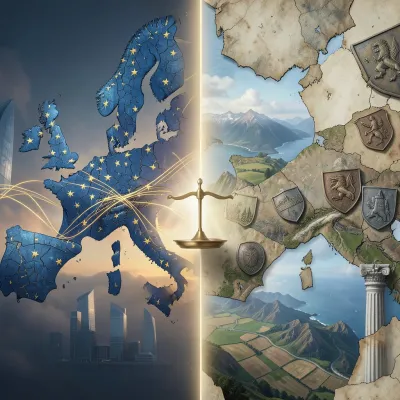
"Union or Unionless" provides a comprehensive analysis of the ongoing tension between federalist integration and decentralized sovereignty within the European Union. The book traces the EU’s evolution from its foundational treaties to the complex institutional framework established by the Lisbon Treaty, examining how successive crises—ranging from the Eurozone debt crisis to the COVID-19 pandemic and the war in Ukraine—have forced the Union to innovate through "crisis governance." It argues that European integration has largely proceeded through functional necessity and legal improvisation rather than a single grand design, resulting in a multi-layered polity where shared authority and national autonomy are constantly renegotiated.
The text delves into specific policy domains, highlighting the "unfinished business" of the single market, the banking union, and the fiscal architecture of the Eurozone. It explores the challenges of democratic legitimacy and the "rule of law" crisis, noting that as the EU expands its reach into digital sovereignty, green energy, and strategic defense, the traditional requirements for unanimous consent often lead to institutional deadlock. To address this, the book evaluates various models of "differentiated integration," such as multi-speed pathways and concentric circles, which allow a vanguard of willing member states to deepen cooperation in areas like defense and finance without requiring universal participation.
A significant portion of the book is dedicated to the practical mechanics of reform, distinguishing between formal treaty changes and "treaty-free" innovations. The author demonstrates how the EU has used intergovernmental agreements, judicial interpretation, and enhanced cooperation to bypass the political hurdles of national ratifications. The text also emphasizes the importance of citizen participation through deliberative forums and referendums, suggesting that any durable political settlement must command popular legitimacy to survive the rising pressures of populism and national skepticism.
Finally, the book presents several strategic scenarios for Europe leading to the year 2040, ranging from a "Federal Lite" model to a more fragmented "Sovereignty First" retreat. It concludes that the future of European integration will likely remain a pragmatic hybrid of state and supranational authority. By mapping the political feasibility of various roadmaps, the book serves as a toolkit for understanding how the EU can maintain its relevance as a global actor while respecting the diverse constitutional identities of its member states.
What You'll Find Inside:
- The book examines the spectrum between full federalism and sovereignty-retaining cooperation, analyzing concrete trade-offs in policy areas like the single market, euro, migration, and defense.
- It explains how differentiated integration (multi-speed, variable geometry models) can reconcile ambition with diversity when guardrails are clearly specified regarding participation, governance, cost-sharing, and portability of rights.
- The work analyzes sovereignty's legal, political, and economic dimensions, showing how pooled sovereignty functions differently across policy areas from competition law to foreign policy.
- It provides actionable roadmaps for reform that identify legal pathways (treaty change or treaty-free), coalition requirements among member states and party families, timing/sequencing, and budgetary implications including own resources and burden-sharing.
- The book stress-tests institutional options against hard realities from recent crises (euro, migration, pandemic, war) to evaluate problem-solving capacity, democratic accountability, fiscal sustainability, distributional fairness, and resilience to shocks.
Who's It For:
This book is designed for academics seeking conceptual clarity on European integration and policymakers who must make decisions under constraints. Scholars will benefit from an integrated framework linking constitutional design to policy outcomes and political incentives, while practitioners will find practical tools like checklists, decision trees, and scenario maps to support real-world negotiations. The content serves both those studying the theoretical foundations of EU integration and those engaged in shaping its future direction.
Table of Contents:
- Introduction
- Chapter 1 The European Idea: From Confederation to Federation?
- Chapter 2 A Short Constitutional History: From Rome to Lisbon and Beyond
- Chapter 3 Sovereignty Reconsidered: Legal, Political and Economic Dimensions
- Chapter 4 Democratic Legitimacy and Accountability in a Layered Polity
- Chapter 5 The Single Market’s Unfinished Business: Free Movement and Fair Competition
- Chapter 6 The Euro at a Crossroads: Monetary Design and Reform Options
- Chapter 7 Fiscal Union Paths: Stabilization, Insurance and Risk Sharing
- Chapter 8 Completing the Banking and Capital Markets Unions
- Chapter 9 Social Europe: Mobility, Convergence and Solidarity Mechanisms
- Chapter 10 Security, Defence and Strategic Autonomy
- Chapter 11 Borders, Schengen and Migration Governance
- Chapter 12 Rule of Law, Courts and Constitutional Pluralism
- Chapter 13 Digital Sovereignty, Industrial Policy and Strategic Technologies
- Chapter 14 Energy, Climate and the Green Transition
- Chapter 15 Differentiated Integration: Multi‑Speed, Variable Geometry and à la carte
- Chapter 16 Core Europe and Circles of Integration: Designing Concentric Models
- Chapter 17 Sovereignty‑Retaining Alternatives: EEA, EFTA and Looser Cooperations
- Chapter 18 Subsidiarity, Devolution and Local Autonomy
- Chapter 19 National Vetoes, Opt‑outs and the Art of Non‑Participation
- Chapter 20 Pathways to Treaty Change and Treaty‑Free Reforms
- Chapter 21 Citizens’ Participation: Referendums, Conventions and Deliberative Forums
- Chapter 22 The EU Budget and Own Resources: Paying for Ambition
- Chapter 23 Enlargement, Neighborhood and External Action
- Chapter 24 Governing Through Crises: Lessons from the Euro, Migration, Pandemic and War
- Chapter 25 Scenarios to 2040: Roadmaps, Coalitions and Political Feasibility
Author:
Published By:
Date Published:
April 30, 2026
Type:
Nonfiction
Language:
English
Word Count:
72,630 words
Reading Time:
5 hours 5 minutes
Sample:
MixCache.com Total Access
Get unlimited access to this book + all books published by MixCache.com for $11.99/month
Subscribe to MTAOr purchase this book individually below
Order:
Buy the Union or Unionless: Federalism, Sovereignty and the Future of European Integration ebook on MixCache.com:
Buy Now
Full ebook will be available immediately
- read online or download as a PDF file.
$5 account credit for all new MixCache.com accounts, usable toward any ebook purchase!*


Ratings & Reviews
Ask Questions About This Book
Have a question about the content? Ask our AI assistant!
Start by asking a question about "Union or Unionless: Federalism, Sovereignty and the Future of European Integration"
Example: "Does this book mention William Shakespeare?"
Thinking...