
Browse by Category
Fiction
- Action & Adventure
- African American
- Anthologies
- Children's Fiction
- Classics
- Comics & Graphic Novels
- Coming of Age
- Contemporary
- Cultural & Regional
- Drama
- Erotica
- Family Life
- Fantasy
- General
- Historical Fiction
- Horror
- Humor & Satire
- Literary Fiction
- Mystery, Thriller & Suspense
- Poetry
- Religious & Inspirational
- Romance
- Science Fiction
- Short Stories
- War & Military
- Westerns
- Women's Fiction
- Young Adult
Non-Fiction
- Antiques & Collectibles
- Arts & Photography
- Biographies & Memoirs
- Business & Money
- Children's Non-Fiction
-
Computers & Technology
- Artificial Intelligence
- Computer Science
- Cybersecurity & Cryptography
- Data Science & Analytics
- Databases & Big Data
- Game Development & Design
- General
- Hardware & DIY
- Mobile App Development
- Networking & Cloud Computing
- Operating Systems
- Programming
- Robotics
- Software
- Software Engineering
- User Experience (UX) & Design
- Web Development & Design
- Cooking, Food & Wine
- Crafts, Hobbies & Home
- Education & Teaching
- Engineering
- General
- Health, Fitness & Dieting
-
History
- African History
- African History - North Africa
- African History - Sub-Saharan Africa
- American History
- American History - 20th Century
- American History - Civil War
- American History - Colonial Period
- Ancient History
- Asian History
- Asian History - China
- Asian History - India
- Asian History - Japan
- Asian History - Southeast Asia
- European History
- European History - Ancient Greece
- European History - Ancient Rome
- European History - Medieval
- European History - Modern
- European History - Renaissance
- General
- Middle Eastern History
- Military History
- Military History - Aviation
- Military History - Naval
- Social & Cultural History
- World History
- Humor & Entertainment
- Industrial Technology
- Language Learning
- Law
- LGBTQ+ Non-Fiction
- Literary Criticism
- Medical Books
- Parenting & Relationships
- Philosophy
- Politics & Social Sciences
- Reference
- Religion & Spirituality
-
Science & Math
- Agricultural Sciences
- Astronomy & Space Science
- Behavioral Sciences
- Biological Sciences
- Botany & Plant Science
- Chemistry
- Earth Sciences
- Engineering - Chemical
- Engineering - Civil
- Engineering - Electrical
- Engineering - Mechanical
- Environment
- General
- Geology
- Mathematics
- Nature & Ecology
- Oceanography
- Paleontology
- Physics
- Statistics
- Self-Help
- Sports & Outdoors
- Study Aids
- Sustainability & Green Living
- Textbooks
- Transportation
- Travel
- True Crime
- Urban Planning & Development
- Veterinary Medicine
- Writing & Publishing
Jump to Section
MixCache.com Total Access
Unlimited reading and audiobooks for every book published by MixCache.com.
Included titles carry the MTA badge.
Learn more →
The Productivity Blueprint for Teams
MTA
Practical Systems, Meetings, and Habits That Multiply Output Without Burning Out
About this book:
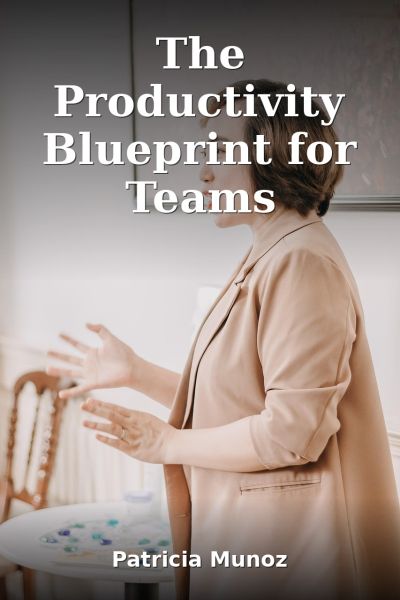
***The Productivity Blueprint for Teams*** is a modular, field-tested guide designed to help managers and team leads transition from "performative busyness" to measurable, outcome-oriented work. The book argues that most teams fail not due to a lack of talent, but because they lack a reliable operating system. It provides a comprehensive framework to replace accidental habits with intentional rituals, emphasizing that clarity of purpose and well-designed systems are more effective than individual discipline for increasing output and preventing burnout.
The core of the blueprint is built on three pillars: **clarity, flow, and sustainable rituals.** It begins by demanding that teams define success through specific, measurable outcomes (OKRs) rather than task lists. It then introduces flow-based systems, such as Kanban, to visualize work and enforce Work-in-Progress (WIP) limits, which reduce the cognitive "tax" of context switching. By implementing standardized intake forms and prioritization frameworks like RICE, teams can stop being reactive to ad-hoc requests and start pulling work based on actual capacity.
To address the common "meeting-heavy" culture, the book advocates for replacing status updates with asynchronous "signals" like shared dashboards and lighthouse updates. It provides a strict anatomy for effective meetings, distinguishing between "Alignment" meetings (sharing context) and "Decision" meetings (choosing a path). This systemic approach extends to documentation, which the author treats as a "product" that must be discoverable and maintained to reduce institutional knowledge silos and accelerate onboarding.
The book concludes with a pragmatic **90-day rollout plan** to implement these changes incrementally. Rather than a total overhaul, it suggests a phased approach: Month 1 focuses on decluttering the calendar; Month 2 on systematizing the flow of work; and Month 3 on optimizing and automating repetitive toil. Throughout, the text emphasizes psychological safety, blameless post-mortems, and a culture of experimentation, encouraging teams to treat their internal processes as a product that requires constant, data-driven iteration.
What You'll Find Inside:
- Clarify and measure outcomes: Focus on measurable results (OKRs, throughput, cycle time) instead of just activity, using metrics as a starting point for team conversations, not as a tool for surveillance.
- Design effective systems: Implement practical frameworks like Kanban and clear work-in-progress (WIP) limits to visualize flow, expose bottlenecks, and reduce the cognitive load of constant context switching.
- Master meetings and communication: Replace low-value status meetings with async signals and dashboards, and design every meeting with a clear purpose, agenda, and decision-making process to reclaim focus time.
- Cultivate psychological safety and sustainable pace: Build a culture where people can raise problems without fear (blameless post-mortems) and protect deep work with focus blocks and clear time policies to prevent burnout.
- Implement and iterate: Use a structured 90-day playbook to roll out changes incrementally, treating process improvements as small, measurable experiments (A/B tests for team practices) to ensure adoption and build a habit of continuous improvement.
Who's It For:
This book is essential for managers, team leads, founders, and operations professionals who are responsible for a team's output and well-being. It is specifically for those leading small to mid-sized teams in fast-paced environments (like tech or consulting) who feel their team is busy but not productive, struggling with meeting overload, burning out, or lacking clear systems for their work. It provides a practical, hands-on blueprint for leaders who want to multiply their team's output without increasing their workload or causing burnout.
Introduction
Most teams aren’t short on talent or tools—they’re short on a reliable way to turn effort into outcomes. Ask around and you’ll hear a familiar story: calendars packed with meetings, chats that never stop, and projects that slip a week at a time until the quarter is gone. People are working hard, sometimes to the point of burnout, yet measurable output doesn’t budge. Busy has become a proxy for productive. This book exists to change that—to replace accidental work patterns with a practical blueprint that scales.
The Productivity Blueprint for Teams is a field guide for managers, founders, and team leads who want measurable gains without burning people out. You’ll learn to define outcomes your team can own, instrument flow without micromanaging, and install lightweight systems that reduce noise and protect focus time. The approach balances strategy (goals, metrics, roles) with hands-on playbooks (meeting templates, intake forms, workflows, and weekly rhythms). It’s evidence-informed and battle-tested with hybrid and distributed teams, but simple enough to run next week.
Think of this as a modular system rather than a doctrine. You can read front-to-back or jump to the chapter that solves today’s pain: fix intake and prioritization (Chapter 6) if everything feels urgent, kill wasteful status meetings (Chapter 12) if your calendar is the bottleneck, or start with psychological safety and sustainable pace (Chapter 5) if morale is fragile.
Enjoying it? The full book includes every chapter.
Table of Contents:
- Introduction Free
- Chapter 1 Clarify Outcomes Free
- Chapter 2 Measure What Matters
- Chapter 3 Roles, Routines, and Rules
- Chapter 4 Communication Protocols
- Chapter 5 Psychological Safety and Sustainable Pace
- Chapter 6 From Requests to Done
- Chapter 7 Kanban and Flow for Knowledge Work
- Chapter 8 Sprints, Cadences, and Continuous Delivery
- Chapter 9 Reducing Context Switches
- Chapter 10 Quality as a First-Class Metric
- Chapter 11 The Anatomy of an Effective Meeting
- Chapter 12 Replacing Status with Signals
- Chapter 13 Decision Meetings vs. Alignment Meetings
- Chapter 14 One-on-Ones, Reviews, and Career Conversations
- Chapter 15 Calendar Hygiene and Time Policies
- Chapter 16 Choosing Tools for Scale
- Chapter 17 Automation and Lightweight Ops
- Chapter 18 Documentation that Actually Works
- Chapter 19 Onboarding and Knowledge Transfer
- Chapter 20 Remote and Hybrid Team Patterns
- Chapter 21 Leading by Metrics and Conversations
- Chapter 22 Experimentation and A/Bing Team Practices
- Chapter 23 Scaling Culture
- Chapter 24 Handling Crisis and Tight Deadlines
- Chapter 25 The 90-Day Productivity Playbook
Included when you buy the full book.
Author:
Published By:
Date Published:
January 8, 2026
Type:
Nonfiction
Language:
English
Word Count:
88,195 words
Reading Time:
6 hours 11 minutes
Sample:
Order:
Buy the The Productivity Blueprint for Teams ebook on MixCache.com:
Buy NowIncludes every chapter. Not sure yet? Read the opening free.
Full ebook will be available immediately
- read online or download as a PDF file.
$5 account credit for all new MixCache.com accounts, usable toward any ebook purchase!*
MixCache.com Total Access
Get unlimited access to this book + all books published by MixCache.com for $11.99/month
Subscribe to MTA





Ratings & Reviews
Ask Questions About This Book
Have a question about the content? Ask our AI assistant!
Start by asking a question about "The Productivity Blueprint for Teams"
Example: "Does this book mention William Shakespeare?"
Thinking...