

How Delhi Speaks: A Linguistic Biography of India's Capital
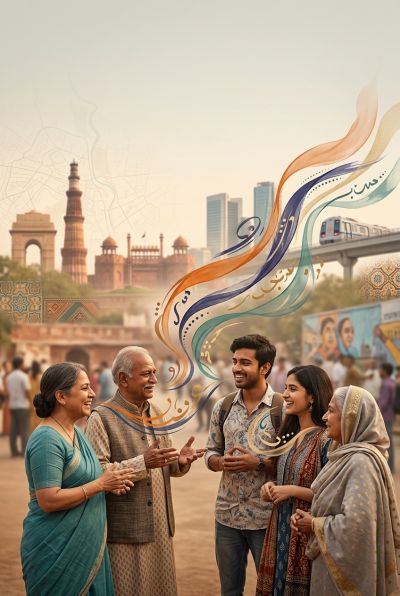
Delhi does not merely host languages; it metabolizes them. Mughal-era Urdu, colonial English, Partition-driven Punjabi, and waves of internal migration have not simply accumulated in the capital — they have fused into a vernacular that switches codes mid-sentence, borrows English verbs via the light verb karna, and conducts entire relationships through the microscopic calculus of tu, tum, aap, and ji. Teresa Flores's The Languages of Delhi treats this hybrid speech not as a deviation from purity but as a sophisticated, rule-governed system that millions navigate daily.
What the book is about
The book spans 25 chapters, moving chronologically from the linguistic substratum of the Doab region through the Mughal, colonial, and post-Partition periods, then pivoting to ethnographic chapters on markets, metros, homes, courts, universities, temples, and digital spaces. Flores combines sociolinguistic analysis — phonology, morphosyntax, discourse markers — with grounded fieldwork vignettes: a coffee-shop conversation about a presentation ("This presentation is giving me so much stress, yaar"), a Karol Bagh shopkeeper deploying Bebe ji to build rapport, a mother translating carry over as hasil for her child's math homework. The intended reader is dual: linguists get systematic treatment of retroflexion under contact, calquing patterns, and code-switching constraints; general readers get the social meanings — why a Punjabi interjection flips footing, how jugaad became a semiotic badge of urban ingenuity, and why Roman-script Hinglish on WhatsApp is neither lazy nor broken but a legitimate written vernacular.
History as living phonology
Flores shows that Delhi's soundscape is sedimentary. Chapter 2 traces how Khariboli — the "standing dialect" of the Doab — provided the grammatical skeleton that Persian first adorned (yielding Urdu), then English later lexicalized. Chapter 3 demonstrates that the 1947 Partition was not just demographic rupture but linguistic restructuring: the exodus of Urdu-speaking Muslims and the arrival of Punjabi-speaking refugees "fundamentally altered the city's linguistic character, a sudden jolt to its existing soundscape." Punjabi contributed retroflex vigor, tonal residues, and discourse markers like ji that became "even more ubiquitous" in Delhi than in Punjab itself. Chapter 5 adds Haryanvi's "bluntness" and "rustic charm" to the mix. The result is a phonology where aspiration softens in code-switched runs, retroflexion deepens under Punjabi influence, and speech tempo accelerates — a "Delhi accent" that outsiders perceive as blunt but insiders recognize as pragmatic efficiency.
Code-switching as social strategy, not deficit
Chapter 12's fieldwork vignettes make the book's central argument concrete: code-switching in Delhi is "not a random jumble of words" but "a highly strategic, nuanced, and often unconscious practice." A college student uses English stress and start inside Hindi grammar because those concepts carry campus currency; a shopkeeper switches to Bebe ji (Punjabi honorific) to soften a price refusal; a government clerk deploys application form, details fill, residential address for bureaucratic precision while maintaining uncle ji for deference. Chapter 14 formalizes this: English nouns become Hindi verbs via karna (decide karna, plan karna, cancel karna), English discourse markers (basically, seriously, you know) slot into Hindi interactional slots, and calques like time par aana (from "come on time") create new idiomatic pathways. The system is productive, not parasitic.
The address system as moral grammar
Chapter 9 elevates tu, tum, aap, and ji from pronouns to "a finely calibrated act, laden with social meaning, reflecting and reproducing hierarchies of class, caste, age, gender, and intimacy." Tu signals deep intimacy or deliberate contempt; tum marks friendly familiarity or benign asymmetry; aap is the default for strangers, elders, and formal settings. The particle ji — appended to names, pronouns, even verbs — "softens an imperative, elevates a title, or transforms a simple name into a respectful address." A domestic worker says Ma'am ji; the employer replies with bare tum. In professional email, colleagues use Ramesh ji to lubricate hierarchy. The system shifts mid-conversation: strangers discovering a shared friend may slide from aap to tum to signal "growing camaraderie." Children in English-dominant homes struggle because English's single "you" erases the entire social algorithm — parents must "consciously teach and reinforce these distinctions."
Youth slang and the digital vernacular
Chapters 11 and 17 track how Delhi's youth turn linguistic hybridity into cultural capital. Jugaad — once a Punjabi noun for improvised vehicle — became a verb (jugaad lagana) and a semiotics of cool: "a clever hack, an innovative workaround... it signals a street-smart intelligence, an ability to navigate complex systems, and a rejection of rigid, formal approaches." Slang cycles at algorithmic speed: fattu, scene, full too, ghanta (dismissive "no way!"). On WhatsApp and Instagram, Roman-script Hinglish dominates: "Hey yaar, aj party ka kya scene hai? Confirm kar de please." This is not orthographic laziness; Romanization "blurs the visual distinction between Hindi and Urdu," reinforcing their shared Hindustani base while signaling "fluency in both local languages and English." Memes become "collective linguistic archive," capturing and disseminating "the ever-evolving slang, idioms, and speech patterns that define contemporary Delhi." Predictive text now learns Romanized Hinglish, "effectively validating and institutionalizing this digital vernacular."
Media as mirror and maker
Chapters 15 and 16 demonstrate a feedback loop: Bollywood, FM radio, and TV news both reflect Delhi speech and legitimize it. Films set in Delhi began "consciously adopt[ing] speech mannerisms, vocabulary, and even the characteristic intonation associated with the capital" — not just for authenticity but because "audiences, especially young Delhiites, often identify with these portrayals, finding their own linguistic habits reflected and validated on a grand scale." FM radio jockeys became "linguistic trendsetters" whose "rapid-fire delivery, an abundance of Hinglish, and the liberal use of youth slang" normalized code-switching as "a deliberate stylistic choice, a marker of cool and relatability." Advertising cemented the register: "baatein karo unlimited," "khaana delivered hai, enjoy karo." Even newsrooms, officially committed to standardized Hindi, leak Delhi inflections — anchors' "slightly different realization of certain sounds, or a faster, more emphatic rhythm" — because "linguistic purity often takes a backseat to immediacy and relatability."
Who should read this
Sociolinguists and linguistic anthropologists will find a rich, data-dense case study of urban contact-induced change, with explicit analytical frameworks for phonology, morphosyntax, and pragmatics. Urbanists, historians, and cultural scholars of South Asia get a thick description of how language materializes in markets, metros, courts, temples, and group chats. General readers curious about Indian multilingualism will appreciate the accessible vignettes and the absence of jargon-for-jargon's-sake. Readers seeking a prescriptive grammar, a phrasebook, or a nationalist narrative of linguistic purity should look elsewhere — Flores's Delhi is hybrid, fluid, and unapologetically so. The book rewards patience: its 25 chapters build a cumulative portrait rather than offering quick takeaways, but the payoff is a toolkit for hearing any multilingual city more precisely.
Read “The Languages of Delhi” on MixCache.com →
Please log in or create an account to leave a comment.
No comments yet. Be the first to say something.