
Browse by Category
Fiction
- Action & Adventure
- African American
- Anthologies
- Children's Fiction
- Classics
- Comics & Graphic Novels
- Coming of Age
- Contemporary
- Cultural & Regional
- Drama
- Erotica
- Fantasy
- General
- Historical Fiction
- Horror
- Humor & Satire
- Literary Fiction
- Mystery, Thriller & Suspense
- Poetry
- Religious & Inspirational
- Romance
- Science Fiction
- Short Stories
- War & Military
- Westerns
- Women's Fiction
- Young Adult
Non-Fiction
- Antiques & Collectibles
- Arts & Photography
- Biographies & Memoirs
- Business & Money
- Children's Non-Fiction
-
Computers & Technology
- Artificial Intelligence
- Computer Science
- Cybersecurity & Cryptography
- Data Science & Analytics
- Databases & Big Data
- Game Development & Design
- General
- Hardware & DIY
- Mobile App Development
- Networking & Cloud Computing
- Operating Systems
- Programming
- Robotics
- Software
- Software Engineering
- User Experience (UX) & Design
- Web Development & Design
- Cooking, Food & Wine
- Crafts, Hobbies & Home
- Education & Teaching
- Engineering
- General
- Health, Fitness & Dieting
-
History
- African History
- African History - North Africa
- African History - Sub-Saharan Africa
- American History
- American History - 20th Century
- American History - Civil War
- American History - Colonial Period
- Ancient History
- Asian History
- Asian History - China
- Asian History - India
- Asian History - Japan
- Asian History - Southeast Asia
- European History
- European History - Ancient Greece
- European History - Ancient Rome
- European History - Medieval
- European History - Modern
- European History - Renaissance
- General
- Middle Eastern History
- Military History
- Military History - Aviation
- Military History - Naval
- Social & Cultural History
- World History
- Humor & Entertainment
- Industrial Technology
- Language Learning
- Law
- LGBTQ+ Non-Fiction
- Literary Criticism
- Medical Books
- Parenting & Relationships
- Philosophy
- Politics & Social Sciences
- Reference
- Religion & Spirituality
-
Science & Math
- Agricultural Sciences
- Astronomy & Space Science
- Behavioral Sciences
- Biological Sciences
- Botany & Plant Science
- Chemistry
- Earth Sciences
- Engineering - Chemical
- Engineering - Civil
- Engineering - Electrical
- Engineering - Mechanical
- Environment
- General
- Geology
- Mathematics
- Nature & Ecology
- Oceanography
- Paleontology
- Physics
- Statistics
- Self-Help
- Sports & Outdoors
- Study Aids
- Sustainability & Green Living
- Textbooks
- Transportation
- Travel
- True Crime
- Urban Planning & Development
- Veterinary Medicine
- Writing & Publishing
Jump to Section
MixCache.com Total Access
Unlimited reading and audiobooks for every book published by MixCache.com.
Included titles carry the MTA badge.
Learn more →
The Languages of Delhi
MTA
Linguistic diversity, dialect contact, and the rise of Modern Delhi Hindi
About this book:
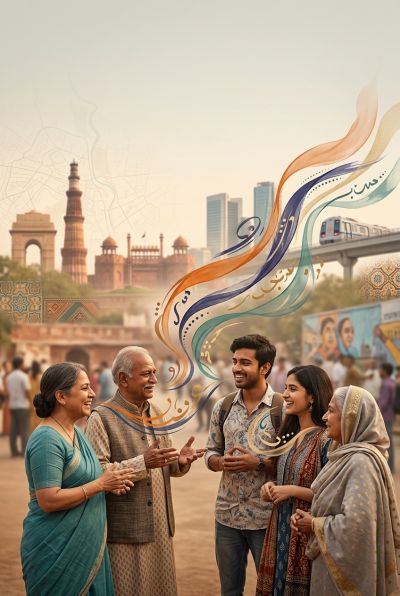
Delhi's linguistic landscape is a product of centuries of contact and migration, shaped by Mughal-era Urdu prestige, British colonial English, the post-Partition Punjabi influx, and ongoing waves of internal migration from across India. These historical layers have created a dynamic ecology where Hindi, Urdu, Punjabi, English, and numerous regional languages coexist and mutually influence one another, particularly in the city's street talk, markets, and domestic spaces. Rather than a monolithic language, Delhi's speech exists on a continuum, with Modern Delhi Hindi emerging as a flexible urban register that draws its grammatical foundation from Khariboli while incorporating lexical, phonological, and pragmatic elements from Punjabi (e.g., intonation, jugaad), Urdu (poetic vocabulary, Nastaliq script), and English (technological loanwords, code-switching).
Modern Delhi Hindi is characterized by its remarkable fluidity in code-switching, blending Hindi, English, and Punjabi within single conversations to navigate social contexts, express identity, and convey nuanced meanings. Phonologically, it exhibits Punjabi-influenced retroflexion and rapid tempo; morphosyntactically, it integrates English verbs via the light verb karna (e.g., decide karna) and adopts English discourse markers like basically and seriously. Lexically, it is a generous borrower, especially from English for modern concepts and from Punjabi for everyday expressions and exclamations. The address system (tu, tum, aap, ji) and honorifics remain crucial markers of respect, intimacy, and social hierarchy, varying by age, gender, caste, and class. Youth culture drives innovation through slang, Hinglish, and Roman script digital communication, while media platforms like Bollywood and FM radio amplify and normalize these hybrid forms.
Language use in Delhi is deeply contextual, varying across public spaces (markets, Metro, signage), private domains (home, kinship interactions), and institutional settings (schools, courts, bureaucracy). In public spheres, strategic code-switching facilitates commerce and social navigation, while media representations both reflect and shape linguistic trends. Within homes and neighborhoods, language preserves regional and communal identities through intergenerational transmission, even as educational institutions promote standardized Hindi and English. Social dimensions such as gender, class, and caste influence speech patterns, from the use of address forms to the performance of respectability and coolness. Digital spaces have further accelerated hybridity through Romanized Hindi/Hinglish, memes, and messaging apps, creating new avenues for linguistic experimentation and identity formation.
Looking ahead, Delhi's linguistic future will be negotiated between policy efforts to promote official languages (Hindi, Punjabi, Urdu) and the pragmatic realities of technological globalization, demographic diversification, and youth-driven innovation. While English maintains its prestige as a language of aspiration and upward mobility, and institutional domains retain bilingual requirements, the vernacular vitality of Delhi Hindi lies in its adaptability—its capacity to absorb new influences from migrants, digital culture, and global media while retaining a core intelligibility. The city's linguistic trajectory will continue to be defined by the creative, everyday practices of its speakers, who navigate multilingualism not as a barrier but as a resource for expressing belonging, aspiration, and urban identity in a constantly evolving metropolis.
What You'll Find Inside:
- Modern Delhi Hindi emerges as a flexible urban register shaped by centuries of language contact between Hindi, Urdu, Punjabi, English, and regional dialects like Haryanvi and Khariboli
- Code-switching functions as a strategic communicative tool for signaling identity, building rapport, expressing modernity, and navigating social hierarchies in Delhi's multilingual ecology
- Post-Partition Punjabi migration and ongoing demographic inflows from Bhojpuri, Bengali, Tamil, and other regions fundamentally transformed Delhi's phonology, lexicon, and interactional patterns
- Media, technology, and digital spaces amplify linguistic innovation through Bollywood, FM radio, Hinglish, Roman script memes, and youth slang like jugaad, creating feedback loops between everyday speech and popular culture
- Address forms (tu/tum/aap/ji), gendered speech norms, and class/caste dynamics reveal how language performs social identity, power relations, and respectability in Delhi's complex social landscape
Who's It For:
This book is ideal for linguists, anthropologists, and sociolinguists interested in language contact, urban speech varieties, and South Asian linguistics. It will also appeal to cultural studies scholars and general readers fascinated by Delhi's multicultural dynamics, offering systematic analysis of phonological and grammatical features alongside ethnographic insights into how language performs identity, gender, and social hierarchies in everyday life.
Table of Contents:
- Introduction
- Chapter 1 City of Tongues: A Portrait of Delhi’s Linguistic Ecology
- Chapter 2 From Shahjahanabad to the Megacity: Historical Layers of Speech
- Chapter 3 Partition, Migration, and the Punjabi Imprint
- Chapter 4 Urdu in Old and New Delhi: Scripts, Schools, and Street Signs
- Chapter 5 Haryanvi, Khariboli, and the Roots of Modern Delhi Hindi
- Chapter 6 English in the Capital: Prestige, Policy, and Everyday Mix
- Chapter 7 Markets and Metro: Language in Public Space
- Chapter 8 Home, Neighborhood, and Kinship Talk
- Chapter 9 Class, Caste, and the Politics of Address: tu, tum, aap, and ji
- Chapter 10 Gendered Voices and Performances of Respectability
- Chapter 11 Youth Slang, Jugaad, and the Semiotics of Cool
- Chapter 12 Code-Switching in Action: Fieldwork Vignettes
- Chapter 13 Phonology on the Move: Sound Change under Contact
- Chapter 14 Morphosyntax at the Junction: Borrowing and Calquing
- Chapter 15 Media, Bollywood, and the Rise of the Delhi Register
- Chapter 16 Radio, TV, and Newsrooms: Standardizing and Stylizing Speech
- Chapter 17 Digital Delhi: Memes, Messaging, and Roman Script
- Chapter 18 Schools, Universities, and Language Socialization
- Chapter 19 Bureaucracy, Courts, and the Language of the State
- Chapter 20 Religion, Ritual, and Sacred Registers
- Chapter 21 Newcomers to the Capital: Bhojpuri, Bengali, Tamil, and Beyond
- Chapter 22 Place, Identity, and Lingua Franca Practices
- Chapter 23 Mapping Multilingual Signage and Soundscapes
- Chapter 24 Modeling Modern Delhi Hindi: A Proposed Profile
- Chapter 25 Futures of the Capital’s Languages: Policy, Technology, and Change
Author:
Published By:
Date Published:
June 6, 2026
Type:
Nonfiction
Language:
English
Word Count:
47,132 words
Reading Time:
3 hours 18 minutes
Sample:
MixCache.com Total Access
Get unlimited access to this book + all books published by MixCache.com for $11.99/month
Subscribe to MTAOr purchase this book individually below
Order:
Buy the The Languages of Delhi ebook on MixCache.com:
Buy Now
Full ebook will be available immediately
- read online or download as a PDF file.
$5 account credit for all new MixCache.com accounts, usable toward any ebook purchase!*




Ratings & Reviews
Ask Questions About This Book
Have a question about the content? Ask our AI assistant!
Start by asking a question about "The Languages of Delhi"
Example: "Does this book mention William Shakespeare?"
Thinking...