
Browse by Category
Fiction
- Action & Adventure
- African American
- Anthologies
- Children's Fiction
- Classics
- Comics & Graphic Novels
- Coming of Age
- Contemporary
- Cultural & Regional
- Drama
- Erotica
- Fantasy
- General
- Historical Fiction
- Horror
- Humor & Satire
- Literary Fiction
- Mystery, Thriller & Suspense
- Poetry
- Religious & Inspirational
- Romance
- Science Fiction
- Short Stories
- War & Military
- Westerns
- Women's Fiction
- Young Adult
Non-Fiction
- Antiques & Collectibles
- Arts & Photography
- Biographies & Memoirs
- Business & Money
- Children's Non-Fiction
-
Computers & Technology
- Artificial Intelligence
- Computer Science
- Cybersecurity & Cryptography
- Data Science & Analytics
- Databases & Big Data
- Game Development & Design
- General
- Hardware & DIY
- Mobile App Development
- Networking & Cloud Computing
- Operating Systems
- Programming
- Robotics
- Software
- Software Engineering
- User Experience (UX) & Design
- Web Development & Design
- Cooking, Food & Wine
- Crafts, Hobbies & Home
- Education & Teaching
- Engineering
- General
- Health, Fitness & Dieting
-
History
- African History
- African History - North Africa
- African History - Sub-Saharan Africa
- American History
- American History - 20th Century
- American History - Civil War
- American History - Colonial Period
- Ancient History
- Asian History
- Asian History - China
- Asian History - India
- Asian History - Japan
- Asian History - Southeast Asia
- European History
- European History - Ancient Greece
- European History - Ancient Rome
- European History - Medieval
- European History - Modern
- European History - Renaissance
- General
- Middle Eastern History
- Military History
- Military History - Aviation
- Military History - Naval
- Social & Cultural History
- World History
- Humor & Entertainment
- Industrial Technology
- Language Learning
- Law
- LGBTQ+ Non-Fiction
- Literary Criticism
- Medical Books
- Parenting & Relationships
- Philosophy
- Politics & Social Sciences
- Reference
- Religion & Spirituality
-
Science & Math
- Agricultural Sciences
- Astronomy & Space Science
- Behavioral Sciences
- Biological Sciences
- Botany & Plant Science
- Chemistry
- Earth Sciences
- Engineering - Chemical
- Engineering - Civil
- Engineering - Electrical
- Engineering - Mechanical
- Environment
- General
- Geology
- Mathematics
- Nature & Ecology
- Oceanography
- Paleontology
- Physics
- Statistics
- Self-Help
- Sports & Outdoors
- Study Aids
- Sustainability & Green Living
- Textbooks
- Transportation
- Travel
- True Crime
- Urban Planning & Development
- Veterinary Medicine
- Writing & Publishing
Jump to Section
MixCache.com Total Access
Unlimited reading and audiobooks for every book published by MixCache.com.
Included titles carry the MTA badge.
Learn more →
A History of Seagate Technology
MTA
The Story of an S&P 500 Company
About this book:
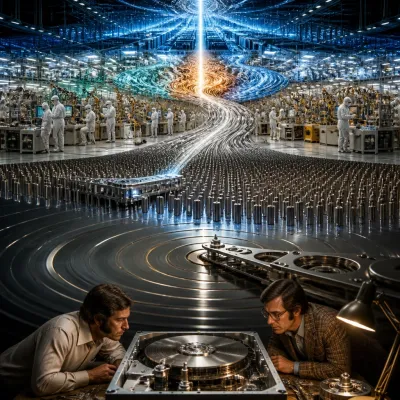
Seagate Technology's journey began in 1979 when Finis Conner and disk drive pioneer Alan Shugart founded the company to create the first 5.25-inch hard drive for microcomputers. The ST-506 and its successor, the ST-412, became industry standards after securing a pivotal contract with IBM for the PC XT, fueling explosive growth that saw revenues soar to $110 million by 1983. Throughout the 1980s and 1990s, Seagate navigated fierce competition and cyclical downturns through relentless engineering innovation—pioneering perpendicular magnetic recording (PMR), giant magnetoresistive (GMR) heads, and higher RPM drives—while expanding a global manufacturing footprint centered in Southeast Asia. Strategic acquisitions, most notably the Imprimis division in 1989, Maxtor in 2006, and Samsung's HDD business in 2011, consolidated market share and brought critical enterprise technology and scale, cementing Seagate's position as a dominant market leader.
The turn of the millennium brought volatility and transformation. Seagate weathered the dot-com bust by going private in 2000 to restructure, returning to the public markets in 2002 and eventually joining the S&P 500 in 2012. As the mobile revolution and cloud computing reshaped demand, Seagate pivoted from a PC-component supplier to a foundational provider of hyperscale data center infrastructure. The company broke the terabyte barrier in 2007 and diversified into solid-state drives (SSDs), hybrid drives, and enterprise storage systems, balancing high-capacity HDDs for cold storage with high-performance flash for hot data. This era also saw a heightened focus on data security through self-encrypting drives, environmental stewardship via power-efficient designs, and a strategic push into software and data management solutions.
In the age of Big Data and artificial intelligence, Seagate's role deepened as its drives became the essential repositories for the massive datasets training AI models and powering analytics. The company invested heavily in next-generation technologies like Heat-Assisted Magnetic Recording (HAMR) and Two-Dimensional Magnetic Recording (TDMR) to push hard drive capacities toward 50TB and beyond, while simultaneously advancing computational storage architectures that process data directly on the device. Looking forward, Seagate envisions a heterogeneous storage landscape spanning from the intelligent edge to the hyperscale core, driven by a commitment to sustainability, cybersecurity, and continuous R&D. Ultimately, Seagate's legacy is defined not merely by the billions of drives shipped, but by its role as the primary enabler of the digital age, providing the physical memory upon which modern computing, commerce, and connectivity are built.
What You'll Find Inside:
- Seagate's pivotal role in launching the personal computer revolution through its pioneering 5.25-inch hard drives (ST-506 and ST-412) and strategic partnership with IBM for the PC XT, which established the hard drive as a standard PC component.
- The company's mastery of strategic acquisitions—including Imprimis, Maxtor, and Samsung's HDD business—that consolidated market share, expanded technological capabilities, and enabled Seagate to dominate the storage industry for decades.
- Seagate's continuous technological evolution from longitudinal to perpendicular magnetic recording (PMR), then to shingled (SMR) and heat-assisted magnetic recording (HAMR), pushing areal density boundaries to deliver the industry's first terabyte drive and beyond.
- Successful navigation of major industry disruptions including the dot-com bust (via a strategic privatization), the rise of solid-state drives, and the shift to cloud computing, demonstrating exceptional corporate resilience and adaptability.
- The company's transformation from a component supplier into a comprehensive data infrastructure provider, now powering hyperscale cloud data centers, enabling AI/Big Data analytics, and pioneering computational storage and edge computing solutions.
Who's It For:
This book is ideal for technology professionals, business strategists, and investors interested in the evolution of the data storage industry and corporate resilience. It will particularly benefit readers seeking insights into how hardware companies navigate technological disruption, manage global supply chains, and execute strategic acquisitions. Students of technology history and innovation management will also find valuable lessons in Seagate's multi-decade journey from startup to S&P 500 leader.
Table of Contents:
- Introduction
- Chapter 1 The Dawn of Digital Storage: Seagate's Genesis
- Chapter 2 Innovation at Its Core: Early Product Development and Milestones
- Chapter 3 The Personal Computer Revolution: Fuelling the Demand for Hard Drives
- Chapter 4 Growth and Expansion: Navigating the Competitive Landscape of the 1980s
- Chapter 5 Seagate's Public Debut: Becoming an S&P 500 Company
- Chapter 6 The Rise of New Technologies: Adapting to Changing Data Storage Needs
- Chapter 7 Global Ambitions: International Markets and Manufacturing
- Chapter 8 Challenges and Triumphs: Overcoming Industry Downturns and Mergers
- Chapter 9 The Terabyte Era: Pushing the Boundaries of Capacity
- Chapter 10 From PCs to Enterprises: Diversifying Seagate's Product Portfolio
- Chapter 11 The Dot-Com Boom and Bust: Seagate's Resilience in a Volatile Market
- Chapter 12 Strategic Acquisitions: Expanding Capabilities and Market Share
- Chapter 13 Solid-State Drives Emerge: A New Frontier in Storage Technology
- Chapter 14 Cloud Computing's Impact: Seagate's Role in Data Centers
- Chapter 15 Data Security and Reliability: Ensuring the Integrity of Information
- Chapter 16 Environmental Stewardship: Sustainable Practices in Manufacturing
- Chapter 17 The Mobile Revolution: Storage for a Connected World
- Chapter 18 Beyond the Drive: Software and Solutions for Data Management
- Chapter 19 Seagate Research and Development: Shaping the Future of Storage
- Chapter 20 Leadership and Culture: The People Behind the Technology
- Chapter 21 Market Dominance: Maintaining a Leading Position in a Dynamic Industry
- Chapter 22 The Age of Big Data: Seagate's Contribution to Analytics and AI
- Chapter 23 The Future of Storage: Emerging Technologies and Trends
- Chapter 24 Seagate's Enduring Legacy: Impact on Technology and Society
- Chapter 25 A Vision for Tomorrow: Continued Innovation and Growth
Author:
Published By:
Date Published:
August 19, 2026
Type:
Nonfiction
Language:
English
Word Count:
36,275 words
Reading Time:
2 hours 32 minutes
Sample:
Order:
Order A History of Seagate Technology (Paperback) on MixCache.com:
Buy NowPrint copy is made to order and ships worldwide. Includes the ebook free, ready to read instantly.
$5 account credit for all new MixCache.com accounts, usable toward any ebook purchase!*


