Browse by Category
Fiction
- Action & Adventure
- African American
- Anthologies
- Children's Fiction
- Classics
- Comics & Graphic Novels
- Coming of Age
- Contemporary
- Cultural & Regional
- Drama
- Erotica
- Fantasy
- General
- Historical Fiction
- Horror
- Humor & Satire
- Literary Fiction
- Mystery, Thriller & Suspense
- Poetry
- Religious & Inspirational
- Romance
- Science Fiction
- Short Stories
- War & Military
- Westerns
- Women's Fiction
- Young Adult
Non-Fiction
- Antiques & Collectibles
- Arts & Photography
- Biographies & Memoirs
- Business & Money
- Children's Non-Fiction
-
Computers & Technology
- Artificial Intelligence
- Computer Science
- Cybersecurity & Cryptography
- Data Science & Analytics
- Databases & Big Data
- Game Development & Design
- General
- Hardware & DIY
- Mobile App Development
- Networking & Cloud Computing
- Operating Systems
- Programming
- Robotics
- Software
- Software Engineering
- User Experience (UX) & Design
- Web Development & Design
- Cooking, Food & Wine
- Crafts, Hobbies & Home
- Education & Teaching
- Engineering
- General
- Health, Fitness & Dieting
-
History
- African History
- African History - North Africa
- African History - Sub-Saharan Africa
- American History
- American History - 20th Century
- American History - Civil War
- American History - Colonial Period
- Ancient History
- Asian History
- Asian History - China
- Asian History - India
- Asian History - Japan
- Asian History - Southeast Asia
- European History
- European History - Ancient Greece
- European History - Ancient Rome
- European History - Medieval
- European History - Modern
- European History - Renaissance
- General
- Middle Eastern History
- Military History
- Military History - Aviation
- Military History - Naval
- Social & Cultural History
- World History
- Humor & Entertainment
- Industrial Technology
- Language Learning
- Law
- LGBTQ+ Non-Fiction
- Literary Criticism
- Medical Books
- Parenting & Relationships
- Philosophy
- Politics & Social Sciences
- Reference
- Religion & Spirituality
-
Science & Math
- Agricultural Sciences
- Astronomy & Space Science
- Behavioral Sciences
- Biological Sciences
- Botany & Plant Science
- Chemistry
- Earth Sciences
- Engineering - Chemical
- Engineering - Civil
- Engineering - Electrical
- Engineering - Mechanical
- Environment
- General
- Geology
- Mathematics
- Nature & Ecology
- Oceanography
- Paleontology
- Physics
- Statistics
- Self-Help
- Sports & Outdoors
- Study Aids
- Sustainability & Green Living
- Textbooks
- Transportation
- Travel
- True Crime
- Urban Planning & Development
- Veterinary Medicine
- Writing & Publishing
Jump to Section

Want unlimited access to all books published by MixCache.com (plus their audiobooks)? Try MixCache.com Total Access. Look for the MTA badge on book covers to identify included titles.
Access to infinite ebooks: Don't see the book you want? Suggest it and we'll create it (free!) for you from scratch with our powerful AI book writer. Then read it with MTA - besides profiting from any sales it makes!
Education In Guatemala
MTA
A Comprehensive Overview from Early Childhood to Higher Education
About this book:
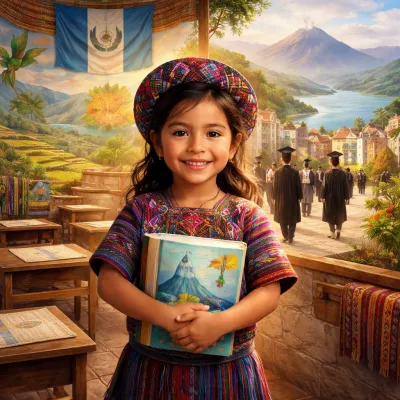
This book provides a comprehensive analysis of Guatemala's educational system, from early childhood to higher education, revealing a landscape shaped by a complex history and persistent challenges. The historical context is crucial, as the legacy of colonialism, a devastating 36-year civil war, and the 1996 Peace Accords continue to influence the system's structure and goals, particularly the push for bilingual intercultural education to serve the nation's large indigenous population. The system is marked by a significant urban-rural divide, where geography, socioeconomic status, and language create profound disparities in access, quality, and retention, especially beyond the primary level.
The book details the structural and thematic issues across all educational levels. Early childhood education is recognized for its importance but suffers from limited access and inconsistent quality. While primary enrollment has improved, the quality remains low due to inadequate teacher training, a severe lack of resources like textbooks, and the challenges of multigrade, often one-room, rural schools. Secondary education faces a major "leakage" in the educational pipeline, with high dropout rates driven by economic pressures, geographical barriers, and safety concerns. Higher education is characterized by a historic public university, the Universidad de San Carlos de Guatemala, and a growing but expensive private sector, making access and affordability significant hurdles for disadvantaged students.
Cross-cutting themes are central to the analysis. The book explores the persistent gender disparities that widen at the secondary level, the profound lack of inclusive education for students with special needs, and the slow, uneven integration of technology. It also examines the critical role of bilingual intercultural education in preserving indigenous languages and improving learning outcomes, as well as the impact of non-formal education and adult literacy programs. The analysis of educational policy, governance, and financing reveals a system struggling with insufficient funding, inefficient resource distribution, and a gap between progressive policies and their practical implementation.
The book concludes by highlighting that despite these formidable challenges, there are numerous success stories and promising initiatives. Case studies of organizations providing sustainable textbook access, culturally responsive early childhood programs, and youth leadership development demonstrate that positive change is possible. The future direction of Guatemalan education, the book argues, depends on a sustained commitment to increasing investment, deepening equity and inclusion, professionalizing teachers, and leveraging technology, all while fostering collaboration to ensure that every learner can reach their full potential.
What You'll Find Inside:
- Comprehensive historical context showing how colonial legacies, civil war, and post-conflict reforms have shaped Guatemala's educational system and ongoing challenges.
- In-depth analysis of access and equity issues, particularly the stark disparities between urban/rural areas, indigenous/non-indigenous populations, and persistent gender gaps in education.
- Detailed examination of bilingual intercultural education (BIE) initiatives and the critical need for culturally relevant instruction in indigenous languages alongside Spanish.
- Exploration of the vital role of international aid organizations, NGOs, and community partnerships in addressing resource gaps and implementing innovative educational programs.
- Discussion of ongoing educational reforms, teacher professionalization efforts, and strategic future directions aimed at improving quality, reducing inequalities, and preparing students for the 21st century.
Who's It For:
This book is essential for policymakers, educators, researchers, and students interested in Guatemala's complex educational landscape. It provides invaluable insights for international development professionals, NGOs, and anyone seeking to understand how historical, cultural, and socioeconomic factors intersect to shape educational opportunities and outcomes in one of Latin America's most diverse nations.
Author:
Published By:
Date Published:
June 26, 2026
Type:
Nonfiction
Language:
English
Word Count:
55,187 words
Reading Time:
3 hours 52 minutes
Sample:
Order:
Order Education In Guatemala (Hardcover) on MixCache.com:
Buy NowPrint copy is made to order and ships worldwide. Includes the ebook free, ready to read instantly.
$5 account credit for all new MixCache.com accounts, usable toward any ebook purchase!*