Browse by Category
Fiction
- Action & Adventure
- African American
- Anthologies
- Children's Fiction
- Classics
- Comics & Graphic Novels
- Coming of Age
- Contemporary
- Cultural & Regional
- Drama
- Erotica
- Fantasy
- General
- Historical Fiction
- Horror
- Humor & Satire
- Literary Fiction
- Mystery, Thriller & Suspense
- Poetry
- Religious & Inspirational
- Romance
- Science Fiction
- Short Stories
- War & Military
- Westerns
- Women's Fiction
- Young Adult
Non-Fiction
- Antiques & Collectibles
- Arts & Photography
- Biographies & Memoirs
- Business & Money
- Children's Non-Fiction
-
Computers & Technology
- Artificial Intelligence
- Computer Science
- Cybersecurity & Cryptography
- Data Science & Analytics
- Databases & Big Data
- Game Development & Design
- General
- Hardware & DIY
- Mobile App Development
- Networking & Cloud Computing
- Operating Systems
- Programming
- Robotics
- Software
- Software Engineering
- User Experience (UX) & Design
- Web Development & Design
- Cooking, Food & Wine
- Crafts, Hobbies & Home
- Education & Teaching
- Engineering
- General
- Health, Fitness & Dieting
-
History
- African History
- African History - North Africa
- African History - Sub-Saharan Africa
- American History
- American History - 20th Century
- American History - Civil War
- American History - Colonial Period
- Ancient History
- Asian History
- Asian History - China
- Asian History - India
- Asian History - Japan
- Asian History - Southeast Asia
- European History
- European History - Ancient Greece
- European History - Ancient Rome
- European History - Medieval
- European History - Modern
- European History - Renaissance
- General
- Middle Eastern History
- Military History
- Military History - Aviation
- Military History - Naval
- Social & Cultural History
- World History
- Humor & Entertainment
- Industrial Technology
- Language Learning
- Law
- LGBTQ+ Non-Fiction
- Literary Criticism
- Medical Books
- Parenting & Relationships
- Philosophy
- Politics & Social Sciences
- Reference
- Religion & Spirituality
-
Science & Math
- Agricultural Sciences
- Astronomy & Space Science
- Behavioral Sciences
- Biological Sciences
- Botany & Plant Science
- Chemistry
- Earth Sciences
- Engineering - Chemical
- Engineering - Civil
- Engineering - Electrical
- Engineering - Mechanical
- Environment
- General
- Geology
- Mathematics
- Nature & Ecology
- Oceanography
- Paleontology
- Physics
- Statistics
- Self-Help
- Sports & Outdoors
- Study Aids
- Sustainability & Green Living
- Textbooks
- Transportation
- Travel
- True Crime
- Urban Planning & Development
- Veterinary Medicine
- Writing & Publishing
Jump to Section

Want unlimited access to all books published by MixCache.com (plus their audiobooks)? Try MixCache.com Total Access. Look for the MTA badge on book covers to identify included titles.
Access to infinite ebooks: Don't see the book you want? Suggest it and we'll create it (free!) for you from scratch with our powerful AI book writer. Then read it with MTA - besides profiting from any sales it makes!
Cyprus
A History
About this book:


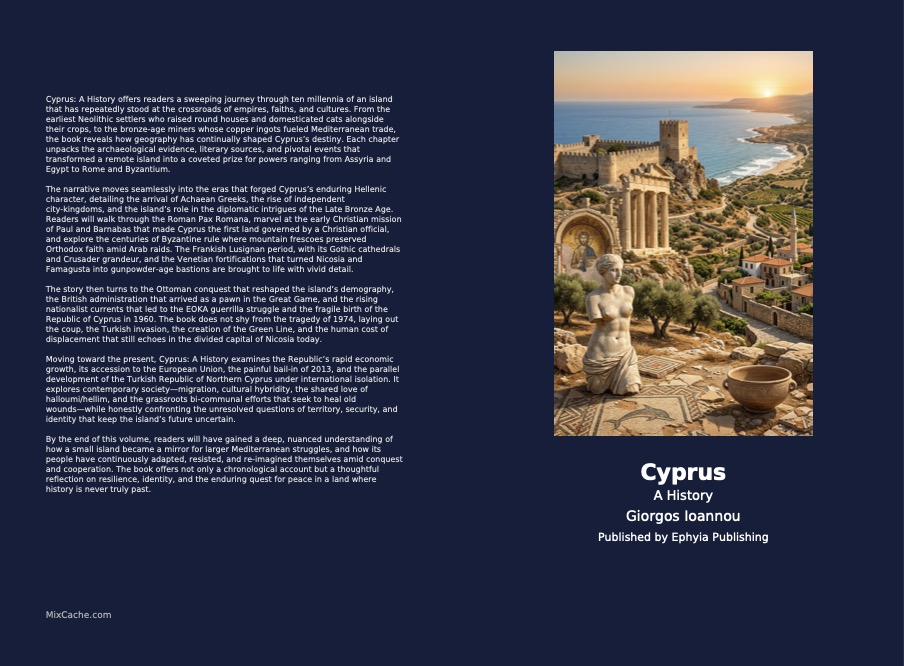
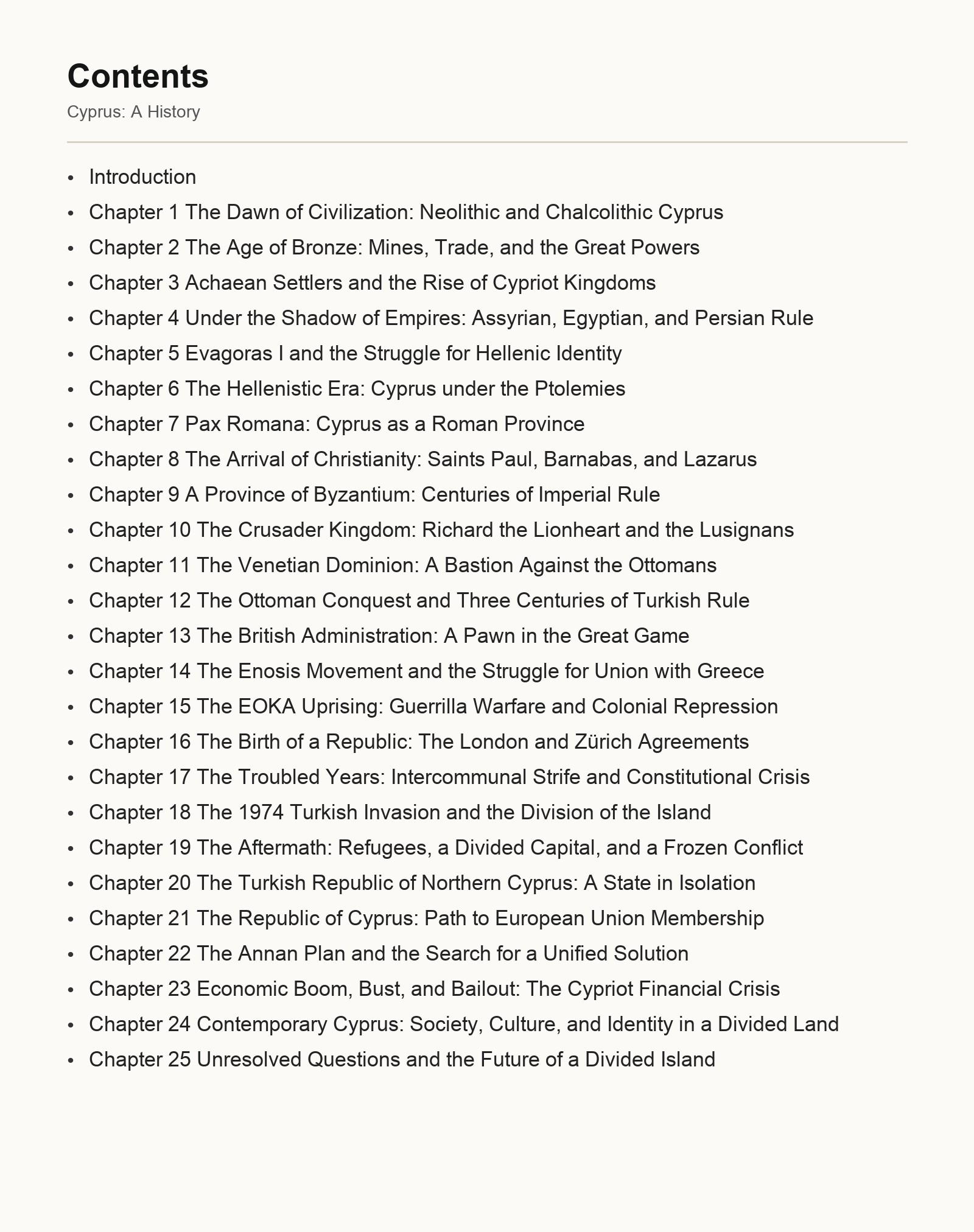
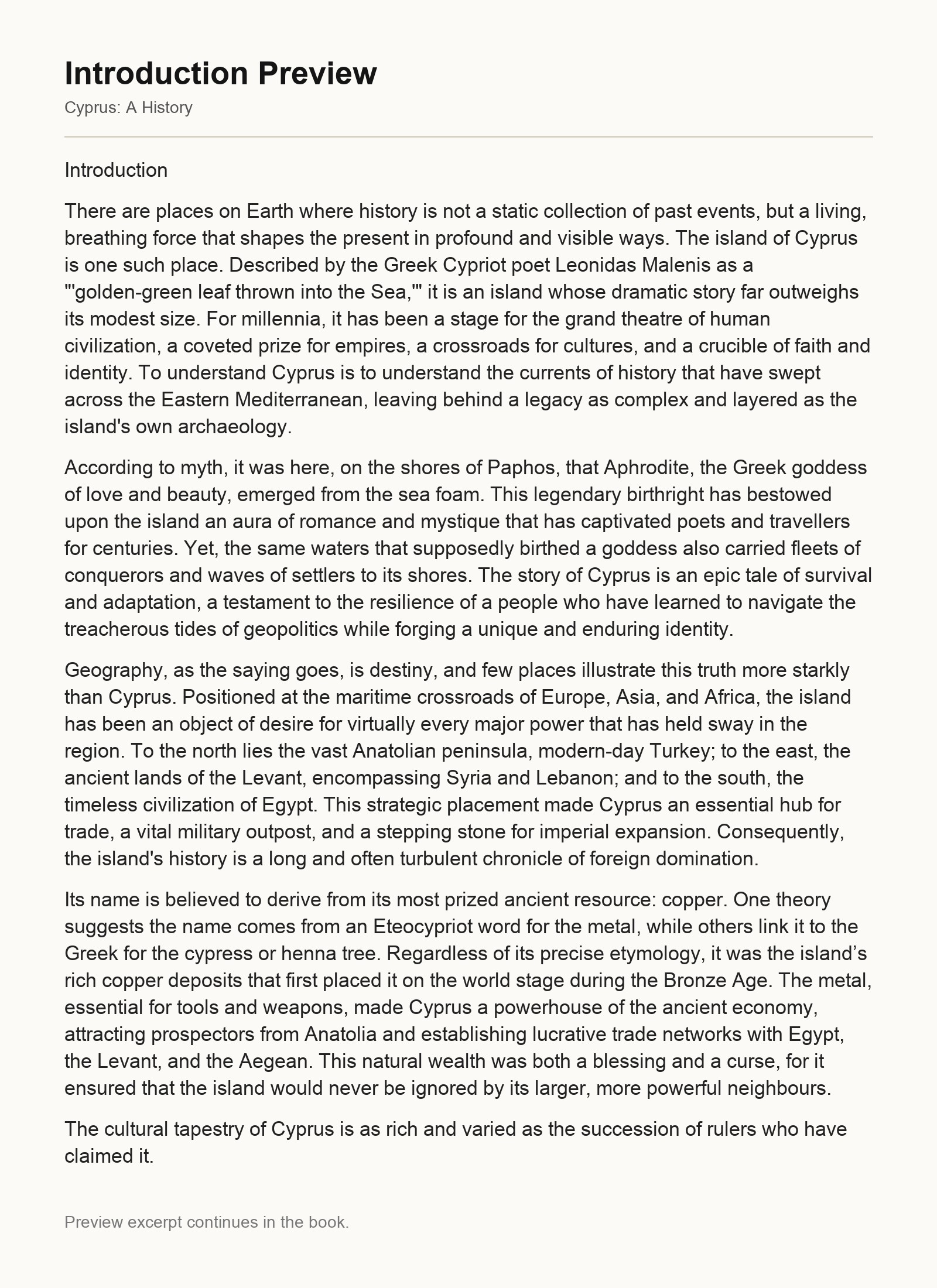
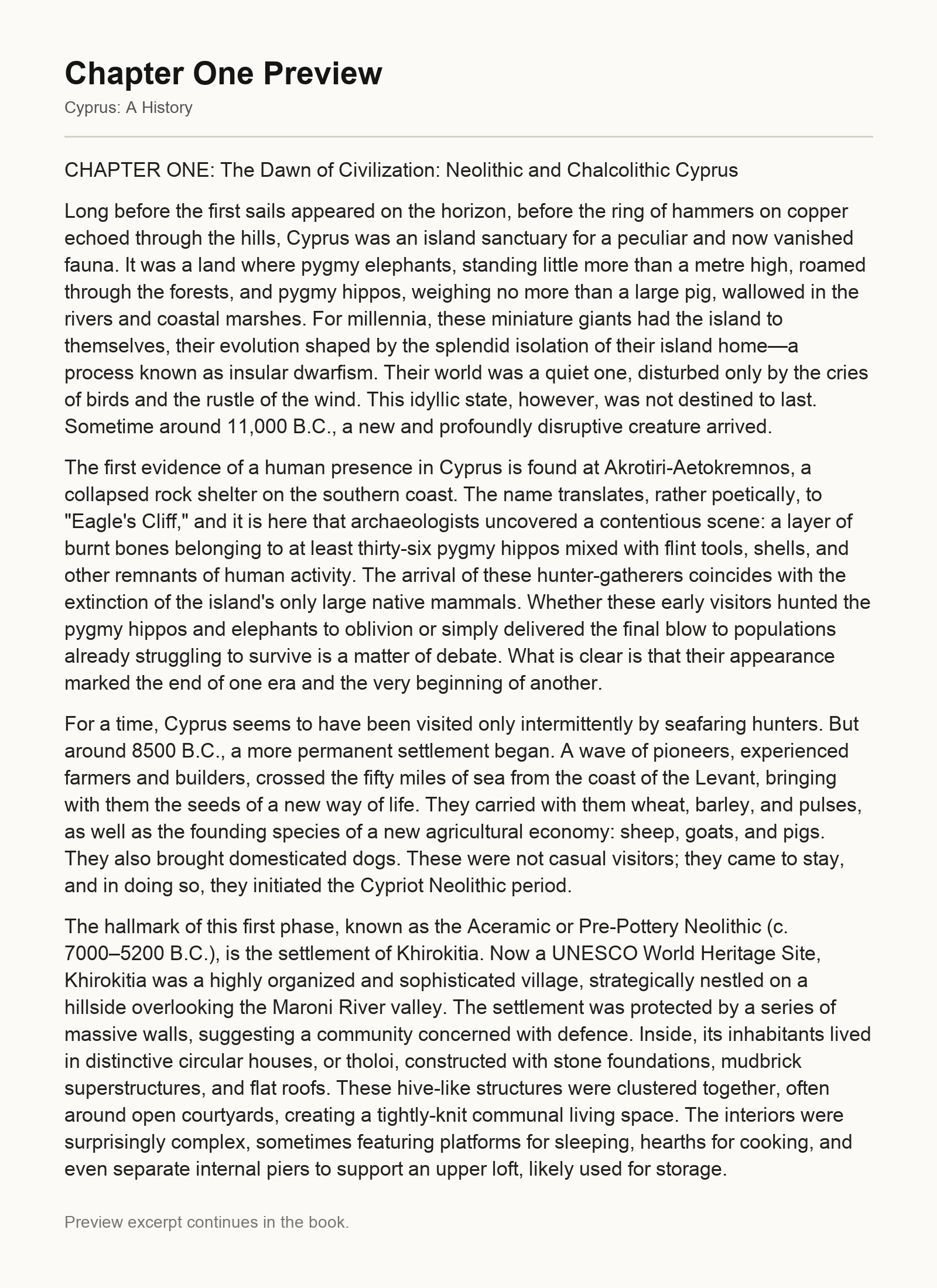
Cyprus: A History offers readers a sweeping journey through ten millennia of an island that has repeatedly stood at the crossroads of empires, faiths, and cultures. From the earliest Neolithic settlers who raised round houses and domesticated cats alongside their crops, to the bronze‑age miners whose copper ingots fueled Mediterranean trade, the book reveals how geography has continually shaped Cyprus’s destiny. Each chapter unpacks the archaeological evidence, literary sources, and pivotal events that transformed a remote island into a coveted prize for powers ranging from Assyria and Egypt to Rome and Byzantium.
The narrative moves seamlessly into the eras that forged Cyprus’s enduring Hellenic character, detailing the arrival of Achaean Greeks, the rise of independent city‑kingdoms, and the island’s role in the diplomatic intrigues of the Late Bronze Age. Readers will walk through the Roman Pax Romana, marvel at the early Christian mission of Paul and Barnabas that made Cyprus the first land governed by a Christian official, and explore the centuries of Byzantine rule where mountain frescoes preserved Orthodox faith amid Arab raids. The Frankish Lusignan period, with its Gothic cathedrals and Crusader grandeur, and the Venetian fortifications that turned Nicosia and Famagusta into gunpowder‑age bastions are brought to life with vivid detail.
The story then turns to the Ottoman conquest that reshaped the island’s demography, the British administration that arrived as a pawn in the Great Game, and the rising nationalist currents that led to the EOKA guerrilla struggle and the fragile birth of the Republic of Cyprus in 1960. The book does not shy from the tragedy of 1974, laying out the coup, the Turkish invasion, the creation of the Green Line, and the human cost of displacement that still echoes in the divided capital of Nicosia today.
Moving toward the present, Cyprus: A History examines the Republic’s rapid economic growth, its accession to the European Union, the painful bail‑in of 2013, and the parallel development of the Turkish Republic of Northern Cyprus under international isolation. It explores contemporary society—migration, cultural hybridity, the shared love of halloumi/hellim, and the grassroots bi‑communal efforts that seek to heal old wounds—while honestly confronting the unresolved questions of territory, security, and identity that keep the island’s future uncertain.
By the end of this volume, readers will have gained a deep, nuanced understanding of how a small island became a mirror for larger Mediterranean struggles, and how its people have continuously adapted, resisted, and re‑imagined themselves amid conquest and cooperation. The book offers not only a chronological account but a thoughtful reflection on resilience, identity, and the enduring quest for peace in a land where history is never truly past.
What You'll Find Inside:
- Cyprus's strategic location at the crossroads of Europe, Asia, and Africa made it a coveted prize for empires throughout history, from Assyrians and Egyptians to Ottomans and British.
- The island's rich copper deposits drove its early economic prominence in the Bronze Age, establishing it as a major power in ancient Mediterranean trade networks.
- Successive waves of settlers—Achaean Greeks, Phoenicians, and others—created a complex cultural tapestry where Hellenic identity endured despite centuries of foreign rule.
- British colonial policies institutionalized the Greek-Turkish divide through communal representation, laying the groundwork for the intercommunal violence that erupted in 1974.
- The 1974 Turkish invasion led to the de facto partition of Cyprus, creating a frozen conflict that persists despite EU membership and numerous reunification efforts.
Who's It For:
This book is ideal for students and scholars of Mediterranean history, international relations, and post-colonial studies seeking to understand the complex historical roots of the Cyprus conflict. It will also appeal to general readers interested in how small islands become geopolitical flashpoints, as well as those studying the European Union's enlargement process and its challenges. Anyone wishing to grasp the interplay between ancient civilizations, imperial powers, and modern nationalism in shaping a nation's destiny will find this comprehensive account invaluable.
Author:
Published By:
Date Published:
May 28, 2026
Type:
Nonfiction
Language:
English
Also Available In:
Word Count:
50,302 words
Reading Time:
3 hours 31 minutes
Sample:
Order:
Order Cyprus (Hardcover) on MixCache.com:
Buy NowPrint copy is made to order and ships worldwide. Includes the ebook free, ready to read instantly.
$5 account credit for all new MixCache.com accounts, usable toward any ebook purchase!*