Browse by Category
Fiction
- Action & Adventure
- African American
- Anthologies
- Children's Fiction
- Classics
- Comics & Graphic Novels
- Coming of Age
- Contemporary
- Cultural & Regional
- Drama
- Erotica
- Fantasy
- General
- Historical Fiction
- Horror
- Humor & Satire
- Literary Fiction
- Mystery, Thriller & Suspense
- Poetry
- Religious & Inspirational
- Romance
- Science Fiction
- Short Stories
- War & Military
- Westerns
- Women's Fiction
- Young Adult
Non-Fiction
- Antiques & Collectibles
- Arts & Photography
- Biographies & Memoirs
- Business & Money
- Children's Non-Fiction
-
Computers & Technology
- Artificial Intelligence
- Computer Science
- Cybersecurity & Cryptography
- Data Science & Analytics
- Databases & Big Data
- Game Development & Design
- General
- Hardware & DIY
- Mobile App Development
- Networking & Cloud Computing
- Operating Systems
- Programming
- Robotics
- Software
- Software Engineering
- User Experience (UX) & Design
- Web Development & Design
- Cooking, Food & Wine
- Crafts, Hobbies & Home
- Education & Teaching
- Engineering
- General
- Health, Fitness & Dieting
-
History
- African History
- African History - North Africa
- African History - Sub-Saharan Africa
- American History
- American History - 20th Century
- American History - Civil War
- American History - Colonial Period
- Ancient History
- Asian History
- Asian History - China
- Asian History - India
- Asian History - Japan
- Asian History - Southeast Asia
- European History
- European History - Ancient Greece
- European History - Ancient Rome
- European History - Medieval
- European History - Modern
- European History - Renaissance
- General
- Middle Eastern History
- Military History
- Military History - Aviation
- Military History - Naval
- Social & Cultural History
- World History
- Humor & Entertainment
- Industrial Technology
- Language Learning
- Law
- LGBTQ+ Non-Fiction
- Literary Criticism
- Medical Books
- Parenting & Relationships
- Philosophy
- Politics & Social Sciences
- Reference
- Religion & Spirituality
-
Science & Math
- Agricultural Sciences
- Astronomy & Space Science
- Behavioral Sciences
- Biological Sciences
- Botany & Plant Science
- Chemistry
- Earth Sciences
- Engineering - Chemical
- Engineering - Civil
- Engineering - Electrical
- Engineering - Mechanical
- Environment
- General
- Geology
- Mathematics
- Nature & Ecology
- Oceanography
- Paleontology
- Physics
- Statistics
- Self-Help
- Sports & Outdoors
- Study Aids
- Sustainability & Green Living
- Textbooks
- Transportation
- Travel
- True Crime
- Urban Planning & Development
- Veterinary Medicine
- Writing & Publishing
Jump to Section
MixCache.com Total Access
Unlimited reading and audiobooks for every book published by MixCache.com.
Included titles carry the MTA badge.
Learn more →
The Impact of Geography on Warfare
How Land, Sea, and Sky Have Shaped Military Strategy
About this book:
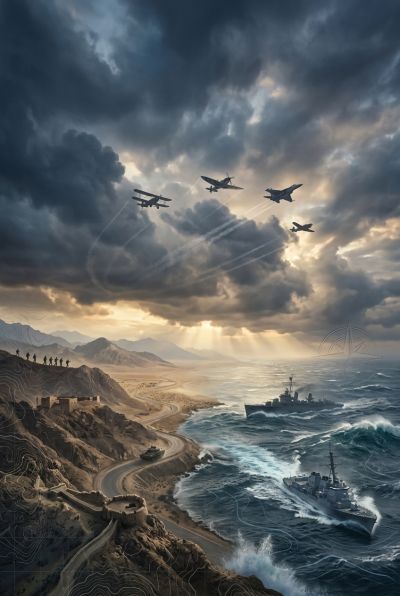
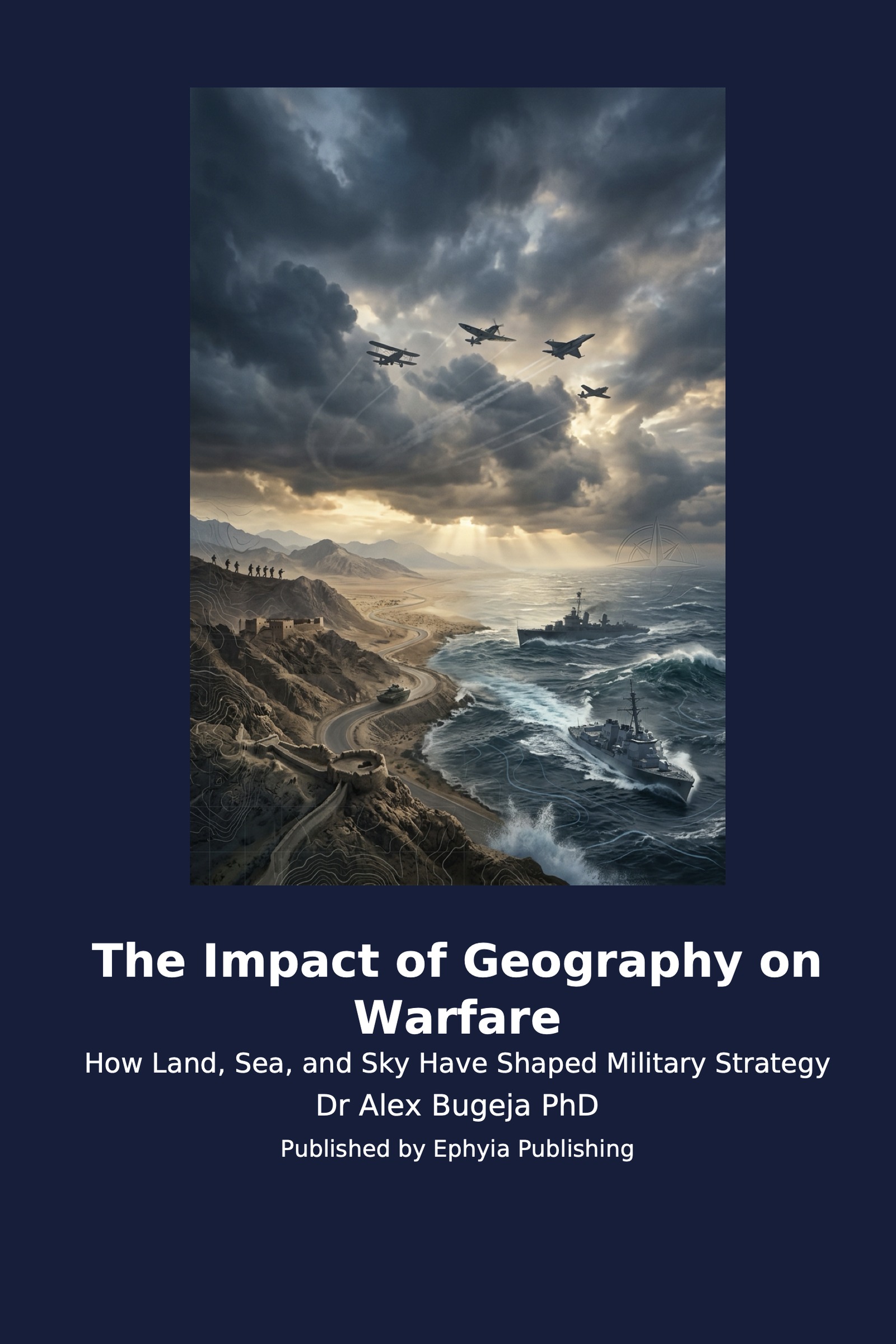

From the deserts of North Africa to the icy waters of the Arctic, this book reveals how the physical world has always been an active participant in war, not just a passive backdrop. Readers will walk through centuries of conflict, seeing how rivers have served as both highways and barriers, how mountain passes have turned the tide of battles, and how jungles have favored the unseen over the overwhelming. Each chapter unpacks a specific terrain—land, sea, sky, and beyond—showing the timeless principles that dictate movement, supply, and surprise, and how ignoring them has led to catastrophic defeats while mastering them has produced legendary victories.
The narrative moves from ancient wisdom to modern technology, illustrating how Sun Tzu’s classifications of ground still apply to tank commanders in the desert and drone operators in the mountains. You’ll learn why controlling a strait or canal can choke an enemy’s economy, how the Volga River anchored the Soviet defense at Stalingrad, and why the D-Day planners studied sand composition and tides before landing on Normandy’s beaches. The book connects these geographic realities to the evolution of naval power, air superiority, and the emergence of space and cyber domains as new high grounds that reshape the very nature of conflict.
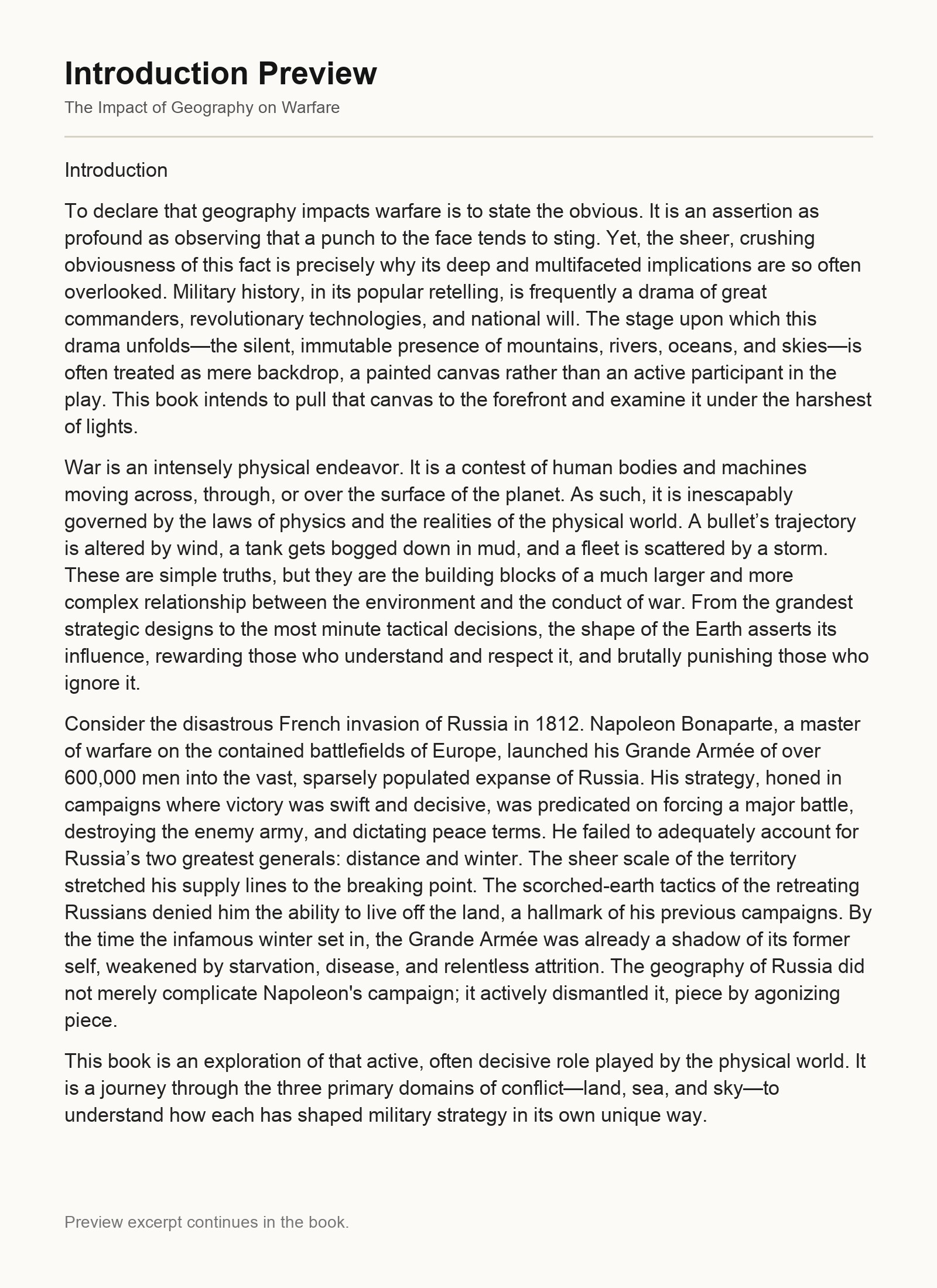
Through detailed case studies—from Napoleon’s disastrous Russian campaign to the island‑hopping leapfrogging of the Pacific War, from the guerrilla tactics of the Viet Cong in the Mekong Delta to the cyber‑physical sabotage of Stuxnet—you’ll experience the cause‑and‑effect relationship between terrain and tactics. The text explains how logistics become the decisive factor in vast, empty landscapes, how weather can ground air fleets or conceal advancing troops, and why urban combat turns every building into a fortress and every civilian into a potential complication.
Looking ahead, the work confronts the pressing challenges of climate change, showing how rising seas threaten naval bases, melting Arctic ice opens new strategic waterways, and extreme weather strains military readiness for humanitarian missions. Readers will gain a clear view of how geography continues to act as a threat multiplier, shaping future flashpoints from the South China Sea to the Sahel, and why understanding the physical world remains essential for any strategist, historian, or student of war.
Ultimately, this book equips you with a deeper appreciation of the enduring truth that weapons and tactics evolve, but the land beneath our feet, the seas that connect us, and the sky above our heads remain the ultimate arbiters of victory and defeat. By mastering the geographic dimensions of warfare, readers will be better prepared to anticipate the complexities of today’s conflicts and anticipate the challenges of tomorrow’s battlefields.
What You'll Find Inside:
- The book reveals how fundamental geographical features like terrain, rivers, mountains, and deserts have consistently shaped military strategy from ancient Sun Tzu principles to modern combined arms operations.
- It examines the enduring importance of sea power, straits, canals, and littoral zones for global power projection, demonstrating why controlling maritime choke points remains critical to naval strategy.
- The work traces the evolution of air power from reconnaissance to strategic bombing and air superiority, showing how mastery of the sky transformed land and naval warfare throughout the 20th century.
- It analyzes emerging 21st-century domains including space, cyber warfare, and climate change impacts, revealing how geography is being redefined in new frontiers of conflict.
- The book concludes with a synthesis of modern combined arms warfare, emphasizing that victory requires integrating land, sea, air, space, and cyber domains into a seamless operational whole.
Who's It For:
This book is essential reading for military professionals, strategists, and policymakers who need to understand how physical geography constrains and enables military operations across all domains. It will also benefit students and scholars of military history, international relations, and security studies seeking a comprehensive analysis of geography's role in shaping conflict from ancient times to the contemporary era. Additionally, anyone interested in understanding current geopolitical hotspots, future security challenges, and the intersection of environmental change with warfare will find this work highly informative.
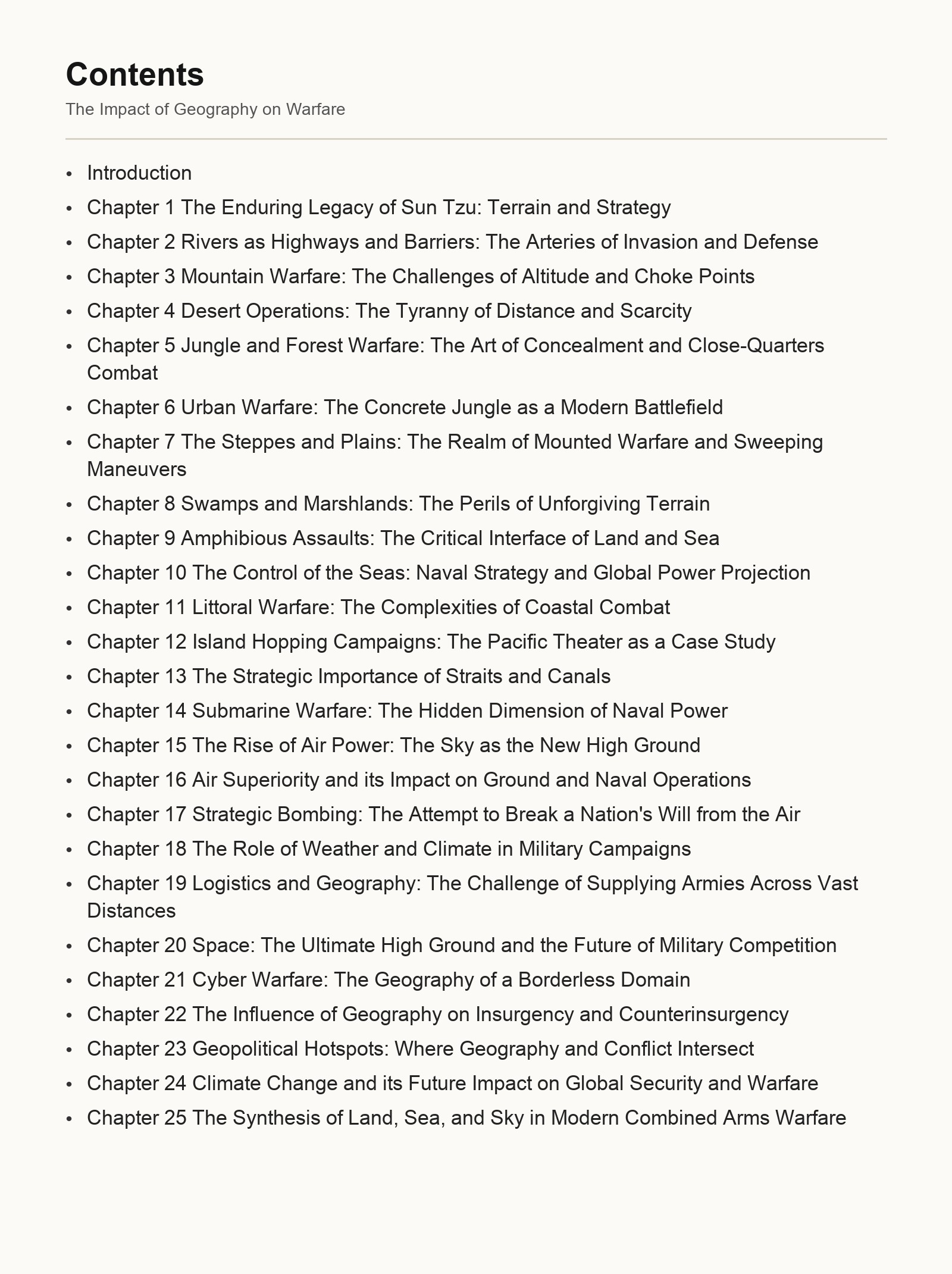
Table of Contents:
- Introduction
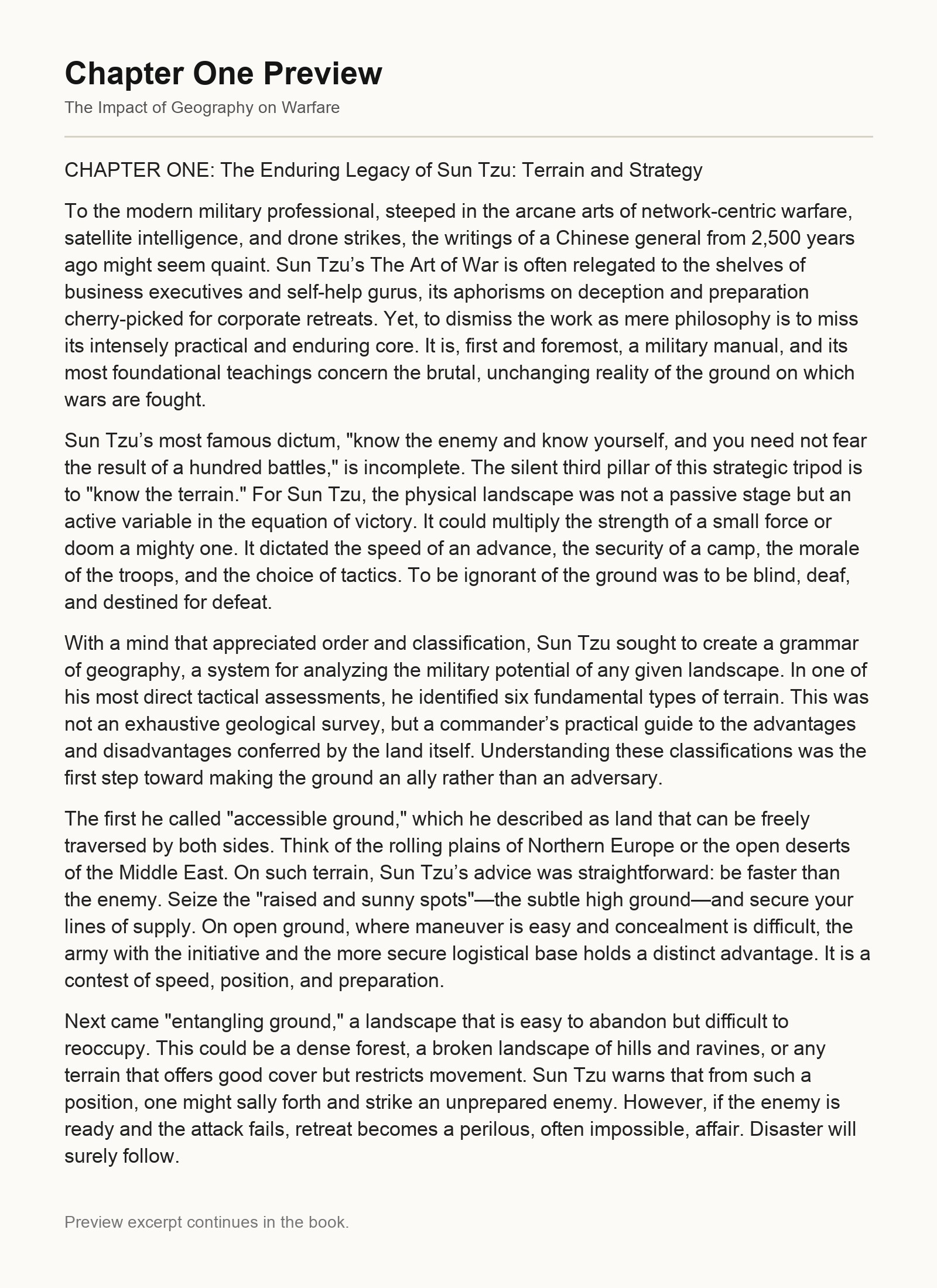
- Chapter 1 The Enduring Legacy of Sun Tzu: Terrain and Strategy
- Chapter 2 Rivers as Highways and Barriers: The Arteries of Invasion and Defense
- Chapter 3 Mountain Warfare: The Challenges of Altitude and Choke Points
- Chapter 4 Desert Operations: The Tyranny of Distance and Scarcity
- Chapter 5 Jungle and Forest Warfare: The Art of Concealment and Close-Quarters Combat
- Chapter 6 Urban Warfare: The Concrete Jungle as a Modern Battlefield
- Chapter 7 The Steppes and Plains: The Realm of Mounted Warfare and Sweeping Maneuvers
- Chapter 8 Swamps and Marshlands: The Perils of Unforgiving Terrain
- Chapter 9 Amphibious Assaults: The Critical Interface of Land and Sea
- Chapter 10 The Control of the Seas: Naval Strategy and Global Power Projection
- Chapter 11 Littoral Warfare: The Complexities of Coastal Combat
- Chapter 12 Island Hopping Campaigns: The Pacific Theater as a Case Study
- Chapter 13 The Strategic Importance of Straits and Canals
- Chapter 14 Submarine Warfare: The Hidden Dimension of Naval Power
- Chapter 15 The Rise of Air Power: The Sky as the New High Ground
- Chapter 16 Air Superiority and its Impact on Ground and Naval Operations
- Chapter 17 Strategic Bombing: The Attempt to Break a Nation's Will from the Air
- Chapter 18 The Role of Weather and Climate in Military Campaigns
- Chapter 19 Logistics and Geography: The Challenge of Supplying Armies Across Vast Distances
- Chapter 20 Space: The Ultimate High Ground and the Future of Military Competition
- Chapter 21 Cyber Warfare: The Geography of a Borderless Domain
- Chapter 22 The Influence of Geography on Insurgency and Counterinsurgency
- Chapter 23 Geopolitical Hotspots: Where Geography and Conflict Intersect
- Chapter 24 Climate Change and its Future Impact on Global Security and Warfare
- Chapter 25 The Synthesis of Land, Sea, and Sky in Modern Combined Arms Warfare
Author:
Published By:
Date Published:
May 20, 2026
Type:
Nonfiction
Language:
English
Also Available In:
Word Count:
54,072 words
Reading Time:
3 hours 47 minutes
Sample:
Order:
Order The Impact of Geography on Warfare (Hardcover) on MixCache.com:
Buy NowPrint copy is made to order and ships worldwide. Includes the ebook free, ready to read instantly.
$5 account credit for all new MixCache.com accounts, usable toward any ebook purchase!*