
Browse by Category
Fiction
- Action & Adventure
- African American
- Anthologies
- Children's Fiction
- Classics
- Comics & Graphic Novels
- Coming of Age
- Contemporary
- Cultural & Regional
- Drama
- Erotica
- Fantasy
- General
- Historical Fiction
- Horror
- Humor & Satire
- Literary Fiction
- Mystery, Thriller & Suspense
- Poetry
- Religious & Inspirational
- Romance
- Science Fiction
- Short Stories
- War & Military
- Westerns
- Women's Fiction
- Young Adult
Non-Fiction
- Antiques & Collectibles
- Arts & Photography
- Biographies & Memoirs
- Business & Money
- Children's Non-Fiction
-
Computers & Technology
- Artificial Intelligence
- Computer Science
- Cybersecurity & Cryptography
- Data Science & Analytics
- Databases & Big Data
- Game Development & Design
- General
- Hardware & DIY
- Mobile App Development
- Networking & Cloud Computing
- Operating Systems
- Programming
- Robotics
- Software
- Software Engineering
- User Experience (UX) & Design
- Web Development & Design
- Cooking, Food & Wine
- Crafts, Hobbies & Home
- Education & Teaching
- Engineering
- General
- Health, Fitness & Dieting
-
History
- African History
- African History - North Africa
- African History - Sub-Saharan Africa
- American History
- American History - 20th Century
- American History - Civil War
- American History - Colonial Period
- Ancient History
- Asian History
- Asian History - China
- Asian History - India
- Asian History - Japan
- Asian History - Southeast Asia
- European History
- European History - Ancient Greece
- European History - Ancient Rome
- European History - Medieval
- European History - Modern
- European History - Renaissance
- General
- Middle Eastern History
- Military History
- Military History - Aviation
- Military History - Naval
- Social & Cultural History
- World History
- Humor & Entertainment
- Industrial Technology
- Language Learning
- Law
- LGBTQ+ Non-Fiction
- Literary Criticism
- Medical Books
- Parenting & Relationships
- Philosophy
- Politics & Social Sciences
- Reference
- Religion & Spirituality
-
Science & Math
- Agricultural Sciences
- Astronomy & Space Science
- Behavioral Sciences
- Biological Sciences
- Botany & Plant Science
- Chemistry
- Earth Sciences
- Engineering - Chemical
- Engineering - Civil
- Engineering - Electrical
- Engineering - Mechanical
- Environment
- General
- Geology
- Mathematics
- Nature & Ecology
- Oceanography
- Paleontology
- Physics
- Statistics
- Self-Help
- Sports & Outdoors
- Study Aids
- Sustainability & Green Living
- Textbooks
- Transportation
- Travel
- True Crime
- Urban Planning & Development
- Veterinary Medicine
- Writing & Publishing
Jump to Section

Want unlimited access to all books published by MixCache.com (plus their audiobooks)? Try MixCache.com Total Access. Look for the MTA badge on book covers to identify included titles.
Access to infinite ebooks: Don't see the book you want? Suggest it and we'll create it (free!) for you from scratch with our powerful AI book writer. Then read it with MTA - besides profiting from any sales it makes!
Native Wildflowers for Pollinator Recovery
MTA
Creating habitat corridors using native wildflower mixes tailored to regional pollinators
About this book:
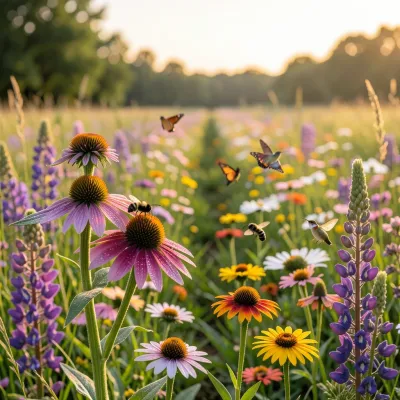
Native wildflowers are the foundation of effective pollinator corridors, providing essential nectar, pollen, and nesting resources that coevolved with regional species. As landscapes become increasingly fragmented by urbanization and intensive agriculture, these corridors serve as functional bridges that allow bees, butterflies, and other pollinators to move, feed, and reproduce safely. By understanding ecoregional templates and reference plant communities, land managers can design seed mixes that maximize biodiversity and ensure seasonal bloom continuity, which is critical for supporting pollinators from early spring emergence through autumn migration.
Successful corridor restoration requires a shift from purely aesthetic gardening to functional ecological design. This involves rigorous site preparation—addressing weed seed banks through methods like solarization or smothering—and selecting appropriate installation techniques such as drill seeding or plug planting. During the critical establishment year, management must balance the need for weed suppression with the protection of young native seedlings. Beyond providing floral resources, high-quality habitat must also include "invisible" infrastructure: bare soil for ground-nesting bees, hollow stems for cavity nesters, and reliable water sources that accommodate various insect morphologies.
Long-term sustainability of these habitats depends on adaptive management and broad-scale partnerships. Utilizing data from community science and regular monitoring allows for targeted reseeding and the adjustment of disturbance regimes, such as mowing and prescribed fire, to maintain diversity. Furthermore, stitching together the landscape requires collaboration across private lands, municipal properties, and utility rights-of-way. By integrating ecological goals with public policy and human-centric design, restoration efforts can transform fragmented fringes into resilient, connected networks that sustain pollinator populations in the face of climate change and habitat loss.
What You'll Find Inside:
- How to design functional habitat corridors using native wildflowers that reconnect fragmented landscapes and support pollinator movement across seasons
- Creating effective seed mixes based on ecoregional knowledge, phenology patterns, and functional traits to ensure season-long bloom continuity
- Practical guidance for site assessment, preparation, installation, and establishment-phase management tailored to different landscapes and constraints
- Strategies for monitoring corridor effectiveness through bloom indices, visitation counts, and reproduction data to inform adaptive management
- Integrating corridors into working lands, urban environments, and community partnerships while designing for both pollinator needs and human engagement
Who's It For:
This book is for land managers, conservation practitioners, gardeners, farmers, municipal workers, utility personnel, and community volunteers seeking to create effective pollinator habitat corridors. It provides practical, science-based guidance for anyone working in urban, suburban, rural, or agricultural settings who wants to support regional pollinators through native wildflower plantings. Readers will find particular value if they're involved in habitat restoration, landscape design, land stewardship, or community science initiatives focused on pollinator recovery. The book serves both beginners needing foundational knowledge and experienced practitioners looking to refine their corridor design and management approaches.
Author:
Published By:
Date Published:
May 4, 2026
Type:
Nonfiction
Language:
English
Word Count:
58,663 words
Reading Time:
4 hours 6 minutes
Sample:
Order:
Order Native Wildflowers for Pollinator Recovery (Hardcover) on MixCache.com:
Buy NowPrint copy is made to order and ships worldwide. Includes the ebook free, ready to read instantly.
$5 account credit for all new MixCache.com accounts, usable toward any ebook purchase!*


