
Browse by Category
Fiction
- Action & Adventure
- African American
- Anthologies
- Children's Fiction
- Classics
- Comics & Graphic Novels
- Coming of Age
- Contemporary
- Cultural & Regional
- Drama
- Erotica
- Fantasy
- General
- Historical Fiction
- Horror
- Humor & Satire
- Literary Fiction
- Mystery, Thriller & Suspense
- Poetry
- Religious & Inspirational
- Romance
- Science Fiction
- Short Stories
- War & Military
- Westerns
- Women's Fiction
- Young Adult
Non-Fiction
- Antiques & Collectibles
- Arts & Photography
- Biographies & Memoirs
- Business & Money
- Children's Non-Fiction
-
Computers & Technology
- Artificial Intelligence
- Computer Science
- Cybersecurity & Cryptography
- Data Science & Analytics
- Databases & Big Data
- Game Development & Design
- General
- Hardware & DIY
- Mobile App Development
- Networking & Cloud Computing
- Operating Systems
- Programming
- Robotics
- Software
- Software Engineering
- User Experience (UX) & Design
- Web Development & Design
- Cooking, Food & Wine
- Crafts, Hobbies & Home
- Education & Teaching
- Engineering
- General
- Health, Fitness & Dieting
-
History
- African History
- African History - North Africa
- African History - Sub-Saharan Africa
- American History
- American History - 20th Century
- American History - Civil War
- American History - Colonial Period
- Ancient History
- Asian History
- Asian History - China
- Asian History - India
- Asian History - Japan
- Asian History - Southeast Asia
- European History
- European History - Ancient Greece
- European History - Ancient Rome
- European History - Medieval
- European History - Modern
- European History - Renaissance
- General
- Middle Eastern History
- Military History
- Military History - Aviation
- Military History - Naval
- Social & Cultural History
- World History
- Humor & Entertainment
- Industrial Technology
- Language Learning
- Law
- LGBTQ+ Non-Fiction
- Literary Criticism
- Medical Books
- Parenting & Relationships
- Philosophy
- Politics & Social Sciences
- Reference
- Religion & Spirituality
-
Science & Math
- Agricultural Sciences
- Astronomy & Space Science
- Behavioral Sciences
- Biological Sciences
- Botany & Plant Science
- Chemistry
- Earth Sciences
- Engineering - Chemical
- Engineering - Civil
- Engineering - Electrical
- Engineering - Mechanical
- Environment
- General
- Geology
- Mathematics
- Nature & Ecology
- Oceanography
- Paleontology
- Physics
- Statistics
- Self-Help
- Sports & Outdoors
- Study Aids
- Sustainability & Green Living
- Textbooks
- Transportation
- Travel
- True Crime
- Urban Planning & Development
- Veterinary Medicine
- Writing & Publishing
Jump to Section
MixCache.com Total Access
Unlimited reading and audiobooks for every book published by MixCache.com.
Included titles carry the MTA badge.
Learn more →
Spice Routes of Delhi
MTA
Tracing culinary migrations, regional influences, and the evolution of New Delhi's palate
About this book:
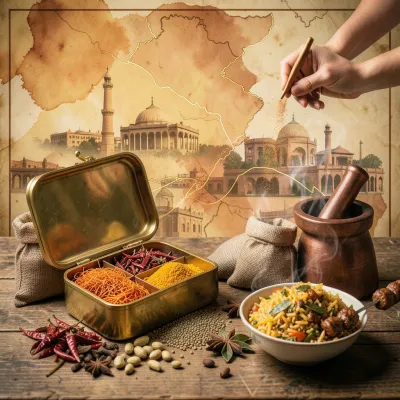
Delhi’s palate is a palimpsest forged by centuries of migration, trade, and shifting power, beginning with early caravanserais that turned the city into a crossroads where indigenous spices met Persian, Central Asian, and later Mughal influences. The Sultanate and Mughal courts introduced wheat‑based breads, fragrant pilafs, rich kormas, kebabs, and the elaborate dastarkhwan, while Awadhi artisans later refined this legacy with delicate kebabs, silken gravies, and the dum pukht technique that still defines Mughlai mornings in Old Delhi’s nihari and biryani stalls. Each wave left ingredients and techniques that were absorbed, adapted, and layered atop earlier traditions.
The most dramatic recent layer arrived with the 1947 Partition, when Punjabi refugees brought the tandoor from village courtyards to urban streets, popularizing naan, tandoori chicken, and the butter‑laden gravies that gave rise to Moti Mahal’s Butter Chicken. Simultaneously, Sindhi traders seeded markets with papad and pulao, Kashmiri migrants added Wazwan’s fragrant meatballs and Pandit‑style vegetarian dishes, and South Indian Udupi cafés—and later chains like Saravana Bhavan—spread idli, dosa, and sambar across the city. Sikh dhabas along the Grand Trunk Road amplified the Punjabi love of butter and hearty, highway‑style fare, while older Mughlai, Awadhi, and regional continuities persisted in neighborhoods from Karol Bagh to Chittaranjan Park.
Beyond these community kitchens, Delhi’s food system relies on spice mandis such as Khari Baoli and increasingly sophisticated cold chains that move chilies, turmeric, vegetables, meat, and dairy across the subcontinent. Street‑food chaat vendors balance crunch, tang, and heat in ever‑evolving cartographies, while temple langars and community meals model large‑scale, donation‑driven feeding. The city’s meat markets negotiate halal and jhatka supply chains, its sweets follow seasonal rhythms from jalebi to kulfi, and its beverages range from chai and lassi to sharbat and modern milkshakes. Regulation, hygiene pressures, media influencers, bloggers, and now delivery apps and dark kitchens continuously reshape how Delhi eats, and diaspora loops return globally refined interpretations of dishes like Butter Chicken, completing a dynamic circuit of culinary exchange that keeps Delhi’s palate forever in flux.
What You'll Find Inside:
- A chronological exploration of Delhi's food history, from ancient caravanserais and Sultanate courts to modern street food and delivery apps.
- How major migrations—Punjabi refugees after Partition, Sindhi traders, Kashmiri Pandits and Wazwan chefs, South Indian Udupi cafés, and Awadhi artisans—reshaped the city's palate.
- The rise of iconic dishes like Butter Chicken, tandoori breads, chaat, and nihari, with case studies on Moti Mahal, Saravana Bhavan, and Sikh dhabas.
- Institutional dimensions of Delhi's food culture: temple langars, community kitchens, restaurant archives as living memory, and the politics of halal/jhatka provisioning.
- Contemporary forces transforming Delhi's cuisine: food media and bloggers, platform economies and dark kitchens, diaspora feedback loops, and sustainability challenges.
Who's It For:
This book is ideal for food historians, culinary students, and anyone interested in the social and cultural dynamics of South Asian cuisine. It will also appeal to Delhi residents, chefs, and restaurateurs seeking a deeper understanding of the city's diverse food landscape, as well as policymakers and urban planners curious about how migration, trade, and regulation shape urban food systems.
Table of Contents:
- Introduction
- Chapter 1 Mapping the Spice Routes: From Caravanserai to Capital
- Chapter 2 Sultanate to Shahjahanabad: Persianate Imprints on Taste
- Chapter 3 Partition and the Punjabi Palate: Refugee Kitchens Remake a City
- Chapter 4 Tandoor Comes to Town: From Courtyard Clay Ovens to Global Icon
- Chapter 5 Moti Mahal and the Birth of Butter Chicken: A Case Study
- Chapter 6 Awadhi Artisans in the Imperial City: Kebabs, Korma, and the Courtly Canon
- Chapter 7 Nihari, Biryani, and the Old Delhi Dawn: Mughlai Mornings Revisited
- Chapter 8 Chaat Cartographies: Street Science of Crunch, Tang, and Heat
- Chapter 9 Sindhi Traders, Markets, and Memories: From Papad to Pulao
- Chapter 10 Kashmiri Threads: Wazwan, Pandit Cuisines, and Delhi Adaptations
- Chapter 11 South Indian Arrivals: Udupi Cafés, Idli Economics, Dosa Diplomacy
- Chapter 12 Saravana Bhavan and the Standardization of Taste: A Chain’s Journey
- Chapter 13 The Sikh Dhaba Highway: GT Road, Butter, and the Art of Service
- Chapter 14 Spice Mandis and Cold Chains: How Ingredients Move
- Chapter 15 From Home to Menu: Recipe Migrations and Attribution
- Chapter 16 Neighborhoods of Appetite: Karol Bagh, Lajpat, CR Park, and Beyond
- Chapter 17 Temple Kitchens, Langar, and Community Eating
- Chapter 18 Halal, Jhatka, and the Politics of Provisioning
- Chapter 19 Sweet Conclusions: Jalebi, Kulfi, Ghevar, and the Seasons
- Chapter 20 Liquid Routes: Chai, Lassi, Sharbat, and the City’s Thirst
- Chapter 21 Restaurants as Archives: Menus, Margins, and Memory
- Chapter 22 Regulation, Hygiene, and the Street: Law Meets Ladle
- Chapter 23 Media, Bloggers, and the New Gatekeepers of Taste
- Chapter 24 Delivery Apps, Dark Kitchens, and the Platformed Palate
- Chapter 25 Global Delhi: Diaspora Feedback Loops and Culinary Diplomacy
Author:
Published By:
Date Published:
June 4, 2026
Type:
Nonfiction
Language:
English
Word Count:
53,602 words
Reading Time:
3 hours 45 minutes
Sample:
Order:
Order Spice Routes of Delhi (Hardcover) on MixCache.com:
Buy NowPrint copy is made to order and ships worldwide. Includes the ebook free, ready to read instantly.
$5 account credit for all new MixCache.com accounts, usable toward any ebook purchase!*


 Includes Audiobook


