
Browse by Category
Fiction
- Action & Adventure
- African American
- Anthologies
- Children's Fiction
- Classics
- Comics & Graphic Novels
- Coming of Age
- Contemporary
- Cultural & Regional
- Drama
- Erotica
- Fantasy
- General
- Historical Fiction
- Horror
- Humor & Satire
- Literary Fiction
- Mystery, Thriller & Suspense
- Poetry
- Religious & Inspirational
- Romance
- Science Fiction
- Short Stories
- War & Military
- Westerns
- Women's Fiction
- Young Adult
Non-Fiction
- Antiques & Collectibles
- Arts & Photography
- Biographies & Memoirs
- Business & Money
- Children's Non-Fiction
-
Computers & Technology
- Artificial Intelligence
- Computer Science
- Cybersecurity & Cryptography
- Data Science & Analytics
- Databases & Big Data
- Game Development & Design
- General
- Hardware & DIY
- Mobile App Development
- Networking & Cloud Computing
- Operating Systems
- Programming
- Robotics
- Software
- Software Engineering
- User Experience (UX) & Design
- Web Development & Design
- Cooking, Food & Wine
- Crafts, Hobbies & Home
- Education & Teaching
- Engineering
- General
- Health, Fitness & Dieting
-
History
- African History
- African History - North Africa
- African History - Sub-Saharan Africa
- American History
- American History - 20th Century
- American History - Civil War
- American History - Colonial Period
- Ancient History
- Asian History
- Asian History - China
- Asian History - India
- Asian History - Japan
- Asian History - Southeast Asia
- European History
- European History - Ancient Greece
- European History - Ancient Rome
- European History - Medieval
- European History - Modern
- European History - Renaissance
- General
- Middle Eastern History
- Military History
- Military History - Aviation
- Military History - Naval
- Social & Cultural History
- World History
- Humor & Entertainment
- Industrial Technology
- Language Learning
- Law
- LGBTQ+ Non-Fiction
- Literary Criticism
- Medical Books
- Parenting & Relationships
- Philosophy
- Politics & Social Sciences
- Reference
- Religion & Spirituality
-
Science & Math
- Agricultural Sciences
- Astronomy & Space Science
- Behavioral Sciences
- Biological Sciences
- Botany & Plant Science
- Chemistry
- Earth Sciences
- Engineering - Chemical
- Engineering - Civil
- Engineering - Electrical
- Engineering - Mechanical
- Environment
- General
- Geology
- Mathematics
- Nature & Ecology
- Oceanography
- Paleontology
- Physics
- Statistics
- Self-Help
- Sports & Outdoors
- Study Aids
- Sustainability & Green Living
- Textbooks
- Transportation
- Travel
- True Crime
- Urban Planning & Development
- Veterinary Medicine
- Writing & Publishing
Jump to Section
MixCache.com Total Access
Unlimited reading and audiobooks for every book published by MixCache.com.
Included titles carry the MTA badge.
Learn more →
Spice Preservation Through Fermentation
MTA
Kimchis, Lacto-Fermented Pastes, and Flavor Development Techniques
About this book:
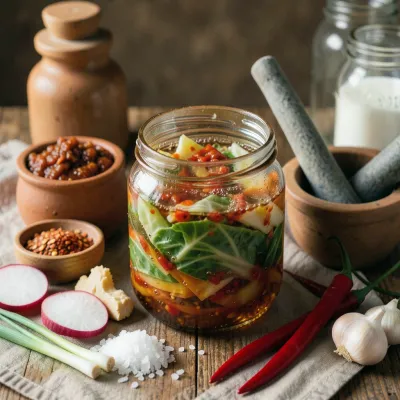
"Spice Preservation Through Fermentation" by Kirsten K. Shockey offers a comprehensive exploration of using fermentation to preserve and enhance the flavor of spices, herbs, and aromatics. The book begins by establishing the scientific and historical context of fermentation, explaining how lactic acid bacteria (LAB), yeasts, and enzymes transform raw ingredients into complex, shelf-stable condiments. It emphasizes food safety through meticulous control of pH, salt concentration, and temperature, stressing the importance of proper sanitation and reliable equipment for both home and small-scale production.
The core of the book delves into practical applications, starting with foundational techniques for lacto-fermented chili pastes and progressing to the intricate world of kimchi bases, highlighting the roles of gochugaru, alliums, and seafood umami. Shockey then expands into specific ingredient-driven ferments, dedicating chapters to herb-driven options like cilantro and basil, and aromatic roots such as ginger, turmeric, and galangal. A unique aspect is the exploration of fermenting whole spices like peppercorns, mustard seeds, and coriander, demonstrating how these dense ingredients yield nuanced flavors over longer fermentation periods. The book also introduces advanced flavor development techniques, including controlled oxidation for ester formation, and the synergy between Maillard reactions (from smoking and roasting) and microbial processes to create deep, savory notes. Texture engineering is covered, detailing how cut size and pectinases influence the final mouthfeel.
Shockey provides a framework for "flavor mapping," teaching readers to identify and track the evolution of acids, esters, glutamates, and nucleotides in their ferments, linking sensory experience to underlying chemistry. It addresses the choice between wild fermentation and starter cultures, offering guidance on when and how to inoculate for consistency or complexity. Troubleshooting common issues like off-flavors, gas production, and surface growth is thoroughly covered, turning potential failures into learning opportunities. The latter part of the book focuses on practical aspects of long-term preservation, including developing shelf-stable products through pasteurization and water activity control, and best practices for packaging, storage, and labeling.
Finally, the book explores the culinary applications of fermented spices with practical recipes and pairing principles, encouraging readers to integrate these vibrant condiments into everyday cooking. It concludes by advocating for zero-waste practices, showing how to repurpose leftover brines, pulps, and spent spices into new flavor boosters. The concluding chapter looks to the future, discussing novel spices, the potential of koji crossovers for enhanced umami, and the role of technology in monitoring and scaling fermentation, positioning "Spice Preservation Through Fermentation" as both a practical guide and an inspirational resource for deepening one's understanding of microbial alchemy.
What You'll Find Inside:
- The science behind how fermentation transforms spice chemistry - turning harsh compounds like capsaicin and allicin into complex, layered flavors through microbial metabolism
- Essential food safety principles for fermented spices - mastering pH, salt concentration, and temperature control to ensure safe, consistent ferments
- Practical techniques for diverse spice ferments - from chili pastes and kimchi to herb ferments and whole spice brines
- Flavor development strategies - controlling acids, esters, glutamates and nucleotides to engineer specific taste profiles
- Applications and preservation methods - using fermented spices in cooking, achieving shelf stability, and zero-waste approaches
Who's It For:
This book is for home cooks, fermentation enthusiasts, and small-scale food producers who want to create complex, safe fermented spice condiments. It's ideal for those interested in both the science and practice of fermentation, seeking to understand microbial transformations while gaining hands-on skills for making kimchi, chili pastes, herb ferments, and more. Readers should have basic kitchen experience but don't need prior fermentation knowledge - the book builds from fundamentals to advanced techniques.
Table of Contents:
- Introduction
- Chapter 1 The Fermentation Lens: Why Spices Thrive in Brine
- Chapter 2 The Microbial Cast: LAB, Yeasts, and Enzymes in Spice Ferments
- Chapter 3 Food Safety Fundamentals: pH, Salt, and Temperature Control
- Chapter 4 Equipment and Sanitation for Small and Home Producers
- Chapter 5 Salt, Sugar, and Water Activity: Designing Stable Brines
- Chapter 6 Spice Chemistry 101: Capsaicin, Piperine, Curcumin, and More
- Chapter 7 From Fresh to Ferment: Preparing Herbs, Aromatics, and Chilies
- Chapter 8 Lacto-Fermented Chili Pastes: Starter Projects and Core Techniques
- Chapter 9 Building Kimchi Bases: Gochugaru, Alliums, and Seafood Umami
- Chapter 10 Regional Kimchi Styles with Spice-Forward Profiles
- Chapter 11 Herb-Driven Ferments: Cilantro, Basil, Dill, and Beyond
- Chapter 12 Aromatic Roots: Ginger, Turmeric, and Galangal in Brine
- Chapter 13 Whole Spice Ferments: Peppercorns, Mustard Seeds, and Coriander
- Chapter 14 Smoked and Roasted Notes: Maillard Meets Microbes
- Chapter 15 Controlled Oxidation and Ester Formation in Pastes
- Chapter 16 Texture Engineering: Cut Size, Pectinases, and Crunch
- Chapter 17 Flavor Mapping: Acids, Esters, Glutamates, and Nucleotides
- Chapter 18 Starter Cultures vs. Wild Ferments: When and How to Inoculate
- Chapter 19 Troubleshooting Off-Flavors, Gas Production, and Surface Growth
- Chapter 20 Developing Shelf-Stable Fermented Condiments
- Chapter 21 Packaging, Storage, and Labeling for Stability and Quality
- Chapter 22 Scaling Up: From Kitchen Batches to Small-Scale Production
- Chapter 23 Fermented Spice Pairings in Cooking: Applications and Recipes
- Chapter 24 Zero-Waste Fermenting: Brines, Pulp, and Spent Spices
- Chapter 25 Future Directions: Novel Spices, Koji Crossovers, and Tech
Author:
Published By:
Date Published:
May 13, 2026
Type:
Nonfiction
Language:
English
Word Count:
69,438 words
Reading Time:
4 hours 52 minutes
Sample:
MixCache.com Total Access
Get unlimited access to this book + all books published by MixCache.com for $11.99/month
Subscribe to MTAOr purchase this book individually below
Order:
Buy the Spice Preservation Through Fermentation ebook on MixCache.com:
Buy Now
Full ebook will be available immediately
- read online or download as a PDF file.
$5 account credit for all new MixCache.com accounts, usable toward any ebook purchase!*



Ratings & Reviews
Ask Questions About This Book
Have a question about the content? Ask our AI assistant!
Start by asking a question about "Spice Preservation Through Fermentation"
Example: "Does this book mention William Shakespeare?"
Thinking...