
Browse by Category
Fiction
- Action & Adventure
- African American
- Anthologies
- Children's Fiction
- Classics
- Comics & Graphic Novels
- Coming of Age
- Contemporary
- Cultural & Regional
- Drama
- Erotica
- Fantasy
- General
- Historical Fiction
- Horror
- Humor & Satire
- Literary Fiction
- Mystery, Thriller & Suspense
- Poetry
- Religious & Inspirational
- Romance
- Science Fiction
- Short Stories
- War & Military
- Westerns
- Women's Fiction
- Young Adult
Non-Fiction
- Antiques & Collectibles
- Arts & Photography
- Biographies & Memoirs
- Business & Money
- Children's Non-Fiction
-
Computers & Technology
- Artificial Intelligence
- Computer Science
- Cybersecurity & Cryptography
- Data Science & Analytics
- Databases & Big Data
- Game Development & Design
- General
- Hardware & DIY
- Mobile App Development
- Networking & Cloud Computing
- Operating Systems
- Programming
- Robotics
- Software
- Software Engineering
- User Experience (UX) & Design
- Web Development & Design
- Cooking, Food & Wine
- Crafts, Hobbies & Home
- Education & Teaching
- Engineering
- General
- Health, Fitness & Dieting
-
History
- African History
- African History - North Africa
- African History - Sub-Saharan Africa
- American History
- American History - 20th Century
- American History - Civil War
- American History - Colonial Period
- Ancient History
- Asian History
- Asian History - China
- Asian History - India
- Asian History - Japan
- Asian History - Southeast Asia
- European History
- European History - Ancient Greece
- European History - Ancient Rome
- European History - Medieval
- European History - Modern
- European History - Renaissance
- General
- Middle Eastern History
- Military History
- Military History - Aviation
- Military History - Naval
- Social & Cultural History
- World History
- Humor & Entertainment
- Industrial Technology
- Language Learning
- Law
- LGBTQ+ Non-Fiction
- Literary Criticism
- Medical Books
- Parenting & Relationships
- Philosophy
- Politics & Social Sciences
- Reference
- Religion & Spirituality
-
Science & Math
- Agricultural Sciences
- Astronomy & Space Science
- Behavioral Sciences
- Biological Sciences
- Botany & Plant Science
- Chemistry
- Earth Sciences
- Engineering - Chemical
- Engineering - Civil
- Engineering - Electrical
- Engineering - Mechanical
- Environment
- General
- Geology
- Mathematics
- Nature & Ecology
- Oceanography
- Paleontology
- Physics
- Statistics
- Self-Help
- Sports & Outdoors
- Study Aids
- Sustainability & Green Living
- Textbooks
- Transportation
- Travel
- True Crime
- Urban Planning & Development
- Veterinary Medicine
- Writing & Publishing
Jump to Section
MixCache.com Total Access
Unlimited reading and audiobooks for every book published by MixCache.com.
Included titles carry the MTA badge.
Learn more →
How the World Might End
Events that could precipitate the end of humanity
About this book:
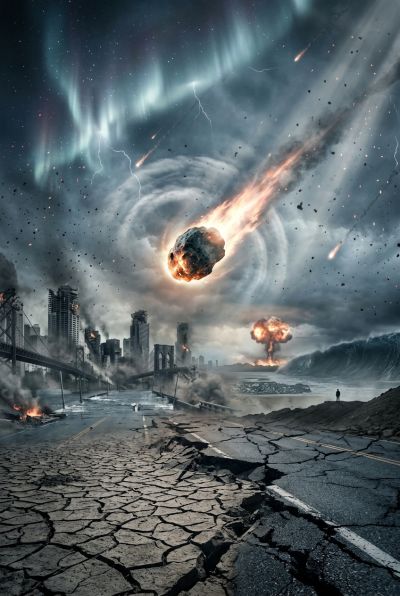
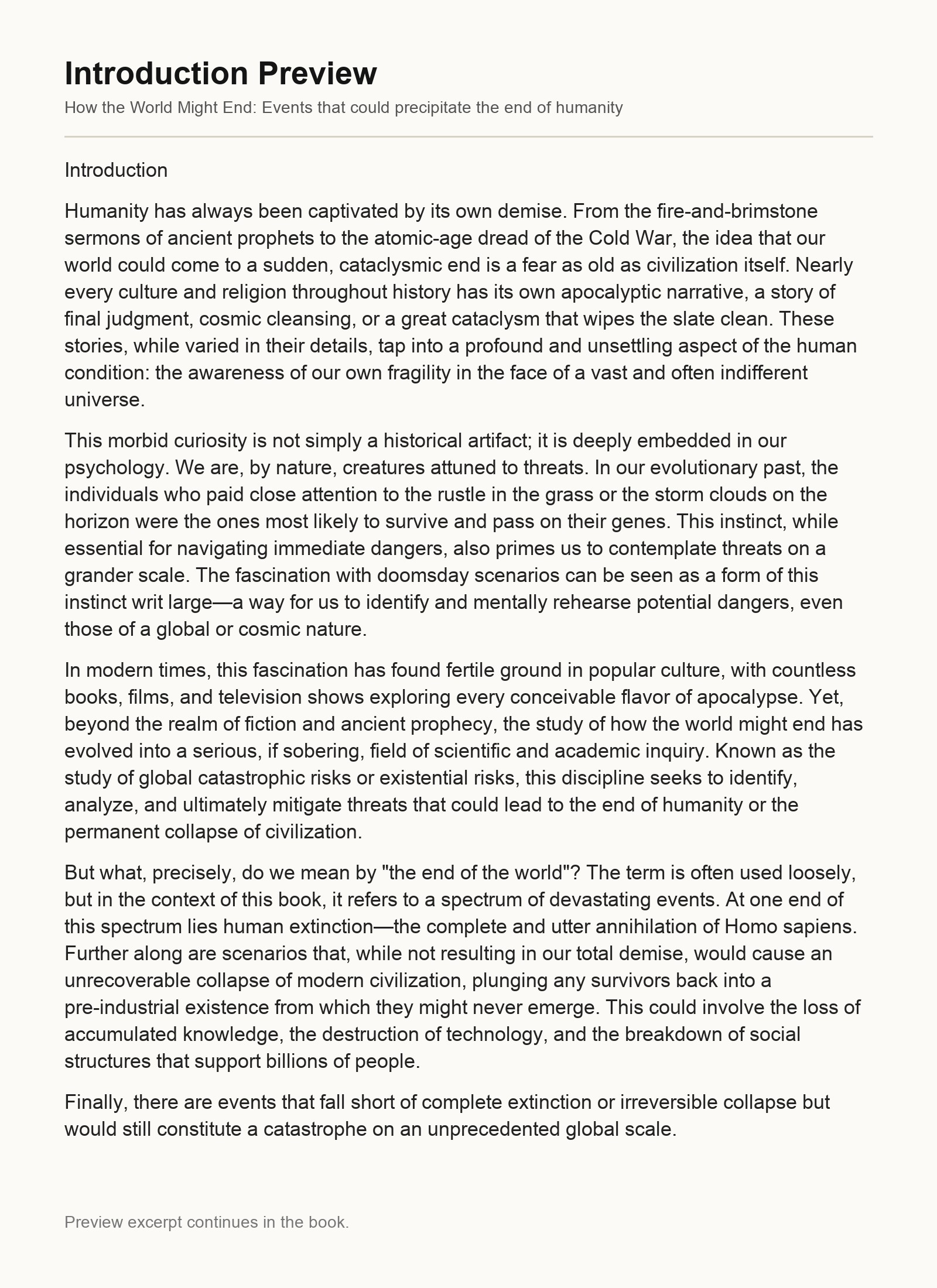
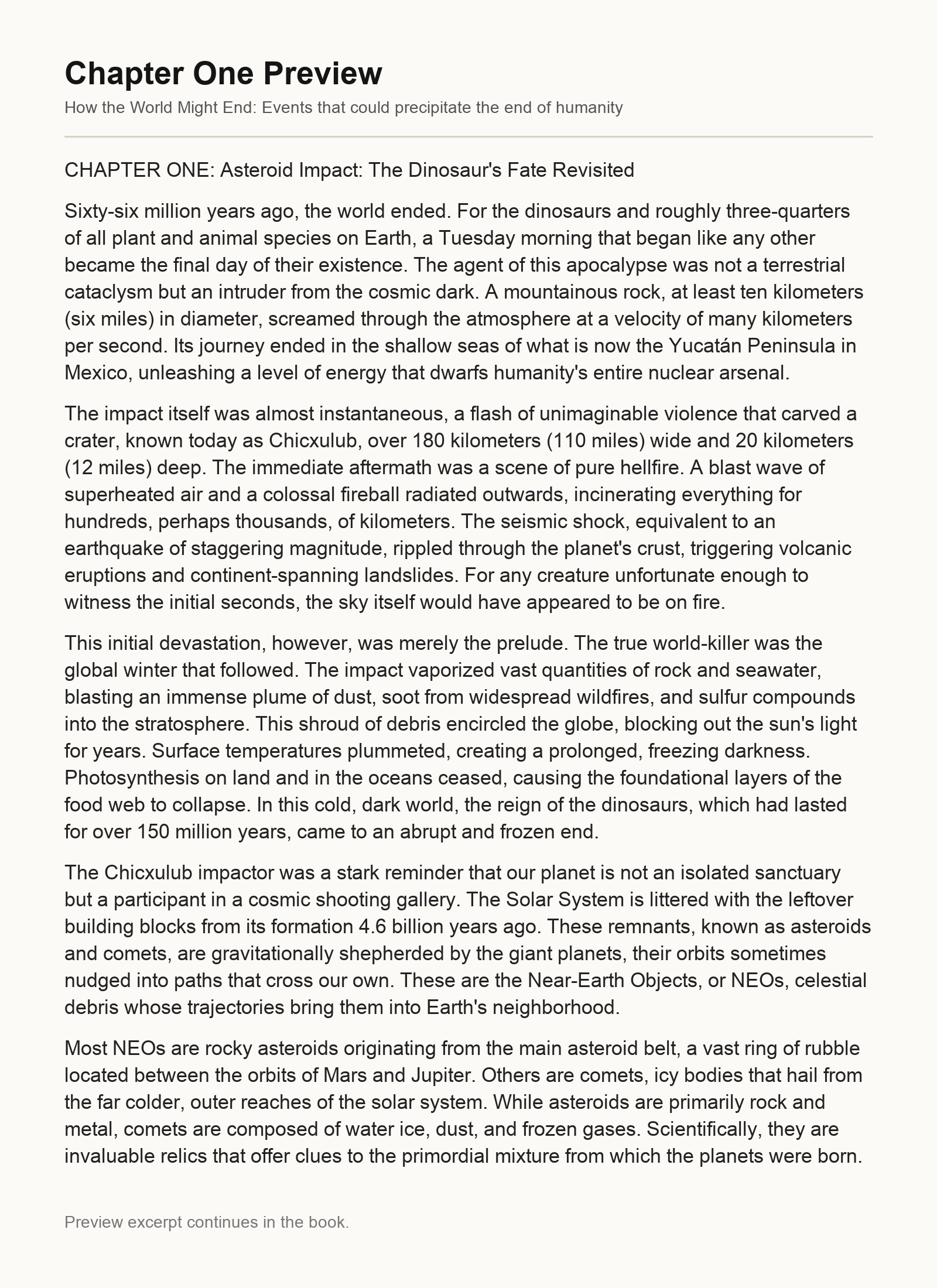
How the World Might End invites readers on a sweeping tour of the myriad ways humanity’s story could come to a close, from the icy reach of a gamma‑ray burst to the quiet creep of a vacuum decay bubble. Each chapter unpacks a distinct existential threat—asteroid impacts, supervolcanoes, climate change, nuclear war, pandemics, bioterrorism, artificial intelligence, nanotechnology, solar flares, resource depletion, ecological collapse, societal breakdown, magnetic pole reversals, methane hydrate release, extraterrestrial encounters, black hole encounters, supernovae, cosmological scenarios like the Big Rip and heat death, and even more speculative dangers such as strangelets, the simulation hypothesis, and the truly unknown. The book blends rigorous science with vivid historical analogues, showing not only what could happen but how likely each scenario is and what, if anything, we can do to avert or survive it.
Readers will gain a clear, accessible understanding of the mechanisms behind each peril: the physics of kinetic impactors and gravity tractors for asteroid defense, the chemistry of stratospheric soot that drives nuclear winter, the feedback loops that turn a methane hydrate release into a runaway greenhouse effect, the alignment problem that underlies AI risk, and the exponential self‑replication logic that fuels the grey goo nightmare. By tracing the evidence—from the iridium layer of the Chicxulub crater to the ice‑60 deposits of ancient supernovae, from the Tunguska airburst to the Carrington solar storm—the text equips readers with the factual foundation needed to assess low‑probability, high‑impact risks without succumbing to sensationalism.
The journey moves seamlessly across disciplines, revealing how cosmic phenomena, planetary geology, biological evolution, and technological innovation intertwine to shape our vulnerability. Chapters on gamma‑ray bursts and black holes illustrate the universe’s raw power, while discussions of supervolcanoes and magnetic pole reversals remind us that deadly forces lie beneath our feet. Sections on pandemics and bioterrorism expose the invisible threats amplified by globalization, and the analyses of artificial intelligence, nanotechnology, and synthetic biology show how our own creations could outpace our control. Finally, philosophical interludes on the simulation hypothesis, vacuum decay, and the unknown unknowns push readers to confront the limits of knowledge and the humility required when facing realities that may lie beyond current comprehension.
Beyond cataloguing doom, the book emphasizes that awareness is the first step toward resilience. Understanding the concrete steps already taken—planetary defense networks, climate mitigation frameworks, pandemic surveillance, AI safety research—shows that humanity is not helpless. The narrative balances stark realism with a sense of agency, illustrating how monitoring near‑Earth objects, strengthening power grids against solar superstorms, preserving biodiversity, and fostering global cooperation can tilt the odds in favor of survival. This knowledge empowers readers to appreciate the precious, fragile nature of our existence and to consider what role they might play in safeguarding it.
Ultimately, How the World Might End offers a thought‑provoking, awe‑inspiring experience that leaves readers with a deeper appreciation for the extraordinary odds that have allowed life to flourish on a tiny rock in a vast cosmos. It challenges complacency, sparks curiosity, and encourages a responsible outlook on the future—whether that means supporting scientific vigilance, advocating for prudent policy, or simply marveling at the intricate tapestry of risks and remedies that define our place in the universe. The book is both a sobering warning and a call to engage with the most vital question of all: how can we ensure that the story of humanity does not have a final chapter?
What You'll Find Inside:
- The book examines both natural cosmic threats (asteroid impacts, supervolcanoes, gamma-ray bursts) and human-made dangers (nuclear war, pandemics, AI) that could cause human extinction or civilizational collapse.
- It explores how climate change and ecological degradation represent slow-motion apocalypses that could unroll the planetary systems supporting human civilization through tipping points and feedback loops.
- The text delves into technological risks from emerging sciences like artificial intelligence (alignment problem), nanotechnology (grey goo scenario), and bioterrorism (designer pathogens) that arise from our own advancement.
- It covers mind-bending cosmic phenomena including vacuum decay, false vacuums, heat death of the universe, and the Big Rip that could end existence itself on a universal scale.
- The book concludes with philosophical considerations including the simulation hypothesis, Fermi Paradox, and the importance of preparing for truly unknown threats to our existence.
Who's It For:
This book is written for intellectually curious readers who seek a scientifically grounded exploration of existential risks facing humanity. It will particularly appeal to those interested in astronomy, physics, environmental science, and technology policy, as well as anyone concerned about humanity's long-term survival. The accessible yet detailed approach makes it suitable for both educated general readers and students in related fields who want to understand the spectrum of threats - from immediate dangers like pandemics to cosmic-scale events like vacuum decay - and what, if anything, can be done to mitigate them.
Table of Contents:
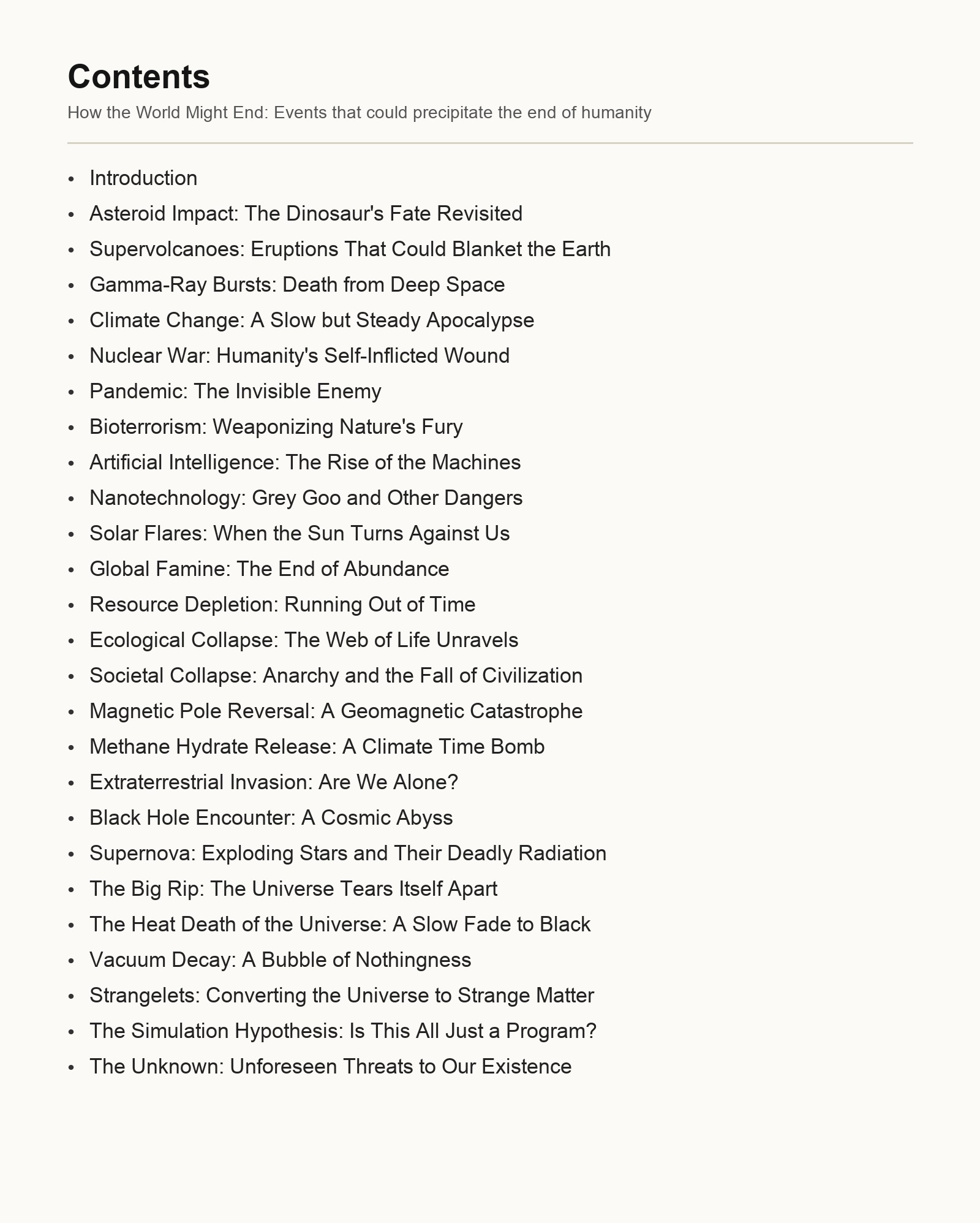
- Introduction
- Asteroid Impact: The Dinosaur's Fate Revisited
- Supervolcanoes: Eruptions That Could Blanket the Earth
- Gamma-Ray Bursts: Death from Deep Space
- Climate Change: A Slow but Steady Apocalypse
- Nuclear War: Humanity's Self-Inflicted Wound
- Pandemic: The Invisible Enemy
- Bioterrorism: Weaponizing Nature's Fury
- Artificial Intelligence: The Rise of the Machines
- Nanotechnology: Grey Goo and Other Dangers
- Solar Flares: When the Sun Turns Against Us
- Global Famine: The End of Abundance
- Resource Depletion: Running Out of Time
- Ecological Collapse: The Web of Life Unravels
- Societal Collapse: Anarchy and the Fall of Civilization
- Magnetic Pole Reversal: A Geomagnetic Catastrophe
- Methane Hydrate Release: A Climate Time Bomb
- Extraterrestrial Invasion: Are We Alone?
- Black Hole Encounter: A Cosmic Abyss
- Supernova: Exploding Stars and Their Deadly Radiation
- The Big Rip: The Universe Tears Itself Apart
- The Heat Death of the Universe: A Slow Fade to Black
- Vacuum Decay: A Bubble of Nothingness
- Strangelets: Converting the Universe to Strange Matter
- The Simulation Hypothesis: Is This All Just a Program?
- The Unknown: Unforeseen Threats to Our Existence
Author:
Published By:
Date Published:
May 29, 2026
Type:
Nonfiction
Language:
English
Also Available In:
Word Count:
50,743 words
Reading Time:
3 hours 33 minutes
Sample:
Order:
Buy the How the World Might End ebook on MixCache.com:
Buy NowThe full ebook will be available immediately to read instantly on any device.
$5 account credit for all new MixCache.com accounts, usable toward any ebook purchase!*





Ratings & Reviews
Ask Questions About This Book
Have a question about the content? Ask our AI assistant!
Start by asking a question about "How the World Might End"
Example: "Does this book mention William Shakespeare?"
Thinking...