
Browse by Category
Fiction
- Action & Adventure
- African American
- Anthologies
- Children's Fiction
- Classics
- Comics & Graphic Novels
- Coming of Age
- Contemporary
- Cultural & Regional
- Drama
- Erotica
- Fantasy
- General
- Historical Fiction
- Horror
- Humor & Satire
- Literary Fiction
- Mystery, Thriller & Suspense
- Poetry
- Religious & Inspirational
- Romance
- Science Fiction
- Short Stories
- War & Military
- Westerns
- Women's Fiction
- Young Adult
Non-Fiction
- Antiques & Collectibles
- Arts & Photography
- Biographies & Memoirs
- Business & Money
- Children's Non-Fiction
-
Computers & Technology
- Artificial Intelligence
- Computer Science
- Cybersecurity & Cryptography
- Data Science & Analytics
- Databases & Big Data
- Game Development & Design
- General
- Hardware & DIY
- Mobile App Development
- Networking & Cloud Computing
- Operating Systems
- Programming
- Robotics
- Software
- Software Engineering
- User Experience (UX) & Design
- Web Development & Design
- Cooking, Food & Wine
- Crafts, Hobbies & Home
- Education & Teaching
- Engineering
- General
- Health, Fitness & Dieting
-
History
- African History
- African History - North Africa
- African History - Sub-Saharan Africa
- American History
- American History - 20th Century
- American History - Civil War
- American History - Colonial Period
- Ancient History
- Asian History
- Asian History - China
- Asian History - India
- Asian History - Japan
- Asian History - Southeast Asia
- European History
- European History - Ancient Greece
- European History - Ancient Rome
- European History - Medieval
- European History - Modern
- European History - Renaissance
- General
- Middle Eastern History
- Military History
- Military History - Aviation
- Military History - Naval
- Social & Cultural History
- World History
- Humor & Entertainment
- Industrial Technology
- Language Learning
- Law
- LGBTQ+ Non-Fiction
- Literary Criticism
- Medical Books
- Parenting & Relationships
- Philosophy
- Politics & Social Sciences
- Reference
- Religion & Spirituality
-
Science & Math
- Agricultural Sciences
- Astronomy & Space Science
- Behavioral Sciences
- Biological Sciences
- Botany & Plant Science
- Chemistry
- Earth Sciences
- Engineering - Chemical
- Engineering - Civil
- Engineering - Electrical
- Engineering - Mechanical
- Environment
- General
- Geology
- Mathematics
- Nature & Ecology
- Oceanography
- Paleontology
- Physics
- Statistics
- Self-Help
- Sports & Outdoors
- Study Aids
- Sustainability & Green Living
- Textbooks
- Transportation
- Travel
- True Crime
- Urban Planning & Development
- Veterinary Medicine
- Writing & Publishing
Jump to Section
MixCache.com Total Access
Unlimited reading and audiobooks for every book published by MixCache.com.
Included titles carry the MTA badge.
Learn more →
Smoke, Salt, Vinegar: Rustic Techniques That Transform Food and Wine Pairing
MTA
Mastering preservation methods to amplify pairings and complementary textures
About this book:
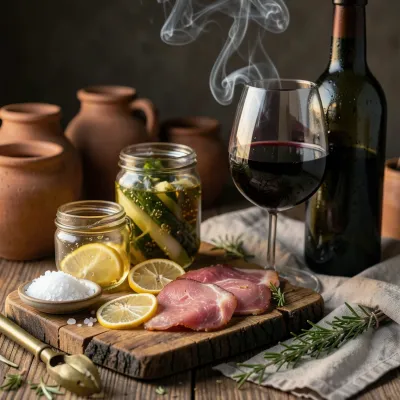
*Smoke, Salt, Vinegar* is a culinary manual that explores how traditional preservation techniques—smoking, curing, brining, and pickling—fundamentally re-engineer the chemical and structural properties of food to enhance wine pairing. The book moves beyond basic flavor profiles, focusing on how these methods manipulate "flavor vectors" like water activity, protein density, and pH levels to influence the way a wine’s tannins, acidity, and fruit are perceived on the palate. By treating preservation as an active design tool, the text provides a framework for cooks and sommeliers to intentionally calibrate the dining experience.
The book is organized by technique, beginning with the physics of smoke. It distinguishes between cold smoking, which adds aromatic phenols without changing texture, and hot smoking, which introduces Maillard depth and rendered fats that soften tannic red wines. Subsequent chapters delve into the science of salinity and acidity, explaining how dry curing concentrates umami and firms proteins to create "bridges" to structured wines, while lactic fermentation creates a rounded acidity that harmonizes more easily with wine than the sharp acetic snap of quick vinegar pickles. Each section emphasizes the importance of precision through tools like salinometers, pH meters, and meticulous documentation.
Beyond specific methods, the author introduces a pairing framework centered on the concepts of "Mirror, Bridge, and Contrast." This systematic approach encourages the use of preserved staples—such as cured egg yolks, smoked oils, and fermented vegetables—as architectural elements that can either echo a wine’s barrel notes, connect disparate flavor profiles through savory depth, or provide necessary palate-cleansing relief from richness. The text also highlights the affinity between "minimal intervention" natural or skin-contact wines and the microbial complexity of fermented foods, suggesting that both represent a shared philosophy of respectful transformation.
The final portion of the book serves as a practical guide for professionals, offering "tasting labs" to train the palate and strategies for designing menus and cellars. By treating the kitchen as a laboratory for sensory calibration, the book argues that preservation is not merely a means of preventing spoilage, but a sophisticated language of flavor. Ultimately, it empowers chefs and restaurateurs to move away from accidental pairings toward a practice of deliberate design, where the transformation of the ingredient is carefully choreographed to meet the specific architecture of the wine in the glass.
What You'll Find Inside:
- Preservation techniques such as smoking, curing, and pickling actively reshape food's flavor, texture, and aroma, which in turn alters how wine's tannin, acidity, and fruit are perceived.
- Salt, acid, umami, and texture are fundamental levers that can be adjusted to either mirror, bridge, or contrast a wine's characteristics, creating intentional pairings.
- Cold and hot smoking, dry curing, brining, fermentation, and dehydration each produce distinct structural and aromatic effects that can be calibrated to suit specific wine styles.
- Understanding the difference between measured pH and perceived acidity, and how sugar, salt, fat, and texture modulate sourness, is essential for achieving harmonious food‑wine balance.
- The book provides practical tools, safety guidelines, tasting labs, and a pairing framework to help cooks and sommeliers design repeatable, preservation‑driven menus and cellar selections.
Who's It For:
Adventurous cooks, restaurateurs, and sommeliers seeking to master preservation methods (smoke, salt, vinegar, curing, fermentation, dehydration) as intentional levers for wine pairing. The book is ideal for those who want to design repeatable, technique‑driven menus and cellar choices, using tasting labs and a mirror‑bridge‑contrast framework to create harmonious, intellectually satisfying food‑wine experiences.
Table of Contents:
- Introduction
- Chapter 1 The Preservation Mindset: Why Old Methods Make New Pairings
- Chapter 2 Taste and Structure: Salt, Acid, Umami, Texture, and Wine
- Chapter 3 Tools, Materials, and Safety for Smoking, Curing, and Pickling
- Chapter 4 Cold Smoking: Capturing Aroma Without Heat
- Chapter 5 Hot Smoking: Managing Wood, Heat, and Time
- Chapter 6 Smoke Meets the Glass: Aromatic Bridges to Wine
- Chapter 7 Dry Curing: Salt, Sugar, and Time as Ingredients
- Chapter 8 Brining: Osmosis, Equilibrium, and Juiciness
- Chapter 9 Culture-Driven Cures: Molds, Enzymes, and Safe Fermentation
- Chapter 10 Salt and Perception: Sweetness, Bitterness, Umami, and Tannin
- Chapter 11 Quick Pickles: Speed, Crunch, and Brightness
- Chapter 12 Fermented Pickles: Lactic Depth and Living Acidity
- Chapter 13 Vinegar Varieties: Styles, Production, and Culinary Use
- Chapter 14 Acid in Balance: pH, Perceived Acidity, and Wine Harmony
- Chapter 15 Dehydration and Concentration: Flavor Density and Mouthfeel
- Chapter 16 Fat as Counterpoint: Smoked Oils, Cured Fats, and Emulsions
- Chapter 17 Texture Design: Crunch, Snap, Silk, and Foam
- Chapter 18 A Pairing Framework: Mirror, Bridge, and Contrast
- Chapter 19 Working with Tannin: Strategies for Reds and Rosés
- Chapter 20 Bubbles and Brine: Sparkling Wines with Salty and Acidic Foods
- Chapter 21 Sweetness, Heat, and Smoke: Calibrating Intensity
- Chapter 22 Skin-Contact and Natural Wines: Texture Meets Fermentation
- Chapter 23 Core Staples: Smoked, Cured, and Pickled Foundations
- Chapter 24 Tasting Labs and Experiments: Training the Palate
- Chapter 25 Designing Menus and Cellars for Preservation-Driven Cuisine
Author:
Published By:
Date Published:
May 9, 2026
Type:
Nonfiction
Language:
English
Word Count:
56,799 words
Reading Time:
3 hours 59 minutes
Sample:
Order:
Order Smoke, Salt, Vinegar: Rustic Techniques That Transform Food and Wine Pairing (Paperback) on MixCache.com:
Buy NowPrint copy is made to order and ships worldwide. Includes the ebook free, ready to read instantly.
$5 account credit for all new MixCache.com accounts, usable toward any ebook purchase!*


