
Browse by Category
Fiction
- Action & Adventure
- African American
- Anthologies
- Children's Fiction
- Classics
- Comics & Graphic Novels
- Coming of Age
- Contemporary
- Cultural & Regional
- Drama
- Erotica
- Fantasy
- General
- Historical Fiction
- Horror
- Humor & Satire
- Literary Fiction
- Mystery, Thriller & Suspense
- Poetry
- Religious & Inspirational
- Romance
- Science Fiction
- Short Stories
- War & Military
- Westerns
- Women's Fiction
- Young Adult
Non-Fiction
- Antiques & Collectibles
- Arts & Photography
- Biographies & Memoirs
- Business & Money
- Children's Non-Fiction
-
Computers & Technology
- Artificial Intelligence
- Computer Science
- Cybersecurity & Cryptography
- Data Science & Analytics
- Databases & Big Data
- Game Development & Design
- General
- Hardware & DIY
- Mobile App Development
- Networking & Cloud Computing
- Operating Systems
- Programming
- Robotics
- Software
- Software Engineering
- User Experience (UX) & Design
- Web Development & Design
- Cooking, Food & Wine
- Crafts, Hobbies & Home
- Education & Teaching
- Engineering
- General
- Health, Fitness & Dieting
-
History
- African History
- African History - North Africa
- African History - Sub-Saharan Africa
- American History
- American History - 20th Century
- American History - Civil War
- American History - Colonial Period
- Ancient History
- Asian History
- Asian History - China
- Asian History - India
- Asian History - Japan
- Asian History - Southeast Asia
- European History
- European History - Ancient Greece
- European History - Ancient Rome
- European History - Medieval
- European History - Modern
- European History - Renaissance
- General
- Middle Eastern History
- Military History
- Military History - Aviation
- Military History - Naval
- Social & Cultural History
- World History
- Humor & Entertainment
- Industrial Technology
- Language Learning
- Law
- LGBTQ+ Non-Fiction
- Literary Criticism
- Medical Books
- Parenting & Relationships
- Philosophy
- Politics & Social Sciences
- Reference
- Religion & Spirituality
-
Science & Math
- Agricultural Sciences
- Astronomy & Space Science
- Behavioral Sciences
- Biological Sciences
- Botany & Plant Science
- Chemistry
- Earth Sciences
- Engineering - Chemical
- Engineering - Civil
- Engineering - Electrical
- Engineering - Mechanical
- Environment
- General
- Geology
- Mathematics
- Nature & Ecology
- Oceanography
- Paleontology
- Physics
- Statistics
- Self-Help
- Sports & Outdoors
- Study Aids
- Sustainability & Green Living
- Textbooks
- Transportation
- Travel
- True Crime
- Urban Planning & Development
- Veterinary Medicine
- Writing & Publishing
Jump to Section
MixCache.com Total Access
Unlimited reading and audiobooks for every book published by MixCache.com.
Included titles carry the MTA badge.
Learn more →
The Persian Kitchen: Food, Identity, and Culinary History of Iran
MTA
A cultural and historical exploration of Persian cuisine and regional foodways
About this book:
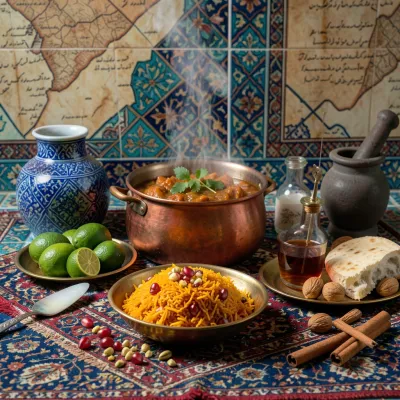
"The Persian Kitchen: Food, Identity, and Culinary History of Iran" offers a comprehensive exploration of Iranian cuisine, transcending mere recipes to delve into the cultural, historical, and geographical factors that have shaped its diverse foodways. The book meticulously traces the evolution of Persian food from ancient empires and Silk Road trade routes to modern diaspora kitchens, demonstrating how ingredients, techniques, and social rituals have been continuously adapted and reimagined across centuries. It highlights the centrality of staples like wheat (bread) and rice, showcasing the meticulous art of their preparation and their architectural role in meal structure.
The text emphasizes the importance of balancing flavors, particularly the interplay of fragrance (saffron, rose water) and tartness (pomegranate, dried limes, verjuice), which is a hallmark of Persian cooking. It extensively covers the diverse roles of herbs, dairy (especially fermented products like yogurt and kashk), and a nuanced spice palette that reflects centuries of trade and cultural exchange. Through detailed chapters dedicated to regional cuisines, the book illustrates how local climates, agricultural practices, and historical influences—from the rain-fed abundance of Gilan and the hearty, Turkic touches of Azerbaijan to the desert craft of Kerman and the maritime flavors of Hormozgan—have each contributed unique characteristics to the broader Iranian culinary identity.
Beyond ingredients and techniques, the book examines the social dimensions of food, focusing on how meals serve as vessels for hospitality, community, and the transmission of knowledge. It explores the significance of markets and bazaars as sensory hubs, the gendered nature of domestic labor and culinary authority within the kitchen, and the role of food in sacred and seasonal celebrations like Nowruz, Ramadan, and Yalda. The final chapter addresses the dynamism of Iranian food in the diaspora, highlighting how immigrant communities innovate and adapt traditional recipes, using food as a vital link to cultural identity, memory, and a means of engaging with new environments and audiences.
Ultimately, "The Persian Kitchen" presents Iranian cuisine as a living, evolving tradition, deeply intertwined with the land, its history, and the people who prepare and share it. It portrays the Persian table not just as a place for sustenance, but as a stage for intricate negotiations of flavor, time, labor, and social connection, where every dish tells a story of resilience, adaptation, and an enduring commitment to generous hospitality.
What You'll Find Inside:
- Explores how Iran's diverse geography—mountains, rivers, deserts, and coasts—shapes regional ingredients, cooking techniques, and meal structures.
- Traces the evolution of Persian cuisine from ancient empires to modern diaspora, showing how trade, migration, and political change continually remake the table.
- Highlights central pantry staples (wheat, rice, herbs, saffron, dried limes, yogurt) and preservation practices (fermentation, pickling) that create depth and balance.
- Examines social rituals of food—bread and rice as foundations, stews and soups as communal vessels, kebabs as ceremonial grilling, and tea/coffeehouses as spaces of hospitality and conversation.
- Connects seasonal festivals (Nowruz, Ramadan, Yalda) and gendered kitchen knowledge to illustrate how food encodes identity, memory, and cultural continuity across Iran and its diaspora.
Who's It For:
This book is ideal for food scholars, culinary historians, and students seeking a deep cultural and historical analysis of Iranian cuisine. It also serves travelers who wish to read markets and meals with a sensory lens, home cooks eager to understand the 'why' behind techniques, and members of the Iranian diaspora looking to reconnect with regional foodways and ancestral flavors.
Table of Contents:
- Introduction
- Chapter 1 Landscapes of Taste: Geography and the Making of Persian Foodways
- Chapter 2 From Empire to Table: A Historical Timeline of Iranian Cuisine
- Chapter 3 The Persian Pantry: Staples, Spices, and Signature Aromatics
- Chapter 4 Water, Wheat, Fire: Bread, Rice, and the Architecture of Meals
- Chapter 5 Herbs and the Color Green: Sabzi in Daily Life and Ceremony
- Chapter 6 Saffron, Rose, and Sour: Balancing Fragrance and Tartness
- Chapter 7 Stews and Soups: Khoresht and Ash as Social Vessels
- Chapter 8 Kebabs Beyond the Grill: Technique, Ritual, and Regional Variants
- Chapter 9 Pickles, Yogurt, and Fermentation: Preserving Seasons, Shaping Identity
- Chapter 10 Tea, Coffeehouses, and Conversation: Spaces of Hospitality
- Chapter 11 Sweets and the Language of Celebration: From Gaz to Sohan
- Chapter 12 Markets, Bazaars, and Gardens: Seasonality, Design, and Supply
- Chapter 13 Gilan and the Caspian Larder: Rice, Fish, and Rainfed Abundance
- Chapter 14 Azerbaijan and the Northwest: Hearty Dishes and Turkic Touches
- Chapter 15 Khorasan and the Northeast: Saffron Fields and Caravan Legacies
- Chapter 16 Khuzestan and the Southwest: Date Palms, Rivers, and Border Blends
- Chapter 17 Fars and Shiraz: Poets’ Cities and Herb-Forward Cuisine
- Chapter 18 Isfahan and Central Iran: Geometry of Flavor in a Historic Capital
- Chapter 19 Kerman and the Southeast: Spice Routes and Desert Craft
- Chapter 20 Kurdistan and the Zagros: Pastoral Larders and Mountain Hearths
- Chapter 21 Baluchestan and the Coast: Heat, Trade, and Maritime Tastes
- Chapter 22 Hormozgan and the Persian Gulf: Indian Ocean Currents on the Table
- Chapter 23 The Sacred and the Seasonal: Nowruz, Ramadan, Muharram, and Yalda
- Chapter 24 Women, Kitchens, and Knowledge: Domestic Labor and Culinary Authority
- Chapter 25 Diaspora, Innovation, and the Future: Iranian Food Across Borders
Author:
Published By:
Date Published:
April 30, 2026
Type:
Nonfiction
Language:
English
Word Count:
75,197 words
Reading Time:
5 hours 16 minutes
Sample:
MixCache.com Total Access
Get unlimited access to this book + all books published by MixCache.com for $11.99/month
Subscribe to MTAOr purchase this book individually below
Order:
Buy the The Persian Kitchen: Food, Identity, and Culinary History of Iran ebook on MixCache.com:
Buy Now
Full ebook will be available immediately
- read online or download as a PDF file.
$5 account credit for all new MixCache.com accounts, usable toward any ebook purchase!*





Ratings & Reviews
Ask Questions About This Book
Have a question about the content? Ask our AI assistant!
Start by asking a question about "The Persian Kitchen: Food, Identity, and Culinary History of Iran"
Example: "Does this book mention William Shakespeare?"
Thinking...