

An Excerpt from “War in Gaza”
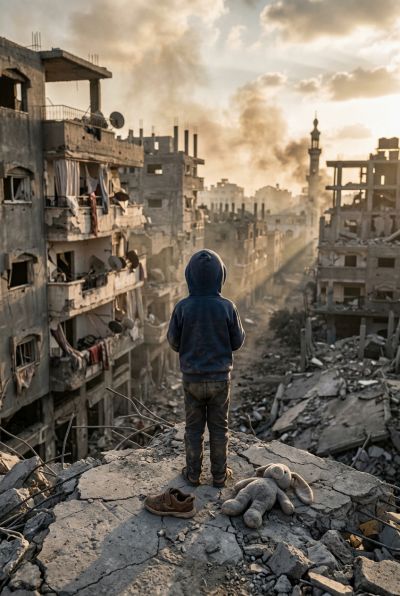
The following is an excerpt from “War in Gaza” by Kairos Valente, available on MixCache.com.
Introduction
This book is an account of a war that, as of this writing in August 2025, refuses to end. It is a chronicle of events that began with a shocking act of violence and spiraled into one of the most destructive conflicts of the 21st century, reshaping the Middle East and sending ripples of discord across the globe. For nearly two years, the Gaza Strip, a sliver of land packed with more than two million souls, has been the epicenter of a cataclysm that has consumed tens of thousands of lives, shattered a society, and ignited fierce political and ideological battles far from its devastated cityscapes. The dust has not settled; in many ways, the storm is still raging.
The war began on October 7, 2023. On a quiet holiday morning, Hamas and other Palestinian militant groups launched an unprecedented, multi-pronged assault from the Gaza Strip into southern Israel. Militants breached the heavily fortified border, attacking military bases and civilian communities, killing some 1,200 people and taking more than 250 hostage. The scale and brutality of the attack, the deadliest in Israel's history, traumatized the nation and triggered a declaration of war from its leaders. "We are at war," Prime Minister Benjamin Netanyahu announced, setting the stage for a military response of unparalleled ferocity.
What followed was a relentless campaign that aimed to eradicate Hamas and secure the return of the hostages. This book will chart the course of that campaign, from the initial, furious aerial bombardment of Gaza to the systematic ground invasions that reduced vast urban areas to rubble. It will document the key phases of the war: the assault on Gaza City and the north, the grueling battles for control of Khan Younis in the south, and the controversial and bloody offensive into Rafah, a city teeming with displaced civilians. We will venture into the subterranean battlefield of Gaza’s infamous tunnels, a strategic labyrinth that proved central to the fighting.
But the story of this war is not confined to the Gaza Strip. It is a conflict that quickly metastasized, drawing in a host of regional and international actors. On Israel’s northern border, a simmering conflict with Hezbollah, the powerful Iran-backed militia in Lebanon, erupted into a near-daily exchange of fire that displaced tens of thousands on both sides and eventually escalated into a brief, but devastating, full-scale war. In the Red Sea, the Houthi movement in Yemen began attacking commercial shipping, disrupting global trade in a declared act of solidarity with the Palestinians. These actions drew a military response from the United States and its allies, transforming a vital waterway into another volatile front.
Throughout these events, the role of the United States has been pivotal and contentious. Washington provided extensive military and diplomatic support to Israel, including billions in aid and the resupply of critical munitions, while also attempting to navigate the escalating humanitarian crisis and press for a resolution. This complex relationship, its internal tensions, and its impact on the course of the war and the wider region will be a recurring theme in the pages that follow. The shifting tides of American policy, often caught between staunch support for an ally and growing international and domestic pressure, became a central drama of the conflict.
This book also seeks to chronicle the immense human cost of the war. As of mid-2025, the toll on Palestinian civilians is staggering, with tens of thousands killed and well over a hundred thousand injured. The vast majority of Gaza's population has been displaced, many multiple times, living in makeshift shelters amid a landscape of ruins. Israel’s intense blockade, implemented in the early days of the war, plunged the territory into a catastrophic humanitarian crisis, with severe shortages of food, water, medicine, and fuel. By August 2025, international agencies officially declared a state of famine in parts of Gaza, a stark testament to the suffering endured by its people.
The fate of the Israeli hostages taken on October 7th became a source of national anguish in Israel and a key sticking point in protracted negotiations for a ceasefire. Their plight, and the desperate efforts to secure their release through both military action and diplomatic channels, is a critical thread in this narrative. The brief truce in November 2023, which saw the exchange of some hostages for Palestinian prisoners, offered a fleeting glimmer of hope, but it soon collapsed, and the war resumed with renewed intensity. Subsequent efforts at mediation, involving Qatar, Egypt, and the United States, were fraught with difficulty, punctuated by periods of intense fighting. A second, longer ceasefire was eventually implemented in early 2025, but it too proved fragile.
Beyond the battlefield, the war has been fought on other fronts. We will examine the information war, a dizzying contest of narratives, propaganda, and media coverage that has shaped global perceptions of the conflict. In an age of social media, the battle for public opinion has been waged with unprecedented fervor, often blurring the lines between fact, fabrication, and perspective. This clash of narratives fueled a massive global protest movement, with citizens in cities around the world taking to the streets to voice their support for one side or the other, and to demand an end to the violence.
The legal and ethical dimensions of the war have also come under intense scrutiny. Allegations of war crimes have been leveled against both Israel and Hamas, prompting investigations by international bodies. The conflict has raised profound questions about the application of international humanitarian law in the context of asymmetric warfare and urban combat. These debates, held in courtrooms and in the court of public opinion, will be explored in detail, presenting the arguments and accusations from all sides.
This book is structured to provide a comprehensive and chronological account of this multifaceted conflict. We will begin by delving into the historical roots that stretch back decades, examining the rise of Hamas and the state of the Gaza Strip before the war, to provide the essential context for understanding the events of October 7th. From there, we will proceed through the major military campaigns, the diplomatic maneuvering, and the widening regional confrontations. We will also dedicate chapters to the civilian experience, the hostage crisis, the role of key international players, and the economic and social impacts of the war.
Finally, we will arrive at the present moment, August 2025. This is a story without a neat conclusion. The war, in its various forms, continues. Plans for the "day after" in Gaza remain contested and uncertain, and the future for both Israelis and Palestinians is deeply unsettled. This book is, therefore, a first draft of history, an attempt to make sense of a complex and ongoing tragedy. Its aim is not to preach or to offer simple solutions, but to lay out the facts as clearly as possible, to present the multiple perspectives involved, and to provide the reader with a thorough understanding of a war that has left an indelible mark on our time.
Read “War in Gaza” on MixCache.com →
Please log in or create an account to leave a comment.
No comments yet. Be the first to say something.