

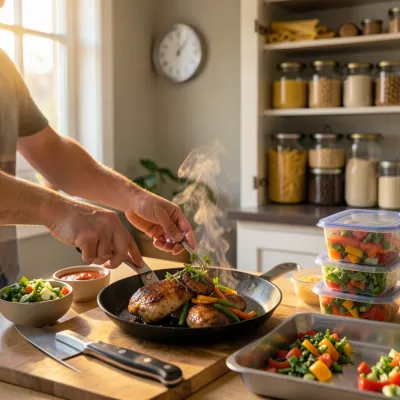
If you've ever stared into your fridge at 6:30 PM wondering how to get dinner on the table by 7:00 without resorting to takeout, you're not alone. The Weeknight Gourmet doesn't promise another collection of 30-minute recipes that assume you have pre-chopped vegetables and a stocked spice rack. Instead, it offers a coherent system for making those tight timelines work in real kitchens with real constraints.
The Weeknight Gourmet is structured around what author Tyler Wilson calls the '30-minute mindset' - not a rigid clock-watching exercise, but a framework for treating weeknight cooking as a sustainable habit. The book moves from foundational concepts (mise en place, pantry building, knife skills) to specific techniques (one-pan meals, sheet-pan dinners, skillet sprints) and protein-specific strategies, before circling back to make-ahead components, leftover reinvention, and budget considerations. It's designed for anyone who feels torn between wanting to eat well and having limited evening time - whether you're a professional squeezing dinner between deadlines, a parent feeding a household, or simply someone who values home-cooked meals but struggles with weekday exhaustion.
The 30-Minute Mindset: More Than Just a Timer
Rather than treating 30 minutes as an arbitrary limit to rush against, Wilson reframes it as a 'negotiation with time' where planning inside the boundary allows flavor to take center stage. As he writes in Chapter 1, 'This is not a race against the clock; it is a negotiation with it, and the first rule of negotiation is knowing what you have to trade.' The core of this approach is mise en place - not as a French affectation but as a 'practical truce between intention and reality.' By organizing ingredients before heat hits the pan, you replace frantic improvisation with calm execution, protecting 'the fragile window between tired and fed.' This mindset shift transforms cooking from a daily crisis into a sustainable habit where 'good food is not an accident. It is an arrangement.'
Building Your Weeknight Engine: The Smart Pantry Approach
Chapter 2 argues that weeknight success begins long before you reach for a knife, starting with how you see your pantry shelves. Wilson introduces the concept of 'layered staples' - ingredients that 'behave well across cuisines and techniques so you can pivot from craving to craving without buying a new bottle or packet for every meal.' These include grains and starches (treated as 'speed demons' when pre-prepped), canned and jarred goods (deserving 'respect rather than apology'), fats and acids ('quiet conductors of flavor'), spices, sauces, fresh aromatics, and dairy. The goal isn't a stockpile but a 'system of ready answers' where 'you buy with purpose, you store with sense, and you cook with a lighter mental load because the groundwork is already laid.' Smart shopping becomes 'an act of editing rather than accumulation' focused on 'flexible building blocks' that create calm rather than anxiety.
Make-Ahead Magic: Cooking for Your Future Self
Chapters 20 and 21 focus on borrowing time from your future self through strategic preparation. Wilson describes make-ahead components as 'flavor as a bank account' where 'every sauce you whisk, every dressing you emulsify, and every aromatic paste you blend is a deposit that pays interest later in the week.' The freezer isn't for forgotten leftovers but for 'flat freezing' components like sauces, roasted vegetables, and cooked grains that become 'small, manageable tools that fit the rhythm of a thirty-minute meal.' This approach reduces decision fatigue by turning 'the question of what to eat into a choice rather than a crisis,' with the key insight that 'you are not spending Sunday in the kitchen; it is about using small pockets of time to create building blocks that speed up your weeknights.' The emphasis is on preserving options, not perfection - 'a bag of chili in the freezer is only useful if you know what it is and when it went in.'
From Pantry to Plate: The Modular Meal Approach
Rather than rigid recipes, Wilson promotes flexible frameworks like 'big salads' and 'buildable bowls' that allow for customization without multiple separate preparations. As noted in Chapters 10 and 19, these approaches treat meals as 'architecture' where 'grains, greens, proteins, sauces, and textures are assembled with the precision of a staging area rather than the rigidity of a recipe.' The bowl format, in particular, lets you 'think in layers rather than steps' where 'most components can cook or sit independently, then meet at the end without argument.' This modularity accommodates different dietary needs within one meal - 'a vegetarian bowl can become a pescatarian bowl with the addition of a piece of fish' - while reducing the mental load of weekday cooking. As Wilson puts it, 'The bowl becomes a canvas rather than a compromise, and the thirty-minute limit feels less like a boundary and more like a comfortable frame.'
Who Should Read This
This book will resonate most with readers who feel overwhelmed by weeknight cooking but aren't looking for yet another collection of aspirational recipes that ignore real-life constraints. It's ideal for those who appreciate understanding the 'why' behind techniques - not just following steps, but learning to build a kitchen system that works with their actual schedule, budget, and energy levels. If you've tried 30-minute cookbooks before and found them frustrating because they assumed ideal conditions you don't have, this approach might finally click. However, if you're looking for elaborate gourmet recipes or strict meal plans, you may want to look elsewhere. The Weeknight Gourmet succeeds by meeting readers where they are - in the messy reality of busy lives - and offering practical, adaptable strategies that make good food possible without demanding perfection.
Read “The Weeknight Gourmet: 30-Minute Dinners for Busy Lives” on MixCache.com →
Please log in or create an account to leave a comment.
No comments yet. Be the first to say something.