

Six Centuries of Resistance: How Assam Survived Empires
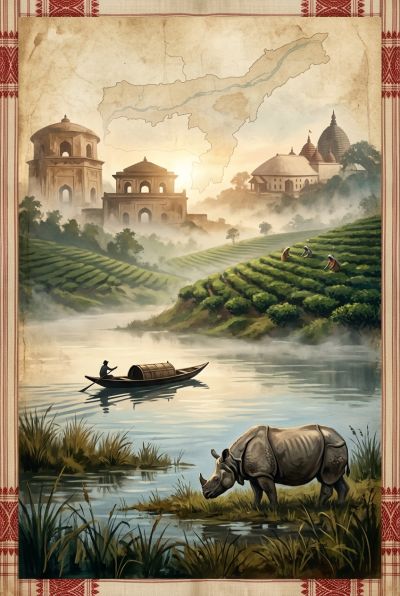
In the northeastern corner of India, a land of red rivers and blue hills has witnessed the rise and fall of empires while forging an identity that refuses to be erased. William Montclair's Een geschiedenis van Assam maps this extraordinary continuity across twenty-five chapters, revealing how geography, migration, and resistance shaped a region that remains distinct within the Indian subcontinent.
What the book is about
The book moves chronologically from the mythical origins of Pragjyotisha — referenced in the Mahabharata and Kalika Purana — through the Varman, Salastambha, and Pala dynasties that established early political and cultural foundations. The narrative then centers on the Ahom kingdom's nearly six-hundred-year rule, detailing its unique Paik labor-military system, the decisive Battle of Saraighat against the Mughals, and the syncretic culture that blended Tai-Ahom traditions with Hindu practices. Later chapters examine British annexation after the Treaty of Yandaboo (1826), the transformation of Assam's economy through opium monopoly and tea plantations, the freedom struggle featuring figures like Kanaklata Barua and Gopinath Bordoloi, and post-independence challenges including Partition's geographic isolation, refugee crises, ethnic movements, and the ongoing negotiation of Assamese identity amid diverse tribal communities. Written for general readers and students of South Asian history, the book draws on Buranji chronicles, inscriptions, and colonial records to construct a narrative that balances political history with social, economic, and cultural analysis.
The Ahom Paik system: A state built on shared obligation
One of the book's most striking contributions is its detailed exposition of the Paik system, which Montclair calls "the backbone of Ahom power." Unlike revenue systems based on cash taxation, every able-bodied male between sixteen and fifty owed rotational labor service to the state — military duty, public works, or craft production — in exchange for tax-exempt land (ga-mati). The system organized men into hierarchical units: a bora commanded twenty paiks, a saikia one hundred, a hazarika one thousand, and a rajkhowa three thousand, with the Borphukan and Barbarua at the apex. This structure "ensured a constant supply of labor for large-scale public projects and, crucially, a massive standing army that could be mobilized quickly in times of war." The khel system further grouped paiks by specialized skills — shipbuilding, weapon-making, engineering — creating a resilient, self-sufficient state apparatus that sustained Ahom independence for centuries.
Saraighat: River warfare as strategic genius
The 1671 Battle of Saraighat receives a chapter-long treatment that illustrates how geography became Assam's greatest weapon. When Mughal forces under Raja Ram Singh I advanced with a formidable fleet, Ahom commander Lachit Borphukan "lured the Mughal fleet into narrow channels where their larger ships were less maneuverable, and then fell upon them with his smaller, faster boats." Despite severe illness, Borphukan personally rallied retreating soldiers with words that Montclair quotes verbatim: "It is a misfortune that my country faces this fleeing crisis. How can I, as commander, flee and seek refuge? Let my body fall on the field, and let the country be victorious." The Ahom victory was not merely military but psychological: "Every Assamese soldier is a Borphukan," the defeated Mughal commander reportedly acknowledged. Montclair frames Saraighat as a defining moment where "indigenous military genius, strategic planning, and unwavering national spirit" defeated an imperial power, cementing a collective memory of resistance that still resonates.
Colonial transformation: Tea, opium, and demographic engineering
The British period reshaped Assam through two extractive industries whose legacies remain contentious. The opium monopoly, inherited from Bengal, became "one of the largest revenue sources for the British administration in Assam, effectively subsidizing the costs of governance and infrastructure development" while devastating local communities through state-sanctioned addiction. Simultaneously, the tea industry — sparked by the 1820s discovery of indigenous Camellia sinensis assamica — triggered "a massive programme for importing indentured labourers from other parts of India, primarily from tribal and impoverished regions." These workers, recruited through deception and coercion, endured "inhumane" conditions in "coolie lines" under the Inland Emigration Act (1859) which "served often to legalize the indenture system, trapping workers in a cycle of debt and exploitation." Montclair notes the demographic consequence: "The influx of these immigrant labourers... fundamentally altered the demography of Assam," creating a plantation workforce that remains marginalized while profits flowed to British capital and the colonial treasury.
Post-independence: The search for an inclusive Assamese identity
The book's final chapters grapple with the unresolved tension between a dominant Assamese linguistic identity and the aspirations of tribal communities (Bodos, Mishings, Karbis, Dimasas, and others) within state borders. Partition severed Assam's land connections to the rest of India, creating the vulnerable "chicken's neck" Siliguri corridor while triggering massive refugee inflows from East Pakistan. The 1960 language movement turned violent in Silchar; the 1979–1985 Assam Agitation demanded detection and deportation of "illegal immigrants" with the Nellie massacre as its tragic nadir. The 1985 Assam Accord set March 25, 1971 as the cutoff date, but implementation remains fraught. Meanwhile, state reorganization created Nagaland (1963), Meghalaya (1972), and Mizoram (1987) from former Assam territory, while the Bodoland Territorial Region (2003) established autonomous governance within the state. Montclair presents these not as settled issues but as "a continuous negotiation" where "the delicate balance between a strong Assamese identity, the recognition of diverse ethnic identities, and the integration of all communities into a harmonious and prosperous state remains an ongoing challenge."
Literature as historical witness: The Buranjis and beyond
A distinctive thread throughout the book is Assam's unusual historical self-consciousness. The Buranjis — royal chronicles initially written in Tai-Ahom, later in Assamese — "stand out for their factuality" and "secular account of events," documenting everything from genealogies and diplomatic correspondence to agricultural yields and natural phenomena. Montclair contrasts them with Puranic histories elsewhere in India that "often blended myth and history." The 15th–16th century neo-Vaishnavite movement led by Srimanta Sankardeva produced a vernacular literary renaissance: translations of the Bhagavata Purana, devotional songs (Borgeet), one-act plays (Ankia Naat in the hybrid Brajavali), and the Kirtan-ghosha. American Baptist missionaries later standardized Assamese grammar and print through publications like Arunodoi (1846), inadvertently fueling the language movement that secured Assamese's restoration as official language in 1873. This literary continuity, Montclair argues, provided "a powerful instrument for legitimacy, administrative precedent, and a collective memory that fostered resilience and pride."
Who should read this
Readers seeking a single-volume history that connects Assam's mythic past to its 21st-century policy challenges will find this book thorough and well-structured. It serves particularly well for those interested in state formation outside the North Indian imperial mainstream, indigenous military systems, colonial extractive economies, and the politics of linguistic and ethnic identity in postcolonial India. Specialists may wish for deeper engagement with archaeological debates on early Kamarupa or more comparative analysis with other Northeast Indian trajectories. General readers should be prepared for dense political narratives in the medieval chapters and a large cast of dynasties, officials, and rebel leaders. The book rewards patience with a coherent framework for understanding how a region at India's margins has repeatedly negotiated autonomy, assimilation, and resistance — a story that remains urgently relevant as Assam navigates citizenship registers, hydrocarbon politics, and its designated role as India's "Act East" gateway.
Read “Een geschiedenis van Assam” on MixCache.com →
Please log in or create an account to leave a comment.
No comments yet. Be the first to say something.