

An Excerpt from “Shores of Exchange: The Swahili Coast and the Indian Ocean World”
The following is an excerpt from “Shores of Exchange: The Swahili Coast and the Indian Ocean World” by Patrick Morris, available on MixCache.com.
Introduction
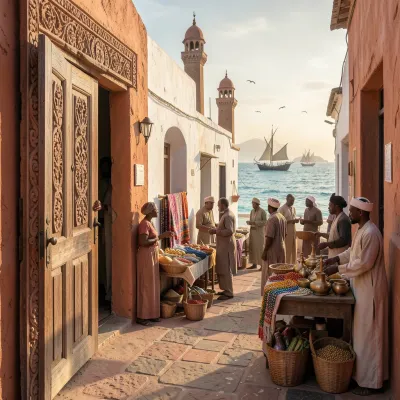
Across the rim of the western Indian Ocean lies a chain of coral shores and island towns long animated by the monsoon. Each season, the winds reversed, drawing vessels to and from Africa, Arabia, Persia, and South Asia and weaving distant communities into a shared maritime world. On these littorals, merchants bargained in shaded loggias, sailors repaired lateen sails, and poets set Kiswahili verse to rhythms that echoed across harbors fragrant with cloves, limes, and tar. This book explores those shores of exchange—places where encounters were routine, difference was negotiated, and urban life was forged through oceanic connection.
The Swahili coast has too often been depicted as a periphery acted upon by external powers. The chapters that follow argue instead for a coastal civilization that was decisively local and profoundly global. Its people cultivated ties that reached to Gujarat and the Gulf while anchoring authority in neighborhood mosques, coral-built palaces, and kinship houses. Cosmopolitanism here was not an abstract ideal but an everyday practice: hosting and intermarriage, bilingual bargaining and shared ritual, the etiquette of hospitality, and the moral economies that bound strangers into communities of trust.
Urban form expressed these entanglements in stone. Builders quarried fossil coral, fired lime, and fashioned courtyards that modulated heat and privacy. Narrow streets threaded houses to mosques and markets, choreographing the movement of gender, status, and trade. Tombs, with their carved inscriptions and pillar silhouettes, made claims to memory and authority that spanned sea and shore. By reading architecture alongside documents and oral histories, we can see how wealth from commerce translated into civic space and how religious life anchored a cosmopolitan ethos.
Language is a second archive of exchange. Kiswahili—a Bantu language shaped by centuries of contact—absorbed words and scripts from Arabic, Persian, Portuguese, and various Indic tongues, yet retained a deep grammar and poetics rooted along the coast. Written in Arabic script as well as Roman letters, and voiced in sermons, contracts, and epic poetry, Kiswahili became both a medium of trade and a vessel of beauty. It linked caravan routes from the interior to ports like Kilwa, Mombasa, and Zanzibar, and it carried ideas—of law, lineage, and belonging—between households and harbors.
Commerce gave these cities their pulse, but it was more than the movement of commodities. Brokers and pilots navigated not only reefs and currents but also reputations, credit, and law. Contracts were sealed with oaths and sureties; partnerships spanned seasons and seas. Gold from the Zambezi hinterland, ivory and grain, beads from India, and porcelains from China circulated through warehouses and verandas, each object bearing the imprint of distant labor and local taste. Markets here were not isolated bazaars but nodes in a web whose strands were political as well as economic.
The book develops these themes through case studies of key city-states: the southern grandeur of Kilwa Kisiwani; the rivalries and reinventions of Mombasa and Malindi; the archipelagic worlds of Lamu and Pate; the clove boom and royal experiment of Zanzibar and Pemba; the northern corridors of Mogadishu; and the gold gateways of Sofala. These chapters draw on archaeology, chronicles, travel accounts, inscriptions, and ethnography to show how memory, myth, and material life intersected. They also trace moments of rupture and reconfiguration—from Portuguese intrusion and Omani ascendency to abolition and the steam age—when global dynamics pressed hard upon local institutions.
Throughout, the argument resists simple origin stories. Claims of Persian “Shirazi” ancestry, for example, are read not as proofs of bloodlines alone but as political idioms of prestige and belonging, mobilized in specific moments. Likewise, “Islamization” appears less as a single event than as a series of practices—of learning, endowment, pilgrimage, and adjudication—through which communities articulated justice and identity. The coast’s distinctiveness lies in this continual translation: of law across languages, of style across materials, of strangers into kin.
Shores of Exchange invites readers to see the Swahili coast as a laboratory of oceanic urbanism and linguistic creativity. By centering cities, language, and cross-cultural commerce, it illuminates how African, Arab, Persian, and South Asian actors co-produced a coastal civilization that was never static, always negotiating. The story that unfolds from Kilwa to Zanzibar is not merely of routes and ports, but of people imagining and building a world at the water’s edge—one monsoon at a time.
Read “Shores of Exchange: The Swahili Coast and the Indian Ocean World” on MixCache.com →
Please log in or create an account to leave a comment.
No comments yet. Be the first to say something.