

How to Build a Kitchen That Cooks for You
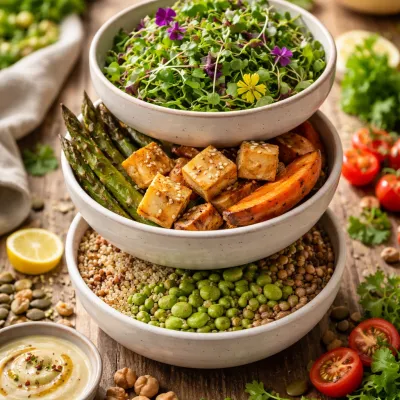
Most vegetarian cookbooks start with recipes. This one starts with a pantry. Scott Murphy's Plant-Forward Plates treats plant-forward eating as a system of interchangeable parts—grains, legumes, sauces, and seasonal vegetables—that can be assembled, adapted, and reused across a week of meals. The result is less a collection of dishes than a framework for cooking that bends to your schedule instead of the other way around.
What the book is about
Plant-Forward Plates spans 25 chapters that move logically from infrastructure to execution. The first six chapters build the foundation: stocking a "smart pantry" of dried and canned legumes, whole grains, fermented condiments, and aromatics; understanding protein pairing across legumes, soy, grains, nuts, and seeds; mastering whole grains from rice and farro to polenta and oats; shopping and storing seasonal vegetables; layering flavor through aromatics, spices, acids, and umami; and preparing building blocks—broths, quick pickles, and condiments—that turn simple components into finished meals. Chapters 7 through 19 apply that foundation to every meal category: breakfasts, breads and flatbreads, substantial salads, soups and stews, grain and bean bowls, skillets and stir-fries, pastas and noodles, oven roasting and casseroles, grilling and char, tofu and tempeh techniques, eggs and dairy as strategic accents, vegetables as main events, and street food-inspired snacks. The final six chapters address real-life logistics: 30-minute weeknight meals, slow cooker and pressure cooker batch cooking, lunchbox assembly, a global flavors tour, converting meat-centric recipes, and fruit-forward desserts. Each recipe includes approximate protein ranges per serving, derived from standard nutritional data, presented as practical guides rather than rigid targets. The intended reader is anyone who wants to cook more vegetables—whether longtime vegetarian, plant-curious omnivore, or someone simply looking for a more sustainable weekday rhythm—without sacrificing satisfaction or flavor depth.
A pantry that eliminates decision fatigue
Murphy's central insight is that good cooking begins before heat meets pan. Chapter 1, "Stocking the Plant-Forward Pantry," reads like a conversation with a practical friend who knows exactly which jars earn their shelf space. He categorizes ingredients by function—legumes for "protein and comfort in equal measure," grains for "chew and heft," fats that "carry flavor," acids as "secret managers of balance," and aromatics where "personality lives." The chapter doesn't just list items; it explains why each matters and how they interact. Dried beans "reward patience with creaminess and body"; canned beans are "weekday heroes" for when "time is tight and hunger is loud"; toasted sesame oil is "not for cooking but for dashes of aroma that make vegetables sit up and listen." Storage advice is equally specific: nuts go in the freezer because "their oils turn bitter faster than you might think"; spices get dated labels "so you do not reach for dust that lost its nerve years ago." This level of granularity continues through Chapter 6, where building blocks like vegetable broth from scraps, quick pickles, tahini sauce, and chili crisp become the "infrastructure that makes flavor layering feel easy rather than exhausting." The payoff appears in later chapters: a grain bowl comes together in minutes because the broth, beans, and dressing are already made.
Protein as a chorus, not a solo
Chapter 2 reframes protein not as a single centerpiece but as a "small chorus of legumes, soy foods, grains, nuts, and seeds." Murphy debunks the persistent myth that salt toughens bean skins—"the old fear... has been quietly debunked by careful testing"—and explains the chemistry of acid timing: acidic ingredients "wait until the beans are tender enough to be coated rather than halted in their tracks." He gives each legume personality: red lentils "dissolve into velvety soups," French lentils offer "a pleasant middle ground, staying intact while developing a slight mineral sweetness," and fresh fava beans deliver "a fleeting creaminess and sweetness that cannot be replicated." Soy foods get equally nuanced treatment: tofu's mildness is "less a limitation than an invitation to season boldly," while tempeh's fermentation gives it "a nuttier, firmer bite" that "takes to marinades and glazes with enthusiasm." The chapter closes with a global perspective—Indian dals, Mexican beans and corn, Ethiopian spiced lentils, Japanese miso and tofu—reminding readers that "plant-forward eating is not a new invention but a worldwide practice refined over generations." Protein calculations appear throughout as ranges, meant to "inform, not intimidate."
Flavor layering as a repeatable habit
Chapter 5, "Flavor Layering: Sauces, Spices, and Aromatics," distills technique into a sequence anyone can practice. Aromatics enter first—"slow, patient sauté" for sweetness, "quick mince added at the end" for brightness. Spices bloom in fat: "cumin, coriander, fennel, and mustard seeds crackle and release oils that would otherwise stay locked inside." Acid arrives late—"a splash of red wine vinegar in a lentil stew, a squeeze of lime over black beans"—to "wake up flavors that may have dulled during cooking." Umami comes from concentrated sources: tomato paste browned in oil, miso, soy sauce, dried mushrooms. The chapter emphasizes texture contrast—"creamy beans next to crunchy seeds, silky grains against chewy tofu"—and balancing heat, bitterness, sweetness, and smoke in stages. Global templates like Indian tadka, Mexican sofrito, and French mirepoix are presented as "ready-made blueprints" to borrow. The result is a mental checklist that replaces guesswork: bloom, build, balance, finish.
Modular cooking for real schedules
The book's most practical innovation is its modular approach, articulated in Chapter 11 ("Grain and Bean Bowls") and reinforced in Chapters 20–22. Murphy advocates cooking components in bulk—"a pot of beans cooked on a Sunday can become a taco filling, a soup, a spread, or a salad topping across several days"—then combining them differently each time. Chapter 20, "Quick Weeknight Winners (30 Minutes or Less)," relies entirely on this: pre-cooked grains, rinsed canned beans, frozen vegetables, and jarred sauces turn a skillet into dinner in minutes. Chapter 21 extends the logic to slow cookers and pressure pots, noting that "batch cooking fits naturally into the rhythm" because both appliances "are designed to produce more food than you might eat in one sitting." Chapter 22 applies it to lunchboxes: "a pot of lentil stew, a tray of roasted vegetables, and a batch of cooked grains can be mixed and matched across several meals, with different sauces and toppings providing fresh personality each time." The through-line is clear: decide less, assemble more.
Conversions that respect the original dish
Chapter 24, "From Meat-Centric to Veg-Centric: Conversions and Makeovers," stands out for treating adaptation as translation rather than substitution. Murphy identifies the qualities that make meat dishes satisfying—"umami, chew, and contrast"—and maps plant ingredients to each. Mushrooms provide "savoriness," caramelized onions give "depth," miso and soy sauce supply "backbone," and thoughtful textures—"crisped tofu to roasted cauliflower steaks"—deliver "that same sense of satisfaction." He details specific swaps: portobello caps for burger-like substance, crumbled extra-firm tofu for taco filling or Bolognese, tempeh bacon for smoky chew, mashed black beans for patties, farro and barley for "chew and heft," roasted eggplant and cauliflower for "dense, almost meaty texture." The chapter acknowledges that some conversions need cheese or eggs as "strategic accents rather than central pillars" and that seitan, while "not a whole food," can replicate "a particular mouthfeel or protein density." Every conversion is tested to be "weeknight-feasible and guest-worthy."
Who should read this
This book serves the cook who wants a system, not just recipes. It's ideal for someone building a vegetarian or plant-forward repertoire from the ground up—especially if they value meal prep, weekday speed, and the ability to improvise with seasonal produce. The global flavors chapter and conversion guide make it useful for omnivore households navigating mixed-diet meals. Readers seeking strictly vegan cooking will need to adjust the eggs-and-dairy-as-accents chapter and occasional cheese suggestions, though the core framework is plant-based. Anyone who prefers highly styled, restaurant-plate photography or narrative-driven food writing should look elsewhere; Murphy's tone is instructional and conversational, focused on technique over aesthetics. For the practical home cook who wants to open the fridge on a Tuesday and know exactly how to turn last week's beans and roasted vegetables into tonight's dinner, Plant-Forward Plates delivers a complete, confidence-building toolkit.
Read “Plant-Forward Plates: Delicious Whole-Food Vegetarian Recipes” on MixCache.com →
Please log in or create an account to leave a comment.
No comments yet. Be the first to say something.