

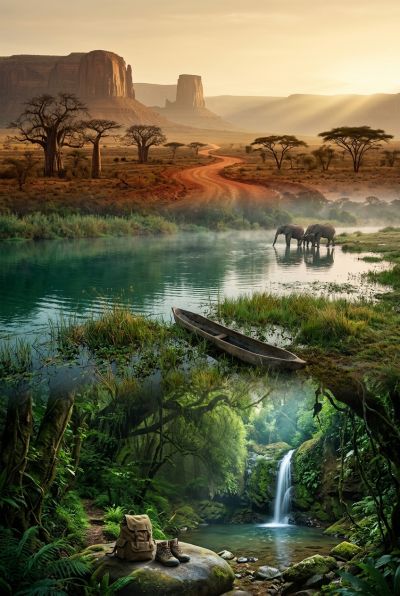
Step off the well‑trodden tourist paths and discover the secret corners of Africa that most travelers never see. This invitation frames Kairos Valente’s Off the Beaten Track in Africa, a collection of twenty‑five chapters that map out places far from the usual safari circuits. The book blends vivid description, cultural portraiture, and practical advice to help readers imagine journeys that are both thrilling and respectful.
What the Book Covers
The volume opens with an introduction that positions the work as a passport to extraordinary places, promising to move beyond the iconic sights of Serengeti, Kilimanjaro and Victoria Falls. Each chapter follows a consistent pattern: a evocative portrait of a location, details about its people and traditions, notes on activities such as trekking or boating, and practical tips on the best time to visit and how to travel responsibly. The intended reader is anyone curious about Africa’s diversity—whether an armchair traveler planning future trips or a seasoned explorer looking for fresh inspiration.
Living Cultures on the Fringes
One of the book’s strongest threads is the way it foregrounds the lives of communities that have adapted to extreme environments. In Lamu, Valente notes that “donkeys are the preferred mode of transport, and the rhythm of life is dictated by the tides,” illustrating how everyday mobility shapes culture. The Himba of Namibia’s Skeleton Coast appear in Chapter 4, where the text describes their “distinctive red ochre body paint, which protects their skin from the sun and insects.” Further south, the Batwa forest dwellers of Uganda are introduced in Chapter 16 as the original inhabitants of Bwindi, whose “traditional hunting and gathering techniques” are shared with visitors today. In the Danakil Desert, Chapter 8 highlights the Afar people, noting that “the camel caravans, laden with blocks of salt, are a common sight in the Danakil” and that their hospitality remains renowned despite harsh conditions. These portraits avoid exoticism, instead showing how culture and ecology intertwine.
Landscapes That Defy Expectation
Valente’s geographic range is striking, presenting natural wonders that challenge typical African imagery. The Avenue of the Baobabs near Morondava is described in Chapter 2 as a place where “these trees, some over 800 years old, have witnessed generations come and go, their silent presence a constant reminder of the power and beauty of nature.” The surreal salt flats of the Danakil Depression appear in Chapter 8, with the molten lava lake at Erta Ale called “a truly mesmerizing spectacle.” Chapter 12 captures the stark beauty of Sossusvlei, where “the night sky… explodes with a million stars” and “towering dunes… range in color from vibrant orange to deep red.” Meanwhile, Chapter 6 immerses readers in the Okavango Delta, noting that “traditional dugout canoes, known as mokoros, are the primary mode of transport, allowing you to navigate the narrow channels and shallow lagoons.” Each landscape is rendered with sensory detail that lets the reader hear the wind, feel the heat, or smell the sage.
Adventure Routes for the Bold
For those who crave active exploration, the book supplies concrete ideas grounded in local reality. Chapter 5 details trekking the Virunga volcanoes, emphasizing that “trekking to see them is a privilege, a chance to witness these gentle giants in their natural habitat,” and advises that “the best time to visit the Virungas is during the dry seasons, from June to September and from December to February.” Chapter 6 proposes gliding through Botswana’s waters in a mokoro, while Chapter 9 invites readers to hike the mystical forest of Dzoukou (though technically outside Africa, it is included as a contrast). Chapter 10 suggests exploring Cameroon’s crater lakes, and Chapter 15 describes the short window when Caño Cristales becomes the “River of Five Colors.” Throughout, Valente couples excitement with caution, reminding readers that “the Virunga Volcanoes are a destination that demands respect” and that permits, guides, and low‑impact practices are essential.
Echoes of Ancient Civilizations
History and archaeology appear as portals into past ingenuity. Chapter 7 walks through the stone ruins of Great Zimbabwe, pointing out that “the Great Enclosure… is a massive elliptical wall, over 250 meters in circumference and 11 meters high.” Chapter 22 takes the reader to Timbuktu, where the Sankore Mosque is described as “the most prestigious of Timbuktu’s universities” and its library once held “hundreds of thousands of manuscripts.” Chapter 25 journeys to Sudan’s Meroë, noting that “the pyramids of Meroë, unlike their Egyptian counterparts, were built as tombs for the Kushite royalty and elite” and that the site’s sandstone blocks still bear “intricate carvings depicting the deceased and various deities.” These sections treat each site not as a checklist item but as a doorway to understanding the continent’s deep cultural layers.
Travel Tips and Responsible Exploration
Beyond storytelling, the book supplies practical guidance that helps turn imagination into itinerary. Repeatedly, Valente flags the optimal windows for travel: the Virunga treks are best “from June to September and from December to February,” the Okavango Delta shines “from June to October,” Sossusvlei is ideal “from May to September,” and Meroë welcomes visitors “from October to April.” He also stresses the need for local guides, noting in Chapter 5 that “hiring a local guide is essential, not only for navigating the trails but also for interpreting the natural and cultural wonders of the region.” Environmental stewardship appears as a recurring theme; chapters on the Skeleton Coast, Virunga, and Sossusvlei all state that the destination “demands respect” and urge travelers to stay on designated trails, minimize waste, and support community‑based initiatives. This blend of inspiration and pragmatism makes the work useful for planning as well as dreaming.
Who Should Read This
Readers who enjoy immersive, detail‑rich travel writing will find much to appreciate here, especially those interested in cultures that live in harmony with extreme landscapes. The book rewards curiosity about local customs, geological oddities, and lesser‑known historical sites, while also offering concrete advice for travelers who wish to visit responsibly. Those seeking a traditional safari guide or a quick‑reference checklist may feel the narrative leans more toward experience than logistics, but the practical tips scattered throughout still provide a useful starting point. Overall, Off the Beaten Track in Africa serves as a thoughtful companion for anyone ready to look beyond the postcard vistas and discover the continent’s quieter, yet equally compelling, corners.
Read “Off the Beaten Track in Africa” on MixCache.com →
Please log in or create an account to leave a comment.
No comments yet. Be the first to say something.