

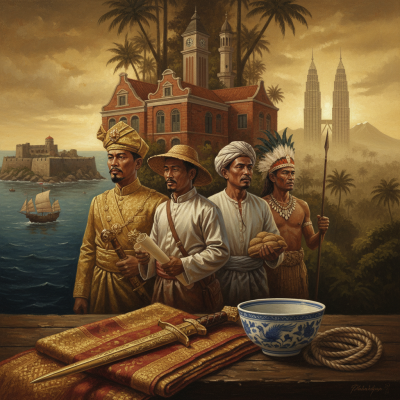
The following is an excerpt from “A History of Malaysia” by Bradford Gutierrez, available on MixCache.com.
Introduction
To understand the history of Malaysia is to understand a story shaped by geography, trade, and a constant influx of peoples and cultures. The very land itself—a long, strategic peninsula reaching down from mainland Asia and the vast, resource-rich island of Borneo—has dictated its destiny. For millennia, this region has been a vital link, a maritime crossroads where civilizations met, mingled, and sometimes clashed. The Strait of Malacca, the narrow channel of water separating the peninsula from the island of Sumatra, is not merely a geographical feature; it is the central artery through which the lifeblood of seaborne trade between East and West has flowed for centuries. This book is an account of the complex, often turbulent, but always fascinating journey of the lands and peoples that would, in the second half of the 20th century, come together to form the modern nation of Malaysia.
The narrative of this land does not begin with the arrival of traders or the establishment of kingdoms. The earliest signs of human life date back tens of thousands of years, with archaeological evidence from the Niah Caves in what is now Sarawak pointing to human habitation around 40,000 years ago. The ancestors of today's diverse population arrived in successive waves over many centuries. Anthropologists believe that the Proto-Malays, an aboriginal people, migrated from Southwest China, followed around 300 B.C. by the Deutero-Malays, who became the direct ancestors of the modern ethnic Malays. These early inhabitants lived in a land of dense jungles and long coastlines, their societies shaped by the rhythms of the tropical environment.
It was the allure of commerce that first drew the outside world to these shores. The Malay Peninsula, known to the ancient Greek geographer Ptolemy as the "Golden Chersonese," or Golden Peninsula, established trade relations with India and China as early as the 1st century BC. This was not a one-way traffic of goods but a profound exchange of ideas, technologies, and beliefs. From India came the great religions of Hinduism and Buddhism, which deeply influenced the language, culture, and political structures of the early inhabitants. The Sanskrit writing system was adopted, and a host of small, Indianized kingdoms rose and fell, particularly along the coasts, serving as prosperous trading outposts. These early states, such as Langkasuka in the north, were often under the sway of larger regional powers, including the Funan empire in Cambodia and, most significantly, the Sumatra-based Srivijaya empire, which held influence over much of the peninsula from the 7th to the 13th centuries.
The next great wave of cultural and religious transformation came with the arrival of Islam. Introduced gradually by Arab and Indian merchants, the faith first took root among the elite and by the 13th and 14th centuries had begun to spread more widely. This period coincided with the rise of what would become the most legendary of the Malay kingdoms: the Malacca Sultanate. Founded around 1400 by a refugee prince from Srivijaya named Parameswara, the port city of Malacca (now Melaka) was perfectly positioned on the strait that bears its name. Aided by a tributary relationship with the powerful Ming Dynasty in China, which offered protection against regional rivals, Malacca flourished.
The fifteenth century is rightly considered the golden age of the Malacca Sultanate. It became the region's pre-eminent trading hub, a bustling, cosmopolitan center where merchants from Arabia, Persia, India, and China gathered to trade spices, silks, and porcelain. But its significance went far beyond commerce. Malacca became a vital center for the propagation of Islam throughout the archipelago. It was during this era that Classical Malay, written in the Jawi script adapted from Arabic, became the lingua franca of maritime Southeast Asia, and a distinct Malay identity, culture, and political philosophy began to coalesce. The systems of governance and the concept of sovereignty, or daulat, established in Malacca would serve as a model for subsequent Malay sultanates for centuries to come.
This prosperous and powerful indigenous state, however, soon attracted the attention of a new and aggressive global power. The fame of Malacca's wealth had reached Europe, and the Portuguese, in their quest to dominate the lucrative spice trade, were the first to arrive. In 1511, a fleet led by Afonso de Albuquerque conquered the city, marking the beginning of a long and transformative colonial era in the Malay Peninsula. The fall of Malacca scattered its ruling family, who went on to establish new sultanates in Johor and Perak, but the peninsula would now be a stage for European rivalries for the next four and a half centuries.
Following the Portuguese, the Dutch emerged as the dominant European power in the region, seizing Malacca in 1641 with the help of the Johor Sultanate. But it was the British who would ultimately establish the most extensive and enduring colonial presence. Starting with the establishment of a trading post in Penang in 1786, followed by Singapore in 1819, and the acquisition of Malacca from the Dutch through the Anglo-Dutch Treaty of 1824, Britain consolidated its control over the key maritime chokepoints. These territories were grouped together as the Straits Settlements, administered directly as a Crown Colony. Over the subsequent decades, through a combination of treaties, political maneuvering, and intervention, British influence extended over the Malay sultanates on the peninsula, establishing a system of indirect rule through British "Residents" who advised the Sultans on all matters except those pertaining to Malay religion and custom.
British rule brought about profound and irreversible changes to the economic and social fabric of the land. To serve the needs of the industrializing West, the colonial administration fostered an extractive economy based on two key commodities: tin and rubber. Malaya became the world's largest producer of both, a feat that required a massive workforce. To meet this demand, the British facilitated the large-scale immigration of laborers from China and India. The Chinese largely came to dominate the tin mines and commercial sectors in the burgeoning towns, while Indians primarily worked on the vast new rubber plantations. While the British built infrastructure like railways and roads to support these industries, this economic development was uneven and created a pluralistic society where different ethnic groups were often associated with specific economic functions—a legacy that would profoundly shape the nation's future.
The era of British dominance, once thought to be permanent, was shattered by the outbreak of the Second World War. The swift invasion and occupation by Japanese forces from 1941 to 1945 was a traumatic event. It not only brought hardship and suffering but also demolished the myth of European invincibility. The occupation, and its aftermath, fanned the flames of local nationalism among all communities. When the British returned after the war, they found a changed political landscape. Their proposal to create a centralized Malayan Union, which would have diminished the sovereignty of the Malay rulers and granted citizenship to recent immigrants, sparked fierce opposition from the Malay community. This crisis led to the birth of the first major Malay political party, the United Malays National Organisation (UMNO).
The immediate post-war years were defined by another major crisis: the Malayan Emergency. In 1948, the Malayan Communist Party (MCP), composed mainly of ethnic Chinese, launched a guerrilla insurgency with the aim of overthrowing the British colonial government and establishing a communist republic. The British declared a state of emergency, and for the next twelve years, a brutal counter-insurgency campaign was waged in the jungles and towns of Malaya. The conflict, which was eventually suppressed by British and Commonwealth forces, was a defining experience for the fledgling nation, shaping its security policies and political alignments for decades to come. It was a complex struggle, seen by some as a communist uprising and by others as an anti-colonial war of liberation.
Amidst this conflict, the journey towards independence gained momentum. A new political formula emerged in the form of the Alliance Party, a coalition representing the three main ethnic communities: UMNO for the Malays, the Malayan Chinese Association (MCA), and the Malayan Indian Congress (MIC). Led by Tunku Abdul Rahman, this multi-ethnic coalition successfully negotiated a path to self-governance. On August 31, 1957, in a moment of profound national pride, the Federation of Malaya achieved its independence, or "Merdeka," from Britain through peaceful diplomacy.
The story of nation-building, however, was not yet complete. In 1961, Tunku Abdul Rahman proposed a bold new idea: to expand the federation to include the British colonies of Singapore, Sabah (then North Borneo), and Sarawak. The idea was to create a larger, more stable entity that could counterbalance communist influences and manage ethnic demographics. Despite opposition from Indonesia, which launched a period of military "Confrontation" against the new state, and the Philippines, which laid a claim to Sabah, the Federation of Malaysia was formally established on September 16, 1963. This new union was not without its immediate challenges. Deep political and ideological differences led to the separation of Singapore from the federation just two years later, in August 1965.
The early years of Malaysia were marked by the difficult task of forging a unified national identity from its diverse population. These underlying ethnic and economic tensions erupted tragically in the race riots of May 13, 1969. This event was a national trauma and a pivotal turning point. In its wake, the government launched the New Economic Policy (NEP) in 1971. This ambitious and far-reaching affirmative action program was designed with two main goals: to eradicate poverty irrespective of race and to restructure society to eliminate the identification of ethnicity with economic function, thereby reducing inter-communal disparities. The NEP aimed to increase the share of national wealth held by the Bumiputera (Malays and other indigenous peoples) and would go on to shape every aspect of Malaysian society, from education to commerce, for the next two decades.
The 1980s and 1990s were dominated by the towering figure of Dr. Mahathir Mohamad, who became Prime Minister in 1981 and held the post for 22 years. This period, known as the Mahathir era, was one of dramatic economic transformation and modernization. Through policies like "Look East," which sought to emulate the work ethic and economic models of Japan and South Korea, and a major push towards privatization and industrialization, Malaysia experienced rapid growth. His tenure saw the creation of the national car, Proton, the construction of massive infrastructure projects like the Petronas Twin Towers and the Kuala Lumpur International Airport, and the launch of Vision 2020, an ambitious blueprint for Malaysia to achieve fully developed nation status.
This era of rapid development was not without political turmoil. The late 1990s saw the emergence of the Reformasi (Reformation) movement, a wave of political protest sparked by the sacking of Mahathir's deputy, Anwar Ibrahim. This movement galvanized a new generation of political activists and led to the formation of a more cohesive opposition. The political landscape began to shift, culminating in the 2008 general election, where the ruling Barisan Nasional coalition, for the first time, lost its two-thirds parliamentary majority.
The first two decades of the 21st century saw Malaysia navigating the crosscurrents of globalization, regional challenges, and mounting internal political pressure. This period was rocked by the 1MDB scandal, a massive financial controversy that implicated high-ranking officials and drew international attention. Public discontent over this and other issues like the rising cost of living reached a crescendo in the general election of May 9, 2018. In a stunning and unprecedented result, the opposition coalition Pakatan Harapan, led by a returning 93-year-old Mahathir Mohamad, defeated the Barisan Nasional, which had governed the country in one form or another since independence. It was the first transition of federal power in Malaysia's history, a moment that redefined the nation's political possibilities.
This book traces this long and winding historical arc, from the earliest human settlements to the complex and vibrant nation of today. It is a story of ancient kingdoms and colonial powers, of economic booms and political crises, of conflict and accommodation. It is the story of how a strategically located piece of land became a meeting point for the world, and how its people have continually navigated the challenges of building a unified, multi-ethnic, and modern nation. The chapters that follow will delve into each of these periods in detail, exploring the events, personalities, and forces that have shaped the remarkable history of Malaysia.
Read “A History of Malaysia” on MixCache.com →
Please log in or create an account to leave a comment.
No comments yet. Be the first to say something.