

A Nation Forged Between Empires: Inside Popescu's History of Moldova
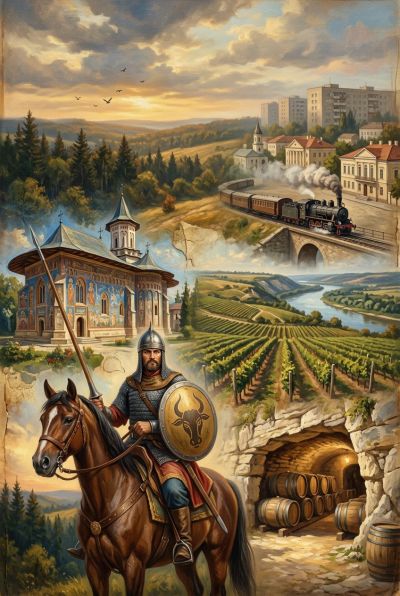
The land between the Prut and Dniester rivers has never been allowed the luxury of insignificance. For centuries it has been a prize, a buffer, and a battlefield for empires — Ottoman, Russian, Habsburg, Soviet — each redrawing its borders and rewriting its identity. Andrei Popescu's A History of Moldova does not merely catalog these invasions; it shows how a people repeatedly adapted, resisted, and reinvented themselves while great powers decided their fate in distant capitals.
What the book is about
Popescu structures the narrative across 25 chapters that move chronologically from the Getae and Dacians of the 6th century BC through the 2023 opening of EU accession negotiations. The first half traces the medieval Principality of Moldavia, its golden age under Stephen the Great, and the long centuries of Ottoman suzerainty and Phanariot Greek rule. The pivotal rupture comes in 1812, when the Treaty of Bucharest splits the principality and Russia annexes the eastern half as Bessarabia — setting the two Moldovas on divergent paths. The Soviet era receives granular treatment: the artificial creation of the Moldavian ASSR in 1924, the 1940 annexation via the Molotov-Ribbentrop Pact, the devastation of World War II and the Holocaust, and the decades of forced collectivization, Russification, and demographic engineering. The final chapters cover the independence movement, the Transnistria war, the catastrophic 1990s transition, the billion-dollar bank theft of 2014, and the geopolitical seesaw that culminates in Maia Sandu's pro-European presidency and Moldova's 2022 EU candidacy. The book assumes no prior specialist knowledge but rewards readers who want to understand how deep historical patterns shape today's headlines.
The foundational myth of Stephen the Great
No figure looms larger in Moldovan historical consciousness than Ștefan cel Mare, whose 47-year reign (1457–1504) forms the book's emotional and symbolic center. Popescu devotes Chapter 4 to unpacking both the man and the myth. Stephen inherited a principality shattered by succession crises and transformed it into a resilient state that commanded European attention. His 1475 victory at Vaslui — where a smaller Moldavian force annihilated an Ottoman army of over 100,000 in a frozen marsh — earned him the papal title "Athleta Christi". Yet Popescu is clear-eyed about the limits of heroic resistance: Stephen lost the Black Sea ports of Chilia and Cetatea Albă in 1484, and his final advice to his son was pragmatic — "it was better to submit to the Sultan than to a pagan king." The chapter reveals how Stephen's church-building program (dozens of monasteries, many still standing) cemented a cultural legacy that outlasted his political achievements, becoming a reservoir of identity for centuries of foreign rule.
The Soviet invention of a separate Moldovan identity
One of the book's most consequential arguments concerns the deliberate construction of "Moldovan" as a nationality and language distinct from Romanian. Chapter 10 details how the 1924 creation of the Moldavian ASSR on the left bank of the Dniester — carved from Ukrainian territory where Moldovans were only 30% of the population — served as a geopolitical "bridgehead" for eventual reclamation of Bessarabia. Soviet linguists manufactured a literary standard based on Transnistrian dialects, loaded it with Russian neologisms, and imposed the Cyrillic script to sever the visual and cultural link with Latin-alphabet Romania. Popescu notes the policy's contradictions: a brief Latinization campaign in the early 1930s was violently reversed in 1938, its architects purged. This engineered identity became state dogma after 1940, enforced through schools, media, and the church hierarchy. The legacy persists; the 1994 Constitution's compromise wording — "Moldovan language, functioning on the basis of the Latin alphabet" — reflects a society still negotiating what to call its own tongue.
The frozen conflict as a geopolitical instrument
Chapter 17 provides a granular account of the 1992 Transnistria war, showing how a brief, brutal conflict became a permanent feature of Moldovan politics. Popescu demonstrates that the "frozen" status was not an accident but a construction: the July 1992 ceasefire agreement made the separatist Pridnestrovian Moldavian Republic an equal partner in a tripartite peacekeeping force alongside Russia and Moldova, with Russian troops as the dominant military presence. General Alexander Lebed's intervention — "Russian army tanks, flying the Russian flag, rolled across the bridge into the city to directly engage the Moldovans" — decided the military outcome. The Joint Control Commission structure gave Moscow a permanent lever over Chișinău's sovereignty. Popescu traces how every subsequent Moldovan government has had to govern around this frozen wound, which complicates EU integration, diverts resources, and serves as a platform for hybrid warfare — as seen in the 2022 "false flag" explosions in Transnistria that coincided with Russia's invasion of Ukraine.
Corruption as a system, not an exception
The "billion-dollar theft" of 2014, dissected in Chapter 21, was not a singular heist but the visible tip of a captured state. Popescu traces how three banks — Banca de Economii, Unibank, and Banca Socială — were gradually consolidated under politically connected figures, notably Ilan Shor, who used a carousel of shell companies and Latvian correspondent accounts to siphon roughly 12% of Moldova's GDP in three days (November 24–26, 2014). The government's secret bailout converted private losses into public debt, "a debt that the country's taxpayers — pensioners, teachers, and farmers — would be forced to repay, with interest, for the next quarter-century." The scandal birthed the Dignity and Truth civic platform and massive protests, yet the subsequent prosecution of former Prime Minister Vlad Filat — while dramatic — left many Moldovans convinced the true architects, particularly oligarch Vladimir Plahotniuc, remained untouched. Popescu argues this episode discredited the entire pro-European political class, creating the opening for Igor Dodon's 2016 pro-Russian presidential victory and years of institutionalized geopolitical schizophrenia.
The diaspora as a political force
A striking thread in the final chapters is the emergence of Moldova's massive labor diaspora — an estimated third of the working-age population — as a decisive electoral constituency. Chapter 24 describes the 2020 presidential election, where "over 260,000 citizens voting abroad, an all-time record" broke 92% for Maia Sandu, overturning Igor Dodon's domestic lead. Popescu connects this to the 2009 "Twitter Revolution" and the 2021 snap parliamentary election that gave Sandu's PAS party a historic absolute majority (63 of 101 seats). The diaspora's vote reflects both material interest — remittances sustain the economy — and a values orientation shaped by life in the EU. Yet Popescu notes the tension: a president elected substantially by non-residents must govern a population that experiences the daily consequences of reform, austerity, and war differently. This dynamic will shape Moldova's EU accession negotiations, where the diaspora's expectations for rapid transformation meet the domestic reality of entrenched interests and Russian pressure.
Who should read this
Readers seeking a single-volume framework for understanding Moldova's present will find this book indispensable. It serves students of Eastern European studies, diplomats, journalists, and travelers who want to move beyond headlines about gas disputes and frozen conflicts into the deep structures that produce them. Specialists may quibble with specific interpretations — the treatment of the 1918 union with Romania is necessarily compressed — but the synthesis is authoritative and the narrative momentum sustained. Those looking primarily for cultural history, literary analysis, or social history from below will want to supplement this political-military-diplomatic narrative. For anyone trying to grasp why a country of 2.5 million matters to the future of Europe's eastern flank, Popescu provides the historical coordinates.
Read “A History of Moldova” on MixCache.com →
Please log in or create an account to leave a comment.
No comments yet. Be the first to say something.