Browse by Category
Fiction
- Action & Adventure
- African American
- Anthologies
- Children's Fiction
- Classics
- Comics & Graphic Novels
- Coming of Age
- Contemporary
- Cultural & Regional
- Drama
- Erotica
- Fantasy
- General
- Historical Fiction
- Horror
- Humor & Satire
- Literary Fiction
- Mystery, Thriller & Suspense
- Poetry
- Religious & Inspirational
- Romance
- Science Fiction
- Short Stories
- War & Military
- Westerns
- Women's Fiction
- Young Adult
Non-Fiction
- Antiques & Collectibles
- Arts & Photography
- Biographies & Memoirs
- Business & Money
- Children's Non-Fiction
-
Computers & Technology
- Artificial Intelligence
- Computer Science
- Cybersecurity & Cryptography
- Data Science & Analytics
- Databases & Big Data
- Game Development & Design
- General
- Hardware & DIY
- Mobile App Development
- Networking & Cloud Computing
- Operating Systems
- Programming
- Robotics
- Software
- Software Engineering
- User Experience (UX) & Design
- Web Development & Design
- Cooking, Food & Wine
- Crafts, Hobbies & Home
- Education & Teaching
- Engineering
- General
- Health, Fitness & Dieting
-
History
- African History
- African History - North Africa
- African History - Sub-Saharan Africa
- American History
- American History - 20th Century
- American History - Civil War
- American History - Colonial Period
- Ancient History
- Asian History
- Asian History - China
- Asian History - India
- Asian History - Japan
- Asian History - Southeast Asia
- European History
- European History - Ancient Greece
- European History - Ancient Rome
- European History - Medieval
- European History - Modern
- European History - Renaissance
- General
- Middle Eastern History
- Military History
- Military History - Aviation
- Military History - Naval
- Social & Cultural History
- World History
- Humor & Entertainment
- Industrial Technology
- Language Learning
- Law
- LGBTQ+ Non-Fiction
- Literary Criticism
- Medical Books
- Parenting & Relationships
- Philosophy
- Politics & Social Sciences
- Reference
- Religion & Spirituality
-
Science & Math
- Agricultural Sciences
- Astronomy & Space Science
- Behavioral Sciences
- Biological Sciences
- Botany & Plant Science
- Chemistry
- Earth Sciences
- Engineering - Chemical
- Engineering - Civil
- Engineering - Electrical
- Engineering - Mechanical
- Environment
- General
- Geology
- Mathematics
- Nature & Ecology
- Oceanography
- Paleontology
- Physics
- Statistics
- Self-Help
- Sports & Outdoors
- Study Aids
- Sustainability & Green Living
- Textbooks
- Transportation
- Travel
- True Crime
- Urban Planning & Development
- Veterinary Medicine
- Writing & Publishing
Jump to Section

Want unlimited access to all books published by MixCache.com (plus their audiobooks)? Try MixCache.com Total Access. Look for the MTA badge on book covers to identify included titles.
Access to infinite ebooks: Don't see the book you want? Suggest it and we'll create it (free!) for you from scratch with our powerful AI book writer. Then read it with MTA - besides profiting from any sales it makes!
Historia de la enfermedad mental
Sobre este libro:



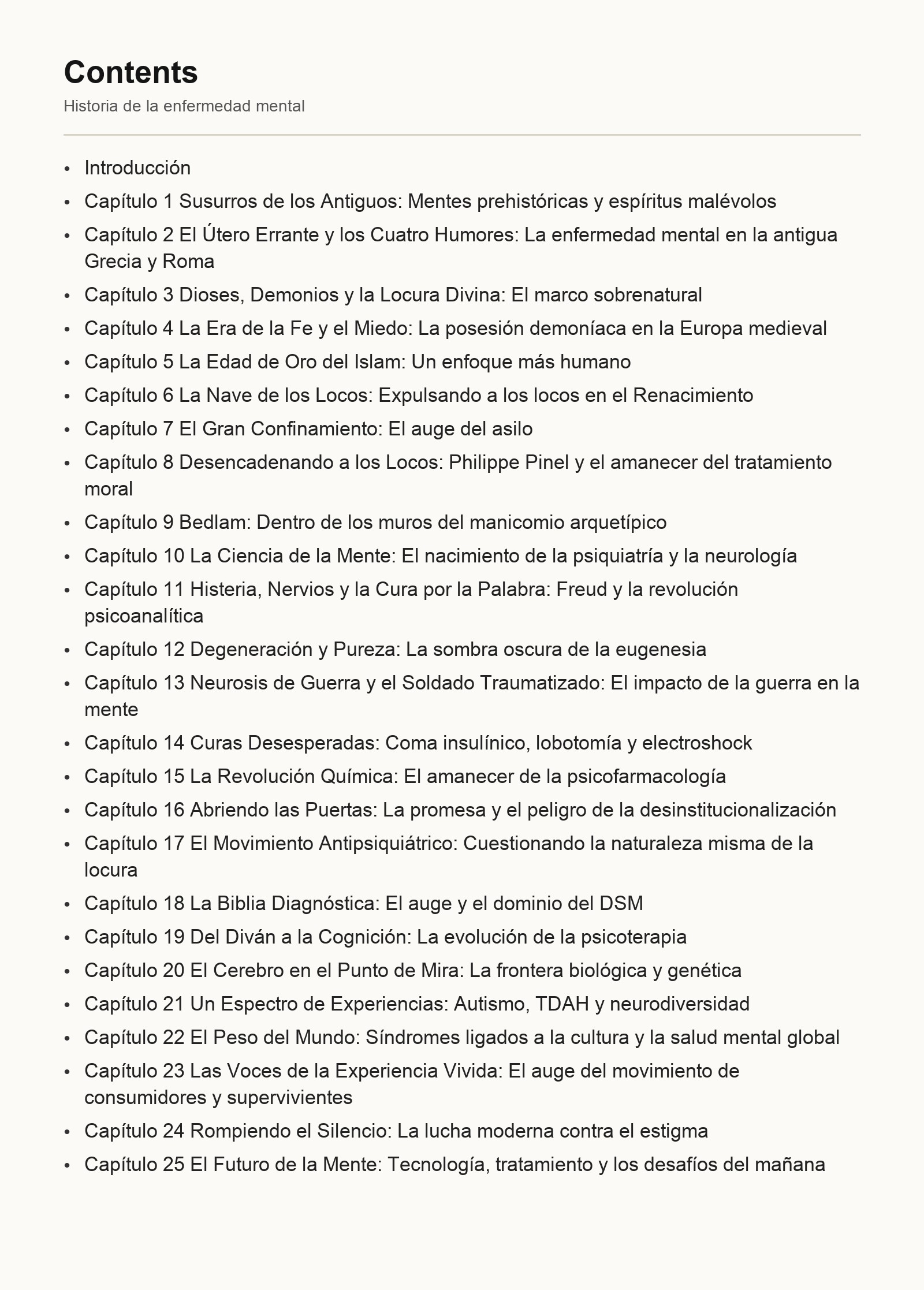
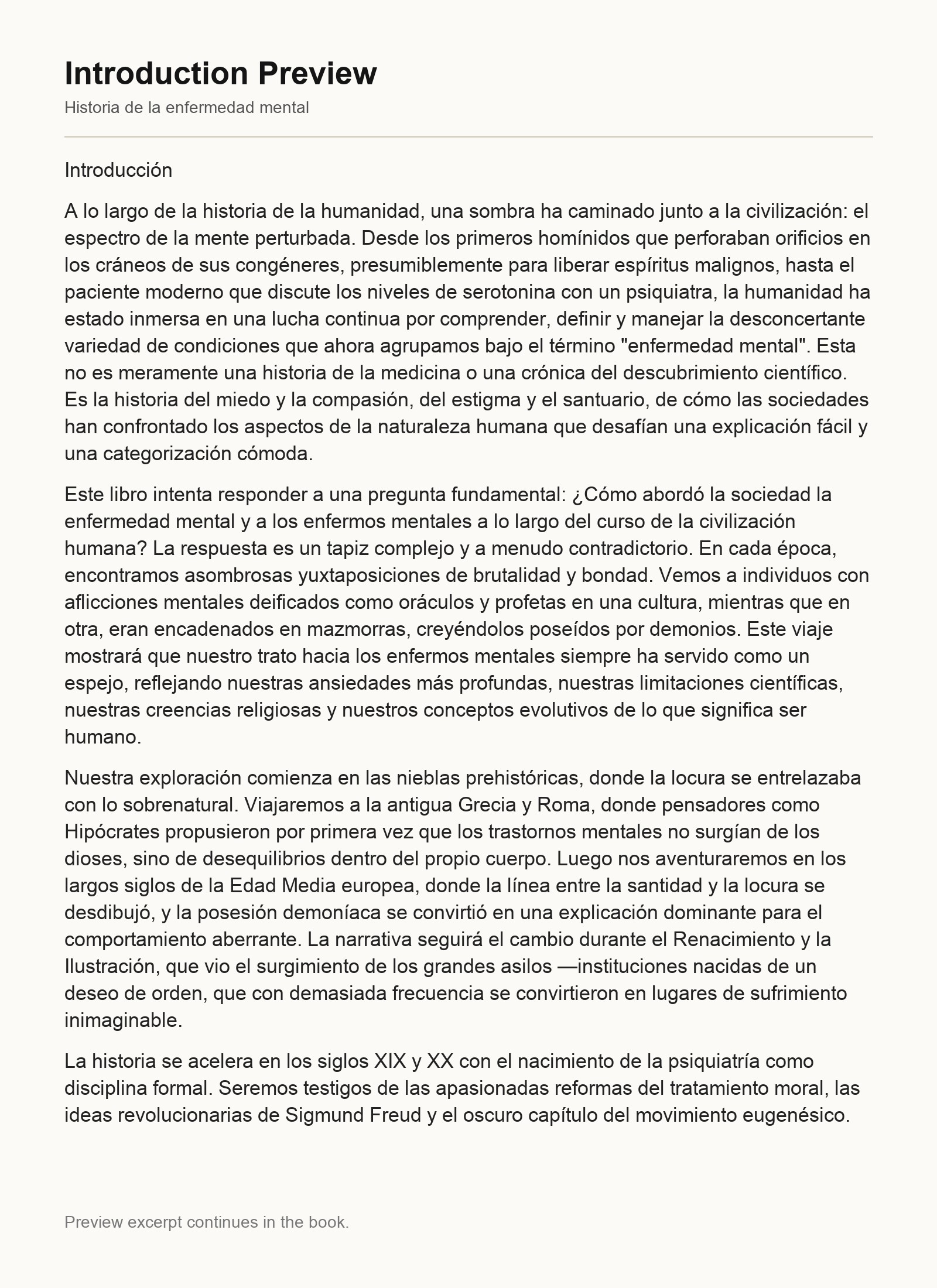
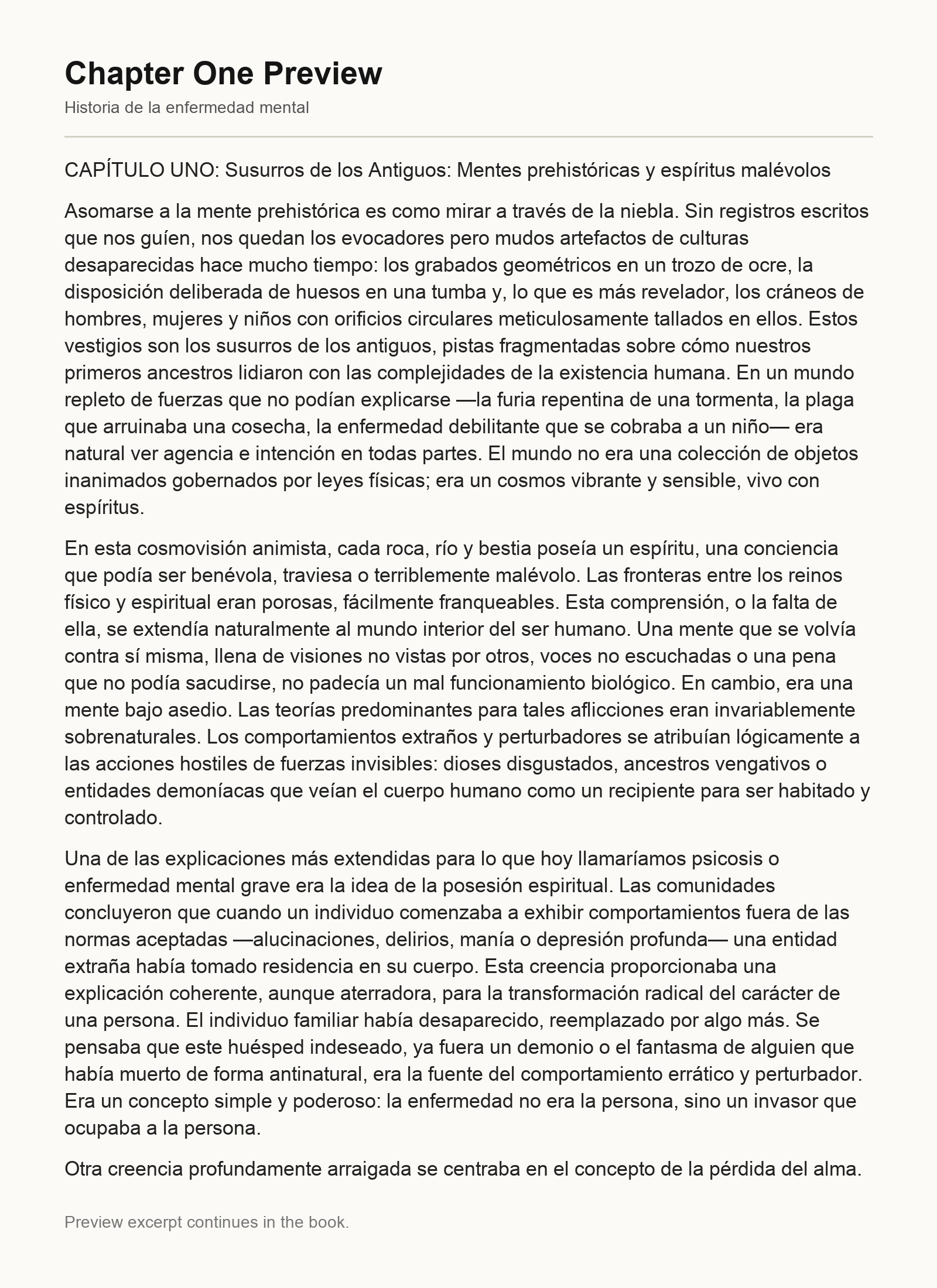
Desde la trepanación prehistórica hasta la neurogenética de vanguardia actual, esta amplia crónica invita a los lectores a recorrer la evolución de los intentos humanos por comprender, tratar y estigmatizar la mente atribulada. Cada capítulo revela cómo diversas culturas interpretaron la locura —ya fuera como posesión divina, desequilibrio humoral, asedio demoníaco o trastorno bioquímico— y cómo tales creencias moldearon desde los rituales chamánicos hasta el auge de los manicomios, el nacimiento de la psiquiatría y las controvertidas terapias del siglo XX.
Los lectores descubrirán las audaces reformas de Philippe Pinel y el York Retreat, presenciarán los espeluznantes espectáculos de Bedlam y seguirán la tensa pugna entre el tratamiento moral y la era de las curas de «choque», como el coma insulínico, la lobotomía y la terapia electroconvulsiva. La narración aborda luego la revolucionaria llegada de los psicofármacos, la ola de desinstitucionalización y las poderosas voces de los movimientos de usuarios y supervivientes que exigieron derechos, dignidad y participación en la formulación de políticas de salud mental.
Más allá de la cronología occidental, el libro explora cómo las sociedades no occidentales conceptualizaron el sufrimiento —a través de síndromes ligados a la cultura como el *amok*, el *koro* y el susto— y muestra los desafíos actuales de la salud mental global al intentar exportar modelos biomédicos sin dejar de respetar las interpretaciones locales del padecimiento. Los capítulos dedicados al autismo, al TDAH y al movimiento de la neurodiversidad desafían al lector a replantearse qué constituye una patología, mientras que las secciones sobre el estigma, las batallas legales y el fenotipado digital arrojan luz sobre la lucha constante por una atención compasiva y equitativa.
Hacia el final de la obra, el lector adquiere una perspectiva matizada sobre la frontera biológica —desde las hipótesis dopaminérgicas y la neuroimagen hasta el renacimiento de los psicodélicos y la predicción mediante inteligencia artificial—, al tiempo que se enfrenta a los persistentes determinantes sociales que configuran la salud mental en todo el mundo. El libro ofrece a cualquier persona interesada en la historia, la medicina, la psicología o la justicia social una profunda comprensión de cómo nuestras ideas sobre la locura han reflejado —y siguen reflejando— quiénes somos como especie.
En definitiva, esta obra es mucho más que un manual de fechas y doctrinas; es una invitación a contemplar la historia de la mente como un espejo de nuestros temores, esperanzas y nuestra cambiante concepción de la humanidad. Ya sea usted estudiante, profesional de la salud, defensor de causas o simplemente alguien interesado en la historia de la enfermedad mental, terminará el libro con una comprensión más profunda de los errores del pasado, los triunfos arduamente conquistados y los desafíos que nos aguardan en nuestra búsqueda por aportar luz, entendimiento y compasión a los mundos interiores de todas las personas.
Lo que encontrarás:
- El libro recorre la evolución de la comprensión de la enfermedad mental, desde las creencias sobrenaturales (posesión espiritual, castigo divino) hasta los modelos biológicos (neurotransmisores, genética) a lo largo de las distintas épocas históricas.
- Examina la tensión constante entre la atención terapéutica y el control social en el tratamiento de la salud mental, revelando cómo los temores de la sociedad a menudo moldearon las respuestas institucionales más que el conocimiento médico.
- Detalla la evolución de las instituciones psiquiátricas, pasando de manicomios inhumanos como Bedlam a los movimientos de reforma (tratamiento moral, desinstitucionalización) y a los enfoques modernos de atención comunitaria.
- Analiza cómo las fuerzas culturales, religiosas y políticas han configurado las definiciones de locura, los enfoques de tratamiento y el estatus social de las personas con enfermedades mentales a lo largo de la historia.
- Destaca el auge de los movimientos de defensa de los pacientes que cuestionan la autoridad psiquiátrica, reivindican derechos y transforman las políticas de salud mental a partir de las perspectivas basadas en la experiencia vivida.
Para quién es:
Este libro es ideal para estudiantes de psicología y psiquiatría que buscan un contexto histórico para las prácticas modernas, para especialistas en humanidades médicas que estudian la construcción social de la enfermedad y para profesionales de la salud mental interesados en comprender la evolución de su campo. Asimismo, resultará de gran interés para defensores de derechos, responsables de políticas públicas y cualquier persona interesada en cómo el trato que la sociedad dispensa a las personas con enfermedades mentales refleja valores más amplios sobre la humanidad, la normalidad y el control social. Los lectores obtendrán una perspectiva más profunda de los debates actuales al comprender sus raíces históricas, arraigadas en siglos de teorías y prácticas en pugna.
Autor:
Publicado por:
Fecha de publicación:
May 28, 2026
Tipo:
No ficción
Idioma:
Spanish
También disponible en:
Número de palabras:
63,627 words
Tiempo de lectura:
4 hours 27 minutes
Muestra:
Order:
Pide Historia de la enfermedad mental (Tapa dura) en MixCache.com:
Buy NowPrint copy is made to order and ships worldwide. Includes the ebook free, ready to read instantly.
$5 account credit for all new MixCache.com accounts, usable toward any ebook purchase!*