
Browse by Category
Fiction
- Action & Adventure
- African American
- Anthologies
- Children's Fiction
- Classics
- Comics & Graphic Novels
- Coming of Age
- Contemporary
- Cultural & Regional
- Drama
- Erotica
- Fantasy
- General
- Historical Fiction
- Horror
- Humor & Satire
- Literary Fiction
- Mystery, Thriller & Suspense
- Poetry
- Religious & Inspirational
- Romance
- Science Fiction
- Short Stories
- War & Military
- Westerns
- Women's Fiction
- Young Adult
Non-Fiction
- Antiques & Collectibles
- Arts & Photography
- Biographies & Memoirs
- Business & Money
- Children's Non-Fiction
-
Computers & Technology
- Artificial Intelligence
- Computer Science
- Cybersecurity & Cryptography
- Data Science & Analytics
- Databases & Big Data
- Game Development & Design
- General
- Hardware & DIY
- Mobile App Development
- Networking & Cloud Computing
- Operating Systems
- Programming
- Robotics
- Software
- Software Engineering
- User Experience (UX) & Design
- Web Development & Design
- Cooking, Food & Wine
- Crafts, Hobbies & Home
- Education & Teaching
- Engineering
- General
- Health, Fitness & Dieting
-
History
- African History
- African History - North Africa
- African History - Sub-Saharan Africa
- American History
- American History - 20th Century
- American History - Civil War
- American History - Colonial Period
- Ancient History
- Asian History
- Asian History - China
- Asian History - India
- Asian History - Japan
- Asian History - Southeast Asia
- European History
- European History - Ancient Greece
- European History - Ancient Rome
- European History - Medieval
- European History - Modern
- European History - Renaissance
- General
- Middle Eastern History
- Military History
- Military History - Aviation
- Military History - Naval
- Social & Cultural History
- World History
- Humor & Entertainment
- Industrial Technology
- Language Learning
- Law
- LGBTQ+ Non-Fiction
- Literary Criticism
- Medical Books
- Parenting & Relationships
- Philosophy
- Politics & Social Sciences
- Reference
- Religion & Spirituality
-
Science & Math
- Agricultural Sciences
- Astronomy & Space Science
- Behavioral Sciences
- Biological Sciences
- Botany & Plant Science
- Chemistry
- Earth Sciences
- Engineering - Chemical
- Engineering - Civil
- Engineering - Electrical
- Engineering - Mechanical
- Environment
- General
- Geology
- Mathematics
- Nature & Ecology
- Oceanography
- Paleontology
- Physics
- Statistics
- Self-Help
- Sports & Outdoors
- Study Aids
- Sustainability & Green Living
- Textbooks
- Transportation
- Travel
- True Crime
- Urban Planning & Development
- Veterinary Medicine
- Writing & Publishing
Jump to Section
MixCache.com Total Access
Unlimited reading and audiobooks for every book published by MixCache.com.
Included titles carry the MTA badge.
Learn more →A History of Mental Illness
About this book:
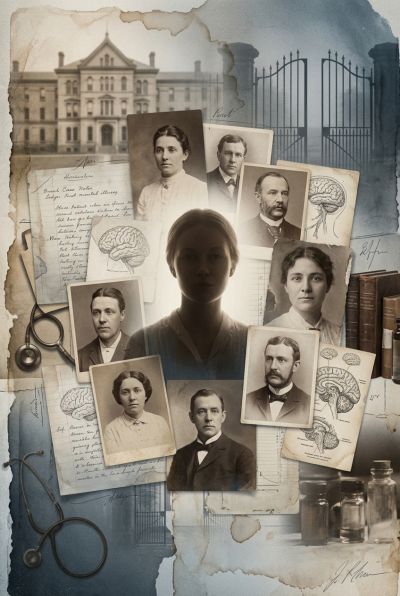
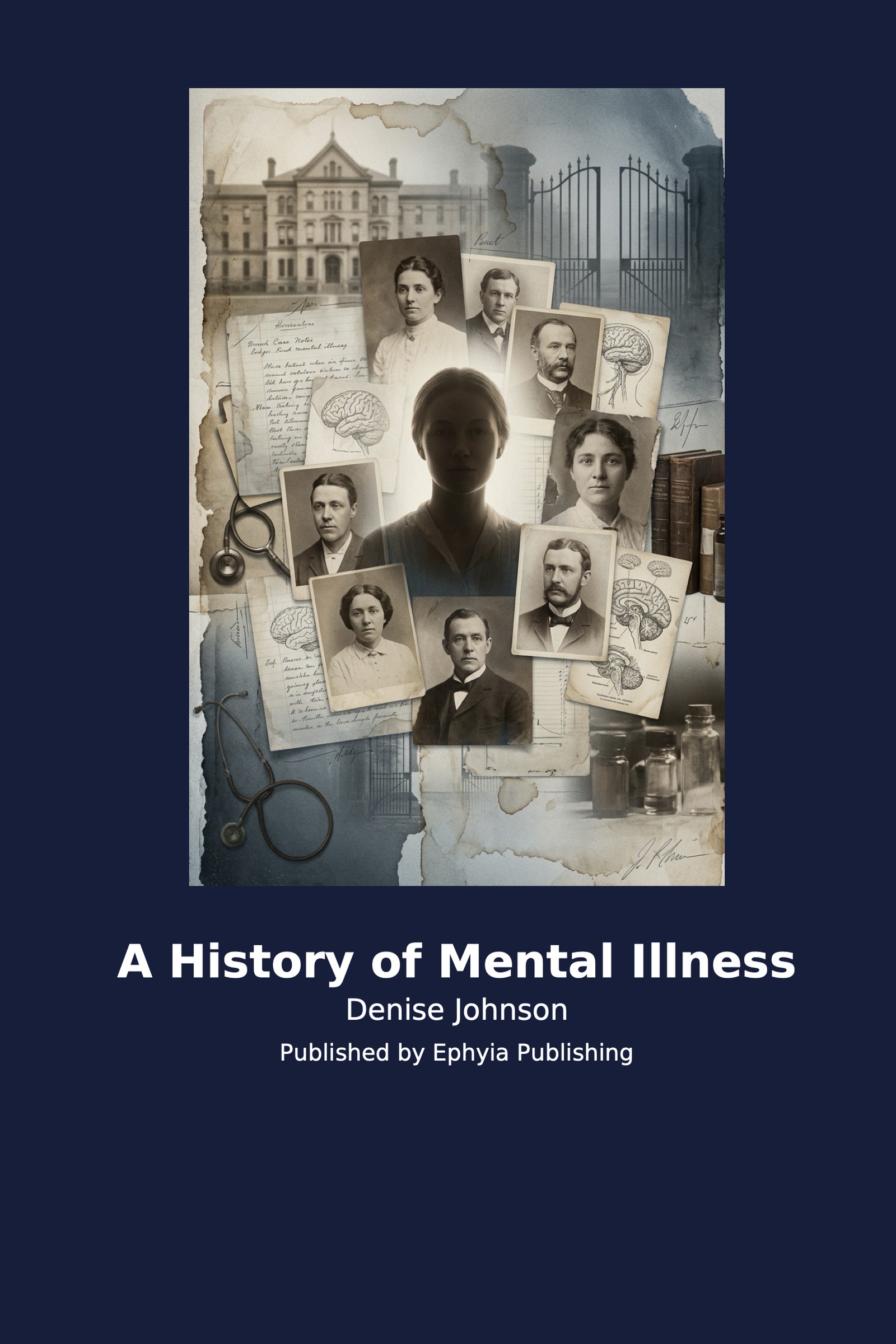

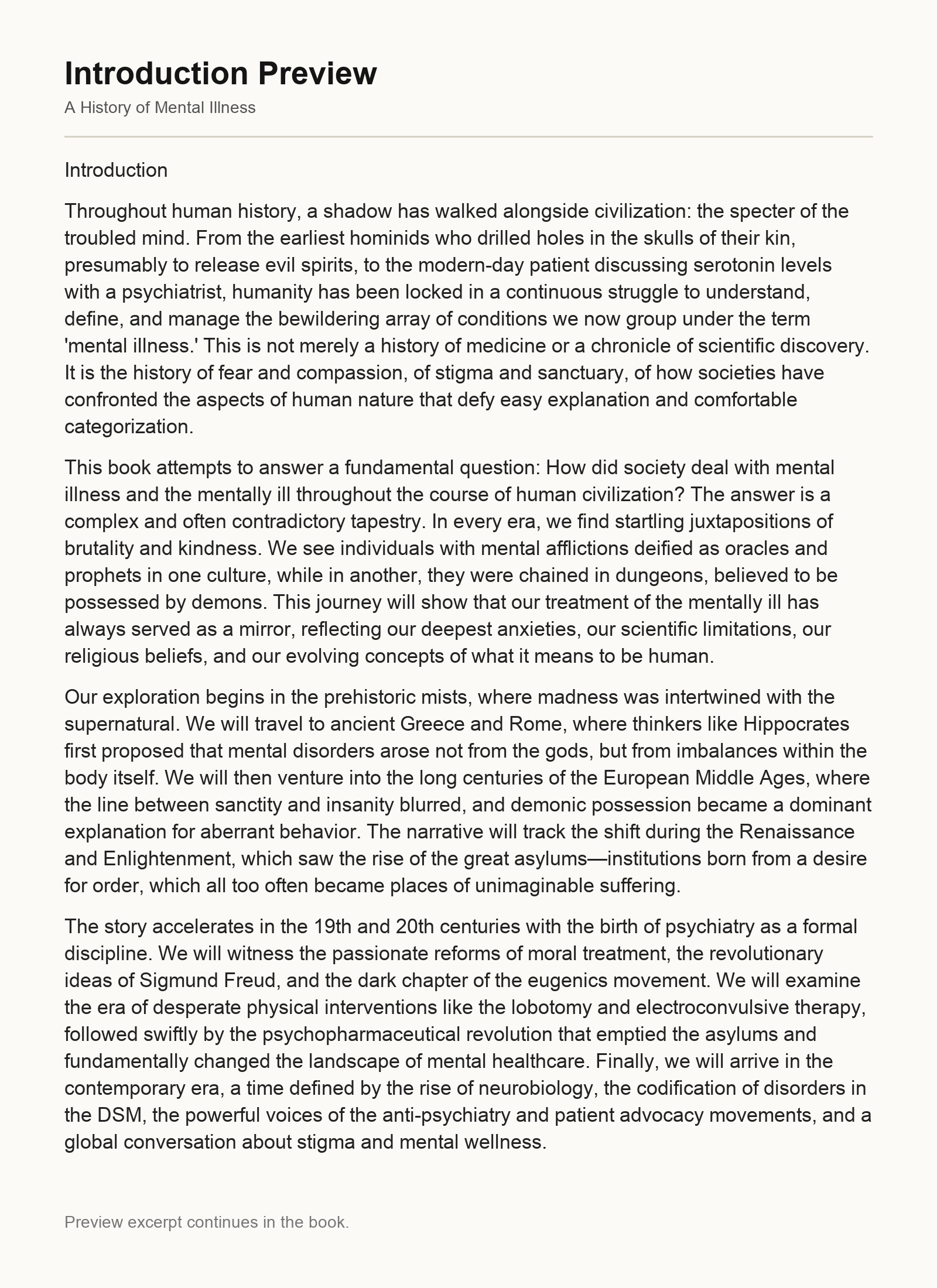
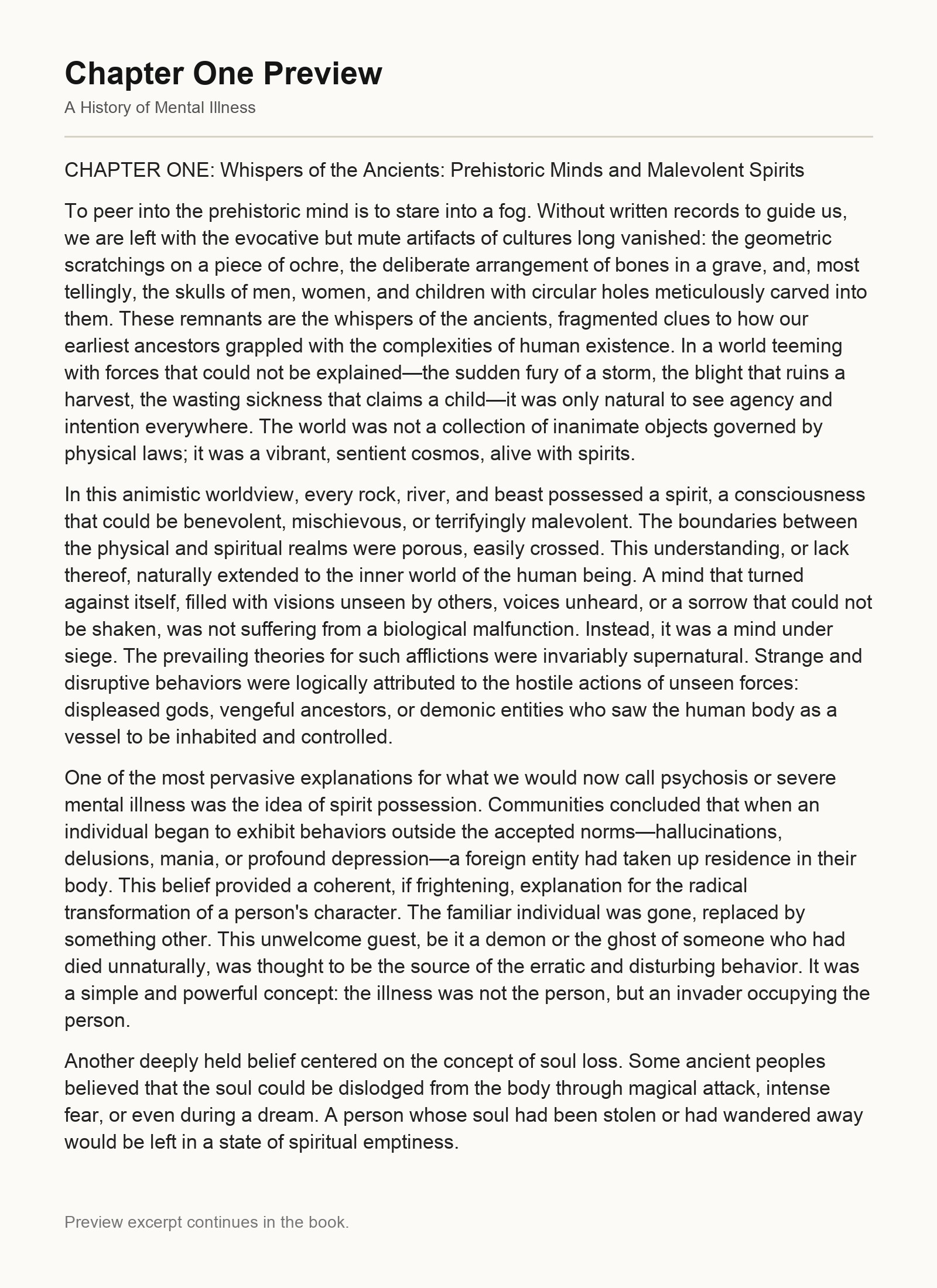
A History of Mental Illness invites readers on an expansive journey through time, tracing how every civilization has grappled with the mysteries of the troubled mind. From the prehistoric shamans who performed trepanation to release supposed evil spirits, to the Greek physicians who first linked madness to bodily humors, the book reveals the shifting explanations that have shaped human understanding—whether they rooted affliction in demonic possession, wandering wombs, or imbalanced fluids. Each chapter uncovers the cultural, religious, and scientific forces that have defined what it means to be mentally ill, showing how fear, compassion, and the quest for order have repeatedly intersected in the treatment of those deemed different.
Readers will walk the halls of medieval Europe where the Church’s exorcisms battled supposed demonic invaders, and then step into the enlightened wards of medieval Islamic bimaristans where music, light, and compassionate care pioneered a more humane model. The narrative follows the rise of the asylum during the Age of Reason, the humanitarian reforms of Philippe Pinel and the York Retreat, and the subsequent emergence of moral treatment that sought to heal through kindness and routine. It details the darker turns of eugenics, the devastating impact of war‑induced shell shock, and the desperate somatic therapies of insulin coma, lobotomy, and electroshock that promised cures but often left lives altered.
The book then charts the chemical revolution that brought antipsychotics and antidepressants into everyday practice, the wave of deinstitutionalization that aimed to empty asylums but often left patients without adequate support, and the powerful critiques of anti‑psychiatry that challenged the very notion of mental illness. Readers will witness the birth of the DSM as psychiatry’s diagnostic bible, the evolution of psychotherapy from Freud’s couch to cognitive‑behavioral and mindfulness‑based approaches, and the growing focus on genetics, neuroimaging, and neuromodulation that now direct cutting‑edge research. Along the way, the text highlights the emergence of neurodiversity, culture‑bound syndromes, and the vital voices of consumer and survivor movements that have reshaped policy and stigma.
Beyond the chronicle of treatments and theories, the book offers a deeply human perspective: it illuminates the lives of countless unnamed individuals who endured misunderstanding, confinement, and neglect while also spotlighting the reformers, physicians, and advocates who fought for dignity and change. By examining how each era’s understanding of madness mirrored its anxieties, values, and scientific limits, the narrative invites readers to reflect on the continuing tension between care and control, between biological explanation and lived experience, and between societal fear and the drive for compassion.
Finally, A History of Mental Illness looks toward the future, exploring how digital phenotyping, artificial intelligence, psychedelic‑assisted therapy, and precision psychiatry may redefine diagnosis and treatment. It confronts the ethical dilemmas that accompany these advances—questions of privacy, consent, and the risk of reducing complex human experiences to mere data points—while emphasizing that lasting progress will require addressing the social determinants of mental health. For anyone curious about how society has sought to mend the mind and what lessons history holds for tomorrow’s challenges, this book provides a thorough, engaging, and thought‑provoking account.
What You'll Find Inside:
- Traces the evolution of mental illness understanding from prehistoric spirit theories and trepanation to humoral theory in ancient Greece and Rome.
- Details the rise and fall of asylums, from moral treatment reforms by Pinel and Tuke to the Great Confinement and eventual deinstitutionalization.
- Explores key developments in biological psychiatry including psychoanalysis, eugenics, psychopharmacology breakthroughs (Thorazine, antidepressants), and modern neuromodulation techniques.
- Examines social movements that challenged psychiatric authority, including anti-psychiatry, consumer/survivor advocacy, and the neurodiversity movement.
- Covers contemporary approaches such as DSM evolution, evidence-based psychotherapies (CBT, DBT), culture-bound syndromes, and emerging technologies like digital phenotyping.
Who's It For:
This book is ideal for students and professionals in psychology, psychiatry, history, and medical humanities seeking a comprehensive historical perspective on mental illness. It will also benefit mental health practitioners wanting to understand the evolution of their field, as well as general readers interested in how societal attitudes, scientific understanding, and treatment approaches toward mental illness have changed from ancient times to the present day.
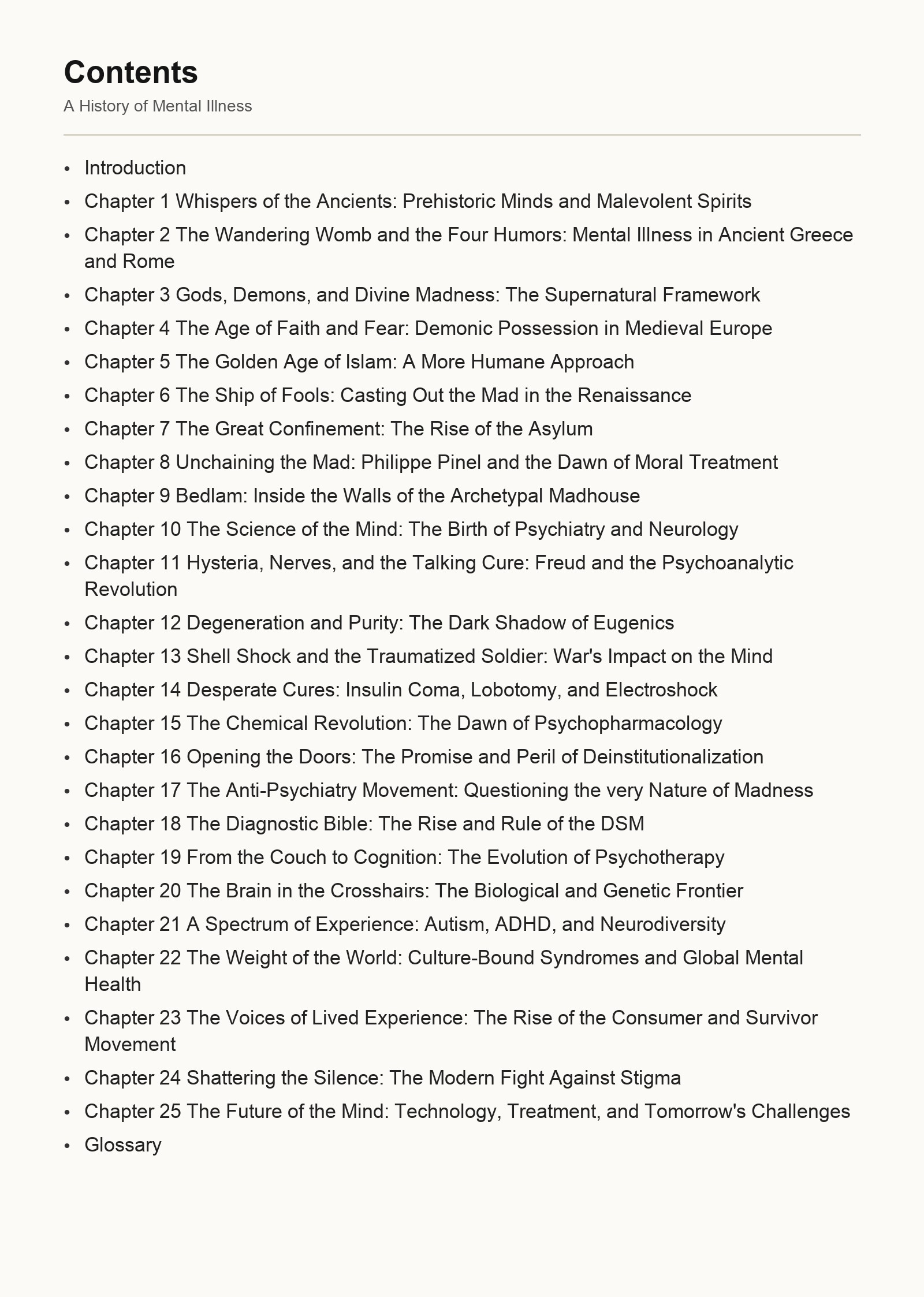
Table of Contents:
- Introduction
- Chapter 1 Whispers of the Ancients: Prehistoric Minds and Malevolent Spirits
- Chapter 2 The Wandering Womb and the Four Humors: Mental Illness in Ancient Greece and Rome
- Chapter 3 Gods, Demons, and Divine Madness: The Supernatural Framework
- Chapter 4 The Age of Faith and Fear: Demonic Possession in Medieval Europe
- Chapter 5 The Golden Age of Islam: A More Humane Approach
- Chapter 6 The Ship of Fools: Casting Out the Mad in the Renaissance
- Chapter 7 The Great Confinement: The Rise of the Asylum
- Chapter 8 Unchaining the Mad: Philippe Pinel and the Dawn of Moral Treatment
- Chapter 9 Bedlam: Inside the Walls of the Archetypal Madhouse
- Chapter 10 The Science of the Mind: The Birth of Psychiatry and Neurology
- Chapter 11 Hysteria, Nerves, and the Talking Cure: Freud and the Psychoanalytic Revolution
- Chapter 12 Degeneration and Purity: The Dark Shadow of Eugenics
- Chapter 13 Shell Shock and the Traumatized Soldier: War's Impact on the Mind
- Chapter 14 Desperate Cures: Insulin Coma, Lobotomy, and Electroshock
- Chapter 15 The Chemical Revolution: The Dawn of Psychopharmacology
- Chapter 16 Opening the Doors: The Promise and Peril of Deinstitutionalization
- Chapter 17 The Anti-Psychiatry Movement: Questioning the very Nature of Madness
- Chapter 18 The Diagnostic Bible: The Rise and Rule of the DSM
- Chapter 19 From the Couch to Cognition: The Evolution of Psychotherapy
- Chapter 20 The Brain in the Crosshairs: The Biological and Genetic Frontier
- Chapter 21 A Spectrum of Experience: Autism, ADHD, and Neurodiversity
- Chapter 22 The Weight of the World: Culture-Bound Syndromes and Global Mental Health
- Chapter 23 The Voices of Lived Experience: The Rise of the Consumer and Survivor Movement
- Chapter 24 Shattering the Silence: The Modern Fight Against Stigma
- Chapter 25 The Future of the Mind: Technology, Treatment, and Tomorrow's Challenges
- Glossary
Ephyia Publishing MixCache.com Book Reference: 15740
Author:
Published By:
Date Published:
May 20, 2026
Type:
Nonfiction
Language:
English
Also Available In:
Word Count:
55,412 words
Reading Time:
3 hours 53 minutes
Sample:
Order:
Buy the A History of Mental Illness ebook on MixCache.com:
Buy NowThe full ebook will be available immediately to read instantly on any device.
$5 account credit for all new MixCache.com accounts, usable toward any ebook purchase!*


Ratings & Reviews
Ask Questions About This Book
Have a question about the content? Ask our AI assistant!
Start by asking a question about "A History of Mental Illness"
Example: "Does this book mention William Shakespeare?"
Thinking...