Browse by Category
Fiction
- Action & Adventure
- African American
- Anthologies
- Children's Fiction
- Classics
- Comics & Graphic Novels
- Coming of Age
- Contemporary
- Cultural & Regional
- Drama
- Erotica
- Fantasy
- General
- Historical Fiction
- Horror
- Humor & Satire
- Literary Fiction
- Mystery, Thriller & Suspense
- Poetry
- Religious & Inspirational
- Romance
- Science Fiction
- Short Stories
- War & Military
- Westerns
- Women's Fiction
- Young Adult
Non-Fiction
- Antiques & Collectibles
- Arts & Photography
- Biographies & Memoirs
- Business & Money
- Children's Non-Fiction
-
Computers & Technology
- Artificial Intelligence
- Computer Science
- Cybersecurity & Cryptography
- Data Science & Analytics
- Databases & Big Data
- Game Development & Design
- General
- Hardware & DIY
- Mobile App Development
- Networking & Cloud Computing
- Operating Systems
- Programming
- Robotics
- Software
- Software Engineering
- User Experience (UX) & Design
- Web Development & Design
- Cooking, Food & Wine
- Crafts, Hobbies & Home
- Education & Teaching
- Engineering
- General
- Health, Fitness & Dieting
-
History
- African History
- African History - North Africa
- African History - Sub-Saharan Africa
- American History
- American History - 20th Century
- American History - Civil War
- American History - Colonial Period
- Ancient History
- Asian History
- Asian History - China
- Asian History - India
- Asian History - Japan
- Asian History - Southeast Asia
- European History
- European History - Ancient Greece
- European History - Ancient Rome
- European History - Medieval
- European History - Modern
- European History - Renaissance
- General
- Middle Eastern History
- Military History
- Military History - Aviation
- Military History - Naval
- Social & Cultural History
- World History
- Humor & Entertainment
- Industrial Technology
- Language Learning
- Law
- LGBTQ+ Non-Fiction
- Literary Criticism
- Medical Books
- Parenting & Relationships
- Philosophy
- Politics & Social Sciences
- Reference
- Religion & Spirituality
-
Science & Math
- Agricultural Sciences
- Astronomy & Space Science
- Behavioral Sciences
- Biological Sciences
- Botany & Plant Science
- Chemistry
- Earth Sciences
- Engineering - Chemical
- Engineering - Civil
- Engineering - Electrical
- Engineering - Mechanical
- Environment
- General
- Geology
- Mathematics
- Nature & Ecology
- Oceanography
- Paleontology
- Physics
- Statistics
- Self-Help
- Sports & Outdoors
- Study Aids
- Sustainability & Green Living
- Textbooks
- Transportation
- Travel
- True Crime
- Urban Planning & Development
- Veterinary Medicine
- Writing & Publishing
Jump to Section
MixCache.com Total Access
Unlimited reading and audiobooks for every book published by MixCache.com.
Included titles carry the MTA badge.
Learn more →A History of Cyprus
About this book:
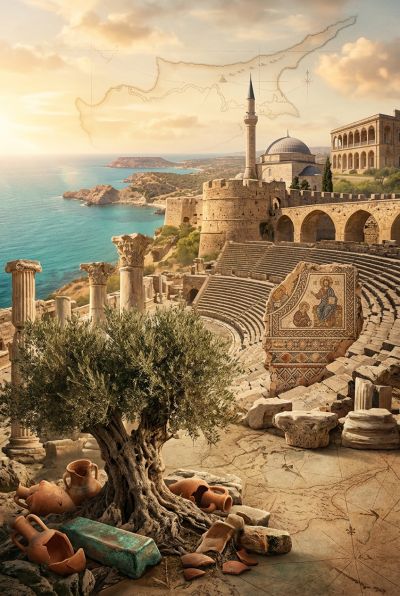


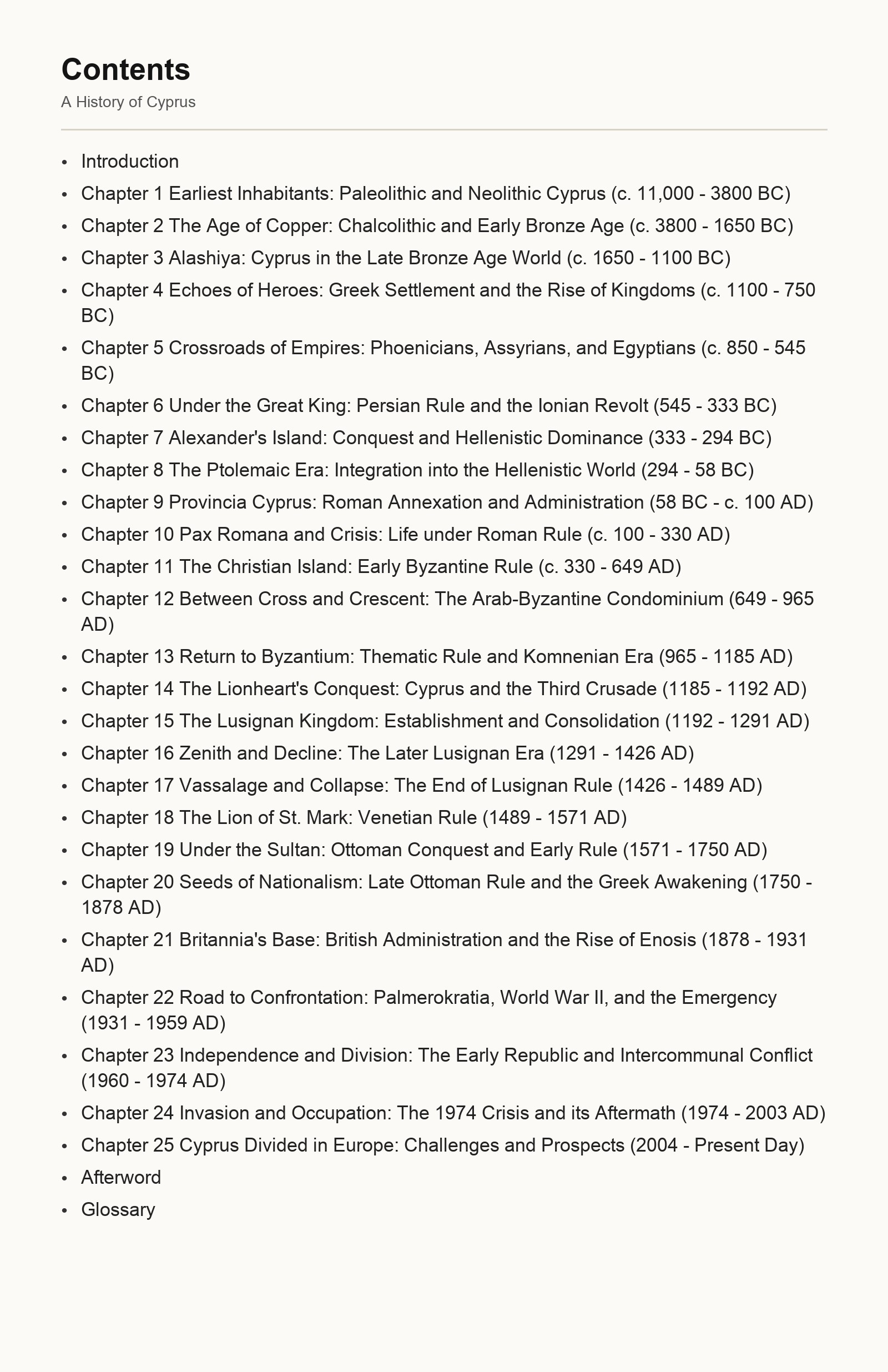
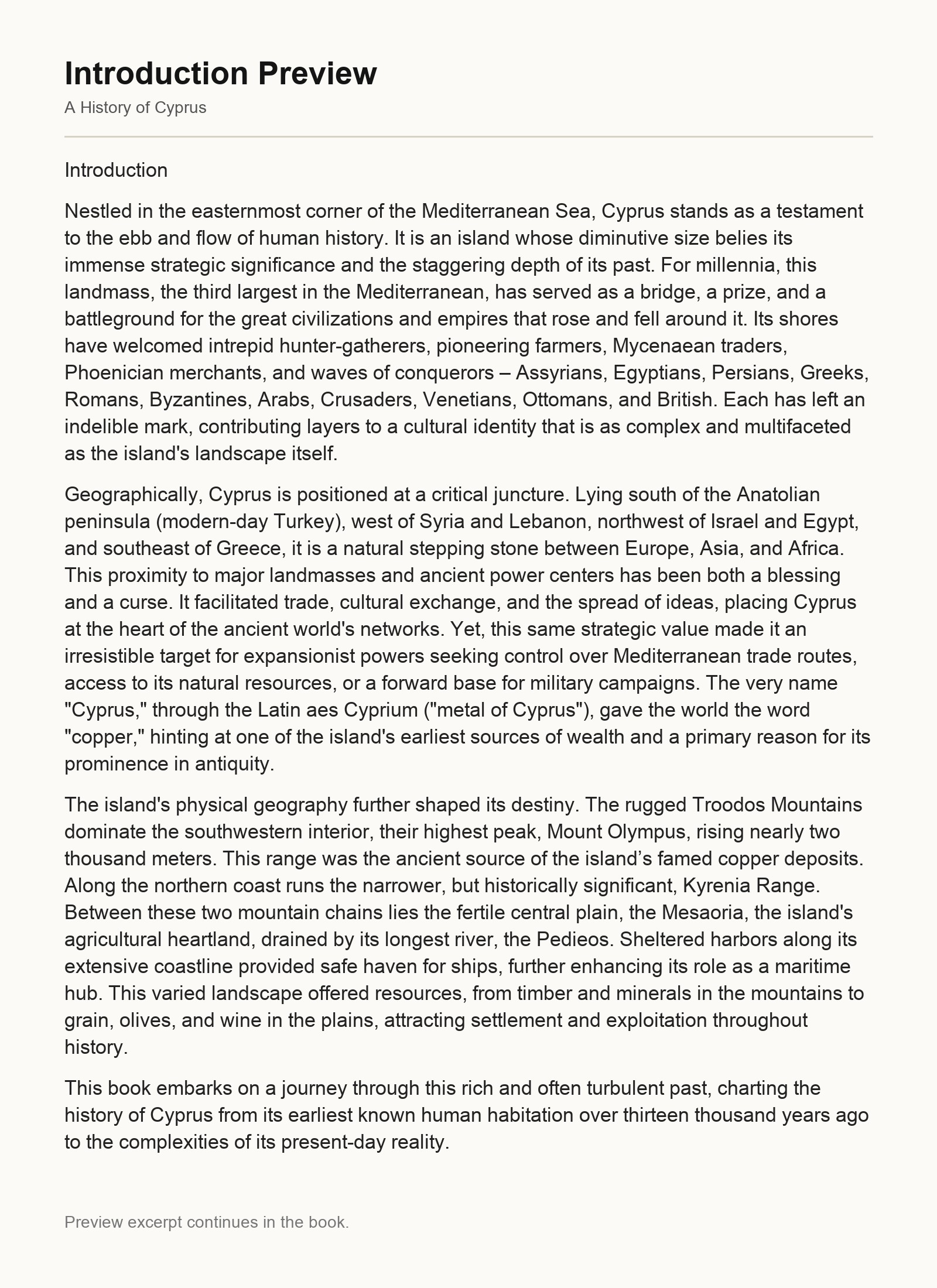
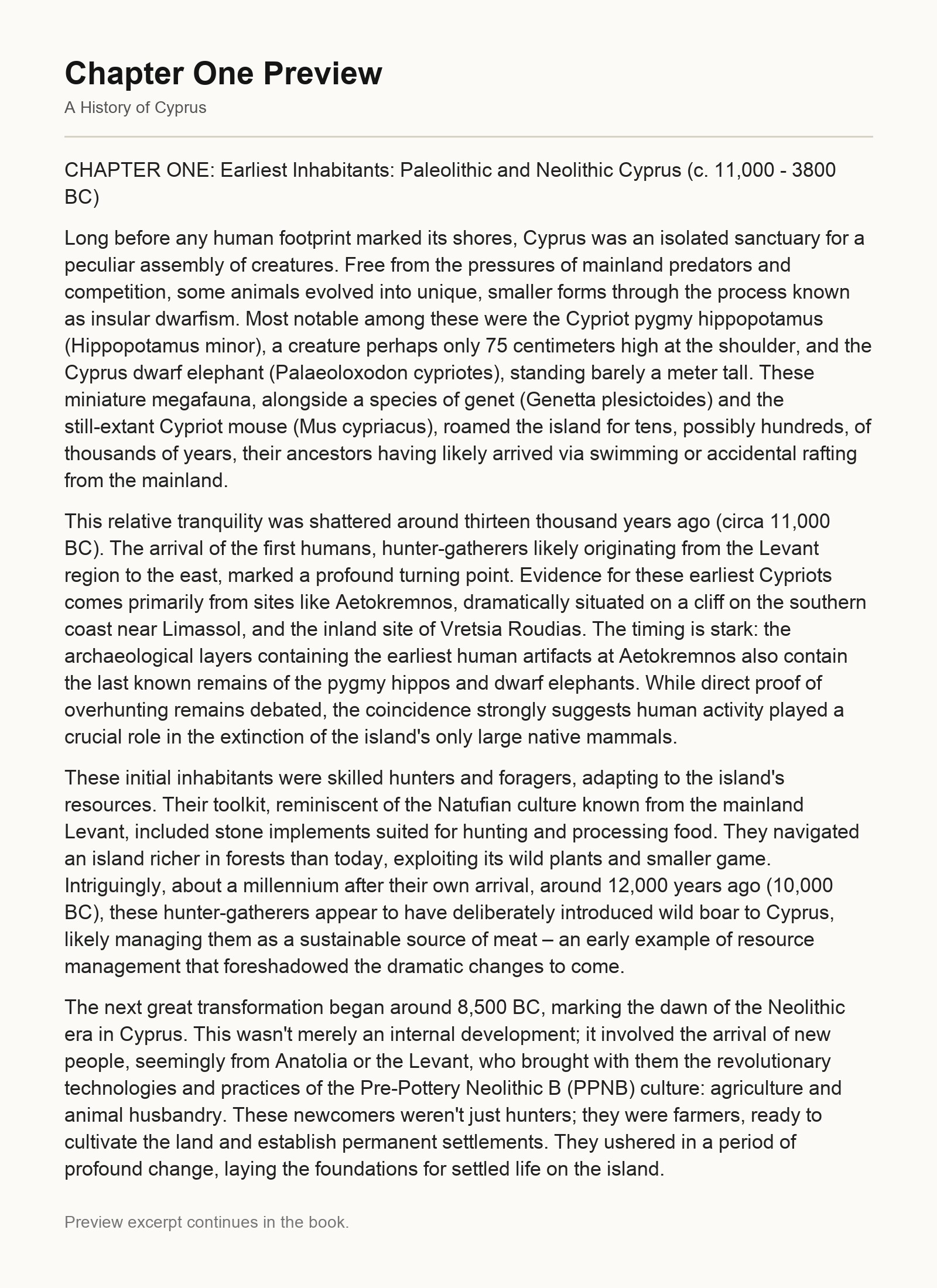
Discover the extraordinary story of Cyprus, an island whose strategic position at the crossroads of Europe, Asia, and Africa has made it a prize coveted by empires for over thirteen thousand years. In this comprehensive history, Dr. Alex Bugeja guides readers from the island's first human inhabitants - hunter-gatherers who encountered pygmy elephants and hippos - through the rise of settled farming communities, the copper trade that gave the island its name, and its emergence as the Late Bronze Age kingdom of Alashiya, a major player in eastern Mediterranean networks.
Journey through centuries of cultural exchange as Cyprus absorbs and transforms influences from Mycenaean Greeks who linked the island to Aphrodite's mythology, Phoenician traders who established commercial hubs, and Near Eastern empires from Assyria to Persia. Readers will learn how the conquests of Alexander the Great ushered in Hellenistic dominance, how Rome integrated the island into its provincial system, and how Byzantine Christianity took root while the autocephalous Church of Cyprus preserved Hellenic identity through centuries of foreign rule.
Experience the island's medieval transformation as it became a Crusader kingdom under the French Lusignan dynasty, witnessed the fortified grandeur of Venetian rule against Ottoman expansion, and endured three centuries of Ottoman administration that established the island's enduring Greek and Turkish communities through the millet system. The narrative reveals how each period - from Arab-Byzantine shared sovereignty to British administration - added layers to Cyprus's complex cultural identity while its copper, timber, and later strategic location continued to shape its destiny.
Explore the modern era's defining conflicts as rising nationalisms under British rule led to the Greek pursuit of enosis (union with Greece) and Turkish Cypriot advocacy for taksim (partition), culminating in the independence of 1960 that failed to bridge communal divides. Readers will gain deep insight into the 1974 crisis - the Greek-backed coup, Turkish invasion, and the resulting division that created the Green Line - as well as the ongoing challenges of reunification efforts, EU membership with suspended northern application, and the geopolitical significance of newly discovered offshore natural gas reserves.
Drawing on archaeological findings from sites like Neolithic Khirokitia and Late Bronze Age Enkomi, ancient texts including the Amarna letters, and modern historical scholarship, this book presents a balanced, chronological account that navigates periods of conflict with neutrality. Readers will understand how Cyprus's history illuminates broader themes of empire dynamics, cultural crossroads, identity formation, and the enduring impact of strategic geography - offering essential context for comprehending not just this remarkable island's past, but its continuing role as a European Union member state at the volatile intersection of civilizations in the twenty-first century.
What You'll Find Inside:
- Cyprus' strategic position at the crossroads of Europe, Asia, and Africa made it a prized asset for empires from the Bronze Age to the British era.
- The island's history is a tapestry of cultural exchange, blending Hellenic, Near Eastern, Roman, Byzantine, Crusader, Venetian, Ottoman, and British influences.
- Natural resources—first copper, then timber, and now offshore gas—have repeatedly attracted foreign interest and shaped Cyprus' economic fortunes.
- Religion has been a defining force, with the autocephalous Orthodox Church preserving Greek identity and Islam forming the core of the Turkish Cypriot community.
- Centuries of foreign rule and ethno‑religious divisions culminated in the 1974 division, leaving Cyprus a divided EU member state grappling with reunification challenges.
Who's It For:
This book is ideal for university students and scholars of Mediterranean, European, or Middle Eastern history seeking a comprehensive, chronological overview of Cyprus. It also serves general readers, diplomats, and policymakers who need to understand the historical roots of the Cyprus problem, the island's strategic significance, and the interplay of empire, nationalism, and identity that continues to shape its present.
Table of Contents:
-
Introduction
-
Chapter 1 Earliest Inhabitants: Paleolithic and Neolithic Cyprus (c. 11,000 - 3800 BC)
-
Chapter 2 The Age of Copper: Chalcolithic and Early Bronze Age (c. 3800 - 1650 BC)
-
Chapter 3 Alashiya: Cyprus in the Late Bronze Age World (c. 1650 - 1100 BC)
-
Chapter 4 Echoes of Heroes: Greek Settlement and the Rise of Kingdoms (c. 1100 - 750 BC)
-
Chapter 5 Crossroads of Empires: Phoenicians, Assyrians, and Egyptians (c. 850 - 545 BC)
-
Chapter 6 Under the Great King: Persian Rule and the Ionian Revolt (545 - 333 BC)
-
Chapter 7 Alexander's Island: Conquest and Hellenistic Dominance (333 - 294 BC)
-
Chapter 8 The Ptolemaic Era: Integration into the Hellenistic World (294 - 58 BC)
-
Chapter 9 Provincia Cyprus: Roman Annexation and Administration (58 BC - c. 100 AD)
-
Chapter 10 Pax Romana and Crisis: Life under Roman Rule (c. 100 - 330 AD)
-
Chapter 11 The Christian Island: Early Byzantine Rule (c. 330 - 649 AD)
-
Chapter 12 Between Cross and Crescent: The Arab-Byzantine Condominium (649 - 965 AD)
-
Chapter 13 Return to Byzantium: Thematic Rule and Komnenian Era (965 - 1185 AD)
-
Chapter 14 The Lionheart's Conquest: Cyprus and the Third Crusade (1185 - 1192 AD)
-
Chapter 15 The Lusignan Kingdom: Establishment and Consolidation (1192 - 1291 AD)
-
Chapter 16 Zenith and Decline: The Later Lusignan Era (1291 - 1426 AD)
-
Chapter 17 Vassalage and Collapse: The End of Lusignan Rule (1426 - 1489 AD)
-
Chapter 18 The Lion of St. Mark: Venetian Rule (1489 - 1571 AD)
-
Chapter 19 Under the Sultan: Ottoman Conquest and Early Rule (1571 - 1750 AD)
-
Chapter 20 Seeds of Nationalism: Late Ottoman Rule and the Greek Awakening (1750 - 1878 AD)
-
Chapter 21 Britannia's Base: British Administration and the Rise of Enosis (1878 - 1931 AD)
-
Chapter 22 Road to Confrontation: Palmerokratia, World War II, and the Emergency (1931 - 1959 AD)
-
Chapter 23 Independence and Division: The Early Republic and Intercommunal Conflict (1960 - 1974 AD)
-
Chapter 24 Invasion and Occupation: The 1974 Crisis and its Aftermath (1974 - 2003 AD)
-
Chapter 25 Cyprus Divided in Europe: Challenges and Prospects (2004 - Present Day)
-
Afterword
-
Glossary
Author:
Published By:
Date Published:
May 28, 2026
Type:
Nonfiction
Language:
English
Also Available In:
Word Count:
57,079 words
Reading Time:
4 hours
Sample:
Order:
Order A History of Cyprus (Hardcover) on MixCache.com:
Buy NowPrint copy is made to order and ships worldwide. Includes the ebook free, ready to read instantly.
$5 account credit for all new MixCache.com accounts, usable toward any ebook purchase!*