Browse by Category
Fiction
- Action & Adventure
- African American
- Anthologies
- Children's Fiction
- Classics
- Comics & Graphic Novels
- Coming of Age
- Contemporary
- Cultural & Regional
- Drama
- Erotica
- Fantasy
- General
- Historical Fiction
- Horror
- Humor & Satire
- Literary Fiction
- Mystery, Thriller & Suspense
- Poetry
- Religious & Inspirational
- Romance
- Science Fiction
- Short Stories
- War & Military
- Westerns
- Women's Fiction
- Young Adult
Non-Fiction
- Antiques & Collectibles
- Arts & Photography
- Biographies & Memoirs
- Business & Money
- Children's Non-Fiction
-
Computers & Technology
- Artificial Intelligence
- Computer Science
- Cybersecurity & Cryptography
- Data Science & Analytics
- Databases & Big Data
- Game Development & Design
- General
- Hardware & DIY
- Mobile App Development
- Networking & Cloud Computing
- Operating Systems
- Programming
- Robotics
- Software
- Software Engineering
- User Experience (UX) & Design
- Web Development & Design
- Cooking, Food & Wine
- Crafts, Hobbies & Home
- Education & Teaching
- Engineering
- General
- Health, Fitness & Dieting
-
History
- African History
- African History - North Africa
- African History - Sub-Saharan Africa
- American History
- American History - 20th Century
- American History - Civil War
- American History - Colonial Period
- Ancient History
- Asian History
- Asian History - China
- Asian History - India
- Asian History - Japan
- Asian History - Southeast Asia
- European History
- European History - Ancient Greece
- European History - Ancient Rome
- European History - Medieval
- European History - Modern
- European History - Renaissance
- General
- Middle Eastern History
- Military History
- Military History - Aviation
- Military History - Naval
- Social & Cultural History
- World History
- Humor & Entertainment
- Industrial Technology
- Language Learning
- Law
- LGBTQ+ Non-Fiction
- Literary Criticism
- Medical Books
- Parenting & Relationships
- Philosophy
- Politics & Social Sciences
- Reference
- Religion & Spirituality
-
Science & Math
- Agricultural Sciences
- Astronomy & Space Science
- Behavioral Sciences
- Biological Sciences
- Botany & Plant Science
- Chemistry
- Earth Sciences
- Engineering - Chemical
- Engineering - Civil
- Engineering - Electrical
- Engineering - Mechanical
- Environment
- General
- Geology
- Mathematics
- Nature & Ecology
- Oceanography
- Paleontology
- Physics
- Statistics
- Self-Help
- Sports & Outdoors
- Study Aids
- Sustainability & Green Living
- Textbooks
- Transportation
- Travel
- True Crime
- Urban Planning & Development
- Veterinary Medicine
- Writing & Publishing
Jump to Section
MixCache.com Total Access
Unlimited reading and audiobooks for every book published by MixCache.com.
Included titles carry the MTA badge.
Learn more →
Exoplanets
Planets Beyond The Solar System
About this book:

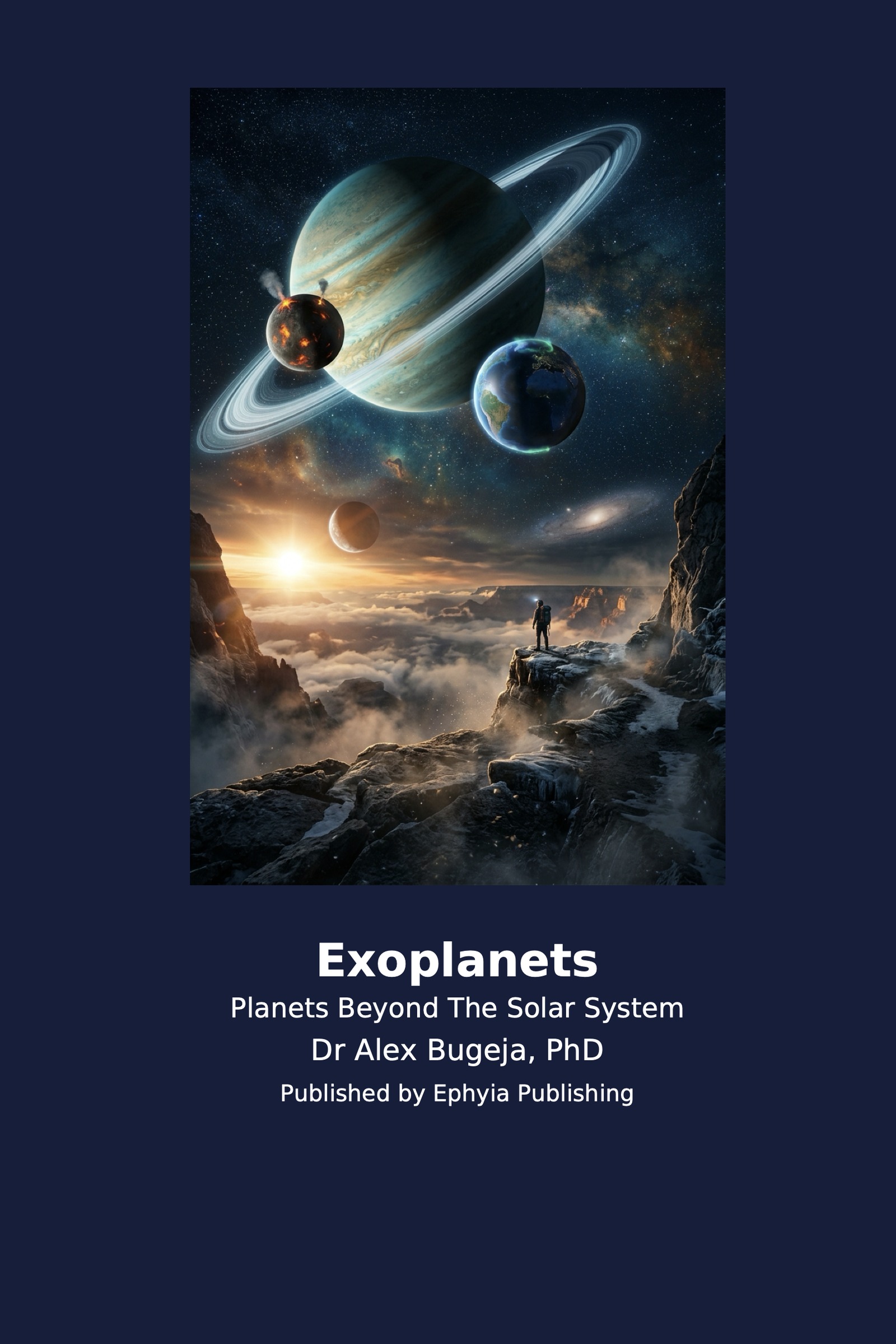
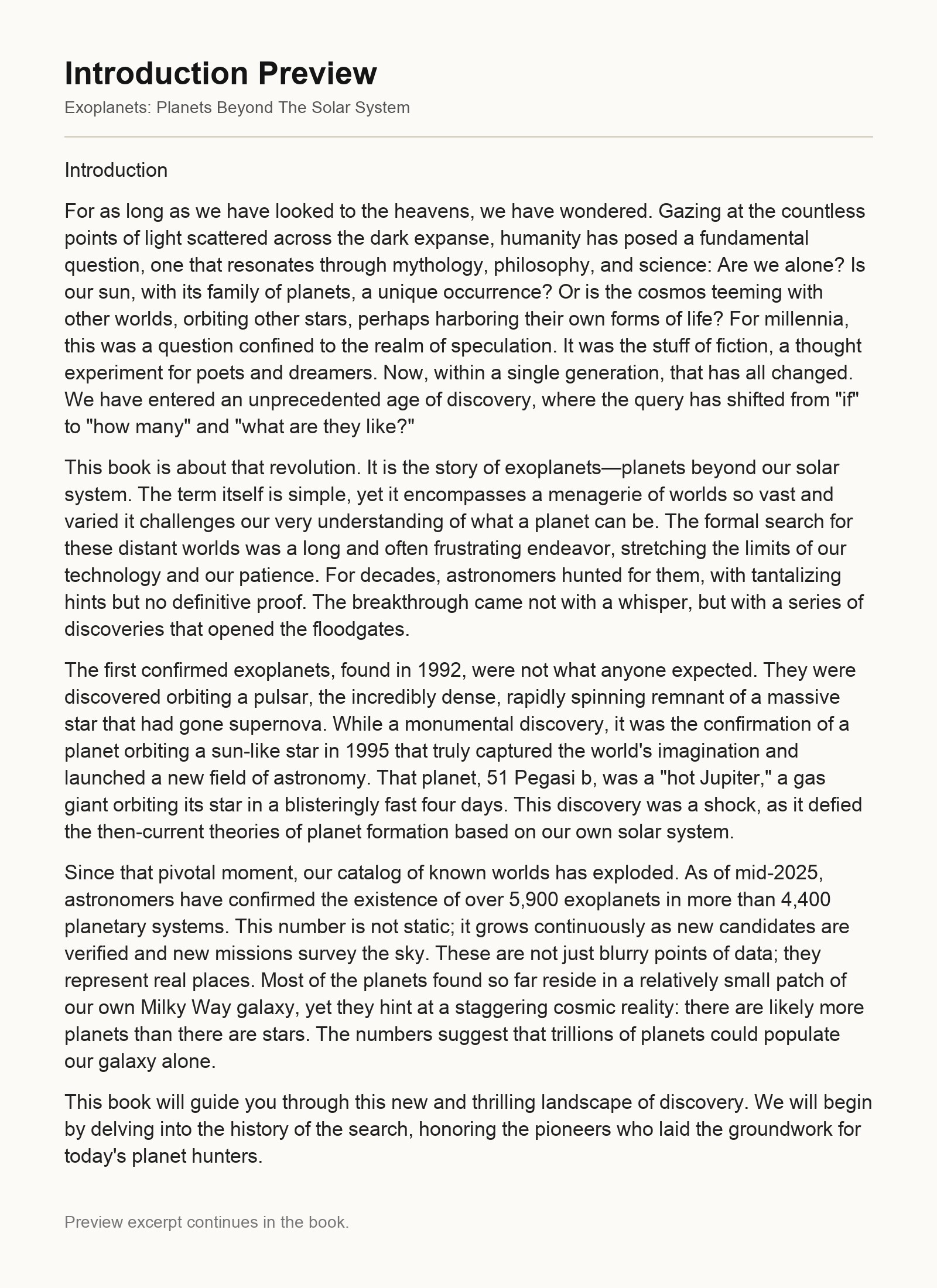
Embark on a voyage beyond our solar system and discover how astronomers have uncovered thousands of worlds orbiting distant stars. From the first hints of pulsar planets to the revolutionary findings of Kepler and the James Webb Space Telescope, this book traces the ingenious methods—transit shadows, stellar wobbles, gravitational lensing, and direct imaging—that allow us to detect planets we can never see with the naked eye. You will learn how each technique reveals a planet’s size, mass, orbit, and even the composition of its atmosphere, turning faint starlight into a detailed portrait of alien worlds.
Explore the astonishing diversity of exoplanets that defy our solar‑system template: scorching hot Jupiters skimming their stars in days, super‑Earths and mini‑Neptunes populating the galaxy’s most common planetary class, lava‑covered worlds, water‑rich ocean planets, and lonely rogue planets drifting through interstellar space. Each chapter unpacks the formation, evolution, and extreme environments of these bodies, showing how nature’s creativity reshapes our understanding of what a planet can be.
Delve into the science of habitability as the book guides you through the Goldilocks zone, tidal heating on icy moons, and the potential for life in exotic settings such as hydrogen‑rich Hycean worlds or subsurface oceans on rogue planets. You will discover how astronomers search for biosignatures—oxygen, methane, and other chemical disequilibria—and what future telescopes like the Extremely Large Telescopes and the Habitable Worlds Observatory aim to achieve in the quest to find a true Earth twin.
Gain insight into the cutting‑edge tools shaping exoplanet research today: high‑resolution spectroscopy, transmission and emission techniques, atmospheric retrieval models, and the power of direct imaging with coronagraphs and starshades. The book explains how these methods let scientists measure wind speeds, map temperature offsets, detect cloud compositions, and even infer a planet’s day length, turning a pinprick of light into a weather report from light‑years away.
Finally, look ahead to the unanswered questions that drive the field—why our solar system lacks super‑Earths, the mysteries of planetary migration, the cloud conundrum obscuring atmospheric views, and the profound silence of the Fermi Paradox. By the end of this journey you will not only know how we find and characterize distant worlds, but also appreciate the scientific wonder and philosophical depth of realizing that we live in a galaxy teeming with planets, each a new frontier in the story of our place in the cosmos.
What You'll Find Inside:
- The revolutionary discovery methods that have revealed over 5,900 confirmed exoplanets, including transit, radial velocity, microlensing, and direct imaging techniques
- The astonishing diversity of exoplanetary worlds, from scorching hot Jupiters and lava worlds to potential water worlds and free-floating rogue planets
- How planetary formation and migration processes explain why our solar system may be unusual compared to the galaxy's predominant super-Earth/mini-Neptune systems
- The search for habitable worlds through the concept of the Goldilocks zone and alternative habitability scenarios like tidally heated moons and hycean worlds
- The cutting-edge characterization of exoplanet atmospheres using spectroscopy with instruments like JWST to detect potential biosignatures of life
Who's It For:
This book is ideal for undergraduate astronomy students, advanced high school students with strong science backgrounds, amateur astronomers, and educated general readers passionate about space exploration. It provides a comprehensive yet accessible overview of exoplanet science that assumes basic familiarity with astronomical concepts but explains technical details clearly. Readers interested in the history of scientific discovery, planetary formation theories, and the ongoing search for life beyond Earth will find particular value in this thorough exploration of one of astronomy's most exciting frontiers.
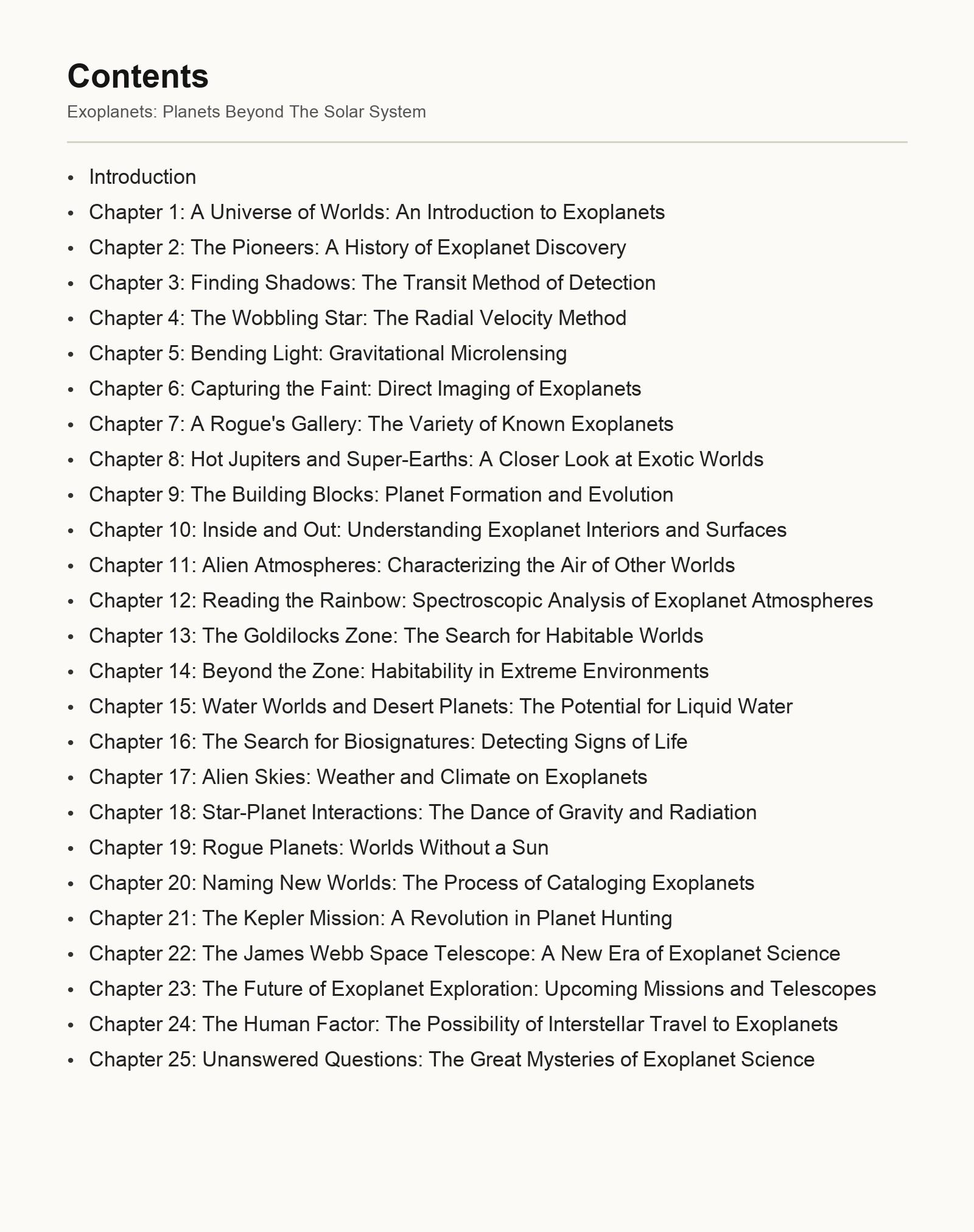
Table of Contents:
- Introduction
- Chapter 1: A Universe of Worlds: An Introduction to Exoplanets
- Chapter 2: The Pioneers: A History of Exoplanet Discovery
- Chapter 3: Finding Shadows: The Transit Method of Detection
- Chapter 4: The Wobbling Star: The Radial Velocity Method
- Chapter 5: Bending Light: Gravitational Microlensing
- Chapter 6: Capturing the Faint: Direct Imaging of Exoplanets
- Chapter 7: A Rogue's Gallery: The Variety of Known Exoplanets
- Chapter 8: Hot Jupiters and Super-Earths: A Closer Look at Exotic Worlds
- Chapter 9: The Building Blocks: Planet Formation and Evolution
- Chapter 10: Inside and Out: Understanding Exoplanet Interiors and Surfaces
- Chapter 11: Alien Atmospheres: Characterizing the Air of Other Worlds
- Chapter 12: Reading the Rainbow: Spectroscopic Analysis of Exoplanet Atmospheres
- Chapter 13: The Goldilocks Zone: The Search for Habitable Worlds
- Chapter 14: Beyond the Zone: Habitability in Extreme Environments
- Chapter 15: Water Worlds and Desert Planets: The Potential for Liquid Water
- Chapter 16: The Search for Biosignatures: Detecting Signs of Life
- Chapter 17: Alien Skies: Weather and Climate on Exoplanets
- Chapter 18: Star-Planet Interactions: The Dance of Gravity and Radiation
- Chapter 19: Rogue Planets: Worlds Without a Sun
- Chapter 20: Naming New Worlds: The Process of Cataloging Exoplanets
- Chapter 21: The Kepler Mission: A Revolution in Planet Hunting
- Chapter 22: The James Webb Space Telescope: A New Era of Exoplanet Science
- Chapter 23: The Future of Exoplanet Exploration: Upcoming Missions and Telescopes
- Chapter 24: The Human Factor: The Possibility of Interstellar Travel to Exoplanets
- Chapter 25: Unanswered Questions: The Great Mysteries of Exoplanet Science
Author:
Published By:
Date Published:
May 27, 2026
Type:
Nonfiction
Language:
English
Also Available In:
Word Count:
48,883 words
Reading Time:
3 hours 25 minutes
Sample:
Order:
Order Exoplanets (Paperback) on MixCache.com:
Buy NowPrint copy is made to order and ships worldwide. Includes the ebook free, ready to read instantly.
$5 account credit for all new MixCache.com accounts, usable toward any ebook purchase!*