
Browse by Category
Fiction
- Action & Adventure
- African American
- Anthologies
- Children's Fiction
- Classics
- Comics & Graphic Novels
- Coming of Age
- Contemporary
- Cultural & Regional
- Drama
- Erotica
- Fantasy
- General
- Historical Fiction
- Horror
- Humor & Satire
- Literary Fiction
- Mystery, Thriller & Suspense
- Poetry
- Religious & Inspirational
- Romance
- Science Fiction
- Short Stories
- War & Military
- Westerns
- Women's Fiction
- Young Adult
Non-Fiction
- Antiques & Collectibles
- Arts & Photography
- Biographies & Memoirs
- Business & Money
- Children's Non-Fiction
-
Computers & Technology
- Artificial Intelligence
- Computer Science
- Cybersecurity & Cryptography
- Data Science & Analytics
- Databases & Big Data
- Game Development & Design
- General
- Hardware & DIY
- Mobile App Development
- Networking & Cloud Computing
- Operating Systems
- Programming
- Robotics
- Software
- Software Engineering
- User Experience (UX) & Design
- Web Development & Design
- Cooking, Food & Wine
- Crafts, Hobbies & Home
- Education & Teaching
- Engineering
- General
- Health, Fitness & Dieting
-
History
- African History
- African History - North Africa
- African History - Sub-Saharan Africa
- American History
- American History - 20th Century
- American History - Civil War
- American History - Colonial Period
- Ancient History
- Asian History
- Asian History - China
- Asian History - India
- Asian History - Japan
- Asian History - Southeast Asia
- European History
- European History - Ancient Greece
- European History - Ancient Rome
- European History - Medieval
- European History - Modern
- European History - Renaissance
- General
- Middle Eastern History
- Military History
- Military History - Aviation
- Military History - Naval
- Social & Cultural History
- World History
- Humor & Entertainment
- Industrial Technology
- Language Learning
- Law
- LGBTQ+ Non-Fiction
- Literary Criticism
- Medical Books
- Parenting & Relationships
- Philosophy
- Politics & Social Sciences
- Reference
- Religion & Spirituality
-
Science & Math
- Agricultural Sciences
- Astronomy & Space Science
- Behavioral Sciences
- Biological Sciences
- Botany & Plant Science
- Chemistry
- Earth Sciences
- Engineering - Chemical
- Engineering - Civil
- Engineering - Electrical
- Engineering - Mechanical
- Environment
- General
- Geology
- Mathematics
- Nature & Ecology
- Oceanography
- Paleontology
- Physics
- Statistics
- Self-Help
- Sports & Outdoors
- Study Aids
- Sustainability & Green Living
- Textbooks
- Transportation
- Travel
- True Crime
- Urban Planning & Development
- Veterinary Medicine
- Writing & Publishing
Jump to Section
MixCache.com Total Access
Unlimited reading and audiobooks for every book published by MixCache.com.
Included titles carry the MTA badge.
Learn more →A History of Timekeeping
About this book:
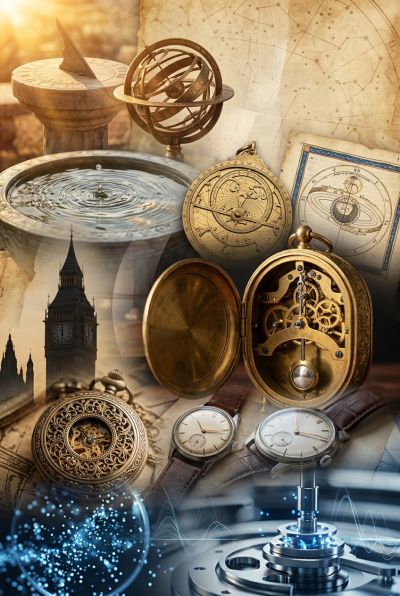
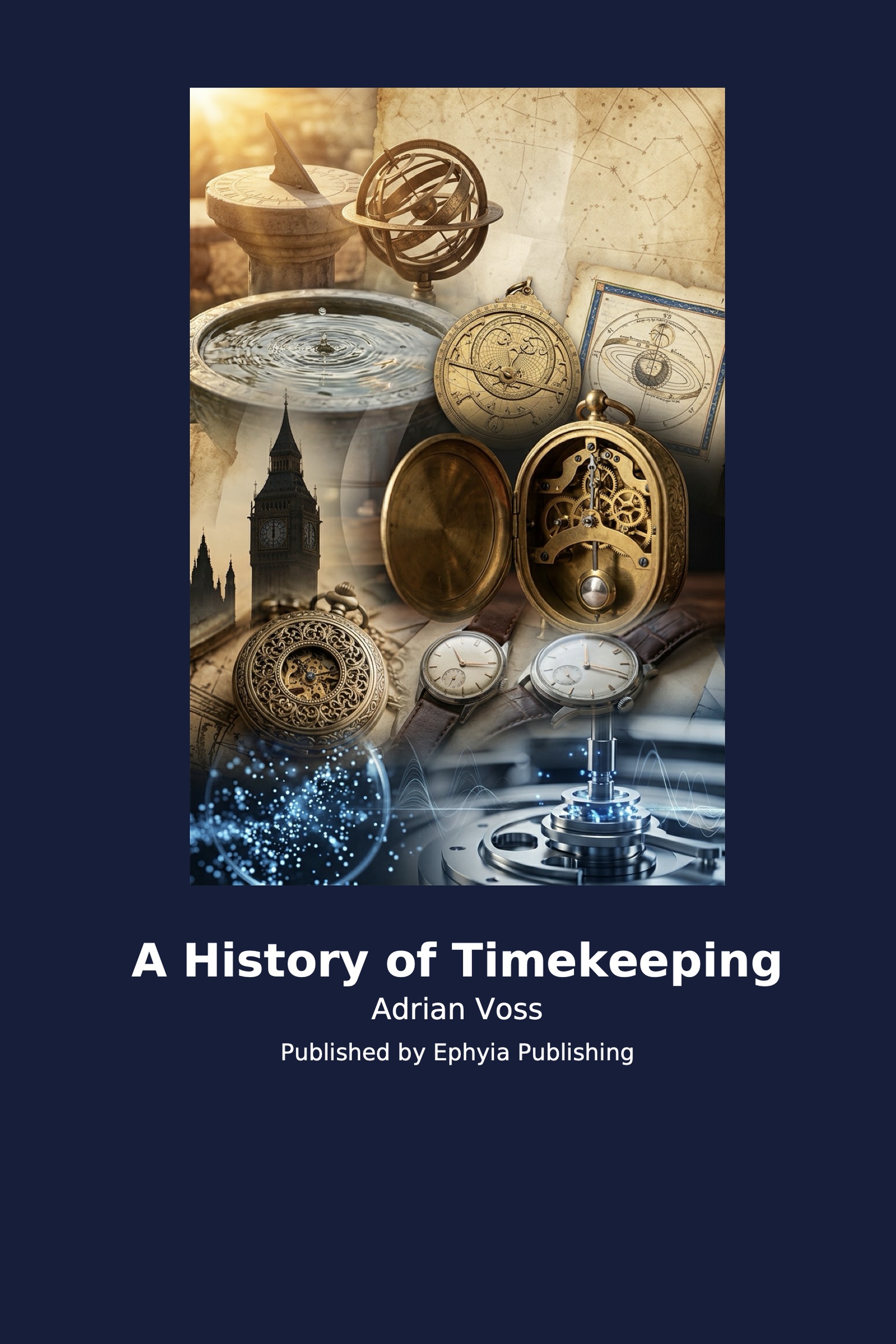
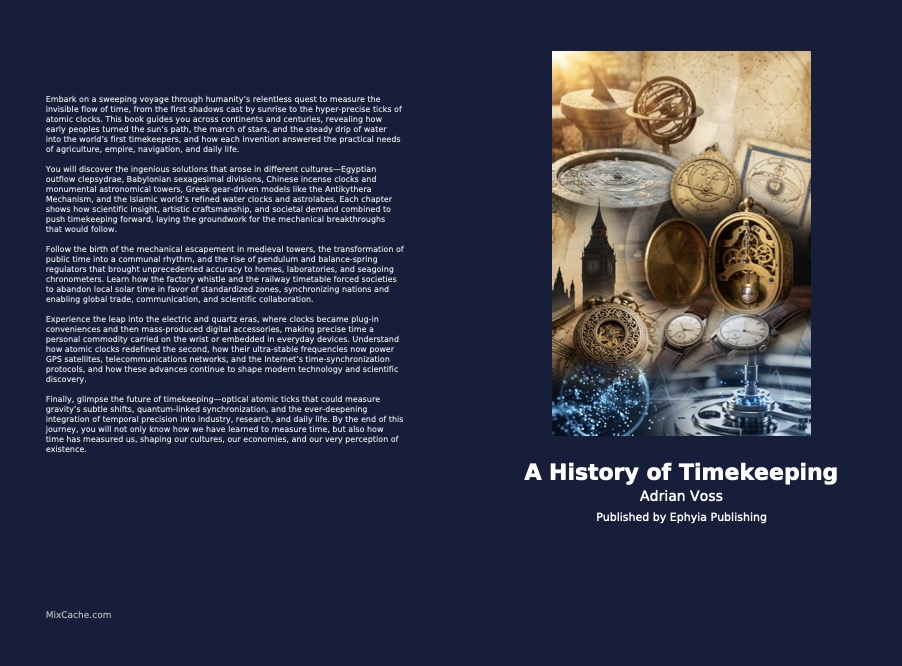
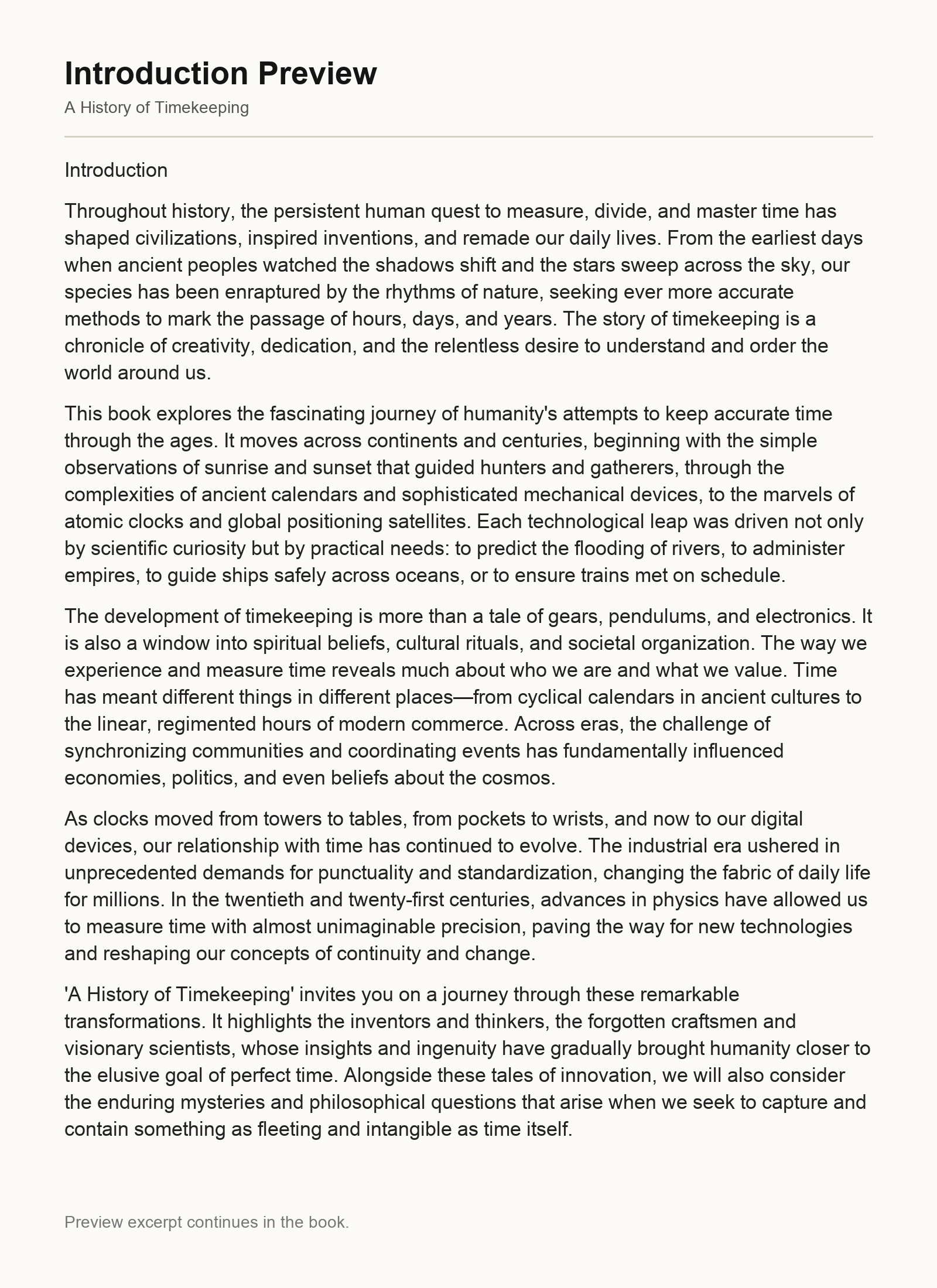
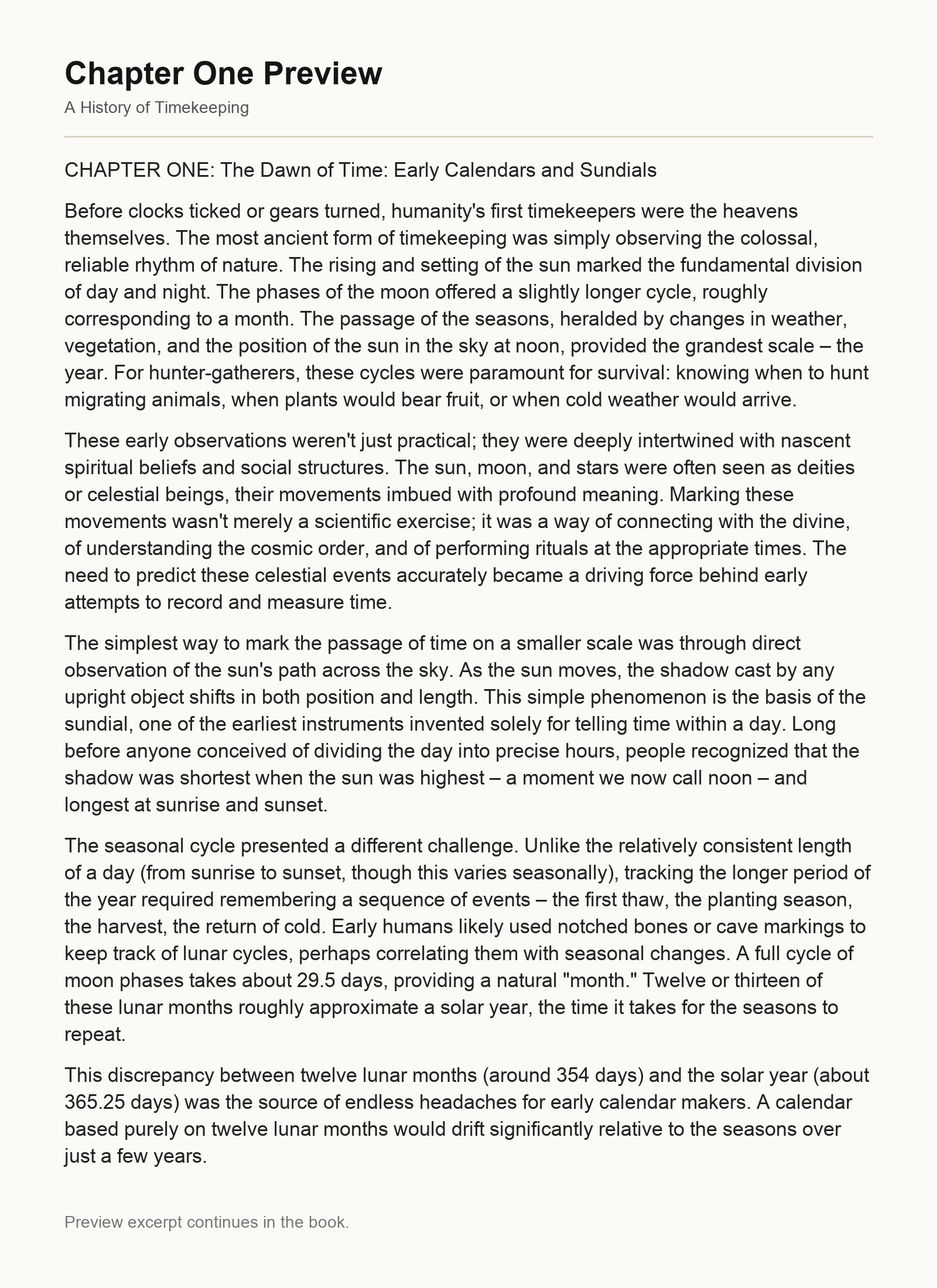
Embark on a sweeping voyage through humanity’s relentless quest to measure the invisible flow of time, from the first shadows cast by sunrise to the hyper‑precise ticks of atomic clocks. This book guides you across continents and centuries, revealing how early peoples turned the sun’s path, the march of stars, and the steady drip of water into the world’s first timekeepers, and how each invention answered the practical needs of agriculture, empire, navigation, and daily life.
You will discover the ingenious solutions that arose in different cultures—Egyptian outflow clepsydrae, Babylonian sexagesimal divisions, Chinese incense clocks and monumental astronomical towers, Greek gear‑driven models like the Antikythera Mechanism, and the Islamic world’s refined water clocks and astrolabes. Each chapter shows how scientific insight, artistic craftsmanship, and societal demand combined to push timekeeping forward, laying the groundwork for the mechanical breakthroughs that would follow.
Follow the birth of the mechanical escapement in medieval towers, the transformation of public time into a communal rhythm, and the rise of pendulum and balance‑spring regulators that brought unprecedented accuracy to homes, laboratories, and seagoing chronometers. Learn how the factory whistle and the railway timetable forced societies to abandon local solar time in favor of standardized zones, synchronizing nations and enabling global trade, communication, and scientific collaboration.
Experience the leap into the electric and quartz eras, where clocks became plug‑in conveniences and then mass‑produced digital accessories, making precise time a personal commodity carried on the wrist or embedded in everyday devices. Understand how atomic clocks redefined the second, how their ultra‑stable frequencies now power GPS satellites, telecommunications networks, and the Internet’s time‑synchronization protocols, and how these advances continue to shape modern technology and scientific discovery.
Finally, glimpse the future of timekeeping—optical atomic ticks that could measure gravity’s subtle shifts, quantum‑linked synchronization, and the ever‑deepening integration of temporal precision into industry, research, and daily life. By the end of this journey, you will not only know how we have learned to measure time, but also how time has measured us, shaping our cultures, our economies, and our very perception of existence.
What You'll Find Inside:
- Early timekeeping relied on celestial observations—sundials, star tracking, and water clocks—to organize agriculture, religion, and daily life before mechanical devices.
- The medieval invention of the verge escapement enabled the first reliable mechanical clocks, transforming timekeeping into a public, tower‑based service that rang bells for entire communities.
- Pendulum and balance‑spring breakthroughs in the 17th century created a precision revolution, allowing clocks to measure seconds accurately and paving the way for portable watches.
- Industrial railways and factories drove the adoption of standard time zones, synchronizing vast regions and reshaping work, travel, and global commerce.
- Atomic clocks, quartz technology, and internet protocols like NTP now provide nanosecond‑level precision, underpinning GPS, digital networks, and cutting‑edge scientific research.
Who's It For:
This book is ideal for general readers with an interest in the history of science and technology, students of horology or engineering, and anyone curious about how humanity’s quest to measure time has shaped civilization—from ancient agriculture to modern GPS and internet synchronization. It offers both a sweeping narrative and detailed insights that will appeal to enthusiasts of cultural history as well as professionals seeking context for today’s time‑critical technologies.
Table of Contents:
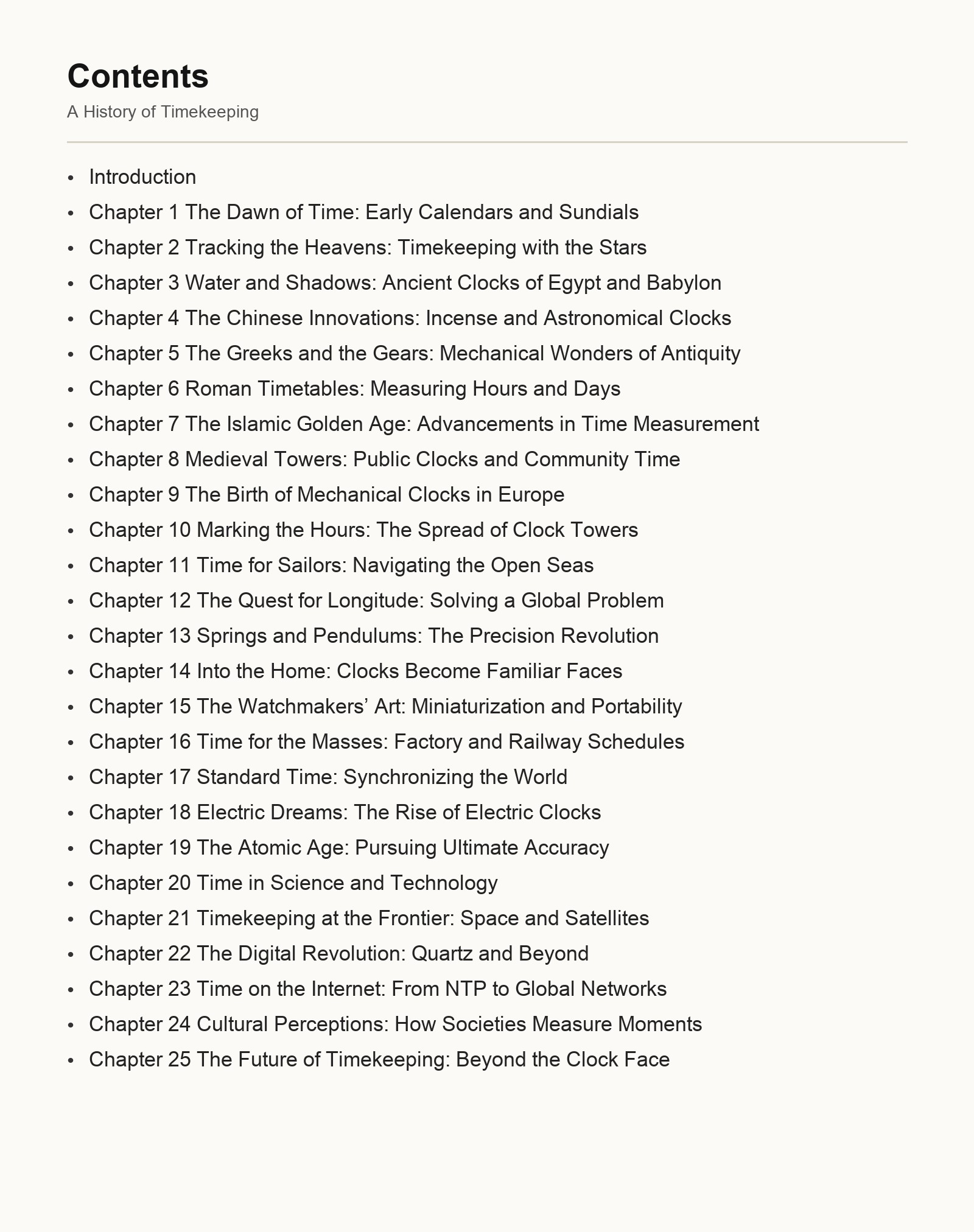
- Introduction
- Chapter 1 The Dawn of Time: Early Calendars and Sundials
- Chapter 2 Tracking the Heavens: Timekeeping with the Stars
- Chapter 3 Water and Shadows: Ancient Clocks of Egypt and Babylon
- Chapter 4 The Chinese Innovations: Incense and Astronomical Clocks
- Chapter 5 The Greeks and the Gears: Mechanical Wonders of Antiquity
- Chapter 6 Roman Timetables: Measuring Hours and Days
- Chapter 7 The Islamic Golden Age: Advancements in Time Measurement
- Chapter 8 Medieval Towers: Public Clocks and Community Time
- Chapter 9 The Birth of Mechanical Clocks in Europe
- Chapter 10 Marking the Hours: The Spread of Clock Towers
- Chapter 11 Time for Sailors: Navigating the Open Seas
- Chapter 12 The Quest for Longitude: Solving a Global Problem
- Chapter 13 Springs and Pendulums: The Precision Revolution
- Chapter 14 Into the Home: Clocks Become Familiar Faces
- Chapter 15 The Watchmakers’ Art: Miniaturization and Portability
- Chapter 16 Time for the Masses: Factory and Railway Schedules
- Chapter 17 Standard Time: Synchronizing the World
- Chapter 18 Electric Dreams: The Rise of Electric Clocks
- Chapter 19 The Atomic Age: Pursuing Ultimate Accuracy
- Chapter 20 Time in Science and Technology
- Chapter 21 Timekeeping at the Frontier: Space and Satellites
- Chapter 22 The Digital Revolution: Quartz and Beyond
- Chapter 23 Time on the Internet: From NTP to Global Networks
- Chapter 24 Cultural Perceptions: How Societies Measure Moments
- Chapter 25 The Future of Timekeeping: Beyond the Clock Face
Author:
Published By:
Date Published:
May 29, 2026
Type:
Nonfiction
Language:
English
Also Available In:
German, Spanish, Italian, Portuguese
Word Count:
40,777 words
Reading Time:
2 hours 51 minutes
Sample:
Order:
Buy the A History of Timekeeping ebook on MixCache.com:
Buy NowThe full ebook will be available immediately to read instantly on any device.
$5 account credit for all new MixCache.com accounts, usable toward any ebook purchase!*






Ratings & Reviews
Ask Questions About This Book
Have a question about the content? Ask our AI assistant!
Start by asking a question about "A History of Timekeeping"
Example: "Does this book mention William Shakespeare?"
Thinking...