Browse by Category
Fiction
- Action & Adventure
- African American
- Anthologies
- Children's Fiction
- Classics
- Comics & Graphic Novels
- Coming of Age
- Contemporary
- Cultural & Regional
- Drama
- Erotica
- Fantasy
- General
- Historical Fiction
- Horror
- Humor & Satire
- Literary Fiction
- Mystery, Thriller & Suspense
- Poetry
- Religious & Inspirational
- Romance
- Science Fiction
- Short Stories
- War & Military
- Westerns
- Women's Fiction
- Young Adult
Non-Fiction
- Antiques & Collectibles
- Arts & Photography
- Biographies & Memoirs
- Business & Money
- Children's Non-Fiction
-
Computers & Technology
- Artificial Intelligence
- Computer Science
- Cybersecurity & Cryptography
- Data Science & Analytics
- Databases & Big Data
- Game Development & Design
- General
- Hardware & DIY
- Mobile App Development
- Networking & Cloud Computing
- Operating Systems
- Programming
- Robotics
- Software
- Software Engineering
- User Experience (UX) & Design
- Web Development & Design
- Cooking, Food & Wine
- Crafts, Hobbies & Home
- Education & Teaching
- Engineering
- General
- Health, Fitness & Dieting
-
History
- African History
- African History - North Africa
- African History - Sub-Saharan Africa
- American History
- American History - 20th Century
- American History - Civil War
- American History - Colonial Period
- Ancient History
- Asian History
- Asian History - China
- Asian History - India
- Asian History - Japan
- Asian History - Southeast Asia
- European History
- European History - Ancient Greece
- European History - Ancient Rome
- European History - Medieval
- European History - Modern
- European History - Renaissance
- General
- Middle Eastern History
- Military History
- Military History - Aviation
- Military History - Naval
- Social & Cultural History
- World History
- Humor & Entertainment
- Industrial Technology
- Language Learning
- Law
- LGBTQ+ Non-Fiction
- Literary Criticism
- Medical Books
- Parenting & Relationships
- Philosophy
- Politics & Social Sciences
- Reference
- Religion & Spirituality
-
Science & Math
- Agricultural Sciences
- Astronomy & Space Science
- Behavioral Sciences
- Biological Sciences
- Botany & Plant Science
- Chemistry
- Earth Sciences
- Engineering - Chemical
- Engineering - Civil
- Engineering - Electrical
- Engineering - Mechanical
- Environment
- General
- Geology
- Mathematics
- Nature & Ecology
- Oceanography
- Paleontology
- Physics
- Statistics
- Self-Help
- Sports & Outdoors
- Study Aids
- Sustainability & Green Living
- Textbooks
- Transportation
- Travel
- True Crime
- Urban Planning & Development
- Veterinary Medicine
- Writing & Publishing
Jump to Section

Want unlimited access to all books published by MixCache.com (plus their audiobooks)? Try MixCache.com Total Access. Look for the MTA badge on book covers to identify included titles.
Access to infinite ebooks: Don't see the book you want? Suggest it and we'll create it (free!) for you from scratch with our powerful AI book writer. Then read it with MTA - besides profiting from any sales it makes!
Sakha
A History
About this book:

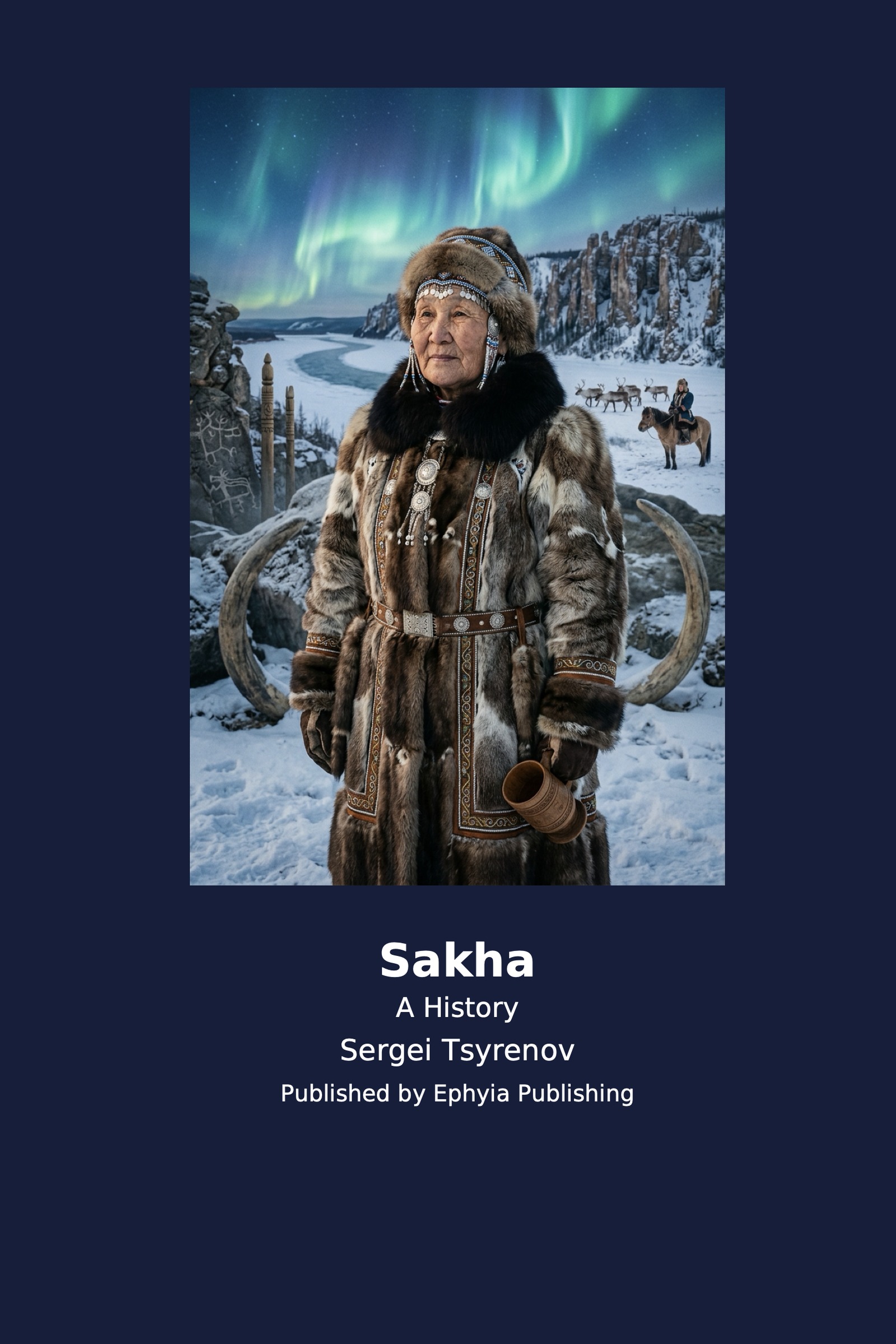
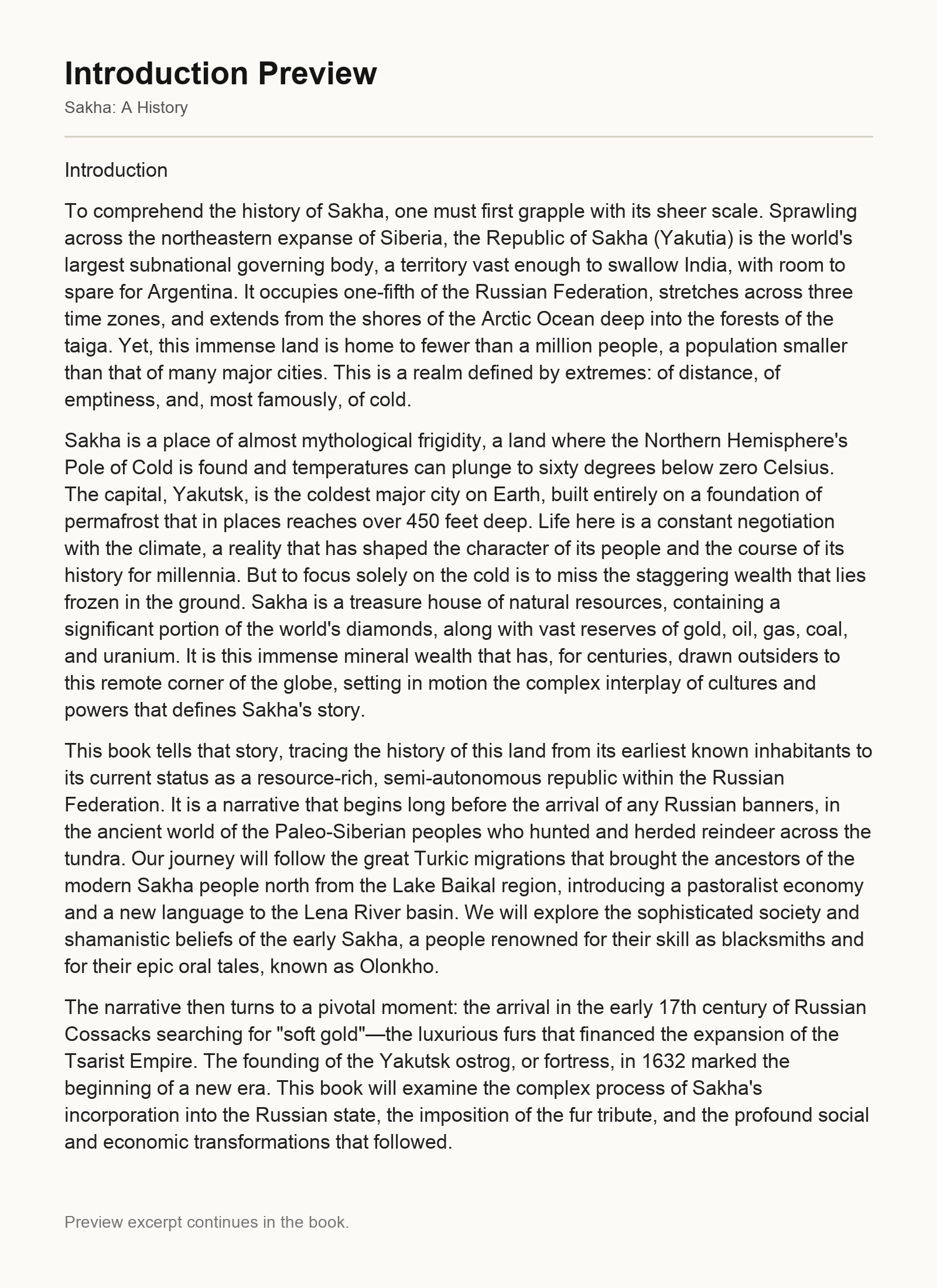
Discover the epic story of Sakha (Yakutia), the world’s largest subnational region, where icy extremes meet untold mineral wealth. This book guides you from the deep Paleolithic past of mammoth hunters on the Lena River basin to the arrival of Turkic pastoralists who forged a unique Sakha identity, blending southern horse‑herding traditions with northern survival skills. You’ll walk alongside the first Russian Cossacks as they sought “soft gold” furs, imposed the yasak tribute, and built the fortress that became Yakutsk, witnessing how conquest reshaped Sakha society, economy, and spirituality for centuries.
Experience the turbulent centuries of Tsarist rule, when Sakha became a remote land of political exile, a “prison without walls” that paradoxically nurtured a revolutionary intelligentsia alongside the indigenous elite. Follow the Sakha through the chaos of the 1917 Revolution, the Civil War, and the birth of the Yakut Autonomous Soviet Socialist Republic, a period of bold cultural indigenization that was later shattered by Stalin’s purges, forced collectivization, and the devastating human cost of industrialization. The narrative then turns to the home front of World War II, where Sakha’s mines, fur trappers, and the legendary ALSIB air route proved vital to the Soviet victory, and to the post‑war diamond and gold rushes that transformed the republic’s landscape while leaving deep environmental and social scars.
Trace the Soviet era’s cultural policies—from the Thaw’s tentative revival of Sakha language and literature to the Stagnation’s rigid Russification—and see how perestroika and glasnost unleashed a powerful national consciousness, culminating in the 1990 Declaration of Sovereignty and the birth of the modern Republic of Sakha (Yakutia). Learn how President Mikhail Nikolayev negotiated a historic power‑sharing agreement that gave Sakha a stake in its own diamond wealth, how a new constitution and the joint‑stock company ALROSA redefined economic relations with Moscow, and how the republic navigated the shock‑therapy 1990s, building state‑led capitalism while preserving pockets of private enterprise and cultural revival.
Finally, immerse yourself in twenty‑first‑century Sakha: a land where ancient Olonkho epics are celebrated at the grand Yhyakh festival, where a burgeoning “Sakhawood” film industry tells local stories to the world, and where the republic grapples with the twin challenges of immense resource dependence and a warming Arctic that threatens the very permafrost beneath its cities, pipelines, and mines. This comprehensive history offers readers a vivid, multidimensional understanding of a people who have continually adapted to extremes—of climate, distance, and political pressure—while striving to preserve a distinct identity in the heart of Siberia.
What You'll Find Inside:
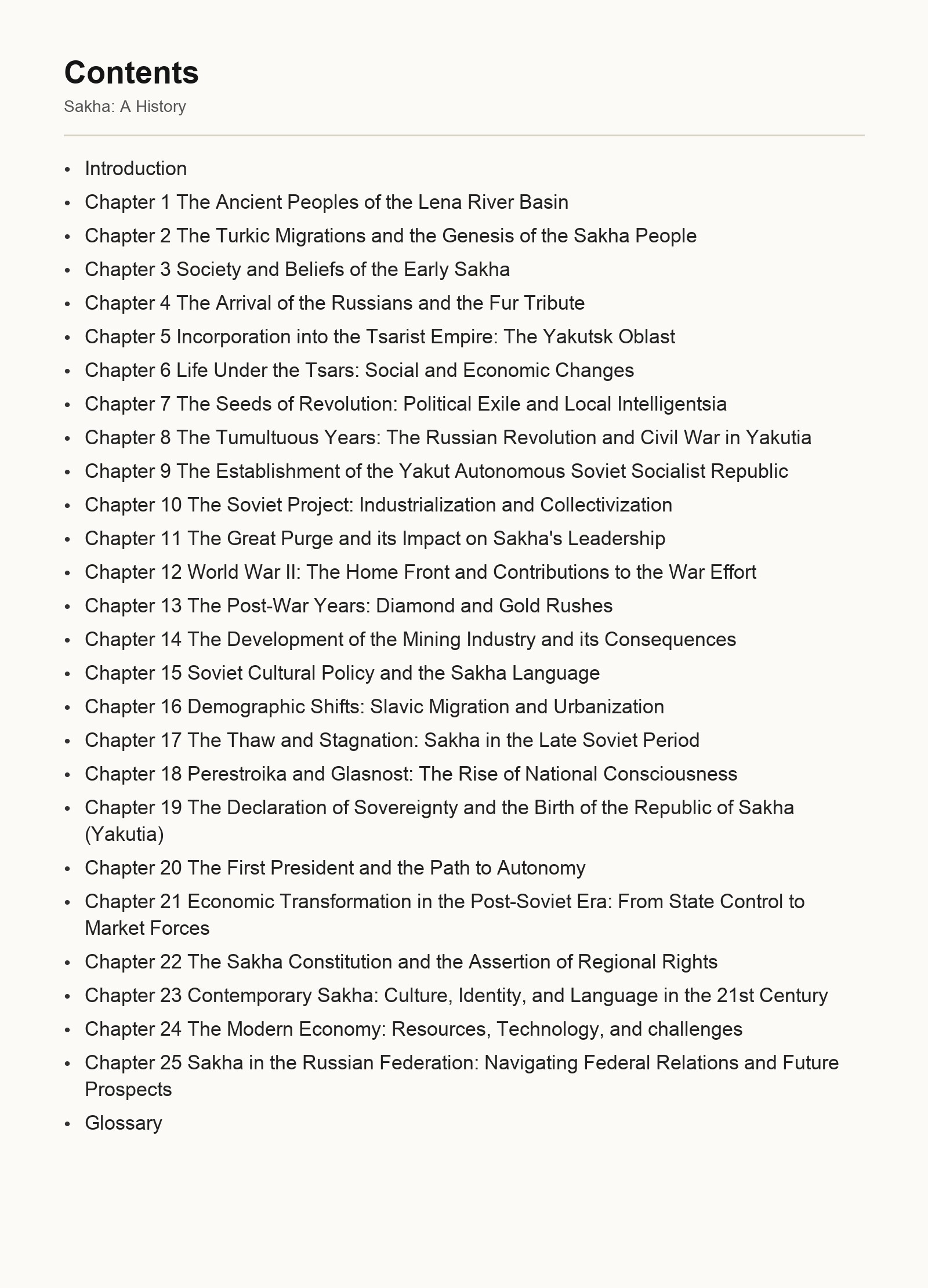
- The book traces Sakha's history from Paleolithic hunters of the Lena River Basin through the Turkic migrations that formed the Sakha people, detailing their adaptation to extreme Siberian conditions over millennia.
- It examines Sakha's centuries-long relationship with the Russian state, from the 17th-century fur tribute (yasak) and Cossack conquest through incorporation into the Tsarist Empire and Soviet period developments.
- The narrative covers the Soviet era's transformative policies including collectivization, industrialization driven by diamond and gold discoveries, the Great Purge's impact on leadership, and World War II contributions.
- It details the post-Soviet sovereignty movement, the 1990 Declaration of State Sovereignty, economic transformation through resource control, and cultural revival efforts in the 21st century.
- The book concludes with contemporary challenges including climate change threats to permafrost infrastructure, demographic shifts, and Sakha's ongoing navigation of federal relations within the Russian Federation.
Who's It For:
This book is ideal for students, researchers, and general readers interested in Siberian history, indigenous cultures, and post-Soviet transitions. It will particularly benefit those studying how indigenous peoples interact with imperial and state powers, resource-driven economic transformations, and cultural resilience in extreme environments. Readers fascinated by Arctic anthropology, the history of nationalism and autonomy movements, or the interplay between traditional cultures and modernization will find valuable insights in this comprehensive historical account.
Author:
Published By:
Date Published:
May 27, 2026
Type:
Nonfiction
Language:
English
Word Count:
44,993 words
Reading Time:
3 hours 9 minutes
Sample:
Order:
Order Sakha (Paperback) on MixCache.com:
Buy NowPrint copy is made to order and ships worldwide. Includes the ebook free, ready to read instantly.
$5 account credit for all new MixCache.com accounts, usable toward any ebook purchase!*