
Browse by Category
Fiction
- Action & Adventure
- African American
- Anthologies
- Children's Fiction
- Classics
- Comics & Graphic Novels
- Coming of Age
- Contemporary
- Cultural & Regional
- Drama
- Erotica
- Fantasy
- General
- Historical Fiction
- Horror
- Humor & Satire
- Literary Fiction
- Mystery, Thriller & Suspense
- Poetry
- Religious & Inspirational
- Romance
- Science Fiction
- Short Stories
- War & Military
- Westerns
- Women's Fiction
- Young Adult
Non-Fiction
- Antiques & Collectibles
- Arts & Photography
- Biographies & Memoirs
- Business & Money
- Children's Non-Fiction
-
Computers & Technology
- Artificial Intelligence
- Computer Science
- Cybersecurity & Cryptography
- Data Science & Analytics
- Databases & Big Data
- Game Development & Design
- General
- Hardware & DIY
- Mobile App Development
- Networking & Cloud Computing
- Operating Systems
- Programming
- Robotics
- Software
- Software Engineering
- User Experience (UX) & Design
- Web Development & Design
- Cooking, Food & Wine
- Crafts, Hobbies & Home
- Education & Teaching
- Engineering
- General
- Health, Fitness & Dieting
-
History
- African History
- African History - North Africa
- African History - Sub-Saharan Africa
- American History
- American History - 20th Century
- American History - Civil War
- American History - Colonial Period
- Ancient History
- Asian History
- Asian History - China
- Asian History - India
- Asian History - Japan
- Asian History - Southeast Asia
- European History
- European History - Ancient Greece
- European History - Ancient Rome
- European History - Medieval
- European History - Modern
- European History - Renaissance
- General
- Middle Eastern History
- Military History
- Military History - Aviation
- Military History - Naval
- Social & Cultural History
- World History
- Humor & Entertainment
- Industrial Technology
- Language Learning
- Law
- LGBTQ+ Non-Fiction
- Literary Criticism
- Medical Books
- Parenting & Relationships
- Philosophy
- Politics & Social Sciences
- Reference
- Religion & Spirituality
-
Science & Math
- Agricultural Sciences
- Astronomy & Space Science
- Behavioral Sciences
- Biological Sciences
- Botany & Plant Science
- Chemistry
- Earth Sciences
- Engineering - Chemical
- Engineering - Civil
- Engineering - Electrical
- Engineering - Mechanical
- Environment
- General
- Geology
- Mathematics
- Nature & Ecology
- Oceanography
- Paleontology
- Physics
- Statistics
- Self-Help
- Sports & Outdoors
- Study Aids
- Sustainability & Green Living
- Textbooks
- Transportation
- Travel
- True Crime
- Urban Planning & Development
- Veterinary Medicine
- Writing & Publishing
Jump to Section
MixCache.com Total Access
Unlimited reading and audiobooks for every book published by MixCache.com.
Included titles carry the MTA badge.
Learn more →The Fermi Paradox
About this book:
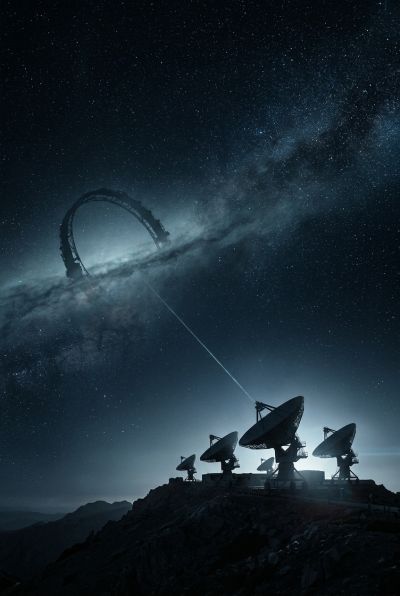
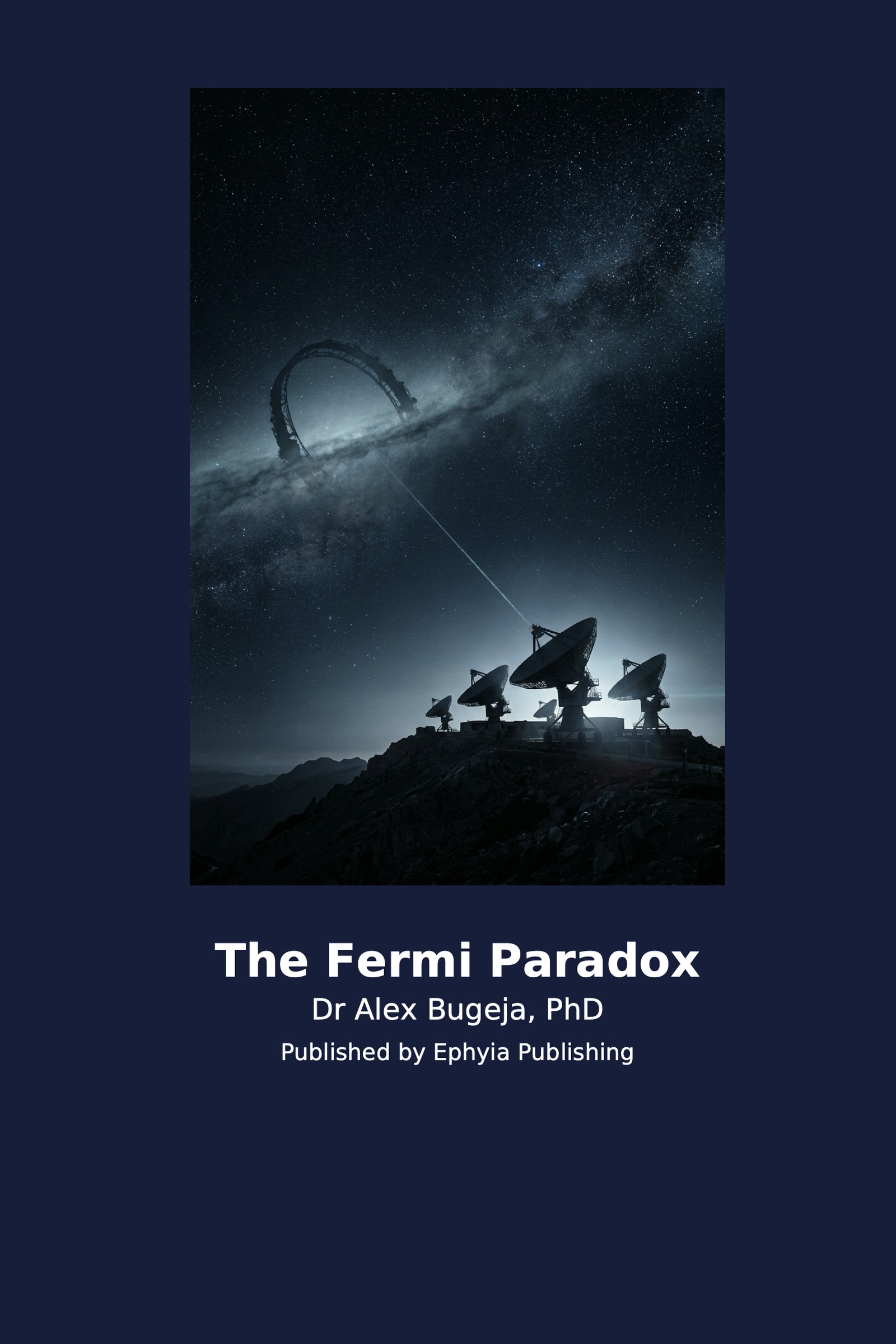
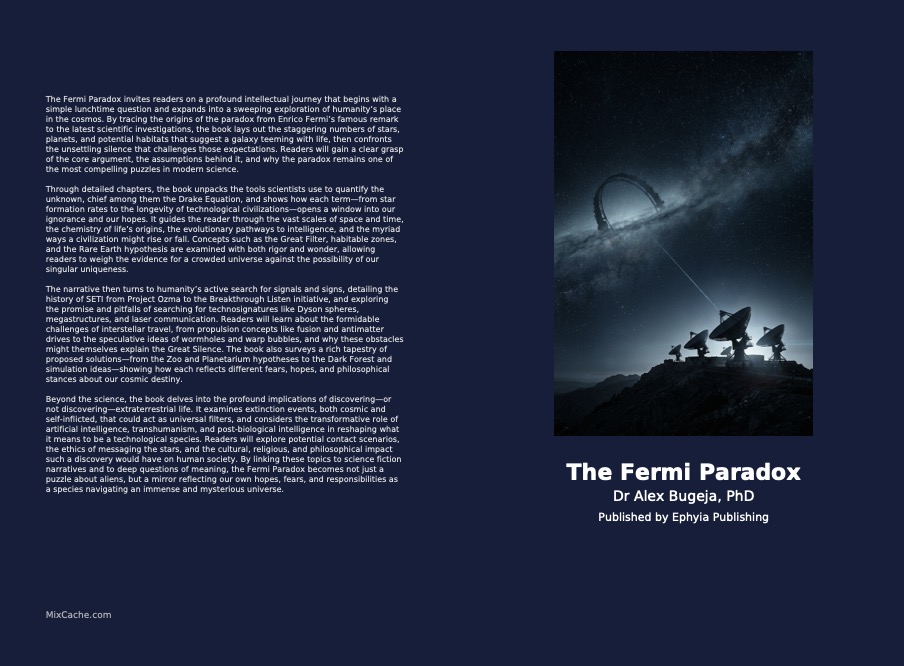
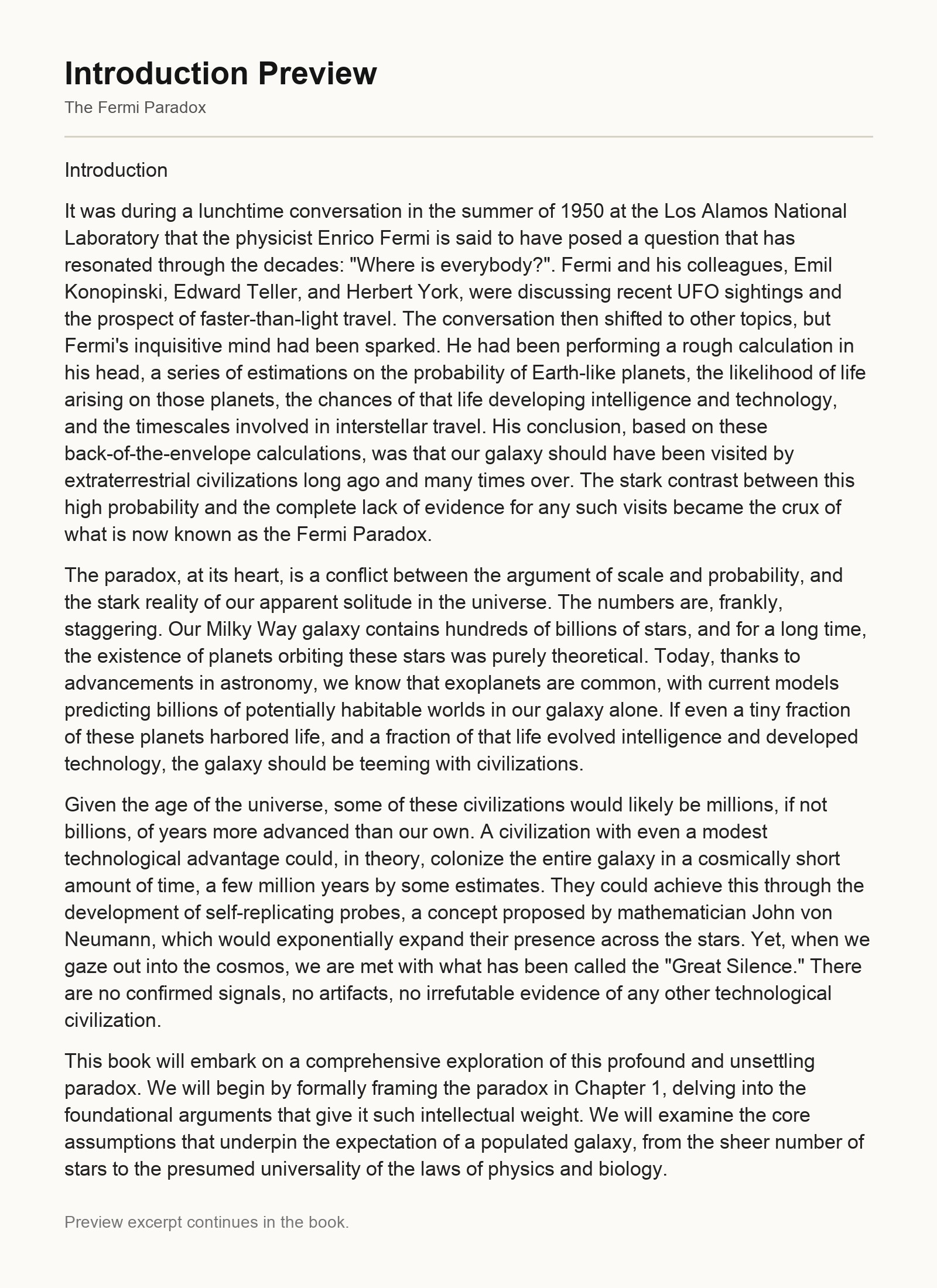
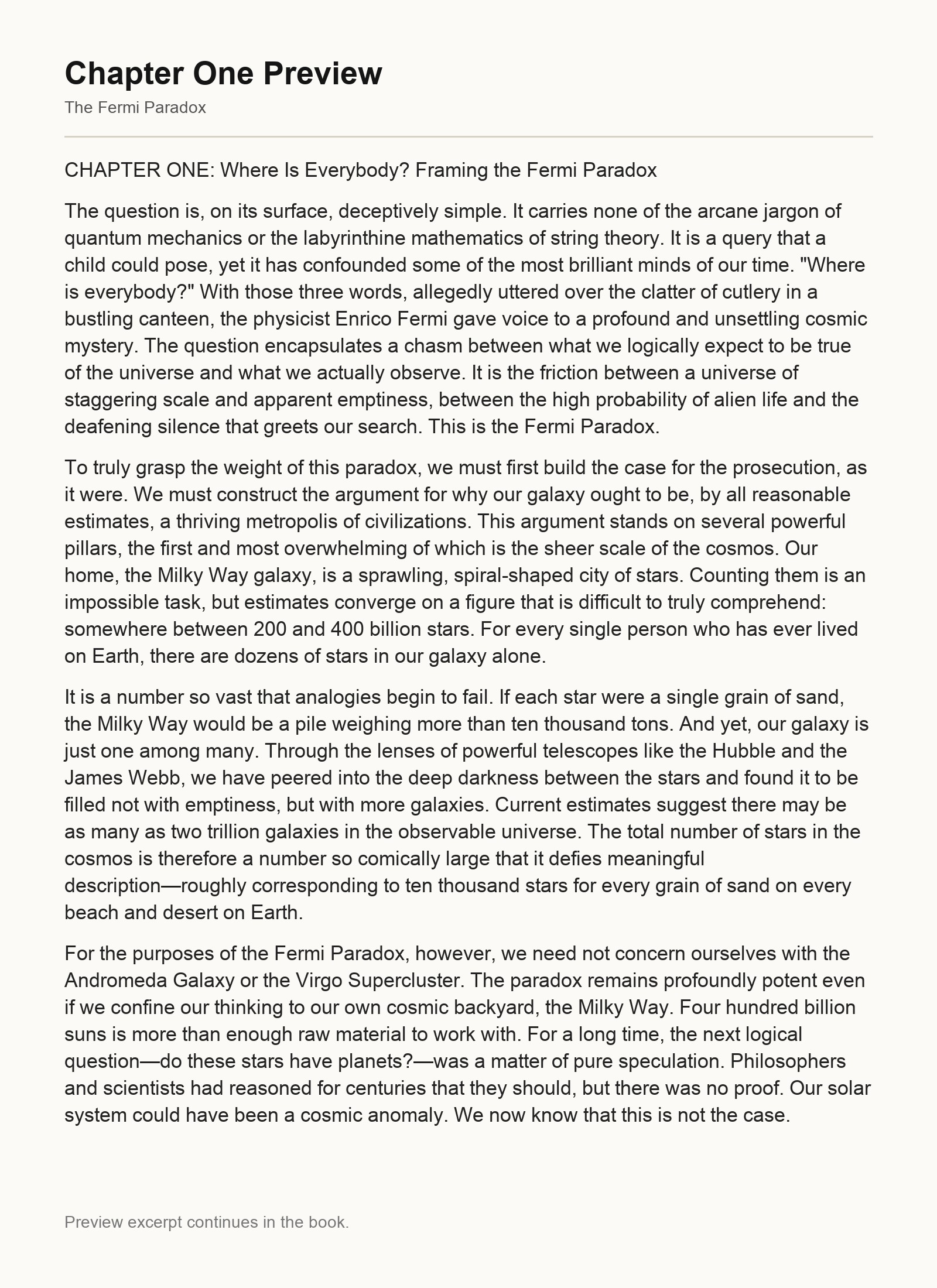
The Fermi Paradox invites readers on a profound intellectual journey that begins with a simple lunchtime question and expands into a sweeping exploration of humanity’s place in the cosmos. By tracing the origins of the paradox from Enrico Fermi’s famous remark to the latest scientific investigations, the book lays out the staggering numbers of stars, planets, and potential habitats that suggest a galaxy teeming with life, then confronts the unsettling silence that challenges those expectations. Readers will gain a clear grasp of the core argument, the assumptions behind it, and why the paradox remains one of the most compelling puzzles in modern science.
Through detailed chapters, the book unpacks the tools scientists use to quantify the unknown, chief among them the Drake Equation, and shows how each term—from star formation rates to the longevity of technological civilizations—opens a window into our ignorance and our hopes. It guides the reader through the vast scales of space and time, the chemistry of life’s origins, the evolutionary pathways to intelligence, and the myriad ways a civilization might rise or fall. Concepts such as the Great Filter, habitable zones, and the Rare Earth hypothesis are examined with both rigor and wonder, allowing readers to weigh the evidence for a crowded universe against the possibility of our singular uniqueness.
The narrative then turns to humanity’s active search for signals and signs, detailing the history of SETI from Project Ozma to the Breakthrough Listen initiative, and exploring the promise and pitfalls of searching for technosignatures like Dyson spheres, megastructures, and laser communication. Readers will learn about the formidable challenges of interstellar travel, from propulsion concepts like fusion and antimatter drives to the speculative ideas of wormholes and warp bubbles, and why these obstacles might themselves explain the Great Silence. The book also surveys a rich tapestry of proposed solutions—from the Zoo and Planetarium hypotheses to the Dark Forest and simulation ideas—showing how each reflects different fears, hopes, and philosophical stances about our cosmic destiny.
Beyond the science, the book delves into the profound implications of discovering—or not discovering—extraterrestrial life. It examines extinction events, both cosmic and self‑inflicted, that could act as universal filters, and considers the transformative role of artificial intelligence, transhumanism, and post‑biological intelligence in reshaping what it means to be a technological species. Readers will explore potential contact scenarios, the ethics of messaging the stars, and the cultural, religious, and philosophical impact such a discovery would have on human society. By linking these topics to science fiction narratives and to deep questions of meaning, the Fermi Paradox becomes not just a puzzle about aliens, but a mirror reflecting our own hopes, fears, and responsibilities as a species navigating an immense and mysterious universe.
What You'll Find Inside:
- The Fermi Paradox arises from the conflict between the high probability of extraterrestrial civilizations given the vast number of stars and habitable planets, and the observed lack of any evidence for such civilizations.
- The Drake Equation provides a framework to estimate the number of detectable civilizations by breaking down the problem into factors like star formation rate, fraction of planets with life, and the lifetime of technological societies.
- Key proposed solutions include the Great Filter (a barrier preventing civilizations from becoming interstellar), the Zoo Hypothesis (advanced civilizations deliberately avoiding contact), and the Rare Earth Hypothesis (complex life is exceptionally rare due to a unique combination of astrophysical and geological conditions).
- The book examines existential risks that could act as a Great Filter, such as nuclear war, climate change, engineered pandemics, and uncontrolled artificial intelligence, highlighting the precarious nature of technological adolescence.
- Search strategies for extraterrestrial intelligence range from traditional radio SETI and optical SETI to the hunt for technosignatures like Dyson spheres, atmospheric pollution, and artifact detection, with new instruments like the James Webb Space Telescope and the Square Kilometre Array expanding our capabilities.
Who's It For:
This book is ideal for readers with a keen interest in astrobiology, cosmology, and the philosophy of science—including university students, science enthusiasts, and anyone fascinated by big questions about life in the universe. It will particularly appeal to those who enjoy speculative yet rigorously grounded explorations of humanity's future, existential risks, and the societal implications of discovering (or not discovering) extraterrestrial intelligence.
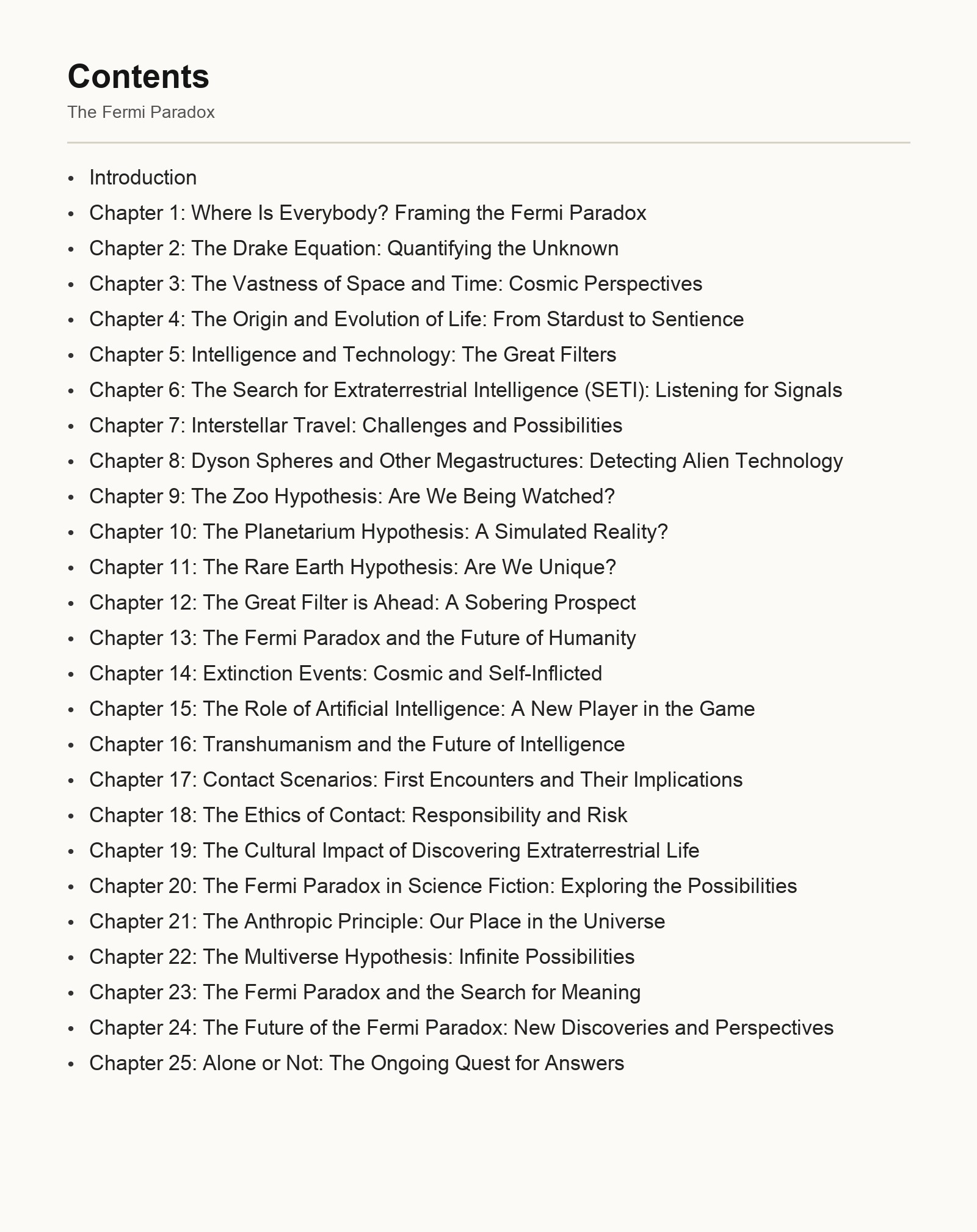
Table of Contents:
-
Introduction
-
Chapter 1: Where Is Everybody? Framing the Fermi Paradox
-
Chapter 2: The Drake Equation: Quantifying the Unknown
-
Chapter 3: The Vastness of Space and Time: Cosmic Perspectives
-
Chapter 4: The Origin and Evolution of Life: From Stardust to Sentience
-
Chapter 5: Intelligence and Technology: The Great Filters
-
Chapter 6: The Search for Extraterrestrial Intelligence (SETI): Listening for Signals
-
Chapter 7: Interstellar Travel: Challenges and Possibilities
-
Chapter 8: Dyson Spheres and Other Megastructures: Detecting Alien Technology
-
Chapter 9: The Zoo Hypothesis: Are We Being Watched?
-
Chapter 10: The Planetarium Hypothesis: A Simulated Reality?
-
Chapter 11: The Rare Earth Hypothesis: Are We Unique?
-
Chapter 12: The Great Filter is Ahead: A Sobering Prospect
-
Chapter 13: The Fermi Paradox and the Future of Humanity
-
Chapter 14: Extinction Events: Cosmic and Self-Inflicted
-
Chapter 15: The Role of Artificial Intelligence: A New Player in the Game
-
Chapter 16: Transhumanism and the Future of Intelligence
-
Chapter 17: Contact Scenarios: First Encounters and Their Implications
-
Chapter 18: The Ethics of Contact: Responsibility and Risk
-
Chapter 19: The Cultural Impact of Discovering Extraterrestrial Life
-
Chapter 20: The Fermi Paradox in Science Fiction: Exploring the Possibilities
-
Chapter 21: The Anthropic Principle: Our Place in the Universe
-
Chapter 22: The Multiverse Hypothesis: Infinite Possibilities
-
Chapter 23: The Fermi Paradox and the Search for Meaning
-
Chapter 24: The Future of the Fermi Paradox: New Discoveries and Perspectives
-
Chapter 25: Alone or Not: The Ongoing Quest for Answers
Author:
Published By:
Date Published:
May 26, 2026
Type:
Nonfiction
Language:
English
Also Available In:
Word Count:
53,303 words
Reading Time:
3 hours 44 minutes
Sample:
Order:
Buy the The Fermi Paradox ebook on MixCache.com:
Buy NowThe full ebook will be available immediately to read instantly on any device.
$5 account credit for all new MixCache.com accounts, usable toward any ebook purchase!*


Ratings & Reviews
Ask Questions About This Book
Have a question about the content? Ask our AI assistant!
Start by asking a question about "The Fermi Paradox"
Example: "Does this book mention William Shakespeare?"
Thinking...