Browse by Category
Fiction
- Action & Adventure
- African American
- Anthologies
- Children's Fiction
- Classics
- Comics & Graphic Novels
- Coming of Age
- Contemporary
- Cultural & Regional
- Drama
- Erotica
- Fantasy
- General
- Historical Fiction
- Horror
- Humor & Satire
- Literary Fiction
- Mystery, Thriller & Suspense
- Poetry
- Religious & Inspirational
- Romance
- Science Fiction
- Short Stories
- War & Military
- Westerns
- Women's Fiction
- Young Adult
Non-Fiction
- Antiques & Collectibles
- Arts & Photography
- Biographies & Memoirs
- Business & Money
- Children's Non-Fiction
-
Computers & Technology
- Artificial Intelligence
- Computer Science
- Cybersecurity & Cryptography
- Data Science & Analytics
- Databases & Big Data
- Game Development & Design
- General
- Hardware & DIY
- Mobile App Development
- Networking & Cloud Computing
- Operating Systems
- Programming
- Robotics
- Software
- Software Engineering
- User Experience (UX) & Design
- Web Development & Design
- Cooking, Food & Wine
- Crafts, Hobbies & Home
- Education & Teaching
- Engineering
- General
- Health, Fitness & Dieting
-
History
- African History
- African History - North Africa
- African History - Sub-Saharan Africa
- American History
- American History - 20th Century
- American History - Civil War
- American History - Colonial Period
- Ancient History
- Asian History
- Asian History - China
- Asian History - India
- Asian History - Japan
- Asian History - Southeast Asia
- European History
- European History - Ancient Greece
- European History - Ancient Rome
- European History - Medieval
- European History - Modern
- European History - Renaissance
- General
- Middle Eastern History
- Military History
- Military History - Aviation
- Military History - Naval
- Social & Cultural History
- World History
- Humor & Entertainment
- Industrial Technology
- Language Learning
- Law
- LGBTQ+ Non-Fiction
- Literary Criticism
- Medical Books
- Parenting & Relationships
- Philosophy
- Politics & Social Sciences
- Reference
- Religion & Spirituality
-
Science & Math
- Agricultural Sciences
- Astronomy & Space Science
- Behavioral Sciences
- Biological Sciences
- Botany & Plant Science
- Chemistry
- Earth Sciences
- Engineering - Chemical
- Engineering - Civil
- Engineering - Electrical
- Engineering - Mechanical
- Environment
- General
- Geology
- Mathematics
- Nature & Ecology
- Oceanography
- Paleontology
- Physics
- Statistics
- Self-Help
- Sports & Outdoors
- Study Aids
- Sustainability & Green Living
- Textbooks
- Transportation
- Travel
- True Crime
- Urban Planning & Development
- Veterinary Medicine
- Writing & Publishing
Jump to Section
MixCache.com Total Access
Unlimited reading and audiobooks for every book published by MixCache.com.
Included titles carry the MTA badge.
Learn more →
The Silk Road
A History
About this book:
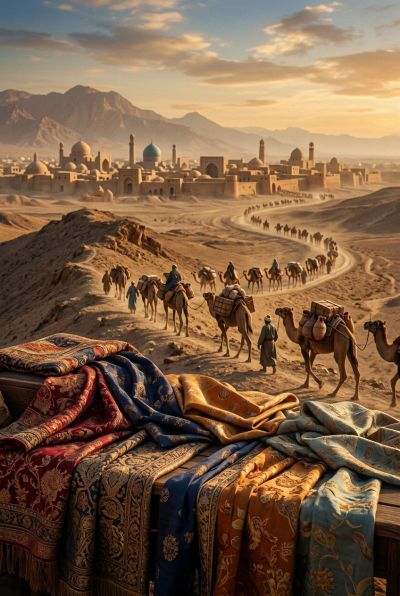
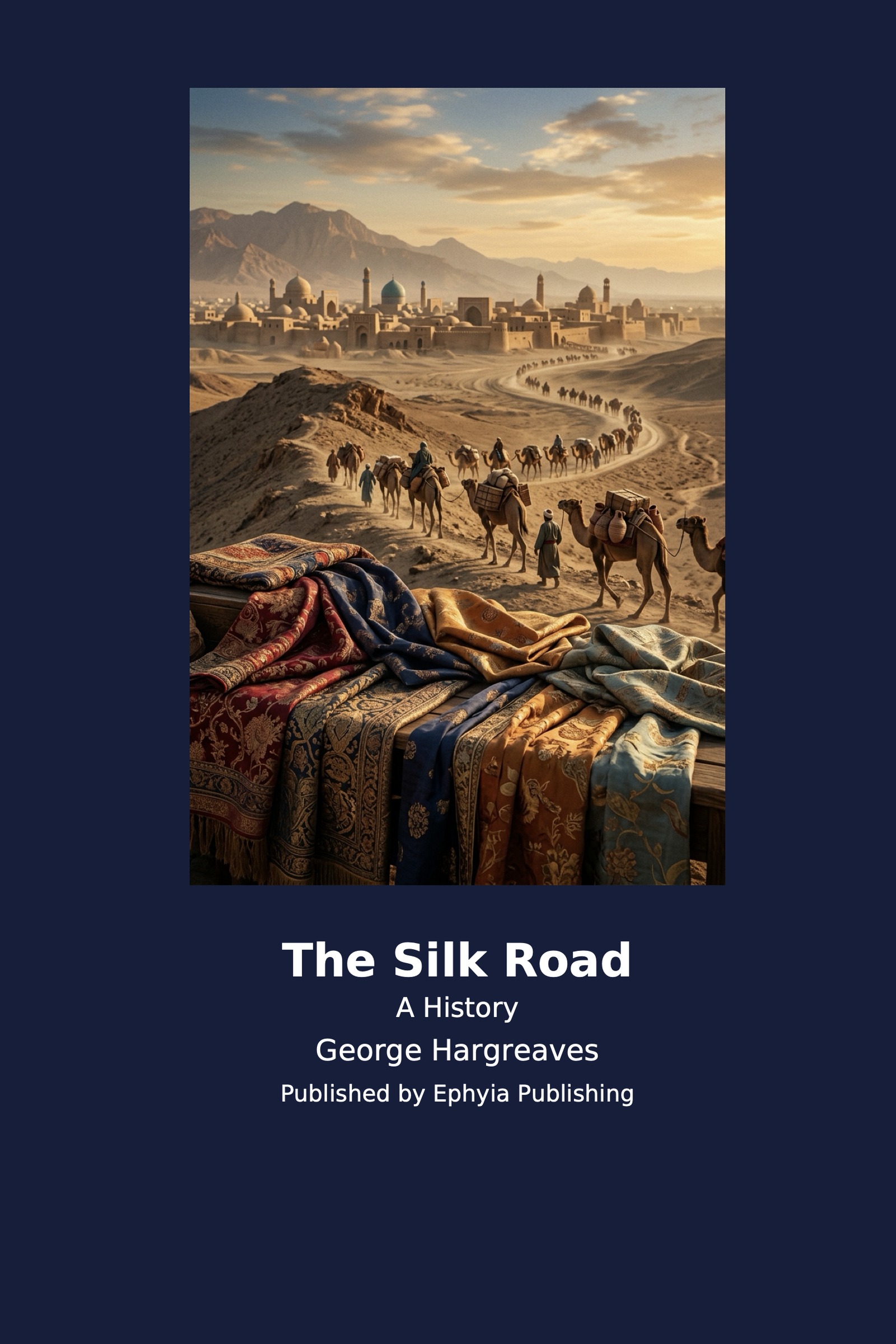
Step into the sweeping narrative of the Silk Road, where desert caravans, maritime fleets, and mountain passes become the arteries of a continent‑spanning exchange. This book traces the evolution of those routes from their earliest precursors—jade trails, lapis routes, and the Persian Royal Road—to the bustling networks that linked Han China with Rome, the Kushan Empire with Tang China, and the Mongol Empire with medieval Europe. Readers will discover how a single thread of silk sparked a fascination that reshaped economies, provoked moral debates, and drove empires to seek the secret of its making.
Beyond luxury goods, the work reveals the staggering variety of cargo that moved along the roads: spices that flavored Roman feasts, precious stones that adorned Buddhist temples, horses that powered Chinese cavalry, and technologies that altered the course of history. Chapters detail the transmission of papermaking, gunpowder, and printing, showing how Chinese inventions traveled west to ignite the European Renaissance, while glassmaking, weaving, and agricultural practices flowed eastward to enrich distant societies. The reader will also encounter the invisible cargo—ideas, religions, and philosophies—that transformed continents as Buddhism, Christianity, Manichaeism, and Zoroastrianism spread alongside merchants and missionaries.
The oasis cities emerge as vibrant hubs where cultures collided and fused. Through vivid descriptions of Samarkand, Bukhara, Kashgar, and Dunhuang, the book illustrates how water‑management ingenuity, multilingual bazaars, and monastic complexes turned arid outposts into melting pots of art, faith, and commerce. Readers will experience the synthesis of styles in Gandharan Buddhist sculpture, Sassanian silverwork, and Timurid tilework, seeing how each motif reflects a dialogue between Greek, Indian, Persian, and Chinese traditions.
Yet the Silk Road was not only a conduit of prosperity; it also carried peril. The narrative confronts the darker side of exchange, tracing how plague‑laden rats and fleas turned trade routes into superhighways for disease, from the Plague of Justinian to the Black Death that reshaped medieval Europe. By examining archaeological treasures—the Dunhuang Library Cave, the mummies of the Tarim Basin, and the Begram Hoard—readers gain a tangible sense of the lives, languages, and losses that lie beneath the sands.
Finally, the book connects past to present, exploring how the ancient legacy informs today’s Belt and Road Initiative, reviving the dream of transcontinental connection through railways, ports, and digital links. Readers will finish with a deeper understanding of how the Silk Road’s history of exchange, conflict, and innovation continues to echo in modern geopolitics, cultural heritage, and the very idea of a globally linked world.
What You'll Find Inside:
- The Silk Road was a vast, shifting network of overland and maritime routes that connected Eurasia, enabling the exchange of goods, ideas, and technologies for over 1,500 years.
- Beyond silk, the routes carried spices, precious metals, horses, ceramics, and revolutionary inventions like papermaking, gunpowder, and printing, which reshaped societies worldwide.
- The Silk Road facilitated the spread of major religions—Buddhism, Christianity, Islam, Manichaeism, and Zoroastrianism—and fostered a rich cultural synthesis visible in art, architecture, and language across continents.
- Periods of political stability, such as the Han Tang dynasties and the Mongol Pax Mongolica, secured the routes and boosted trade, while disease, plague, and fragmentation led to their decline.
- The Silk Road's legacy endures in modern initiatives like China's Belt and Road, reflecting the enduring human drive to connect distant civilizations through trade and infrastructure.
Who's It For:
This book is ideal for history enthusiasts, students of world or Asian history, and general readers interested in the origins of global trade, cultural exchange, and how ancient networks shaped the modern world.
Table of Contents:
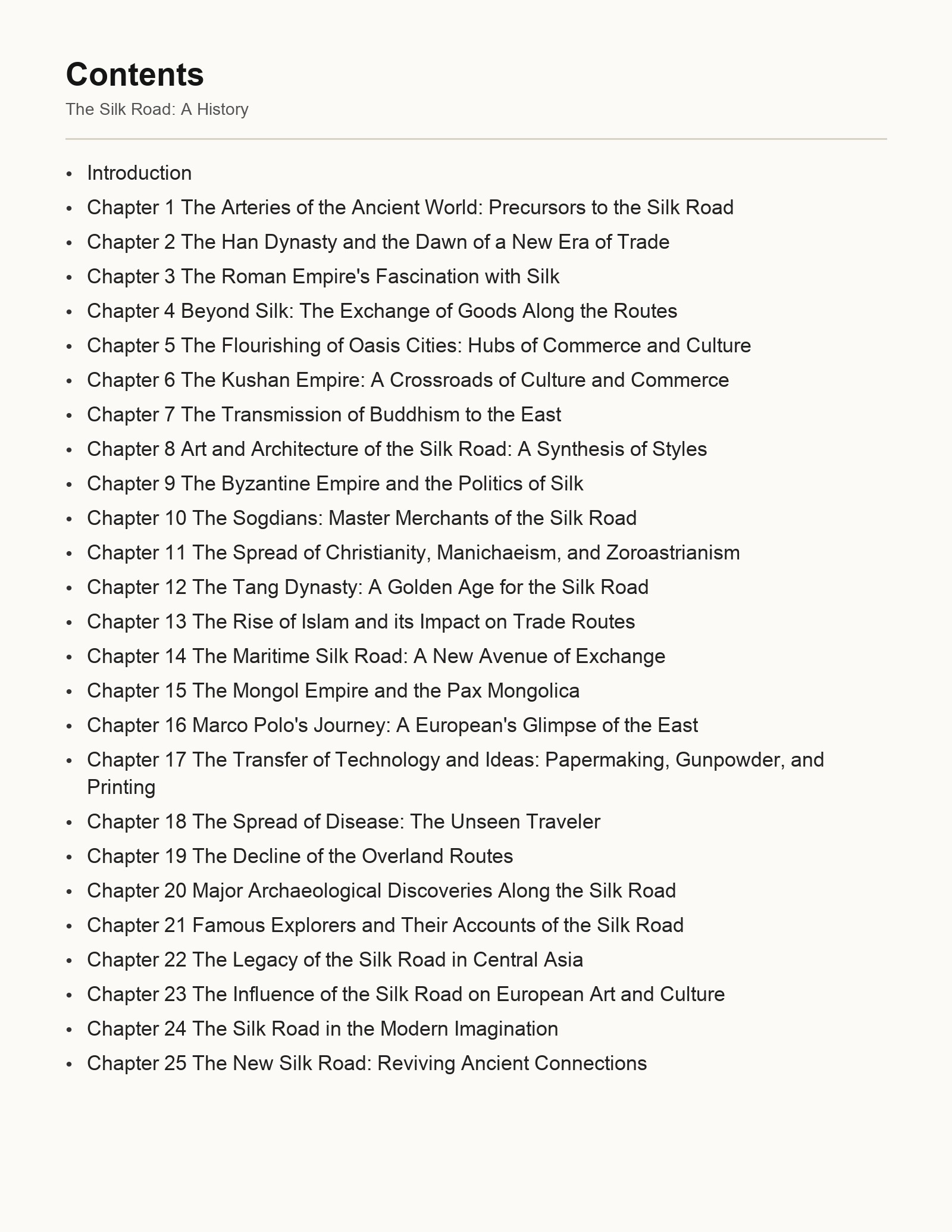
- Introduction
- Chapter 1 The Arteries of the Ancient World: Precursors to the Silk Road
- Chapter 2 The Han Dynasty and the Dawn of a New Era of Trade.
- Chapter 3 The Roman Empire's Fascination with Silk.
- Chapter 4 Beyond Silk: The Exchange of Goods Along the Routes.
- Chapter 5 The Flourishing of Oasis Cities: Hubs of Commerce and Culture.
- Chapter 6 The Kushan Empire: A Crossroads of Culture and Commerce.
- Chapter 7 The Transmission of Buddhism to the East.
- Chapter 8 Art and Architecture of the Silk Road: A Synthesis of Styles.
- Chapter 9 The Byzantine Empire and the Politics of Silk.
- Chapter 10 The Sogdians: Master Merchants of the Silk Road
- Chapter 11 The Spread of Christianity, Manichaeism, and Zoroastrianism.
- Chapter 12 The Tang Dynasty: A Golden Age for the Silk Road.
- Chapter 13 The Rise of Islam and its Impact on Trade Routes.
- Chapter 14 The Maritime Silk Road: A New Avenue of Exchange.
- Chapter 15 The Mongol Empire and the Pax Mongolica.
- Chapter 16 Marco Polo's Journey: A European's Glimpse of the East.
- Chapter 17 The Transfer of Technology and Ideas: Papermaking, Gunpowder, and Printing.
- Chapter 18 The Spread of Disease: The Unseen Traveler.
- Chapter 19 The Decline of the Overland Routes.
- Chapter 20 Major Archaeological Discoveries Along the Silk Road.
- Chapter 21 Famous Explorers and Their Accounts of the Silk Road
- Chapter 22 The Legacy of the Silk Road in Central Asia.
- Chapter 23 The Influence of the Silk Road on European Art and Culture
- Chapter 24 The Silk Road in the Modern Imagination
- Chapter 25 The New Silk Road: Reviving Ancient Connections.
Author:
Published By:
Date Published:
May 26, 2026
Type:
Nonfiction
Language:
English
Also Available In:
German, French, Italian, Dutch, Portuguese
Word Count:
49,027 words
Reading Time:
3 hours 26 minutes
Sample:
Order:
Order The Silk Road (Hardcover) on MixCache.com:
Buy NowPrint copy is made to order and ships worldwide. Includes the ebook free, ready to read instantly.
$5 account credit for all new MixCache.com accounts, usable toward any ebook purchase!*