Browse by Category
Fiction
- Action & Adventure
- African American
- Anthologies
- Children's Fiction
- Classics
- Comics & Graphic Novels
- Coming of Age
- Contemporary
- Cultural & Regional
- Drama
- Erotica
- Fantasy
- General
- Historical Fiction
- Horror
- Humor & Satire
- Literary Fiction
- Mystery, Thriller & Suspense
- Poetry
- Religious & Inspirational
- Romance
- Science Fiction
- Short Stories
- War & Military
- Westerns
- Women's Fiction
- Young Adult
Non-Fiction
- Antiques & Collectibles
- Arts & Photography
- Biographies & Memoirs
- Business & Money
- Children's Non-Fiction
-
Computers & Technology
- Artificial Intelligence
- Computer Science
- Cybersecurity & Cryptography
- Data Science & Analytics
- Databases & Big Data
- Game Development & Design
- General
- Hardware & DIY
- Mobile App Development
- Networking & Cloud Computing
- Operating Systems
- Programming
- Robotics
- Software
- Software Engineering
- User Experience (UX) & Design
- Web Development & Design
- Cooking, Food & Wine
- Crafts, Hobbies & Home
- Education & Teaching
- Engineering
- General
- Health, Fitness & Dieting
-
History
- African History
- African History - North Africa
- African History - Sub-Saharan Africa
- American History
- American History - 20th Century
- American History - Civil War
- American History - Colonial Period
- Ancient History
- Asian History
- Asian History - China
- Asian History - India
- Asian History - Japan
- Asian History - Southeast Asia
- European History
- European History - Ancient Greece
- European History - Ancient Rome
- European History - Medieval
- European History - Modern
- European History - Renaissance
- General
- Middle Eastern History
- Military History
- Military History - Aviation
- Military History - Naval
- Social & Cultural History
- World History
- Humor & Entertainment
- Industrial Technology
- Language Learning
- Law
- LGBTQ+ Non-Fiction
- Literary Criticism
- Medical Books
- Parenting & Relationships
- Philosophy
- Politics & Social Sciences
- Reference
- Religion & Spirituality
-
Science & Math
- Agricultural Sciences
- Astronomy & Space Science
- Behavioral Sciences
- Biological Sciences
- Botany & Plant Science
- Chemistry
- Earth Sciences
- Engineering - Chemical
- Engineering - Civil
- Engineering - Electrical
- Engineering - Mechanical
- Environment
- General
- Geology
- Mathematics
- Nature & Ecology
- Oceanography
- Paleontology
- Physics
- Statistics
- Self-Help
- Sports & Outdoors
- Study Aids
- Sustainability & Green Living
- Textbooks
- Transportation
- Travel
- True Crime
- Urban Planning & Development
- Veterinary Medicine
- Writing & Publishing
Jump to Section
MixCache.com Total Access
Unlimited reading and audiobooks for every book published by MixCache.com.
Included titles carry the MTA badge.
Learn more →A History of Tibet
About this book:


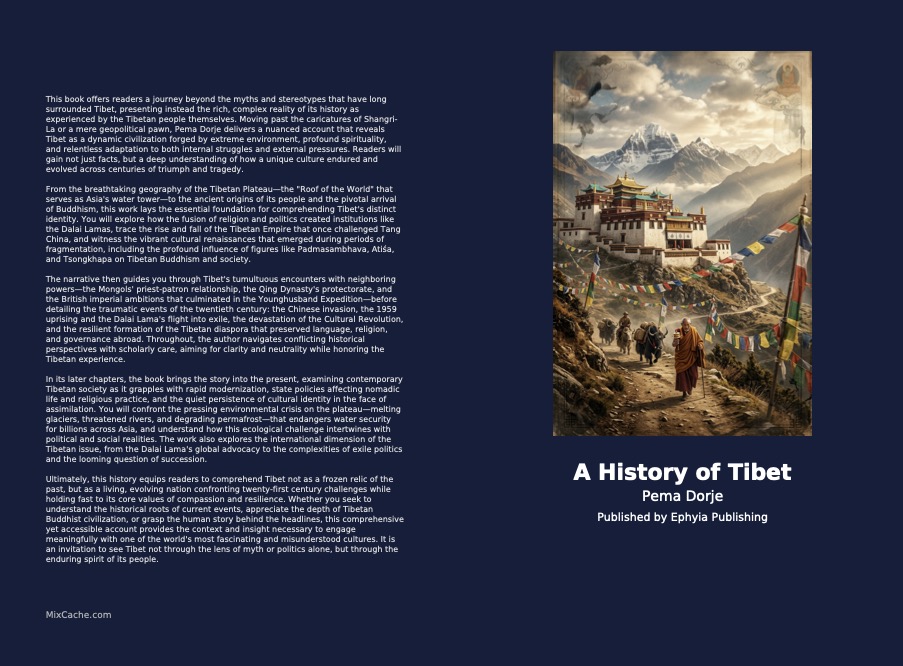
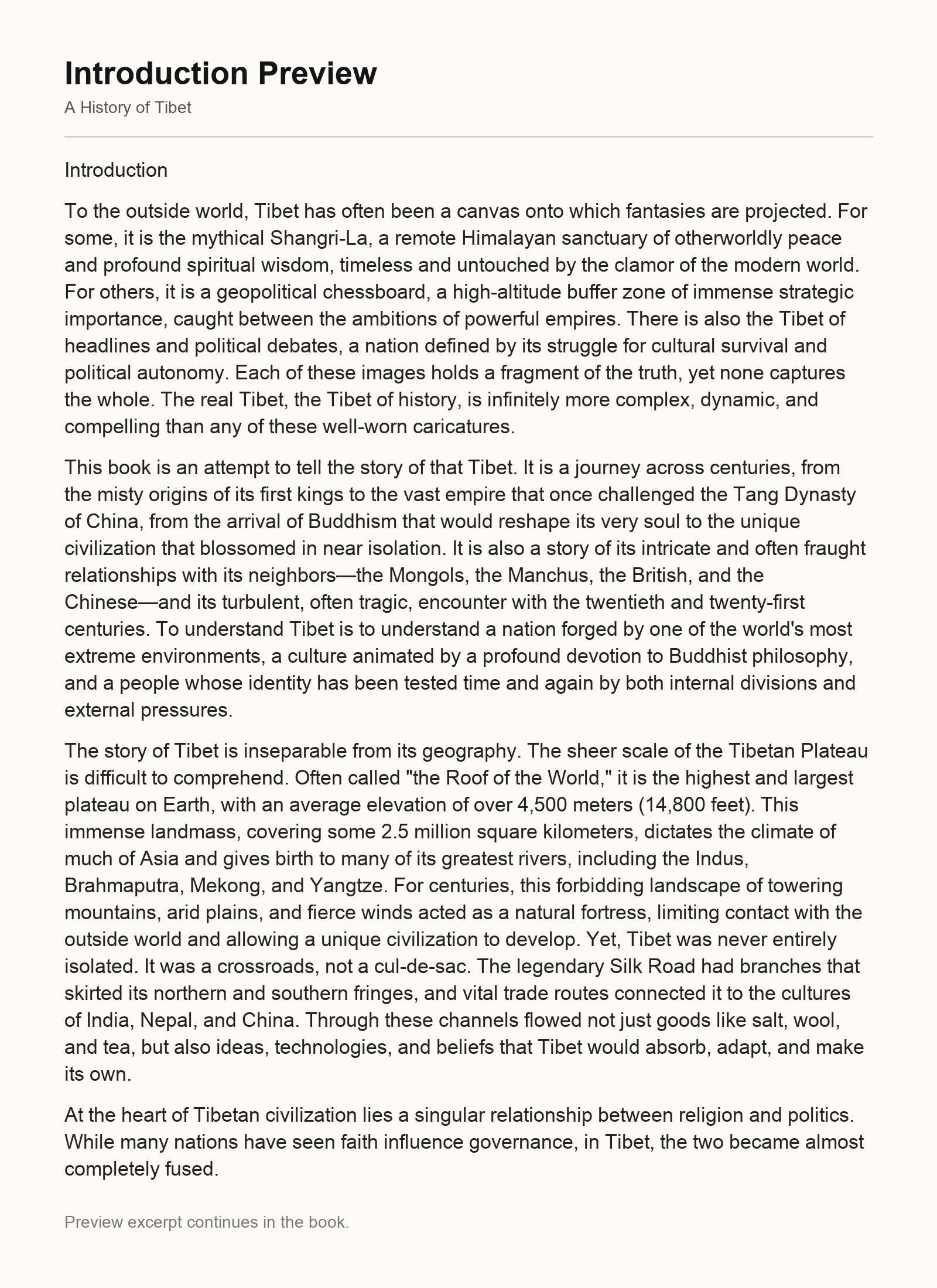
This book offers readers a journey beyond the myths and stereotypes that have long surrounded Tibet, presenting instead the rich, complex reality of its history as experienced by the Tibetan people themselves. Moving past the caricatures of Shangri-La or a mere geopolitical pawn, Pema Dorje delivers a nuanced account that reveals Tibet as a dynamic civilization forged by extreme environment, profound spirituality, and relentless adaptation to both internal struggles and external pressures. Readers will gain not just facts, but a deep understanding of how a unique culture endured and evolved across centuries of triumph and tragedy.
From the breathtaking geography of the Tibetan Plateau—the "Roof of the World" that serves as Asia's water tower—to the ancient origins of its people and the pivotal arrival of Buddhism, this work lays the essential foundation for comprehending Tibet's distinct identity. You will explore how the fusion of religion and politics created institutions like the Dalai Lamas, trace the rise and fall of the Tibetan Empire that once challenged Tang China, and witness the vibrant cultural renaissances that emerged during periods of fragmentation, including the profound influence of figures like Padmasambhava, Atiśa, and Tsongkhapa on Tibetan Buddhism and society.
The narrative then guides you through Tibet's tumultuous encounters with neighboring powers—the Mongols' priest-patron relationship, the Qing Dynasty's protectorate, and the British imperial ambitions that culminated in the Younghusband Expedition—before detailing the traumatic events of the twentieth century: the Chinese invasion, the 1959 uprising and the Dalai Lama's flight into exile, the devastation of the Cultural Revolution, and the resilient formation of the Tibetan diaspora that preserved language, religion, and governance abroad. Throughout, the author navigates conflicting historical perspectives with scholarly care, aiming for clarity and neutrality while honoring the Tibetan experience.
In its later chapters, the book brings the story into the present, examining contemporary Tibetan society as it grapples with rapid modernization, state policies affecting nomadic life and religious practice, and the quiet persistence of cultural identity in the face of assimilation. You will confront the pressing environmental crisis on the plateau—melting glaciers, threatened rivers, and degrading permafrost—that endangers water security for billions across Asia, and understand how this ecological challenge intertwines with political and social realities. The work also explores the international dimension of the Tibetan issue, from the Dalai Lama's global advocacy to the complexities of exile politics and the looming question of succession.
Ultimately, this history equips readers to comprehend Tibet not as a frozen relic of the past, but as a living, evolving nation confronting twenty-first century challenges while holding fast to its core values of compassion and resilience. Whether you seek to understand the historical roots of current events, appreciate the depth of Tibetan Buddhist civilization, or grasp the human story behind the headlines, this comprehensive yet accessible account provides the context and insight necessary to engage meaningfully with one of the world's most fascinating and misunderstood cultures. It is an invitation to see Tibet not through the lens of myth or politics alone, but through the enduring spirit of its people.
What You'll Find Inside:
- The book traces Tibet's evolution from its mythic origins and the Yarlung Dynasty through the rise and fall of the Tibetan Empire, detailing how geography and early rulers shaped the nation.
- It explains the introduction and institutionalization of Buddhism, highlighting key figures like Padmasambhava and Trisong Detsen, and the founding of Samye Monastery as the cornerstone of Tibetan Buddhist civilization.
- The narrative covers the unique Gelug school and the Dalai Lama institution, from its founding by Tsongkhapa to the political unification under the Great Fifth Dalai Lama and the establishment of the Ganden Phodrang government.
- It examines Tibet's turbulent modern history, including the Chinese invasion, the Seventeen-Point Agreement, the 1959 uprising, the Cultural Revolution, and the ongoing struggle for autonomy and cultural preservation.
- The book concludes with contemporary issues: the Tibetan diaspora, environmental crises on the plateau, the future of the Dalai Lama lineage, and the tension between tradition and modernity within Tibet and exile communities.
Who's It For:
This book is ideal for students, scholars, and general readers interested in Asian history, Buddhist studies, and geopolitical affairs. It provides a comprehensive yet accessible overview of Tibet's complex past and present, making it valuable for anyone seeking to understand the interplay of religion, politics, and environment in shaping a unique civilization at the heart of Asia.
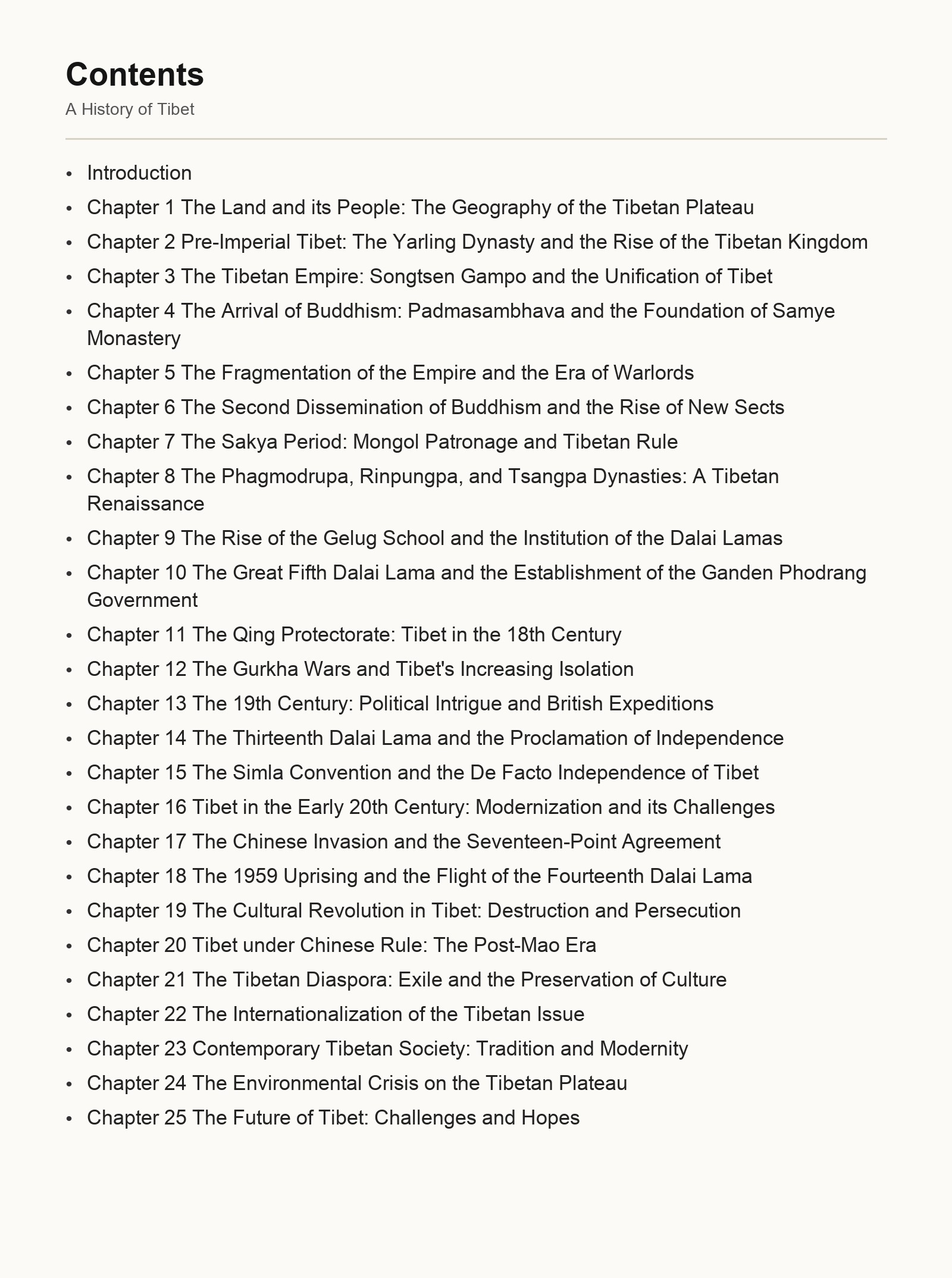
Table of Contents:
- Introduction
- Chapter 1 The Land and its People: The Geography of the Tibetan Plateau
- Chapter 2 Pre-Imperial Tibet: The Yarling Dynasty and the Rise of the Tibetan Kingdom
- Chapter 3 The Tibetan Empire: Songtsen Gampo and the Unification of Tibet
- Chapter 4 The Arrival of Buddhism: Padmasambhava and the Foundation of Samye Monastery
- Chapter 5 The Fragmentation of the Empire and the Era of Warlords
- Chapter 6 The Second Dissemination of Buddhism and the Rise of New Sects
- Chapter 7 The Sakya Period: Mongol Patronage and Tibetan Rule
- Chapter 8 The Phagmodrupa, Rinpungpa, and Tsangpa Dynasties: A Tibetan Renaissance
- Chapter 9 The Rise of the Gelug School and the Institution of the Dalai Lamas
- Chapter 10 The Great Fifth Dalai Lama and the Establishment of the Ganden Phodrang Government
- Chapter 11 The Qing Protectorate: Tibet in the 18th Century
- Chapter 12 The Gurkha Wars and Tibet's Increasing Isolation
- Chapter 13 The 19th Century: Political Intrigue and British Expeditions
- Chapter 14 The Thirteenth Dalai Lama and the Proclamation of Independence
- Chapter 15 The Simla Convention and the De Facto Independence of Tibet
- Chapter 16 Tibet in the Early 20th Century: Modernization and its Challenges
- Chapter 17 The Chinese Invasion and the Seventeen-Point Agreement
- Chapter 18 The 1959 Uprising and the Flight of the Fourteenth Dalai Lama
- Chapter 19 The Cultural Revolution in Tibet: Destruction and Persecution
- Chapter 20 Tibet under Chinese Rule: The Post-Mao Era
- Chapter 21 The Tibetan Diaspora: Exile and the Preservation of Culture
- Chapter 22 The Internationalization of the Tibetan Issue
- Chapter 23 Contemporary Tibetan Society: Tradition and Modernity
- Chapter 24 The Environmental Crisis on the Tibetan Plateau
- Chapter 25 The Future of Tibet: Challenges and Hopes
Author:
Published By:
Date Published:
May 26, 2026
Type:
Nonfiction
Language:
English
Also Available In:
Word Count:
49,729 words
Reading Time:
3 hours 29 minutes
Sample:
Order:
Order A History of Tibet (Hardcover) on MixCache.com:
Buy NowPrint copy is made to order and ships worldwide. Includes the ebook free, ready to read instantly.
$5 account credit for all new MixCache.com accounts, usable toward any ebook purchase!*