Browse by Category
Fiction
- Action & Adventure
- African American
- Anthologies
- Children's Fiction
- Classics
- Comics & Graphic Novels
- Coming of Age
- Contemporary
- Cultural & Regional
- Drama
- Erotica
- Fantasy
- General
- Historical Fiction
- Horror
- Humor & Satire
- Literary Fiction
- Mystery, Thriller & Suspense
- Poetry
- Religious & Inspirational
- Romance
- Science Fiction
- Short Stories
- War & Military
- Westerns
- Women's Fiction
- Young Adult
Non-Fiction
- Antiques & Collectibles
- Arts & Photography
- Biographies & Memoirs
- Business & Money
- Children's Non-Fiction
-
Computers & Technology
- Artificial Intelligence
- Computer Science
- Cybersecurity & Cryptography
- Data Science & Analytics
- Databases & Big Data
- Game Development & Design
- General
- Hardware & DIY
- Mobile App Development
- Networking & Cloud Computing
- Operating Systems
- Programming
- Robotics
- Software
- Software Engineering
- User Experience (UX) & Design
- Web Development & Design
- Cooking, Food & Wine
- Crafts, Hobbies & Home
- Education & Teaching
- Engineering
- General
- Health, Fitness & Dieting
-
History
- African History
- African History - North Africa
- African History - Sub-Saharan Africa
- American History
- American History - 20th Century
- American History - Civil War
- American History - Colonial Period
- Ancient History
- Asian History
- Asian History - China
- Asian History - India
- Asian History - Japan
- Asian History - Southeast Asia
- European History
- European History - Ancient Greece
- European History - Ancient Rome
- European History - Medieval
- European History - Modern
- European History - Renaissance
- General
- Middle Eastern History
- Military History
- Military History - Aviation
- Military History - Naval
- Social & Cultural History
- World History
- Humor & Entertainment
- Industrial Technology
- Language Learning
- Law
- LGBTQ+ Non-Fiction
- Literary Criticism
- Medical Books
- Parenting & Relationships
- Philosophy
- Politics & Social Sciences
- Reference
- Religion & Spirituality
-
Science & Math
- Agricultural Sciences
- Astronomy & Space Science
- Behavioral Sciences
- Biological Sciences
- Botany & Plant Science
- Chemistry
- Earth Sciences
- Engineering - Chemical
- Engineering - Civil
- Engineering - Electrical
- Engineering - Mechanical
- Environment
- General
- Geology
- Mathematics
- Nature & Ecology
- Oceanography
- Paleontology
- Physics
- Statistics
- Self-Help
- Sports & Outdoors
- Study Aids
- Sustainability & Green Living
- Textbooks
- Transportation
- Travel
- True Crime
- Urban Planning & Development
- Veterinary Medicine
- Writing & Publishing
Jump to Section
MixCache.com Total Access
Unlimited reading and audiobooks for every book published by MixCache.com.
Included titles carry the MTA badge.
Learn more →
The Fertile Crescent
MTA
A History
About this book:
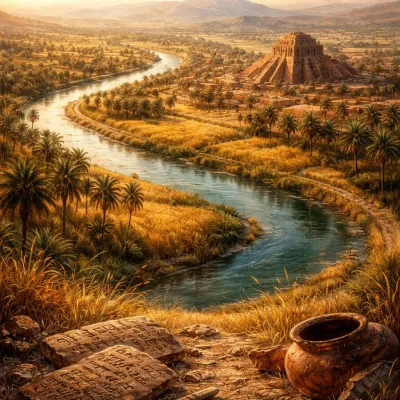
The Fertile Crescent’s story begins with its unique geography—a crescent of water‑rich plains, rain‑fed highlands, and coastal valleys that encouraged early settlement. Natufian semi‑permanent villages gave way to the Pre‑Pottery Neolithic, where deliberate cultivation of emmer wheat, barley, lentils and the domestication of goats and sheep produced a reliable food surplus. This agricultural revolution spurred the growth of villages into towns, evidenced by the Hassuna, Samarra and Halaf cultures, whose irrigation, pottery and trade networks laid the groundwork for true urban life. In southern Mesopotamia the Ubaid period refined canal systems and temple construction, culminating in the Uruk explosion of the fourth millennium BCE: massive cities like Uruk, the invention of proto‑cuneiform for administrative record‑keeping, and the emergence of temple‑centered economies that fused religious authority with early kingship.
From these foundations rose the Sumerian city‑states of the Early Dynastic Age, whose competing polities produced sophisticated law, literature and monumental ziggurats. Sargon of Akkad forged the world’s first empire, uniting Sumer and Akkad under a centralized administration and setting a precedent for later rulers. The Old Babylonian period under Hammurabi delivered a celebrated law code and a flourishing of mathematics, astronomy and literature, while northern powers such as the Mitanni, Hittites and Kassites vied for influence alongside the maritime Phoenicians, who spread their alphabet across the Mediterranean. In the southern highlands the kingdoms of Israel, Judah and their neighbors cultivated distinct tribal identities rooted in Yahwistic worship, only to be overwhelmed by the Assyrian Empire’s iron‑armed, deportation‑driven hegemony. Assyrian dominance gave way to a Neo‑Babylonian renaissance under Nebuchadnezzar II, whose monumental Babylon and advances in astronomy briefly revived Mesopotamian glory before the Achaemenid Persians incorporated the region into a vast, tolerant empire governed by satrapies and the Royal Road. Hellenistic Seleucid rule followed Alexander’s conquest, blending Greek cities like Antioch and Seleucia with enduring Mesopotamian traditions, until the Parthians and later Romans turned the Fertile Crescent into a contested frontier of legionaries and cataphracts. The Sasanian Persians revived Iranian imperial power, fostering a vibrant intellectual crossroads where Syriac Christianity, Judaism, Manichaeism and Zoroastrianism coexisted amid continual Byzantine‑Sasanian warfare.
The arrival of Islam in the seventh century transformed the region yet again: rapid Arab‑Muslim conquests toppled the exhausted Byzantine and Sasanian empires, and the Abbasid caliphate established Baghdad as a beacon of the Islamic Golden Age, translating Greek, Persian and Indian knowledge and nurturing advances in algebra, astronomy, medicine and philosophy. Subsequent centuries saw the Crusader states clash with Seljuk Turks and the Ayyubids under Saladin, the devastating Mongol sack of Baghdad and Timurid raids, and the gradual emergence of Ottoman‑Safavid rivalry that divided the crescent between Sunni and Shiʿi spheres. After World War I the Ottoman collapse gave way to British and French mandates that created the modern states of Iraq, Syria, Lebanon, Jordan and Palestine/Israel, a process marked by oil discoveries, Arab nationalism, successive Arab‑Israeli wars, coups, authoritarian regimes, the Iran‑Iraq conflict, the Gulf Wars, the Arab Spring and ongoing sectarian and humanitarian challenges. Throughout these millennia the Fertile Crescent has remained a crucible of innovation, empire, trade and ideas—its ancient soils continuing to shape the political, cultural and ecological realities of the present day.
What You'll Find Inside:
- The Fertile Crescent’s geography—particularly the Tigris and Euphrates rivers and Levantine valleys—determined where agriculture, irrigation, and the first cities could arise.
- From Natufian hunter‑gatherers to the domestication of founder crops and animals, the Agricultural Revolution created food surpluses that enabled population growth and social complexity.
- The Uruk period produced the world’s first true cities, monumental temple complexes, administrative bureaucracies, and the invention of cuneiform writing for record‑keeping.
- A succession of empires—Akkadian, Assyrian, Babylonian, Persian, Hellenistic, Roman/Parthian, Sasanian, Islamic caliphates, and Ottoman‑Safavid rivals—showed a recurring pattern of conquest, integration, and cultural exchange across the region.
- Throughout its long history, the Fertile Crescent remained a crossroads of trade, water management, religious innovation, and adaptive resilience, linking prehistoric developments to modern nation‑state formation.
Who's It For:
This book is ideal for undergraduate students, graduate scholars, and educated general readers interested in the deep history of the Middle East. It provides a comprehensive, theme‑driven overview that will benefit those studying archaeology, ancient history, or the origins of civilization, as well as anyone seeking to understand how the Fertile Crescent’s past shapes its present.
Table of Contents:
- Introduction
- Chapter 1 <Land Between Rivers: Geography and Boundaries>
- Chapter 2 <Before Cities: Natufians and the Pre-Pottery Neolithic>
- Chapter 3 <Seeds of Change: The Agricultural Revolution>
- Chapter 4 <From Villages to Towns: Hassuna, Samarra, and Halaf>
- Chapter 5 <The Uruk World: First Cities and States>
- Chapter 6 <Writing and Number: Cuneiform and Administration>
- Chapter 7 <Gods, Temples, and Kingship: Religion and Power>
- Chapter 8 <Sumerian City-States and the Early Dynastic Age>
- Chapter 9 <Sargon’s Vision: The Akkadian Empire>
- Chapter 10 <Law and Learning in Old Babylon: Hammurabi and His Age>
- Chapter 11 <Chariots and Northern Powers: Mitanni, Hittites, and Kassites>
- Chapter 12 <Traders of Purple: The Phoenicians and the Levant>
- Chapter 13 <Highland Kingdoms: Israel, Judah, and Their Neighbors>
- Chapter 14 <Assyria Ascendant: Empire of Iron>
- Chapter 15 <The Neo-Babylonian Renaissance>
- Chapter 16 <Achaemenid Persia and the Satrapies of the Crescent>
- Chapter 17 <From Alexander to Antioch: Hellenistic Transformations>
- Chapter 18 <Frontiers of Power: Rome and Parthia>
- Chapter 19 <Sasanian Splendor and the Late Antique Crossroads>
- Chapter 20 <The Coming of Islam: Conquest and Continuity>
- Chapter 21 <Abbasid Baghdad and the Golden Age>
- Chapter 22 <Crusades, Seljuks, and Ayyubids: Faith and Power in the Levant>
- Chapter 23 <Mongols to Timurids: Shock and Reconfiguration>
- Chapter 24 <Ottoman–Safavid Rivalries: Provinces and Peoples>
- Chapter 25 <Mandates to Modern States: The Long Twentieth Century>
Author:
Published By:
Date Published:
May 24, 2026
Type:
Nonfiction
Language:
English
Word Count:
46,228 words
Reading Time:
3 hours 14 minutes
Sample:
Order:
Order The Fertile Crescent (Paperback) on MixCache.com:
Buy NowPrint copy is made to order and ships worldwide. Includes the ebook free, ready to read instantly.
$5 account credit for all new MixCache.com accounts, usable toward any ebook purchase!*