Browse by Category
Fiction
- Action & Adventure
- African American
- Anthologies
- Children's Fiction
- Classics
- Comics & Graphic Novels
- Coming of Age
- Contemporary
- Cultural & Regional
- Drama
- Erotica
- Fantasy
- General
- Historical Fiction
- Horror
- Humor & Satire
- Literary Fiction
- Mystery, Thriller & Suspense
- Poetry
- Religious & Inspirational
- Romance
- Science Fiction
- Short Stories
- War & Military
- Westerns
- Women's Fiction
- Young Adult
Non-Fiction
- Antiques & Collectibles
- Arts & Photography
- Biographies & Memoirs
- Business & Money
- Children's Non-Fiction
-
Computers & Technology
- Artificial Intelligence
- Computer Science
- Cybersecurity & Cryptography
- Data Science & Analytics
- Databases & Big Data
- Game Development & Design
- General
- Hardware & DIY
- Mobile App Development
- Networking & Cloud Computing
- Operating Systems
- Programming
- Robotics
- Software
- Software Engineering
- User Experience (UX) & Design
- Web Development & Design
- Cooking, Food & Wine
- Crafts, Hobbies & Home
- Education & Teaching
- Engineering
- General
- Health, Fitness & Dieting
-
History
- African History
- African History - North Africa
- African History - Sub-Saharan Africa
- American History
- American History - 20th Century
- American History - Civil War
- American History - Colonial Period
- Ancient History
- Asian History
- Asian History - China
- Asian History - India
- Asian History - Japan
- Asian History - Southeast Asia
- European History
- European History - Ancient Greece
- European History - Ancient Rome
- European History - Medieval
- European History - Modern
- European History - Renaissance
- General
- Middle Eastern History
- Military History
- Military History - Aviation
- Military History - Naval
- Social & Cultural History
- World History
- Humor & Entertainment
- Industrial Technology
- Language Learning
- Law
- LGBTQ+ Non-Fiction
- Literary Criticism
- Medical Books
- Parenting & Relationships
- Philosophy
- Politics & Social Sciences
- Reference
- Religion & Spirituality
-
Science & Math
- Agricultural Sciences
- Astronomy & Space Science
- Behavioral Sciences
- Biological Sciences
- Botany & Plant Science
- Chemistry
- Earth Sciences
- Engineering - Chemical
- Engineering - Civil
- Engineering - Electrical
- Engineering - Mechanical
- Environment
- General
- Geology
- Mathematics
- Nature & Ecology
- Oceanography
- Paleontology
- Physics
- Statistics
- Self-Help
- Sports & Outdoors
- Study Aids
- Sustainability & Green Living
- Textbooks
- Transportation
- Travel
- True Crime
- Urban Planning & Development
- Veterinary Medicine
- Writing & Publishing
Jump to Section
MixCache.com Total Access
Unlimited reading and audiobooks for every book published by MixCache.com.
Included titles carry the MTA badge.
Learn more →
The Mail
A Concise History
About this book:


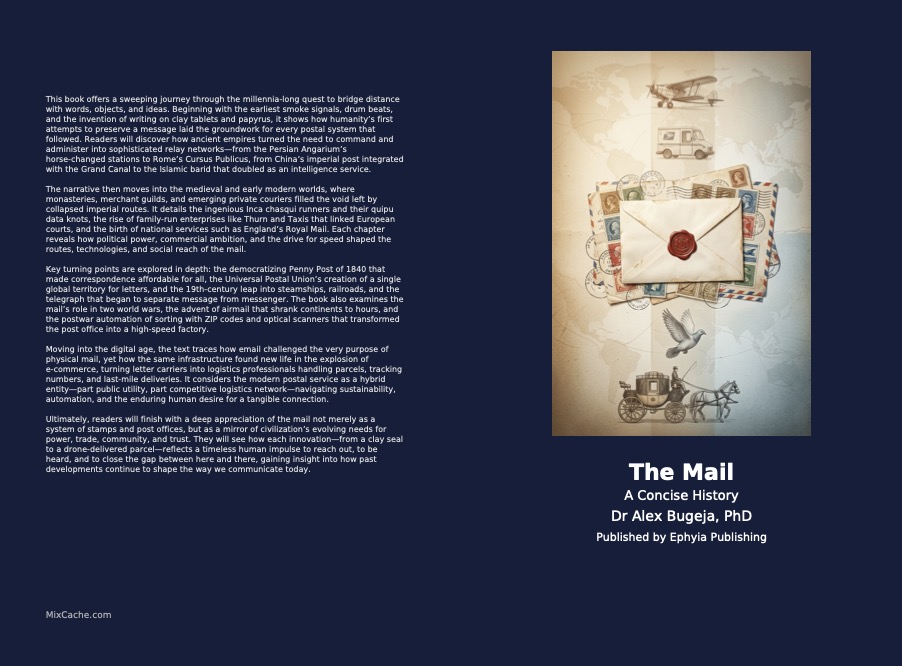
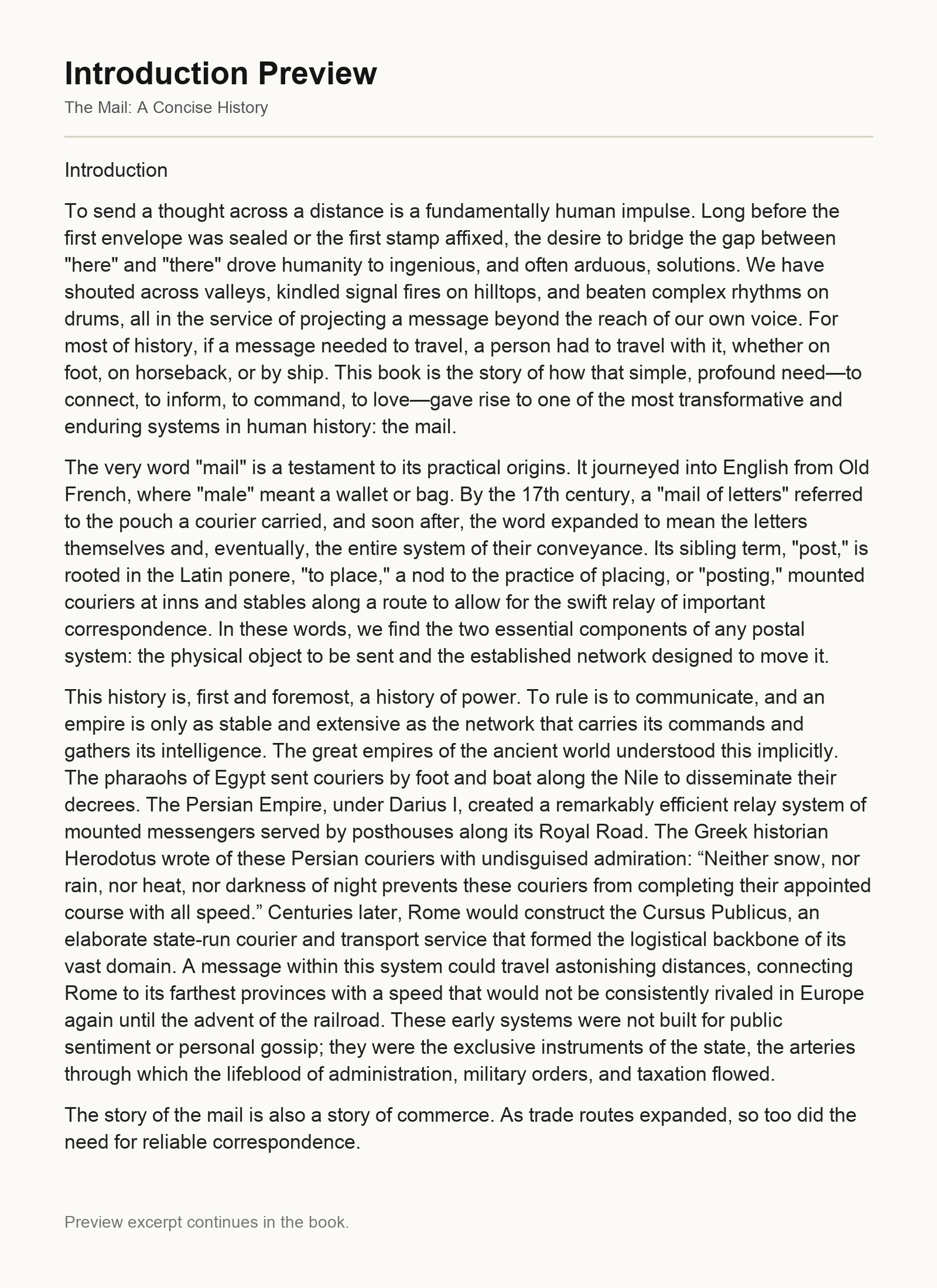
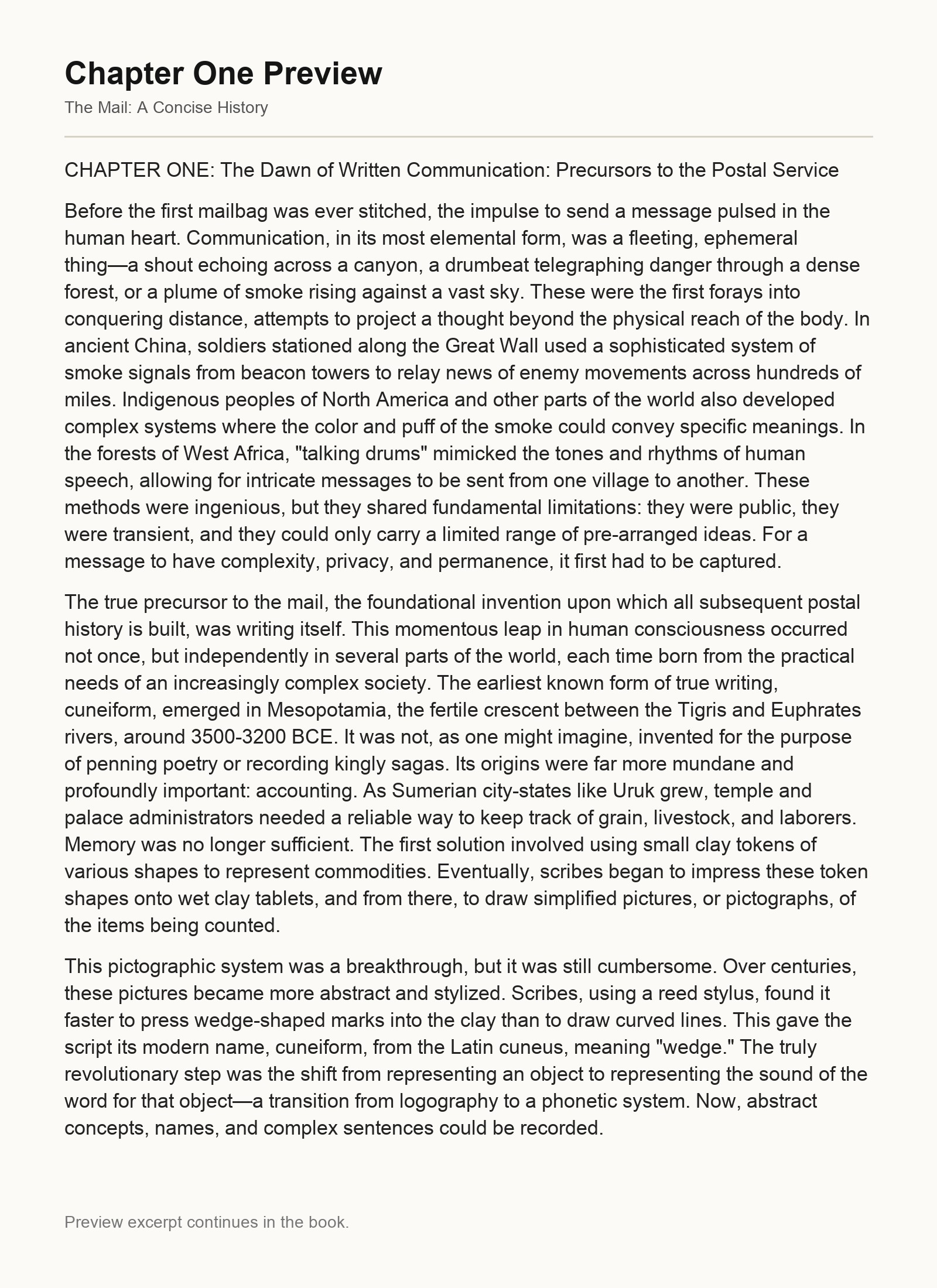
This book offers a sweeping journey through the millennia‑long quest to bridge distance with words, objects, and ideas. Beginning with the earliest smoke signals, drum beats, and the invention of writing on clay tablets and papyrus, it shows how humanity’s first attempts to preserve a message laid the groundwork for every postal system that followed. Readers will discover how ancient empires turned the need to command and administer into sophisticated relay networks—from the Persian Angarium’s horse‑changed stations to Rome’s Cursus Publicus, from China’s imperial post integrated with the Grand Canal to the Islamic barid that doubled as an intelligence service.
The narrative then moves into the medieval and early modern worlds, where monasteries, merchant guilds, and emerging private couriers filled the void left by collapsed imperial routes. It details the ingenious Inca chasqui runners and their quipu data knots, the rise of family‑run enterprises like Thurn and Taxis that linked European courts, and the birth of national services such as England’s Royal Mail. Each chapter reveals how political power, commercial ambition, and the drive for speed shaped the routes, technologies, and social reach of the mail.
Key turning points are explored in depth: the democratizing Penny Post of 1840 that made correspondence affordable for all, the Universal Postal Union’s creation of a single global territory for letters, and the 19th‑century leap into steamships, railroads, and the telegraph that began to separate message from messenger. The book also examines the mail’s role in two world wars, the advent of airmail that shrank continents to hours, and the postwar automation of sorting with ZIP codes and optical scanners that transformed the post office into a high‑speed factory.
Moving into the digital age, the text traces how email challenged the very purpose of physical mail, yet how the same infrastructure found new life in the explosion of e‑commerce, turning letter carriers into logistics professionals handling parcels, tracking numbers, and last‑mile deliveries. It considers the modern postal service as a hybrid entity—part public utility, part competitive logistics network—navigating sustainability, automation, and the enduring human desire for a tangible connection.
Ultimately, readers will finish with a deep appreciation of the mail not merely as a system of stamps and post offices, but as a mirror of civilization’s evolving needs for power, trade, community, and trust. They will see how each innovation—from a clay seal to a drone‑delivered parcel—reflects a timeless human impulse to reach out, to be heard, and to close the gap between here and there, gaining insight into how past developments continue to shape the way we communicate today.
What You'll Find Inside:
- The evolution of mail from ancient precursors like writing systems and messenger networks to imperial communication systems such as the Persian Angarium and Roman Cursus Publicus, revealing how state power depended on controlling information flow.
- How the Penny Post, Universal Postal Union, and 19th-century technologies (railroads, steamships, airmail) transformed mail from an elite privilege into a democratized public utility that connected ordinary people across vast distances.
- The dual historical role of postal services as both commercial engines facilitating trade and commerce, and state instruments used for surveillance, censorship, and propaganda during conflicts from the World Wars to the Cold War.
- How postal systems have continually adapted to technological disruption—competing with telegraph/telephone, embracing automation (ZIP codes, sorting machines), and now evolving into e-commerce logistics networks while maintaining their core mission of connection.
- The enduring significance of physical mail in the digital age, where tangible letters and parcels retain unique emotional and practical value that digital communication cannot replicate, particularly in e-commerce fulfillment and personal correspondence.
Who's It For:
This book is ideal for history enthusiasts, students of communication or logistics, and general readers interested in how infrastructure shapes society. It will particularly appeal to those who enjoy works examining the intersection of technology, business, and culture—such as readers of 'The Box' by Marc Levinson or 'The Information' by James Gleick—and professionals in postal services, logistics, or e-commerce seeking historical context for today's digital transformation.
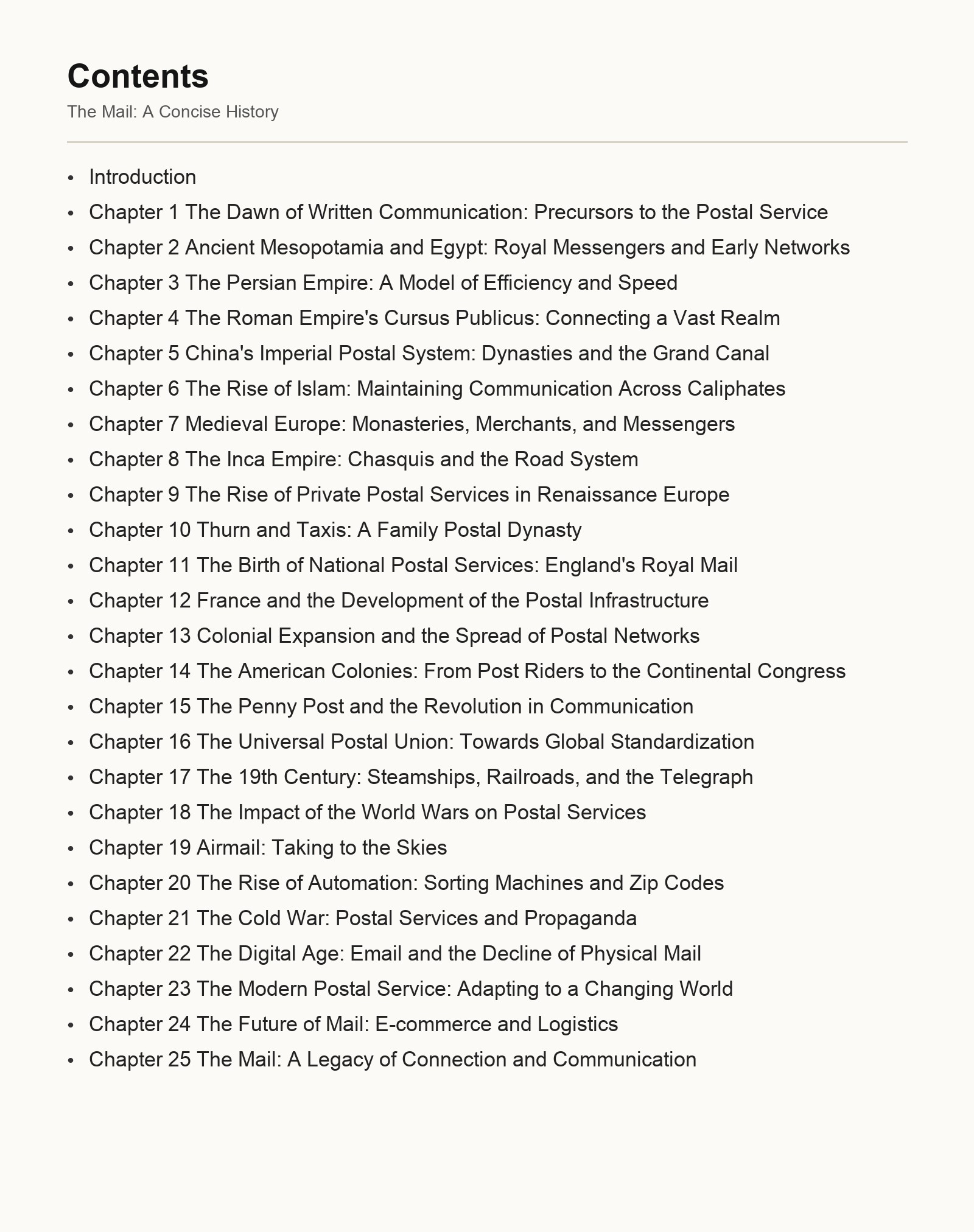
Table of Contents:
-
Introduction
-
Chapter 1 The Dawn of Written Communication: Precursors to the Postal Service
-
Chapter 2 Ancient Mesopotamia and Egypt: Royal Messengers and Early Networks
-
Chapter 3 The Persian Empire: A Model of Efficiency and Speed
-
Chapter 4 The Roman Empire's Cursus Publicus: Connecting a Vast Realm
-
Chapter 5 China's Imperial Postal System: Dynasties and the Grand Canal
-
Chapter 6 The Rise of Islam: Maintaining Communication Across Caliphates
-
Chapter 7 Medieval Europe: Monasteries, Merchants, and Messengers
-
Chapter 8 The Inca Empire: Chasquis and the Road System
-
Chapter 9 The Rise of Private Postal Services in Renaissance Europe
-
Chapter 10 Thurn and Taxis: A Family Postal Dynasty
-
Chapter 11 The Birth of National Postal Services: England's Royal Mail
-
Chapter 12 France and the Development of the Postal Infrastructure
-
Chapter 13 Colonial Expansion and the Spread of Postal Networks
-
Chapter 14 The American Colonies: From Post Riders to the Continental Congress
-
Chapter 15 The Penny Post and the Revolution in Communication
-
Chapter 16 The Universal Postal Union: Towards Global Standardization
-
Chapter 17 The 19th Century: Steamships, Railroads, and the Telegraph
-
Chapter 18 The Impact of the World Wars on Postal Services
-
Chapter 19 Airmail: Taking to the Skies
-
Chapter 20 The Rise of Automation: Sorting Machines and Zip Codes
-
Chapter 21 The Cold War: Postal Services and Propaganda
-
Chapter 22 The Digital Age: Email and the Decline of Physical Mail
-
Chapter 23 The Modern Postal Service: Adapting to a Changing World
-
Chapter 24 The Future of Mail: E-commerce and Logistics
-
Chapter 25 The Mail: A Legacy of Connection and Communication
Author:
Published By:
Date Published:
May 23, 2026
Type:
Nonfiction
Language:
English
Also Available In:
German, Spanish, Italian, Portuguese
Word Count:
45,058 words
Reading Time:
3 hours 9 minutes
Sample:
Order:
Order The Mail (Hardcover) on MixCache.com:
Buy NowPrint copy is made to order and ships worldwide. Includes the ebook free, ready to read instantly.
$5 account credit for all new MixCache.com accounts, usable toward any ebook purchase!*