
Browse by Category
Fiction
- Action & Adventure
- African American
- Anthologies
- Children's Fiction
- Classics
- Comics & Graphic Novels
- Coming of Age
- Contemporary
- Cultural & Regional
- Drama
- Erotica
- Fantasy
- General
- Historical Fiction
- Horror
- Humor & Satire
- Literary Fiction
- Mystery, Thriller & Suspense
- Poetry
- Religious & Inspirational
- Romance
- Science Fiction
- Short Stories
- War & Military
- Westerns
- Women's Fiction
- Young Adult
Non-Fiction
- Antiques & Collectibles
- Arts & Photography
- Biographies & Memoirs
- Business & Money
- Children's Non-Fiction
-
Computers & Technology
- Artificial Intelligence
- Computer Science
- Cybersecurity & Cryptography
- Data Science & Analytics
- Databases & Big Data
- Game Development & Design
- General
- Hardware & DIY
- Mobile App Development
- Networking & Cloud Computing
- Operating Systems
- Programming
- Robotics
- Software
- Software Engineering
- User Experience (UX) & Design
- Web Development & Design
- Cooking, Food & Wine
- Crafts, Hobbies & Home
- Education & Teaching
- Engineering
- General
- Health, Fitness & Dieting
-
History
- African History
- African History - North Africa
- African History - Sub-Saharan Africa
- American History
- American History - 20th Century
- American History - Civil War
- American History - Colonial Period
- Ancient History
- Asian History
- Asian History - China
- Asian History - India
- Asian History - Japan
- Asian History - Southeast Asia
- European History
- European History - Ancient Greece
- European History - Ancient Rome
- European History - Medieval
- European History - Modern
- European History - Renaissance
- General
- Middle Eastern History
- Military History
- Military History - Aviation
- Military History - Naval
- Social & Cultural History
- World History
- Humor & Entertainment
- Industrial Technology
- Language Learning
- Law
- LGBTQ+ Non-Fiction
- Literary Criticism
- Medical Books
- Parenting & Relationships
- Philosophy
- Politics & Social Sciences
- Reference
- Religion & Spirituality
-
Science & Math
- Agricultural Sciences
- Astronomy & Space Science
- Behavioral Sciences
- Biological Sciences
- Botany & Plant Science
- Chemistry
- Earth Sciences
- Engineering - Chemical
- Engineering - Civil
- Engineering - Electrical
- Engineering - Mechanical
- Environment
- General
- Geology
- Mathematics
- Nature & Ecology
- Oceanography
- Paleontology
- Physics
- Statistics
- Self-Help
- Sports & Outdoors
- Study Aids
- Sustainability & Green Living
- Textbooks
- Transportation
- Travel
- True Crime
- Urban Planning & Development
- Veterinary Medicine
- Writing & Publishing
Jump to Section
MixCache.com Total Access
Unlimited reading and audiobooks for every book published by MixCache.com.
Included titles carry the MTA badge.
Learn more →
A History of Bhutan
The Story of the Land of the Thunder Dragon
About this book:

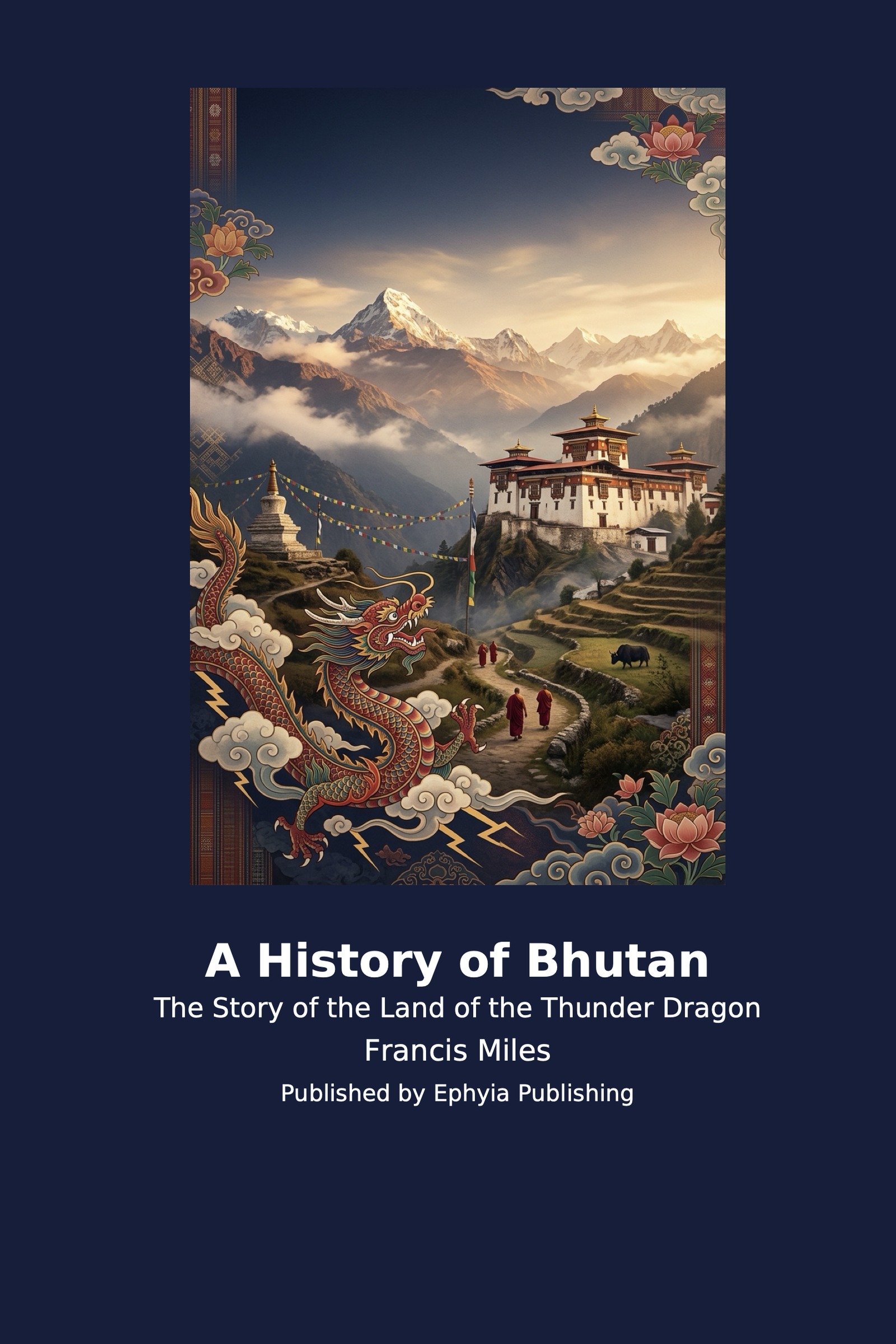
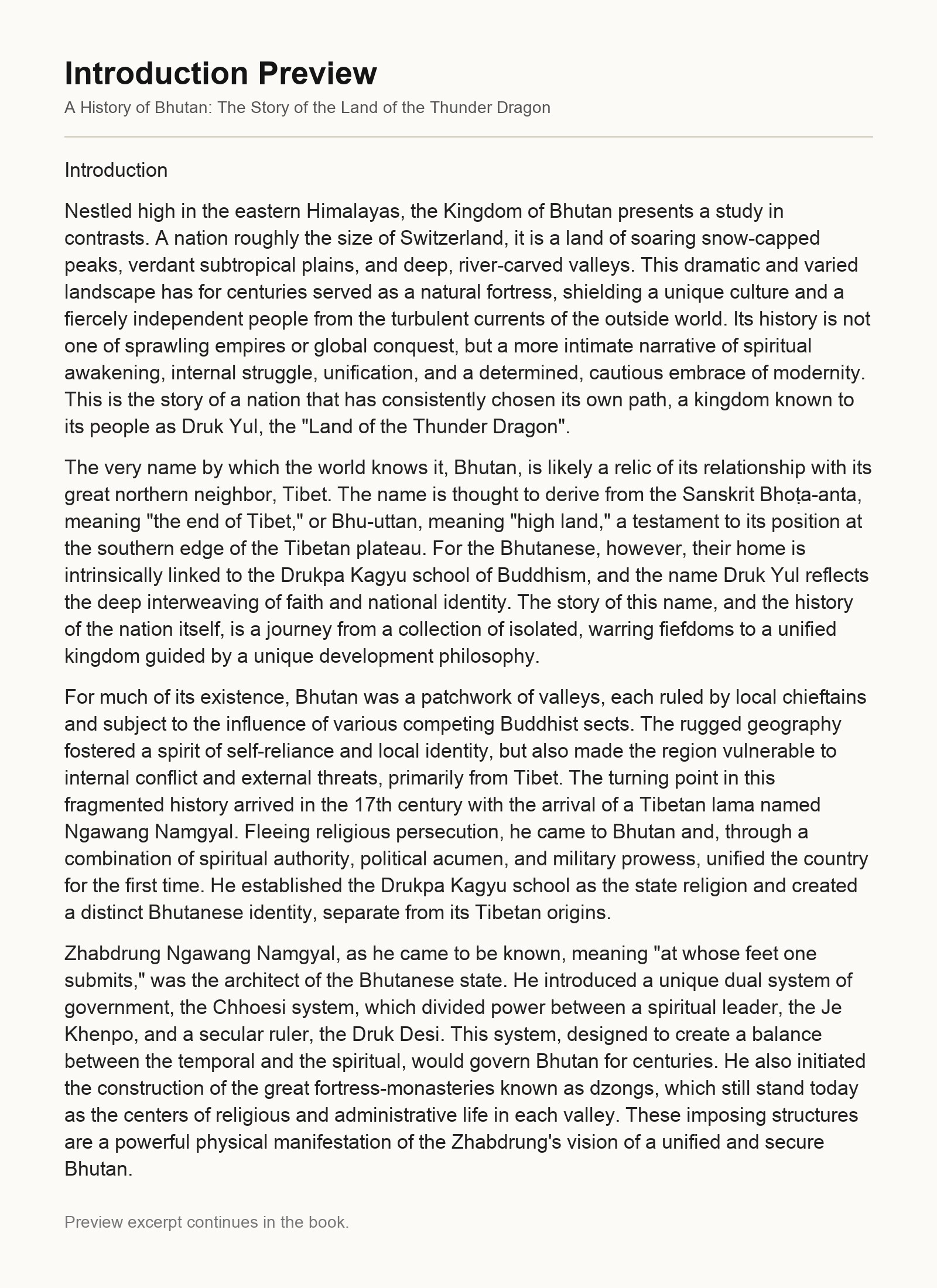
A History of Bhutan invites readers on a sweeping journey through the kingdom’s past, from the mist‑shrouded valleys of prehistoric settlers and the ancient Bon religion to the dramatic arrival of Guru Rinpoche and the early seeds of Buddhism. Each chapter reveals how geography shaped isolated communities, how competing Buddhist schools vied for influence, and how the rugged landscape both protected and challenged the people who called it home. Readers will gain a vivid sense of the spiritual foundations that have endured for centuries, even as they adapted to new ideas and outside pressures.
The narrative then turns to the pivotal seventeenth‑century figure Zhabdrung Ngawang Namgyal, whose visionary leadership unified warring valleys, instituted the distinctive Chhoesi dual system of government, and erected the awe‑inspiring dzongs that still dominate the landscape. Through detailed accounts of invasions, internal strife, and the long silence after his death, the book shows how Bhutan’s early leaders balanced spiritual authority with secular power, laying the institutional groundwork for a nation that would survive amid powerful neighbors.
Later sections trace the rise of the Wangchuck dynasty, from the battlefield triumphs of Ugyen Wangchuck that ended centuries of civil war to the peaceful establishment of Bhutan’s first hereditary monarchy. Readers will follow the careful modernization drives of King Jigme Dorji Wangchuck, the bold environmental and cultural policies of King Jigme Singye Wangchuck’s Gross National Happiness philosophy, and the historic transition to democracy led by the fourth king’s abdication and the fifth king’s coronation. The book illuminates how each monarch navigated isolation, foreign relations, and internal reform while preserving Bhutan’s unique identity.
Beyond politics and royalty, the work immerses readers in the living culture of contemporary Bhutan: the vibrant tshechu festivals, the national dress of gho and kira, the aromas of ema datshi and suja, and the rhythmic life of farming villages juxtaposed with the growing pulse of Thimphu. Chapters on arts, architecture, education, healthcare, and the nation’s pioneering commitment to environmental conservation reveal how tradition and modernity coexist, and how Bhutan’s constitution mandates that at least sixty percent of its land remain forested forever.
Finally, the book looks ahead to the challenges and opportunities of the twenty‑first century—hydropower dependence, youth unemployment, climate change, and the ambitious Gelephu Mindfulness City project—while reflecting on the enduring quest for balance between tradition and globalization. By the end, readers will not only have absorbed a comprehensive history of the Land of the Thunder Dragon but will also have experienced the resilience, spirituality, and thoughtful pragmatism that continue to shape Bhutan’s path forward.
What You'll Find Inside:
- The unification of Bhutan by Zhabdrung Ngawang Namgyal in the 17th century and his establishment of the dual Chhoesi system separating spiritual and temporal governance.
- The end of centuries of civil war and the establishment of the Wangchuck monarchy in 1907 under Ugyen Wangchuck, Bhutan's first hereditary king.
- The development and implementation of Gross National Happiness (GNH) as Bhutan's unique development philosophy balancing material progress with spiritual, cultural, and environmental well-being.
- Bhutan's peaceful transition from absolute monarchy to democratic constitutional monarchy, culminating in the first national elections in 2008.
- Contemporary challenges facing Bhutan including economic diversification, youth unemployment, climate change impacts, and balancing tradition with modernity in a globalized world.
Who's It For:
This book is ideal for students and scholars of Asian history, political science, and development studies seeking to understand Bhutan's unique journey from isolation to global engagement. It will also appeal to general readers interested in Himalayan cultures, Buddhist societies, alternative governance models, and how small nations navigate complex geopolitical landscapes while preserving their cultural identity. Anyone studying monarchy, democracy, or innovative development philosophies like Gross National Happiness will find valuable insights in this comprehensive historical account.
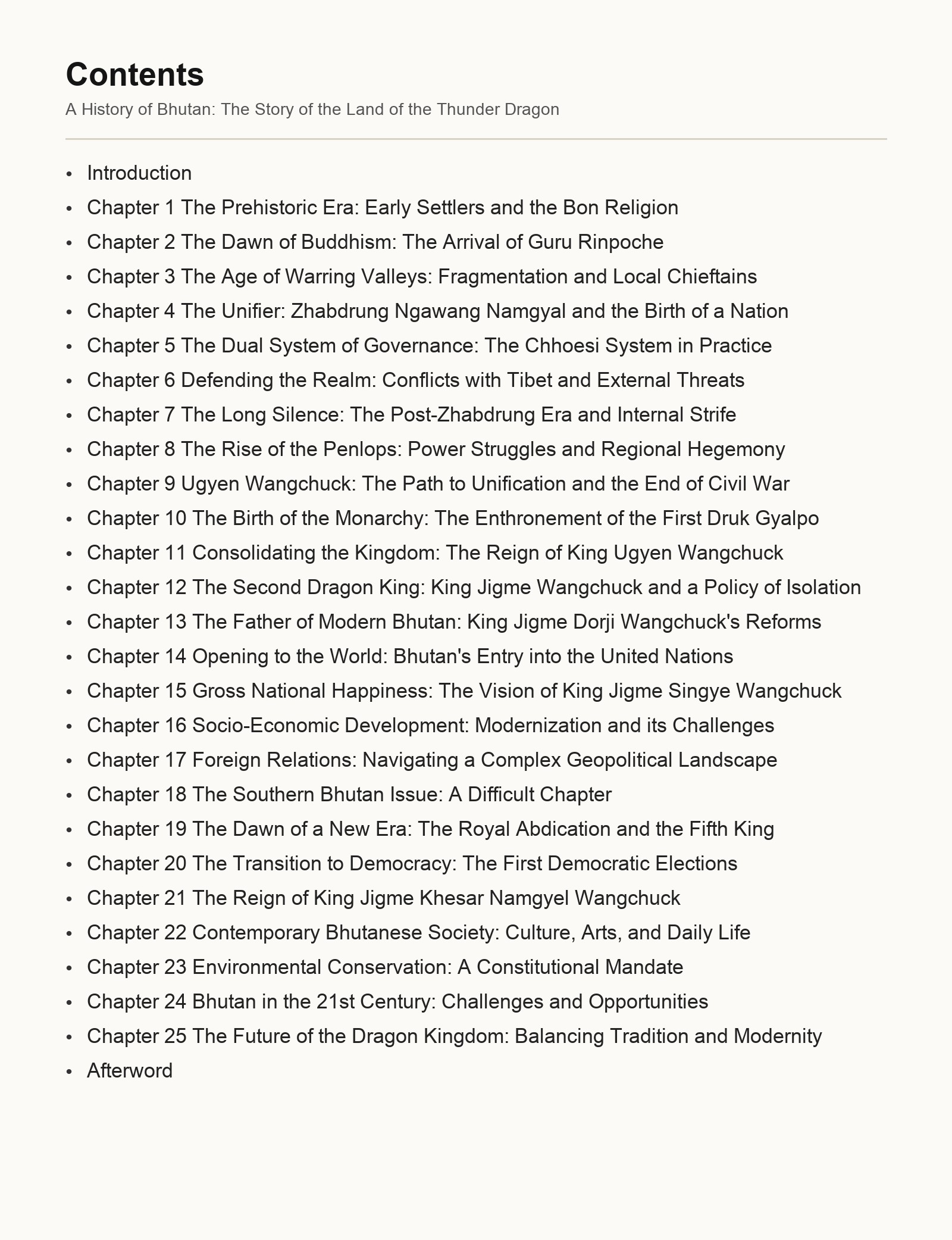
Table of Contents:
- Introduction
- Chapter 1 The Prehistoric Era: Early Settlers and the Bon Religion
- Chapter 2 The Dawn of Buddhism: The Arrival of Guru Rinpoche
- Chapter 3 The Age of Warring Valleys: Fragmentation and Local Chieftains
- Chapter 4 The Unifier: Zhabdrung Ngawang Namgyal and the Birth of a Nation
- Chapter 5 The Dual System of Governance: The Chhoesi System in Practice
- Chapter 6 Defending the Realm: Conflicts with Tibet and External Threats
- Chapter 7 The Long Silence: The Post-Zhabdrung Era and Internal Strife
- Chapter 8 The Rise of the Penlops: Power Struggles and Regional Hegemony
- Chapter 9 Ugyen Wangchuck: The Path to Unification and the End of Civil War
- Chapter 10 The Birth of the Monarchy: The Enthronement of the First Druk Gyalpo
- Chapter 11 Consolidating the Kingdom: The Reign of King Ugyen Wangchuck
- Chapter 12 The Second Dragon King: King Jigme Wangchuck and a Policy of Isolation
- Chapter 13 The Father of Modern Bhutan: King Jigme Dorji Wangchuck's Reforms
- Chapter 14 Opening to the World: Bhutan's Entry into the United Nations
- Chapter 15 Gross National Happiness: The Vision of King Jigme Singye Wangchuck
- Chapter 16 Socio-Economic Development: Modernization and its Challenges
- Chapter 17 Foreign Relations: Navigating a Complex Geopolitical Landscape
- Chapter 18 The Southern Bhutan Issue: A Difficult Chapter
- Chapter 19 The Dawn of a New Era: The Royal Abdication and the Fifth King
- Chapter 20 The Transition to Democracy: The First Democratic Elections
- Chapter 21 The Reign of King Jigme Khesar Namgyel Wangchuck
- Chapter 22 Contemporary Bhutanese Society: Culture, Arts, and Daily Life
- Chapter 23 Environmental Conservation: A Constitutional Mandate
- Chapter 24 Bhutan in the 21st Century: Challenges and Opportunities
- Chapter 25 The Future of the Dragon Kingdom: Balancing Tradition and Modernity
- Afterword
Author:
Published By:
Date Published:
May 21, 2026
Type:
Nonfiction
Language:
English
Also Available In:
Word Count:
46,008 words
Reading Time:
3 hours 13 minutes
Sample:
Order:
Order A History of Bhutan (Paperback) on MixCache.com:
Buy NowPrint copy is made to order and ships worldwide. Includes the ebook free, ready to read instantly.
$5 account credit for all new MixCache.com accounts, usable toward any ebook purchase!*


