Browse by Category
Fiction
- Action & Adventure
- African American
- Anthologies
- Children's Fiction
- Classics
- Comics & Graphic Novels
- Coming of Age
- Contemporary
- Cultural & Regional
- Drama
- Erotica
- Fantasy
- General
- Historical Fiction
- Horror
- Humor & Satire
- Literary Fiction
- Mystery, Thriller & Suspense
- Poetry
- Religious & Inspirational
- Romance
- Science Fiction
- Short Stories
- War & Military
- Westerns
- Women's Fiction
- Young Adult
Non-Fiction
- Antiques & Collectibles
- Arts & Photography
- Biographies & Memoirs
- Business & Money
- Children's Non-Fiction
-
Computers & Technology
- Artificial Intelligence
- Computer Science
- Cybersecurity & Cryptography
- Data Science & Analytics
- Databases & Big Data
- Game Development & Design
- General
- Hardware & DIY
- Mobile App Development
- Networking & Cloud Computing
- Operating Systems
- Programming
- Robotics
- Software
- Software Engineering
- User Experience (UX) & Design
- Web Development & Design
- Cooking, Food & Wine
- Crafts, Hobbies & Home
- Education & Teaching
- Engineering
- General
- Health, Fitness & Dieting
-
History
- African History
- African History - North Africa
- African History - Sub-Saharan Africa
- American History
- American History - 20th Century
- American History - Civil War
- American History - Colonial Period
- Ancient History
- Asian History
- Asian History - China
- Asian History - India
- Asian History - Japan
- Asian History - Southeast Asia
- European History
- European History - Ancient Greece
- European History - Ancient Rome
- European History - Medieval
- European History - Modern
- European History - Renaissance
- General
- Middle Eastern History
- Military History
- Military History - Aviation
- Military History - Naval
- Social & Cultural History
- World History
- Humor & Entertainment
- Industrial Technology
- Language Learning
- Law
- LGBTQ+ Non-Fiction
- Literary Criticism
- Medical Books
- Parenting & Relationships
- Philosophy
- Politics & Social Sciences
- Reference
- Religion & Spirituality
-
Science & Math
- Agricultural Sciences
- Astronomy & Space Science
- Behavioral Sciences
- Biological Sciences
- Botany & Plant Science
- Chemistry
- Earth Sciences
- Engineering - Chemical
- Engineering - Civil
- Engineering - Electrical
- Engineering - Mechanical
- Environment
- General
- Geology
- Mathematics
- Nature & Ecology
- Oceanography
- Paleontology
- Physics
- Statistics
- Self-Help
- Sports & Outdoors
- Study Aids
- Sustainability & Green Living
- Textbooks
- Transportation
- Travel
- True Crime
- Urban Planning & Development
- Veterinary Medicine
- Writing & Publishing
Jump to Section
MixCache.com Total Access
Unlimited reading and audiobooks for every book published by MixCache.com.
Included titles carry the MTA badge.
Learn more →
Genesis and Exogenesis
Theories about the origin of life on Earth
About this book:
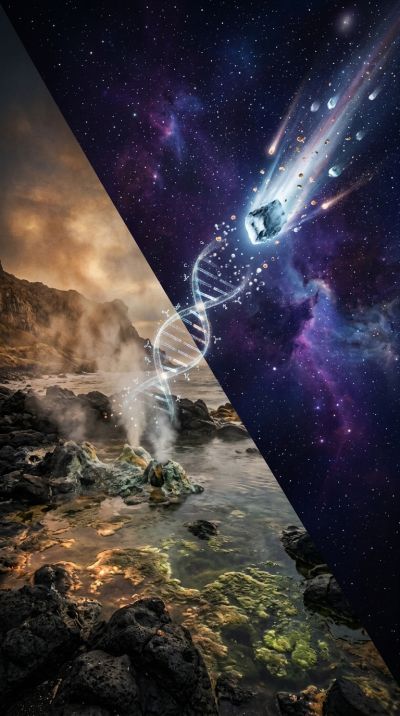

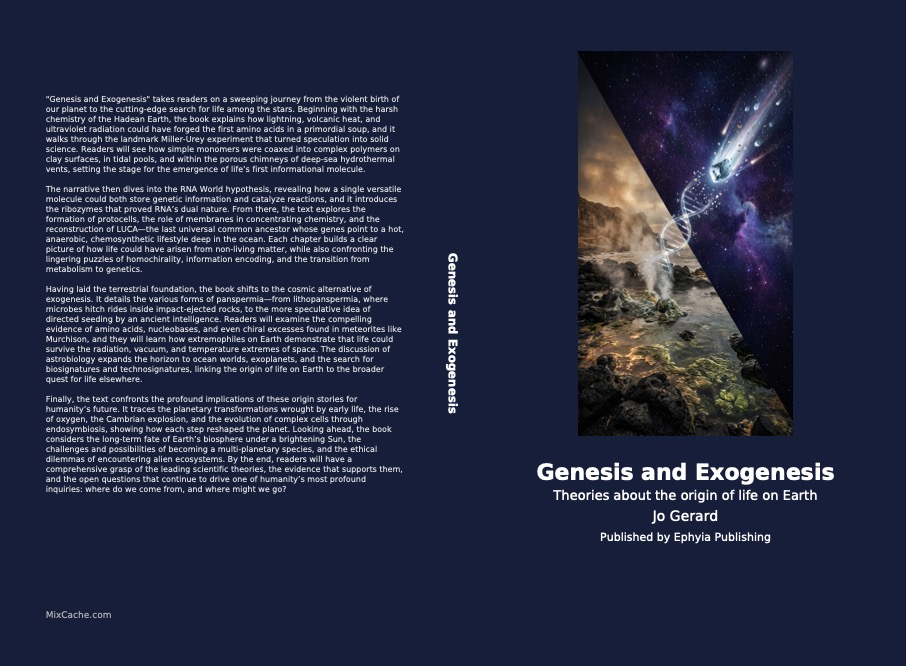
"Genesis and Exogenesis" takes readers on a sweeping journey from the violent birth of our planet to the cutting‑edge search for life among the stars. Beginning with the harsh chemistry of the Hadean Earth, the book explains how lightning, volcanic heat, and ultraviolet radiation could have forged the first amino acids in a primordial soup, and it walks through the landmark Miller‑Urey experiment that turned speculation into solid science. Readers will see how simple monomers were coaxed into complex polymers on clay surfaces, in tidal pools, and within the porous chimneys of deep‑sea hydrothermal vents, setting the stage for the emergence of life’s first informational molecule.
The narrative then dives into the RNA World hypothesis, revealing how a single versatile molecule could both store genetic information and catalyze reactions, and it introduces the ribozymes that proved RNA’s dual nature. From there, the text explores the formation of protocells, the role of membranes in concentrating chemistry, and the reconstruction of LUCA—the last universal common ancestor whose genes point to a hot, anaerobic, chemosynthetic lifestyle deep in the ocean. Each chapter builds a clear picture of how life could have arisen from non‑living matter, while also confronting the lingering puzzles of homochirality, information encoding, and the transition from metabolism to genetics.
Having laid the terrestrial foundation, the book shifts to the cosmic alternative of exogenesis. It details the various forms of panspermia—from lithopanspermia, where microbes hitch rides inside impact‑ejected rocks, to the more speculative idea of directed seeding by an ancient intelligence. Readers will examine the compelling evidence of amino acids, nucleobases, and even chiral excesses found in meteorites like Murchison, and they will learn how extremophiles on Earth demonstrate that life could survive the radiation, vacuum, and temperature extremes of space. The discussion of astrobiology expands the horizon to ocean worlds, exoplanets, and the search for biosignatures and technosignatures, linking the origin of life on Earth to the broader quest for life elsewhere.
Finally, the text confronts the profound implications of these origin stories for humanity’s future. It traces the planetary transformations wrought by early life, the rise of oxygen, the Cambrian explosion, and the evolution of complex cells through endosymbiosis, showing how each step reshaped the planet. Looking ahead, the book considers the long‑term fate of Earth’s biosphere under a brightening Sun, the challenges and possibilities of becoming a multi‑planetary species, and the ethical dilemmas of encountering alien ecosystems. By the end, readers will have a comprehensive grasp of the leading scientific theories, the evidence that supports them, and the open questions that continue to drive one of humanity’s most profound inquiries: where do we come from, and where might we go?
What You'll Find Inside:
- The book explores both terrestrial abiogenesis (life originating on Earth) and exogenesis (life delivered from space) as competing theories for life's origin.
- Key experimental evidence is covered, including the Miller-Urey experiment that created amino acids and the RNA World hypothesis that bridges chemistry and biology.
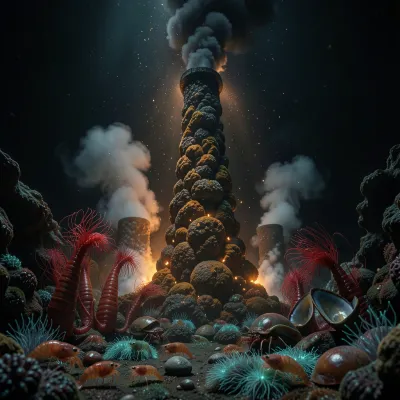
- Hydrothermal vents are examined as potential cradles of life, offering protected environments rich in chemical energy for early metabolic processes.
- The search for extraterrestrial life is detailed through SETI, technosignatures, and exoplanet research, including the Drake Equation's framework for estimating alien civilizations.
- Extremophiles' survival in harsh conditions is discussed as evidence supporting panspermia's plausibility for interplanetary life transfer.
Who's It For:
This book is ideal for scientifically curious readers, students, and educators interested in astrobiology and the origins of life. It provides a comprehensive yet accessible overview of both terrestrial and extraterrestrial origin theories, making complex scientific concepts understandable without requiring specialized expertise. Anyone fascinated by humanity's place in the cosmos and the fundamental question of where we come from will find this exploration engaging and informative.
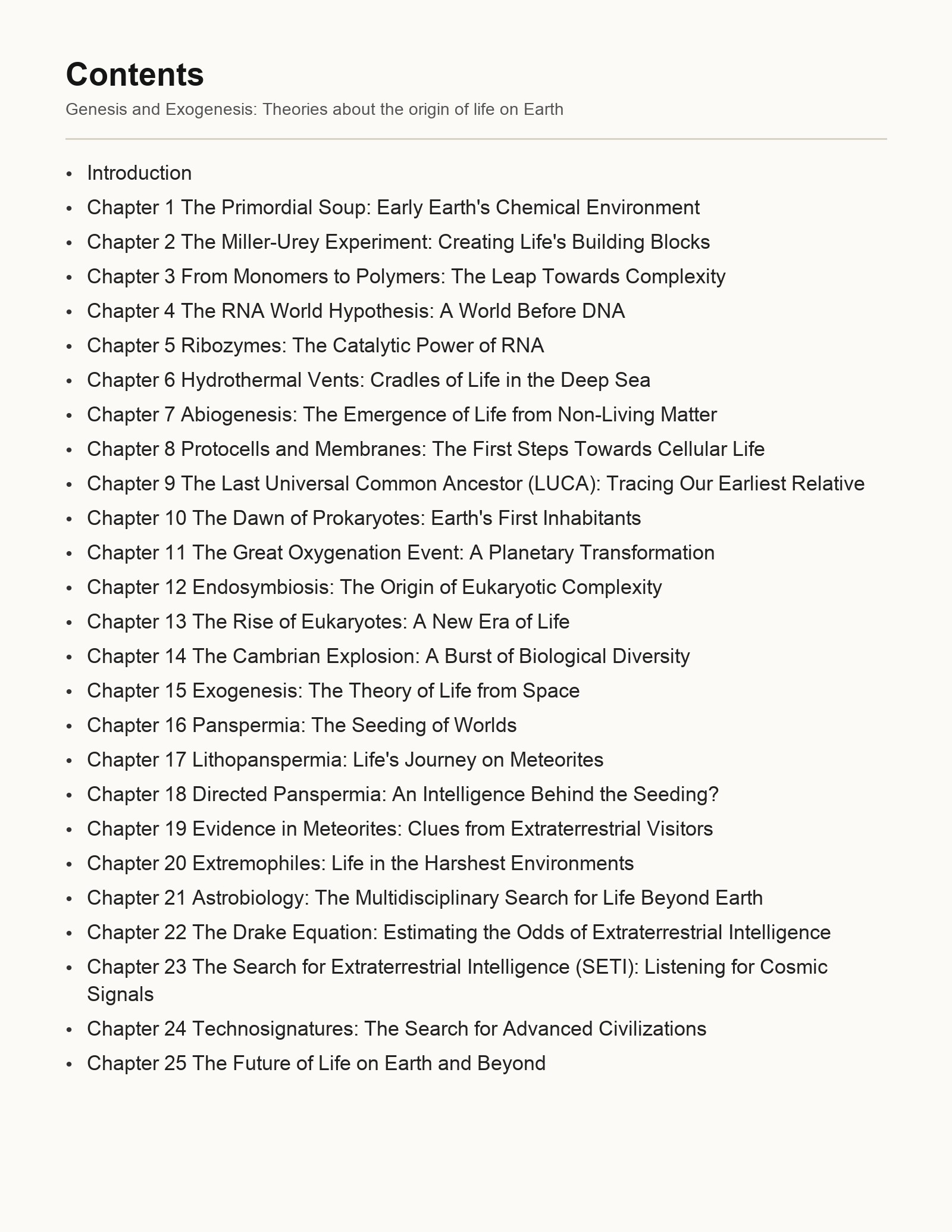
Table of Contents:
- Introduction
- Chapter 1 The Primordial Soup: Early Earth's Chemical Environment.
- Chapter 2 The Miller-Urey Experiment: Creating Life's Building Blocks.
- Chapter 3 From Monomers to Polymers: The Leap Towards Complexity
- Chapter 4 The RNA World Hypothesis: A World Before DNA.
- Chapter 5 Ribozymes: The Catalytic Power of RNA.
- Chapter 6 Hydrothermal Vents: Cradles of Life in the Deep Sea.
- Chapter 7 Abiogenesis: The Emergence of Life from Non-Living Matter.
- Chapter 8 Protocells and Membranes: The First Steps Towards Cellular Life
- Chapter 9 The Last Universal Common Ancestor (LUCA): Tracing Our Earliest Relative.
- Chapter 10 The Dawn of Prokaryotes: Earth's First Inhabitants.
- Chapter 11 The Great Oxygenation Event: A Planetary Transformation
- Chapter 12 Endosymbiosis: The Origin of Eukaryotic Complexity.
- Chapter 13 The Rise of Eukaryotes: A New Era of Life.
- Chapter 14 The Cambrian Explosion: A Burst of Biological Diversity.
- Chapter 15 Exogenesis: The Theory of Life from Space.
- Chapter 16 Panspermia: The Seeding of Worlds.
- Chapter 17 Lithopanspermia: Life's Journey on Meteorites
- Chapter 18 Directed Panspermia: An Intelligence Behind the Seeding?.
- Chapter 19 Evidence in Meteorites: Clues from Extraterrestrial Visitors
- Chapter 20 Extremophiles: Life in the Harshest Environments
- Chapter 21 Astrobiology: The Multidisciplinary Search for Life Beyond Earth
- Chapter 22 The Drake Equation: Estimating the Odds of Extraterrestrial Intelligence
- Chapter 23 The Search for Extraterrestrial Intelligence (SETI): Listening for Cosmic Signals.
- Chapter 24 Technosignatures: The Search for Advanced Civilizations
- Chapter 25 The Future of Life on Earth and Beyond
Author:
Published By:
Date Published:
May 17, 2026
Type:
Nonfiction
Language:
English
Word Count:
56,389 words
Reading Time:
3 hours 57 minutes
Sample:
Order:
Order Genesis and Exogenesis (Paperback) on MixCache.com:
Buy NowPrint copy is made to order and ships worldwide. Includes the ebook free, ready to read instantly.
$5 account credit for all new MixCache.com accounts, usable toward any ebook purchase!*