Browse by Category
Fiction
- Action & Adventure
- African American
- Anthologies
- Children's Fiction
- Classics
- Comics & Graphic Novels
- Coming of Age
- Contemporary
- Cultural & Regional
- Drama
- Erotica
- Fantasy
- General
- Historical Fiction
- Horror
- Humor & Satire
- Literary Fiction
- Mystery, Thriller & Suspense
- Poetry
- Religious & Inspirational
- Romance
- Science Fiction
- Short Stories
- War & Military
- Westerns
- Women's Fiction
- Young Adult
Non-Fiction
- Antiques & Collectibles
- Arts & Photography
- Biographies & Memoirs
- Business & Money
- Children's Non-Fiction
-
Computers & Technology
- Artificial Intelligence
- Computer Science
- Cybersecurity & Cryptography
- Data Science & Analytics
- Databases & Big Data
- Game Development & Design
- General
- Hardware & DIY
- Mobile App Development
- Networking & Cloud Computing
- Operating Systems
- Programming
- Robotics
- Software
- Software Engineering
- User Experience (UX) & Design
- Web Development & Design
- Cooking, Food & Wine
- Crafts, Hobbies & Home
- Education & Teaching
- Engineering
- General
- Health, Fitness & Dieting
-
History
- African History
- African History - North Africa
- African History - Sub-Saharan Africa
- American History
- American History - 20th Century
- American History - Civil War
- American History - Colonial Period
- Ancient History
- Asian History
- Asian History - China
- Asian History - India
- Asian History - Japan
- Asian History - Southeast Asia
- European History
- European History - Ancient Greece
- European History - Ancient Rome
- European History - Medieval
- European History - Modern
- European History - Renaissance
- General
- Middle Eastern History
- Military History
- Military History - Aviation
- Military History - Naval
- Social & Cultural History
- World History
- Humor & Entertainment
- Industrial Technology
- Language Learning
- Law
- LGBTQ+ Non-Fiction
- Literary Criticism
- Medical Books
- Parenting & Relationships
- Philosophy
- Politics & Social Sciences
- Reference
- Religion & Spirituality
-
Science & Math
- Agricultural Sciences
- Astronomy & Space Science
- Behavioral Sciences
- Biological Sciences
- Botany & Plant Science
- Chemistry
- Earth Sciences
- Engineering - Chemical
- Engineering - Civil
- Engineering - Electrical
- Engineering - Mechanical
- Environment
- General
- Geology
- Mathematics
- Nature & Ecology
- Oceanography
- Paleontology
- Physics
- Statistics
- Self-Help
- Sports & Outdoors
- Study Aids
- Sustainability & Green Living
- Textbooks
- Transportation
- Travel
- True Crime
- Urban Planning & Development
- Veterinary Medicine
- Writing & Publishing
Jump to Section

Want unlimited access to all books published by MixCache.com (plus their audiobooks)? Try MixCache.com Total Access. Look for the MTA badge on book covers to identify included titles.
Access to infinite ebooks: Don't see the book you want? Suggest it and we'll create it (free!) for you from scratch with our powerful AI book writer. Then read it with MTA - besides profiting from any sales it makes!
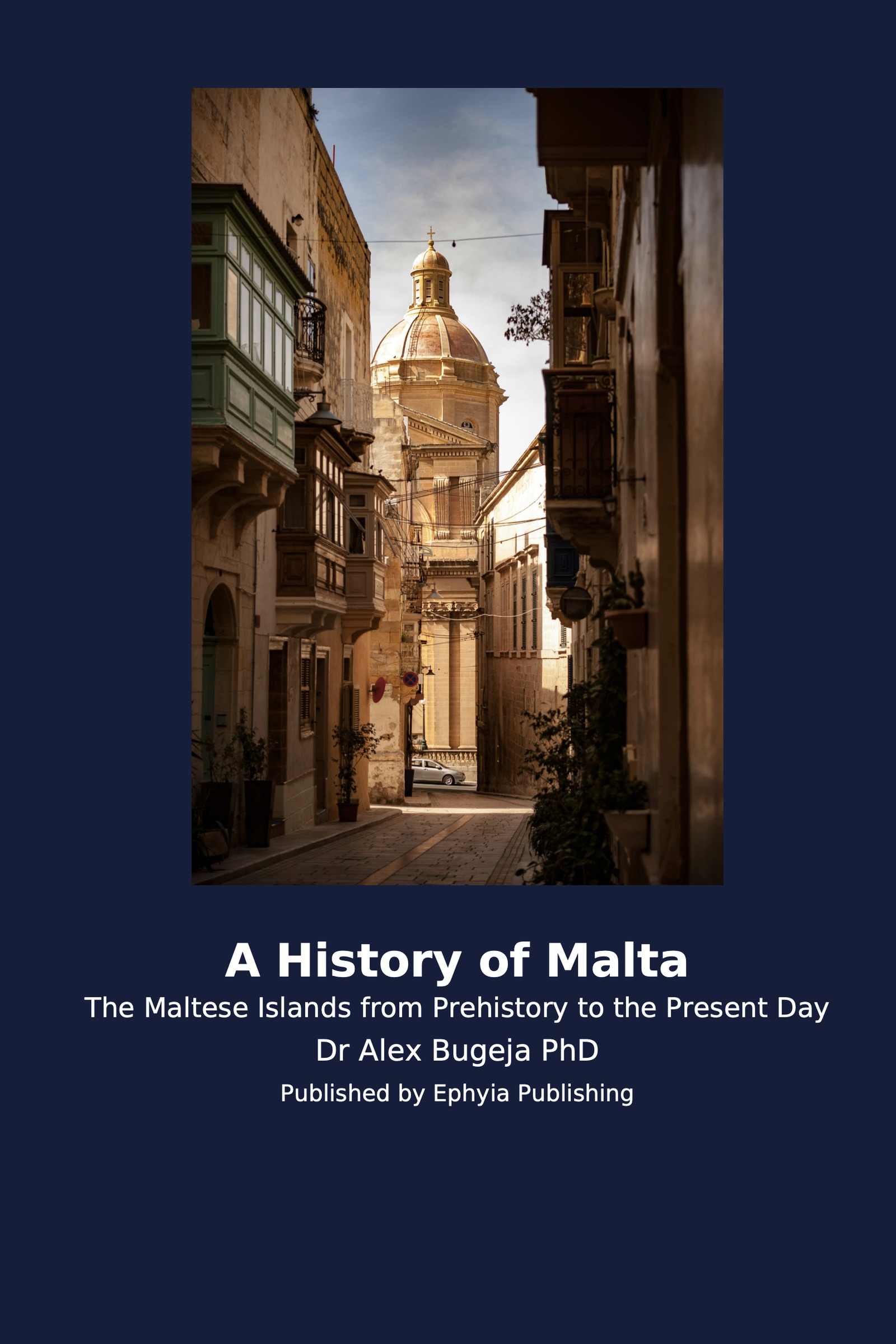
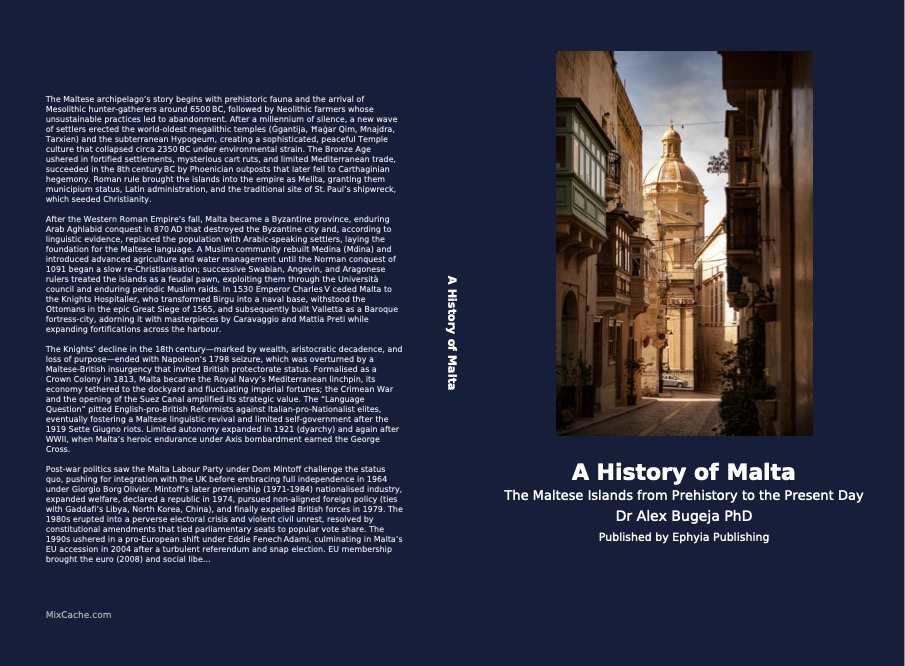
A History of Malta
The Maltese Islands from Prehistory to the Present Day
About this book:
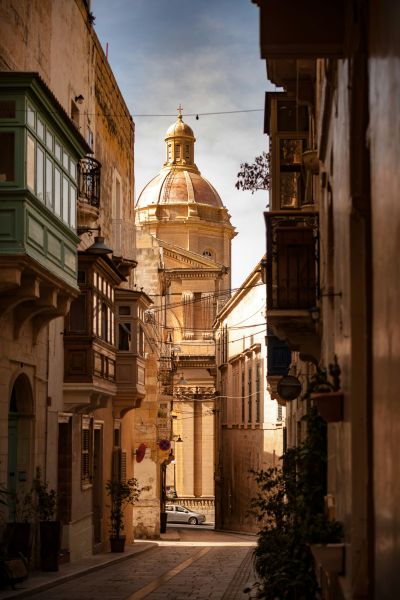
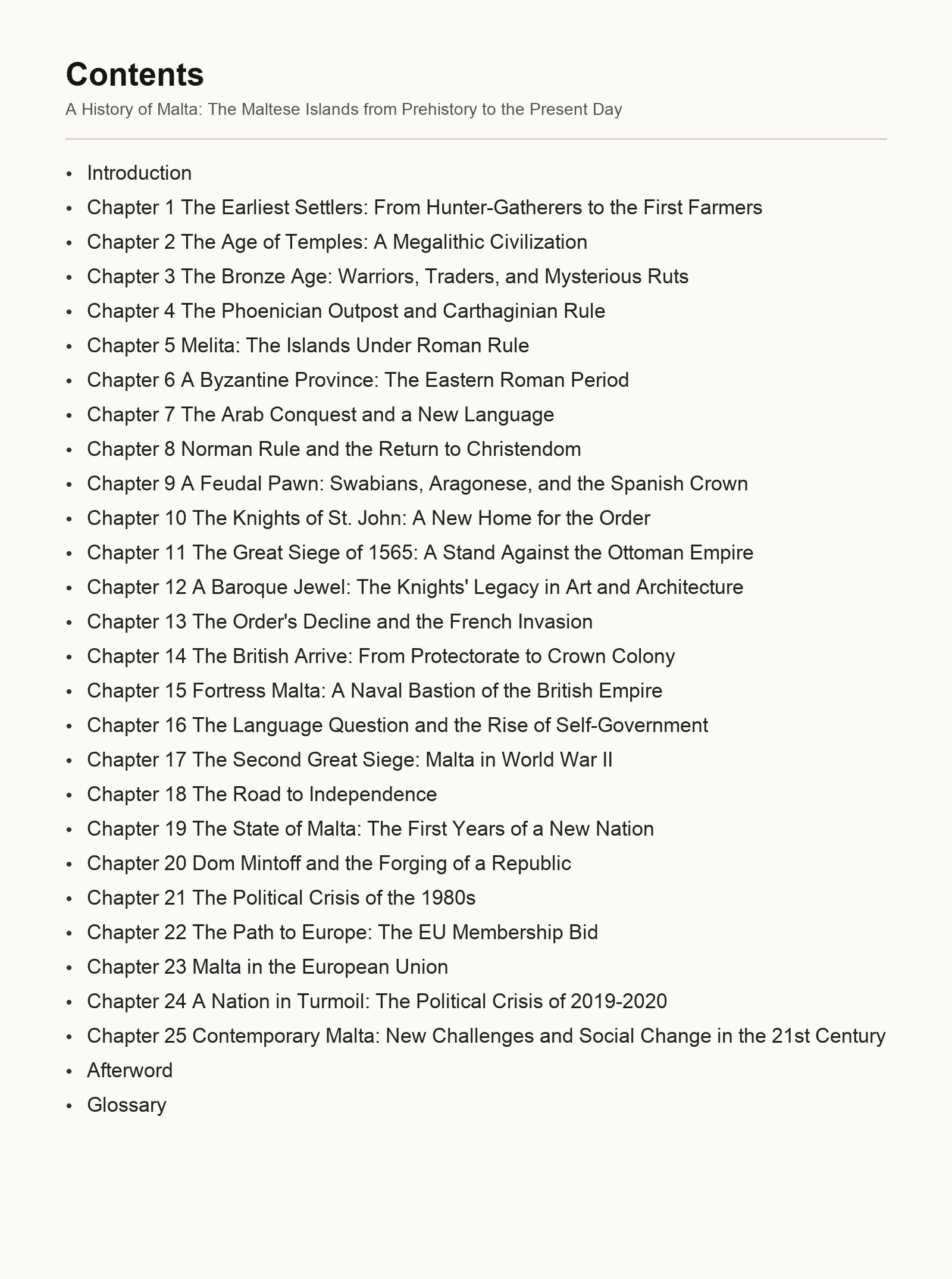
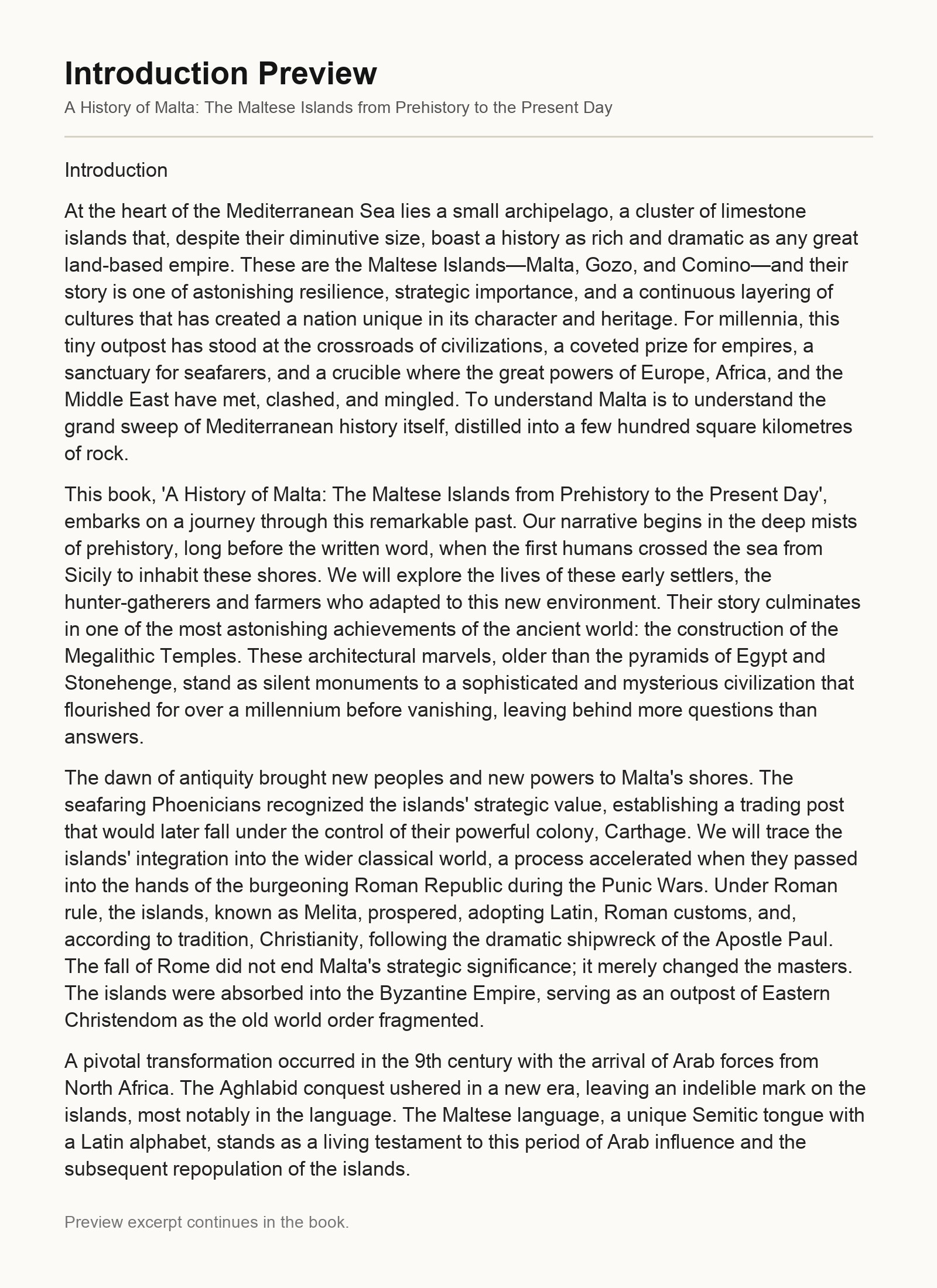
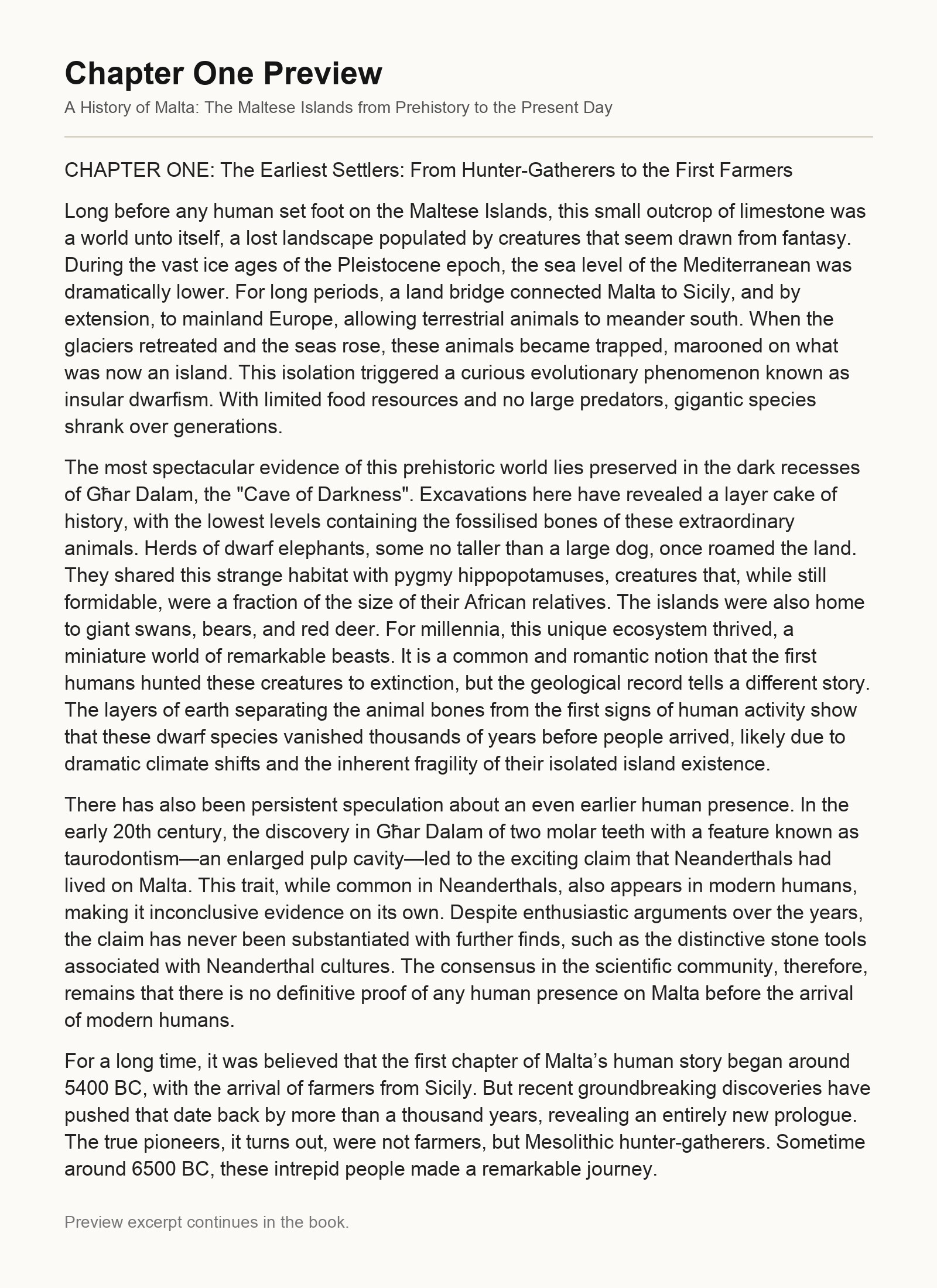
The Maltese archipelago’s story begins with prehistoric fauna and the arrival of Mesolithic hunter‑gatherers around 6500 BC, followed by Neolithic farmers whose unsustainable practices led to abandonment. After a millennium of silence, a new wave of settlers erected the world‑oldest megalithic temples (Ġgantija, Ħaġar Qim, Mnajdra, Tarxien) and the subterranean Hypogeum, creating a sophisticated, peaceful Temple culture that collapsed circa 2350 BC under environmental strain. The Bronze Age ushered in fortified settlements, mysterious cart ruts, and limited Mediterranean trade, succeeded in the 8th century BC by Phoenician outposts that later fell to Carthaginian hegemony. Roman rule brought the islands into the empire as Melita, granting them municipium status, Latin administration, and the traditional site of St. Paul’s shipwreck, which seeded Christianity.
After the Western Roman Empire’s fall, Malta became a Byzantine province, enduring Arab Aghlabid conquest in 870 AD that destroyed the Byzantine city and, according to linguistic evidence, replaced the population with Arabic‑speaking settlers, laying the foundation for the Maltese language. A Muslim community rebuilt Medina (Mdina) and introduced advanced agriculture and water management until the Norman conquest of 1091 began a slow re‑Christianisation; successive Swabian, Angevin, and Aragonese rulers treated the islands as a feudal pawn, exploiting them through the Università council and enduring periodic Muslim raids. In 1530 Emperor Charles V ceded Malta to the Knights Hospitaller, who transformed Birgu into a naval base, withstood the Ottomans in the epic Great Siege of 1565, and subsequently built Valletta as a Baroque fortress‑city, adorning it with masterpieces by Caravaggio and Mattia Preti while expanding fortifications across the harbour.
The Knights’ decline in the 18th century—marked by wealth, aristocratic decadence, and loss of purpose—ended with Napoleon’s 1798 seizure, which was overturned by a Maltese‑British insurgency that invited British protectorate status. Formalised as a Crown Colony in 1813, Malta became the Royal Navy’s Mediterranean linchpin, its economy tethered to the dockyard and fluctuating imperial fortunes; the Crimean War and the opening of the Suez Canal amplified its strategic value. The “Language Question” pitted English‑pro‑British Reformists against Italian‑pro‑Nationalist elites, eventually fostering a Maltese linguistic revival and limited self‑government after the 1919 Sette Giugno riots. Limited autonomy expanded in 1921 (dyarchy) and again after WWII, when Malta’s heroic endurance under Axis bombardment earned the George Cross.
Post‑war politics saw the Malta Labour Party under Dom Mintoff challenge the status quo, pushing for integration with the UK before embracing full independence in 1964 under Giorgio Borg Olivier. Mintoff’s later premiership (1971‑1984) nationalised industry, expanded welfare, declared a republic in 1974, pursued non‑aligned foreign policy (ties with Gaddafi’s Libya, North Korea, China), and finally expelled British forces in 1979. The 1980s erupted into a perverse electoral crisis and violent civil unrest, resolved by constitutional amendments that tied parliamentary seats to popular vote share. The 1990s ushered in a pro‑European shift under Eddie Fenech Adami, culminating in Malta’s EU accession in 2004 after a turbulent referendum and snap election. EU membership brought the euro (2008) and social liberalisation (divorce 2011, same‑sex marriage 2017, cannabis legalisation 2021), yet also exposed corruption, the murder of journalist Daphne Caruana Galizia in 2017, and a subsequent political crisis that toppled Joseph Muscat’s government. Subsequent leaders have grappled with pandemic recovery, economic growth driven by tourism, iGaming and financial services, institutional reforms to strengthen the rule of law, and ongoing tensions between development and heritage preservation, all while Malta navigates its place as a prosperous, multicultural EU member state haunted by the legacy of its tumultuous past.
What You'll Find Inside:
- Explore Malta's prehistoric megalithic temples, including Ġgantija and Ħaġar Qim, which are older than Stonehenge and the Egyptian pyramids, revealing a sophisticated Neolithic civilization that thrived for 1,500 years.
- Trace the island's strategic importance through successive occupations by Phoenicians, Carthaginians, Romans, Arabs, Normans, and the Knights of St. John, each leaving lasting cultural and linguistic imprints.
- Understand the heroic Great Siege of 1565 where the Knights of St. John and Maltese civilians repelled a massive Ottoman invasion, a victory that shattered the myth of Ottoman invincibility across Europe.
- Learn about Malta's pivotal role in World War II, enduring relentless Axis bombardment that earned the entire island the George Cross for collective gallantry, now featured on the national flag.
- Follow Malta's journey to independence from British rule, its political turbulence in the late 20th century, and its eventual accession to the European Union in 2004, shaping its modern European identity.
Who's It For:
This book is ideal for history enthusiasts, students of Mediterranean or European studies, and general readers interested in how small island nations have navigated millennia of foreign rule, cultural synthesis, and strategic importance. It will particularly appeal to those with Maltese heritage, travelers seeking deeper understanding of the islands they visit, and anyone fascinated by the interplay between geography, resilience, and historical change in shaping national identity.
Author:
Published By:
Date Published:
May 26, 2026
Type:
Nonfiction
Language:
English
Also Available In:
German, Spanish, French, Italian, Dutch
Word Count:
52,195 words
Reading Time:
3 hours 39 minutes
Sample:
Order:
Order A History of Malta (Paperback) on MixCache.com:
Buy NowPrint copy is made to order and ships worldwide. Includes the ebook free, ready to read instantly.
$5 account credit for all new MixCache.com accounts, usable toward any ebook purchase!*