Browse by Category
Fiction
- Action & Adventure
- African American
- Anthologies
- Children's Fiction
- Classics
- Comics & Graphic Novels
- Coming of Age
- Contemporary
- Cultural & Regional
- Drama
- Erotica
- Fantasy
- General
- Historical Fiction
- Horror
- Humor & Satire
- Literary Fiction
- Mystery, Thriller & Suspense
- Poetry
- Religious & Inspirational
- Romance
- Science Fiction
- Short Stories
- War & Military
- Westerns
- Women's Fiction
- Young Adult
Non-Fiction
- Antiques & Collectibles
- Arts & Photography
- Biographies & Memoirs
- Business & Money
- Children's Non-Fiction
-
Computers & Technology
- Artificial Intelligence
- Computer Science
- Cybersecurity & Cryptography
- Data Science & Analytics
- Databases & Big Data
- Game Development & Design
- General
- Hardware & DIY
- Mobile App Development
- Networking & Cloud Computing
- Operating Systems
- Programming
- Robotics
- Software
- Software Engineering
- User Experience (UX) & Design
- Web Development & Design
- Cooking, Food & Wine
- Crafts, Hobbies & Home
- Education & Teaching
- Engineering
- General
- Health, Fitness & Dieting
-
History
- African History
- African History - North Africa
- African History - Sub-Saharan Africa
- American History
- American History - 20th Century
- American History - Civil War
- American History - Colonial Period
- Ancient History
- Asian History
- Asian History - China
- Asian History - India
- Asian History - Japan
- Asian History - Southeast Asia
- European History
- European History - Ancient Greece
- European History - Ancient Rome
- European History - Medieval
- European History - Modern
- European History - Renaissance
- General
- Middle Eastern History
- Military History
- Military History - Aviation
- Military History - Naval
- Social & Cultural History
- World History
- Humor & Entertainment
- Industrial Technology
- Language Learning
- Law
- LGBTQ+ Non-Fiction
- Literary Criticism
- Medical Books
- Parenting & Relationships
- Philosophy
- Politics & Social Sciences
- Reference
- Religion & Spirituality
-
Science & Math
- Agricultural Sciences
- Astronomy & Space Science
- Behavioral Sciences
- Biological Sciences
- Botany & Plant Science
- Chemistry
- Earth Sciences
- Engineering - Chemical
- Engineering - Civil
- Engineering - Electrical
- Engineering - Mechanical
- Environment
- General
- Geology
- Mathematics
- Nature & Ecology
- Oceanography
- Paleontology
- Physics
- Statistics
- Self-Help
- Sports & Outdoors
- Study Aids
- Sustainability & Green Living
- Textbooks
- Transportation
- Travel
- True Crime
- Urban Planning & Development
- Veterinary Medicine
- Writing & Publishing
Jump to Section
MixCache.com Total Access
Unlimited reading and audiobooks for every book published by MixCache.com.
Included titles carry the MTA badge.
Learn more →
Foodways of Empire: Culinary History and Regional Cuisines of China
MTA
A cultural and gastronomic history linking food production, regional tastes, and imperial tastes
About this book:
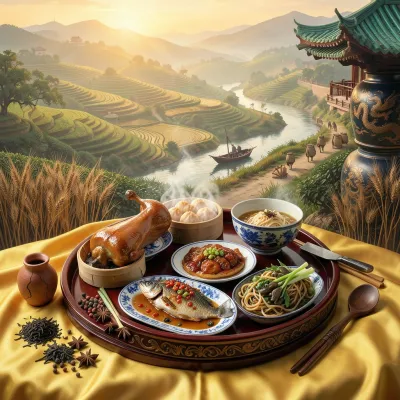
"Foodways of Empire: Culinary History and Regional Cuisines of China" offers a comprehensive cultural and gastronomic history of China, arguing that food is inextricably linked to power, identity, and societal development. The book traces the evolution of Chinese cuisine from ancient times to the modern era, examining how environmental factors, technological innovations, imperial policies, migrations, and religious beliefs have shaped what people eat and how it's prepared. It delves into the foundational role of staple grains like millet, rice, and wheat, and the transformative impact of preservation techniques such as salt-curing and soy fermentation, including the development of soy sauce and doubanjiang.
The narrative highlights the profound influence of external trade routes like the Silk Roads and maritime spice routes, which introduced new ingredients like sesame, grapes, and various spices, enriching the Chinese pantry and diversifying regional flavors. It explores the Grand Canal's crucial role in moving grain and fostering culinary exchange between the north and south, and examines the elaborate kitchens of the imperial court, where food served as a symbol of power, status, and ritual, influencing wider culinary trends. The book also details the rise of Buddhist vegetarian traditions within monasteries and their impact on meat substitutes and plant-based cooking.
A significant portion of the book is dedicated to analyzing specific regional cuisines, demonstrating how local ecology, history, and ethnic groups have forged distinct culinary identities. From the fresh, delicate flavors of Jiangnan (Suzhou, Hangzhou) and the robust, wheat-based dishes of the northern plains (Beijing, Shandong), to the fiery ma-la of Sichuan, the sour-spicy complexity of Guizhou, the coastal abundance of Fujian and Teochew, and the highland foraging traditions of Yunnan, each region's food tells a unique story of adaptation. It also explores the impact of migration on groups like the Hakka and Hui, whose foodways became essential for maintaining identity in new lands.
Finally, the book addresses the challenges and transformations brought by modernity, including the impact of famine, revolution, and the shift from traditional hearths to factory canteens and fast food. It concludes by examining the global diaspora of Chinese food in Chinatowns worldwide, where adaptation and innovation have created new culinary forms that negotiate authenticity and identity. Through detailed analysis of historical texts, economic records, and culinary practices, the book ultimately presents recipes not just as instructions, but as "archives" – edible records that encapsulate millennia of Chinese history and cultural evolution.
What You'll Find Inside:
- How imperial dynasties used food systems—including tribute, granaries, and state monopolies—to project power, feed populations, and legitimize rule across millennia
- The extraordinary regional diversity of Chinese cuisines shaped by geography, climate, and local ingredients, from Sichuan's ma-la heat to Jiangnan's refined freshness
- How Silk Road overland routes and maritime spice trails introduced transformative ingredients like sesame, pepper, cinnamon, and citrus that became fundamental to Chinese cooking
- The sophisticated preservation and fermentation traditions—salt curing, soy fermentation, vegetable pickling—that created China's deep, complex flavor profiles and enabled culinary sophistication
- How migration, diaspora communities, and modern forces have continuously adapted Chinese food traditions while maintaining core culinary identities across China and worldwide
Who's It For:
This book is ideal for students and scholars of food history, Chinese studies, and Asian studies seeking to understand the intersection of cuisine with imperial power, trade, and regional identity. It will also deeply appeal to culinary professionals, chefs, and serious food enthusiasts who want to explore the historical roots and cultural significance behind Chinese regional dishes. General readers with a strong interest in how food shapes—and is shaped by—politics, migration, and cultural exchange will find this work both informative and engaging.
Table of Contents:
- Introduction
- Chapter 1 Millet, Rice, and Wheat: Grains at the Core of Civilization
- Chapter 2 Empire and Appetite: Food and Power from Qin to Qing
- Chapter 3 Silk Roads and Spice Routes: External Influences on the Chinese Pantry
- Chapter 4 Salt, Soy, and Fermentation: The Chemistry of Preservation
- Chapter 5 Tea as Statecraft: Tribute, Trade, and Taste
- Chapter 6 The Grand Canal: Moving Grain, Moving Flavors
- Chapter 7 Kitchens of the Court: Imperial Banquets and Ritual Foods
- Chapter 8 Monasteries and Markets: Vegetarian Traditions and Temple Economies
- Chapter 9 Migration and Diaspora: Hakka, Hui, and the Flows of People
- Chapter 10 Fire and Wok: Techniques that Shaped a Cuisine
- Chapter 11 Medicine and the Menu: Food, Health, and Cosmology
- Chapter 12 Famine, Reform, and Revolution: Politics at the Table
- Chapter 13 The Cantonese Cosmopolis: Guangzhou, Hong Kong, and Dim Sum Culture
- Chapter 14 Sichuan Heat: Pepper, Policy, and a Taste for Ma-La
- Chapter 15 Jiangnan Elegance: Suzhou, Hangzhou, and the Aesthetics of Freshness
- Chapter 16 Northern Hearths: Beijing, Shandong, and the Wheat Frontier
- Chapter 17 Hunan’s Rustic Spice: Farmers, Officials, and Revolutionary Kitchens
- Chapter 18 The Dry Northwest: Noodles, Lamb, and Muslim Foodways
- Chapter 19 Coastal Abundance: Fujian, Teochew, and the Arts of Seafood
- Chapter 20 Yunnan Crossroads: Highland Heritages and Foraged Flavors
- Chapter 21 The Southwest’s Sour and Hot: Guizhou’s Pickles and Peppers
- Chapter 22 Taiwan’s Hybrid Table: Indigenous Roots and Colonial Layers
- Chapter 23 Modernity on a Plate: Factories, Canteens, and Fast Food
- Chapter 24 Global Chinatowns: Adaptation, Authenticity, and Identity
- Chapter 25 Recipes as Archives: Cooking the Past into the Present
Author:
Published By:
Date Published:
May 15, 2026
Type:
Nonfiction
Language:
English
Word Count:
68,799 words
Reading Time:
4 hours 49 minutes
Sample:
Order:
Order Foodways of Empire: Culinary History and Regional Cuisines of China (Hardcover) on MixCache.com:
Buy NowPrint copy is made to order and ships worldwide. Includes the ebook free, ready to read instantly.
$5 account credit for all new MixCache.com accounts, usable toward any ebook purchase!*